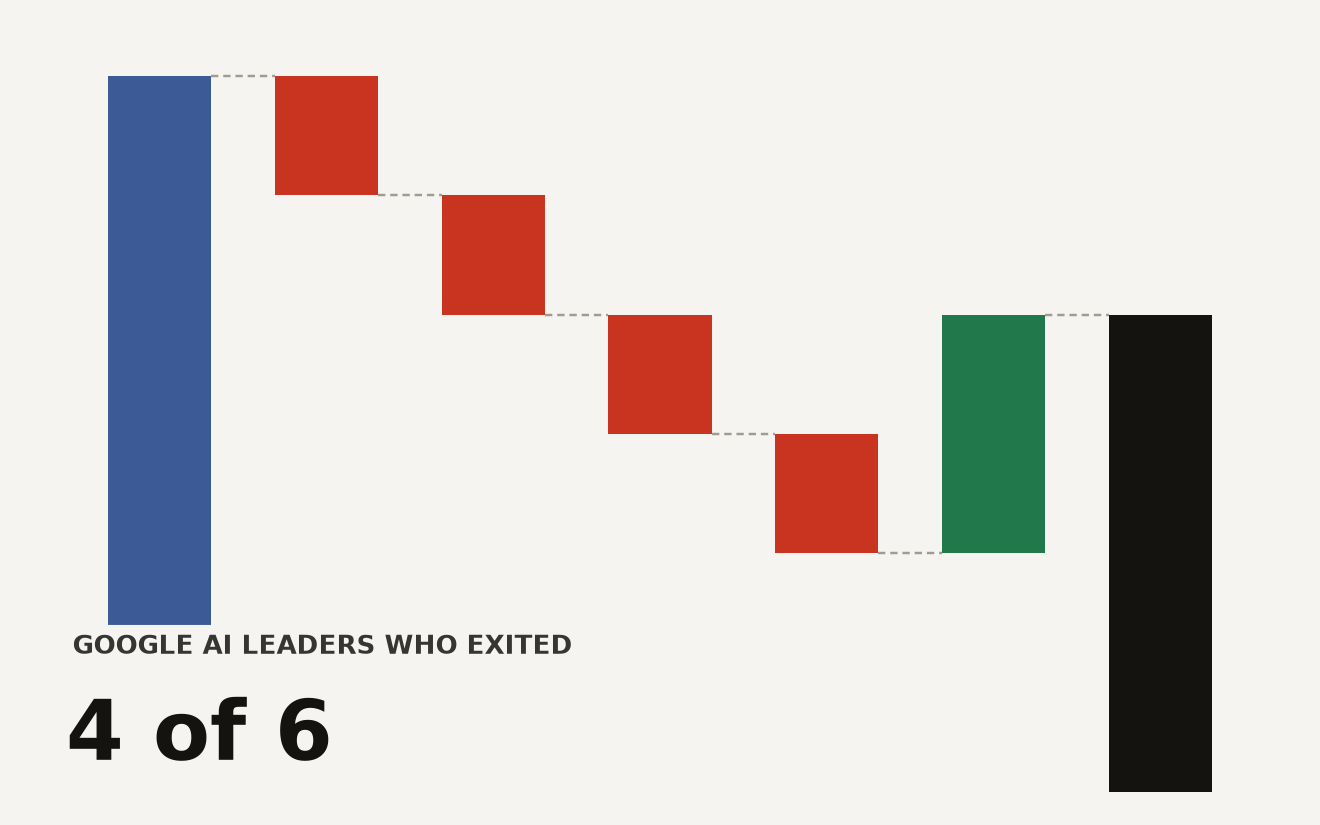
When four of the six names that defined Google's AI research arm walk out the door in the same week, the press release about a "next chapter" does a lot of heavy lifting. Google's AI leadership shakeup, announced in early August 2026, moves Demis Hassabis out of DeepMind's day-to-day operations and into a role focused on AGI research as DeepMind chair and Alphabet's chief scientist. His CTO, Koray Kavukcuoglu, takes the operational reins. More consequential: Jeff Dean, a 27-year Google veteran and the company's 30th employee, is leaving to co-found Discovery Loop, a startup that aims to automate thousands of science and engineering experiments across drug discovery, hardware design, clean energy, and material design. Three other top Google AI researchers are joining him: Sanjay Ghemawat, Quoc Le, and Oriol Vinyals.
The Google AI leadership shakeup exposes a competitive gap with OpenAI and Anthropic that internal reshuffling alone will not close. Both Hassabis and Google CEO Sundar Pichai acknowledged the company needs to improve, with Pichai writing that Google is "super focused on the areas where we need to improve" and Hassabis conceding the company is entering a "next chapter." When your own CEO and top AI scientist are both publicly admitting you are behind, the question is whether the people left can close the gap.
What exactly changed in Google's AI org?
The changes hit three layers of Google's AI hierarchy simultaneously. Hassabis moves from CEO of DeepMind to a chairmanship and the Alphabet chief scientist title, where he will focus on AGI and long-term research while continuing to lead Isomorphic Labs, the drug-discovery spinoff. Kavukcuoglu, previously CTO, steps up to run DeepMind as the operational leader. The Verge reported that industry observers viewed the change as Hassabis stepping aside in favor of a faster-moving, product-focused push. The signal is clear: Google wants an operator in charge, not a research visionary.
Then comes the exodus. Dean, Ghemawat, Le, and Vinyals are not rotating to other teams inside Alphabet. They are leaving to build Discovery Loop, which targets automated scientific experimentation at a scale that humans cannot match manually. These are not mid-level engineers. Dean and Ghemawat have together shaped Google's core computing infrastructure for over two decades, co-authoring the MapReduce paper that defined distributed data processing. Le's work on sequence-to-sequence learning helped lay the groundwork for modern language modeling. Vinyals led DeepMind's game-playing AI research, including the StarCraft II program AlphaStar. Their departures remove decades of accumulated knowledge from the systems Google uses to train and deploy its models.
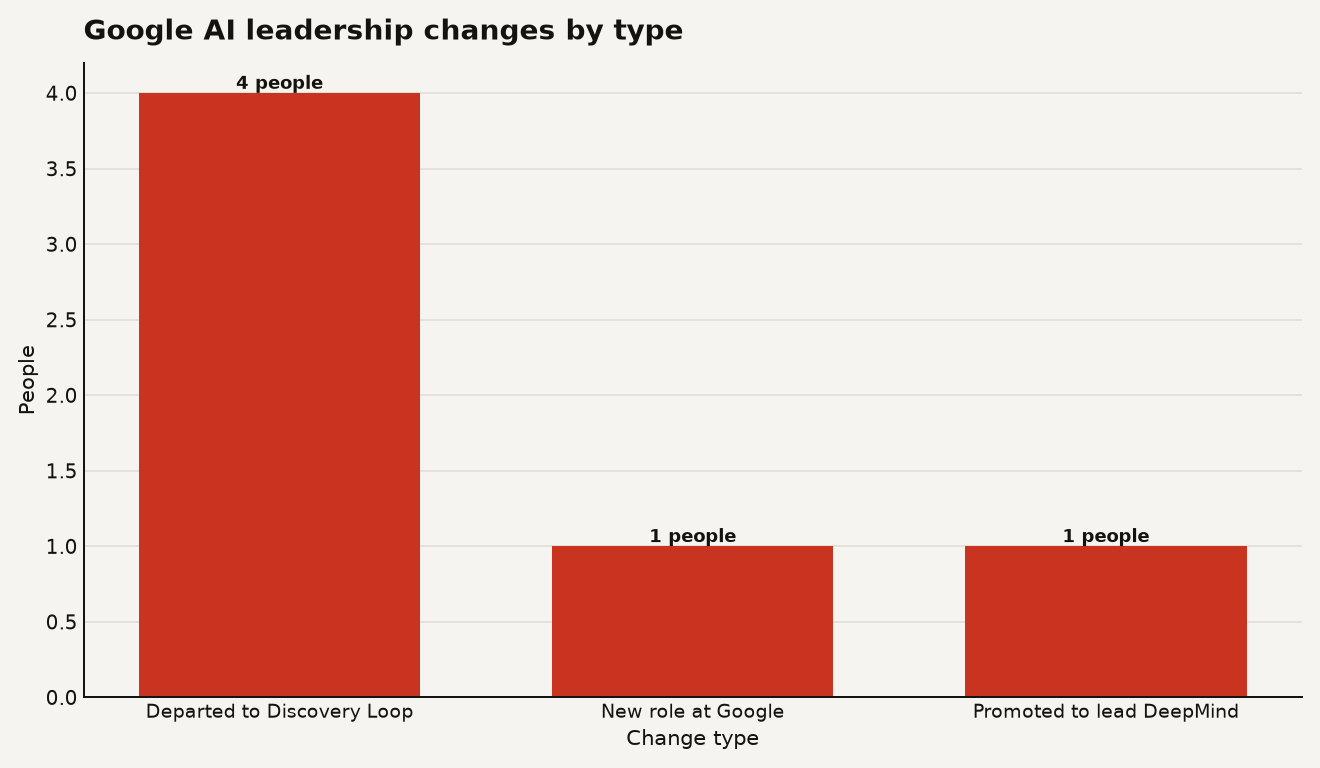
The chart below breaks down the six named leaders caught in the shakeup: four departing to Discovery Loop, one shifting to a research role, one promoted to operational command.
Why is Jeff Dean leaving now?
The official line is that Dean wants to pursue science automation. The timeline tells a more complicated story. In April 2026, after Anthropic was blacklisted by the Pentagon for refusing to allow its AI in domestic mass surveillance and lethal autonomous weapons, Google stepped in to fill the gap, signing on to let the Defense Department use its AI for "any lawful use." That decision detonated a fault line inside Google's AI organization.
Dean had publicly opposed both of those use cases. In February, he wrote on X that "mass surveillance violates the Fourth Amendment and has a chilling effect on freedom of expression." In 2018, both Dean and Hassabis signed a public pledge stating that "the decision to take a human life should never be delegated to a machine." In March, Dean was one of dozens of tech leaders who filed an amicus brief supporting Anthropic's lawsuit against the Trump administration over its decision to label the company a supply chain risk after Anthropic held its red lines on military use.
Tyler Johnston, founder of the nonprofit AI watchdog The Midas Project, told The Verge that the DoD deal "has already caused staff departures and a unionization effort at DeepMind." He also noted that DeepMind was originally acquired by Google with an agreement not to sell its technology for military or intelligence purposes. That agreement, apparently, no longer holds.
The pressure was not only ethical. A former Google employee told The Verge that internal competition around AI products has been more intense than anything seen in the last decade, with explicit pressure to hire people who can speed up product launches. Hassabis has been open about preferring scientific advancement over commercialization. That instinct works in a research lab. It becomes a liability when OpenAI and Anthropic are shipping frontier models faster than you are.
How far behind is Google in the model race?
The Verge's reporting is blunt: Google is still viewed as slower-moving than OpenAI and Anthropic, and it has not lapped them in frontier models. The problem is structural. Google ships late, ships conservative, and ships less often. Pichai's own memo told employees to "continue to move fast and with clear purpose here," which is the kind of thing CEOs write when the opposite has been the case.
The competitive picture is not uniformly grim. Google still has advantages in compute scale, distribution through Search and Android, and a deep research bench even after the departures. The Verge noted that Google is "the most successful of the established tech giants" in AI. But being the best of the legacy companies is a low bar when the actual frontier is being set by two newer labs with smaller teams and faster iteration cycles. Anthropic just landed a five billion dollar infrastructure partnership with AMD, signaling that the compute access gap is closing too.
There is also the question of what Google loses in institutional knowledge. The four departing researchers are not just talented individuals. They are the people who built the training infrastructure, the optimization frameworks, and the research culture that produced Gemini. Replacing them is a reconstruction problem, not a hiring problem.
What does this mean for builders using Google AI?
If you are building on Gemini or Vertex AI, the shakeup raises three practical questions:
- Model trajectory. With Hassabis moving to AGI research and Kavukcuoglu taking over product, expect Google's model roadmap to prioritize shipping speed over novel architecture. That could mean faster iteration on existing Gemini variants, but fewer breakthrough capabilities. If you need cutting-edge reasoning or agentic performance, the risk that Google falls further behind OpenAI and Anthropic is real and growing.
- Talent stability. Four of the people who built Google's training infrastructure and core ML frameworks are gone. The systems they built will keep running, but the institutional knowledge required to extend them just walked out the door. Bugs in Gemini's training pipeline that Dean or Ghemawat would have diagnosed in an afternoon now go to whoever is next in line.
- Platform ethics. Google's decision to fill the Pentagon gap left by Anthropic signals a willingness to prioritize government contracts over employee ethics concerns. If you are building applications where guardrails on surveillance or lethal autonomy matter, Anthropic's red lines are now a differentiator, not just a positioning choice.
There is also a marketplace signal here. Discovery Loop is targeting scientific experiment automation, which is a massive, underserved market. If you are a founder or product lead evaluating where AI delivers the most value, automated scientific discovery is now a space with serious founding talent and a clear thesis.
Should you change your AI stack because of this?
Not yet. Google's models are still competitive for most production workloads, and Vertex AI's enterprise features, security controls, and integration with Google Cloud remain strong. The shakeup does not make Gemini unusable overnight. What it does is raise the risk premium on betting your roadmap exclusively on Google's frontier models.
The practical move is hedging. If you are already multi-model, this is confirmation to stay that way. If you are single-vendor on Google, now is the time to abstract your model layer so you can swap in Claude or GPT without rewriting your application logic. The cost of abstraction is low. The cost of being locked into a platform whose talent drain accelerates is high.
Watch for two signals over the next quarter. First, whether Kavukcuoglu can ship a Gemini release that materially closes the gap with Claude or GPT on reasoning and agentic tasks. Second, whether more researchers follow Dean out the door. One departure is a career decision. Four in a week is a pattern. Six would be a verdict.
The talent drain is the story
Google can reorganize its AI org chart every quarter and it will not change the underlying physics. Frontier models are built by small teams of exceptional people. Google just lost four of them, including the engineer who literally wrote the systems that train its models. The competitive gap with OpenAI and Anthropic is a people problem. And the people are leaving.