The first useful way to read Claude Science is through plumbing. Science already runs on code, databases, notebooks, schedulers, file formats, citations, and lab systems that rarely agree on anything. Anthropic’s new product tries to put an agent in the middle of that mess and make it accountable enough for a scientist to trust the trail.
Claude Science is a bet that the next big AI workflow is research operations: the unglamorous layer between an idea and a result.
Anthropic introduced Claude Science on June 30, 2026 as an AI workbench for scientists, releasing it in beta for Claude Pro, Max, Team, and Enterprise users. Claude Science ships with over 60 curated skills and connectors, runs locally on macOS or Linux, connects to remote machines over SSH or HPC login nodes, and creates auditable histories for outputs.
That last phrase, auditable histories, matters more than the demo sparkle. A research agent that cannot explain where a figure came from is a liability. A research agent that can pull from PubMed, ChEMBL, Benchling, 10x Genomics, ClinicalTrials.gov, and a compute cluster while leaving a traceable record starts to look like a new interface for R&D. If you build software for regulated teams, the lesson is blunt: the agent UI is moving toward the systems of record.
Claude Science as an AI workbench
Anthropic calls Claude Science an AI workbench, and the product page says it integrates common research tools, produces auditable artifacts, and gives flexible access to computing resources. The beta is available to paid Claude customers on Pro, Max, Team, and Enterprise plans, while the setup guide says the app supports macOS 13 or later and Linux x64.
That makes Claude Science closer to a research IDE than a browser tab. The app can run analyses locally, talk to remote systems, and coordinate specialist agents. Anthropic says a generalist coordinating agent has access to over 60 curated skills and connectors for genomics, single-cell analysis, proteomics, structural biology, cheminformatics, and related work. It also says a reviewer agent checks citations and calculations, then flags or corrects errors.
MIT Technology Review reported from Anthropic’s launch event that Alexander Tarashansky demonstrated the system autonomously identifying drug candidates for phenylketonuria, a rare genetic disease. The same report quoted Eric Kauderer-Abrams, Anthropic’s head of life sciences, saying Claude Science sits “right up there with Claude Code and Claude Cowork” among the company’s major products.
The product also builds on last year’s less polished life sciences push. Anthropic announced Claude for Life Sciences on October 20, 2025, adding connectors for Benchling, BioRender, PubMed, Scholar Gateway by Wiley, Synapse.org, and 10x Genomics. Claude Science turns that connector strategy into a standalone app with its own runtime and workflow surface.
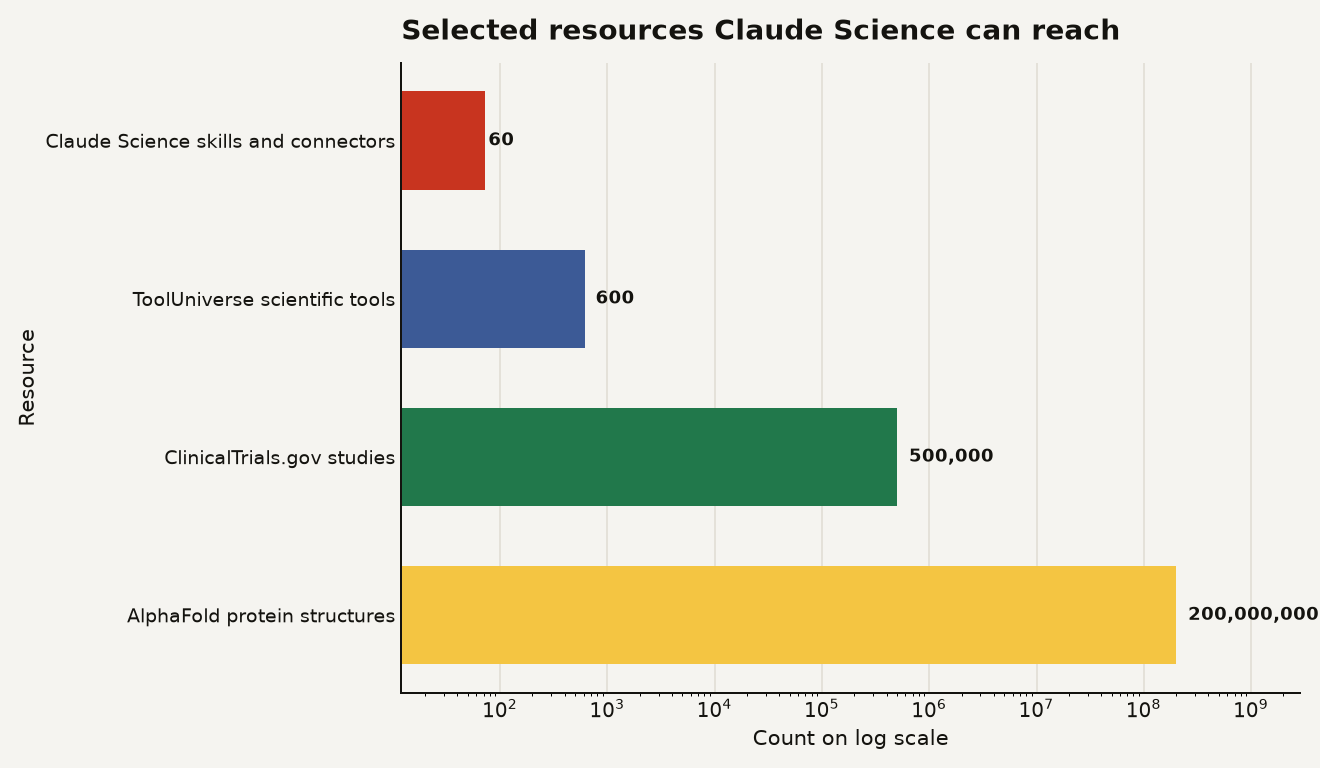
The scale of the connected resources is the part builders should stare at. Claude Science itself has 60 plus curated skills and connectors, the ToolUniverse connector exposes 600 plus vetted scientific tools, ClinicalTrials.gov is described in Anthropic’s guide as covering 500000 plus clinical studies, and AlphaFold DB provides open access to over 200 million protein structure predictions. The chart below shows why the workbench is best understood as an orchestration layer over scientific infrastructure, not as a single model feature.
This is also where Anthropic’s older bet on MCP becomes strategic. The company open sourced the Model Context Protocol on November 25, 2024 to standardize how AI assistants connect to data sources, tools, and development environments. Claude Science is what MCP looks like when the user is not a sales rep asking a CRM question, but a biologist trying to move from a sequence file to a figure without losing provenance.
Science follows the Claude Code template
Coding gave Anthropic the template. Claude Code made delegation feel normal for developers: give an agent a repo, a goal, and enough permissions, then inspect the diff. Science has a similar workflow shape, except the stakes are nastier. The agent touches literature, experimental metadata, statistical choices, compute environments, and sometimes regulated records.
Anthropic has a credible technical reason to push here. In its October 2025 life sciences announcement, the company said Claude Sonnet 4.5 scored 0.83 on Protocol QA, compared with a human baseline of 0.79 and Sonnet 4 at 0.74. That benchmark does not prove Claude can discover drugs. It does show Anthropic had already tuned and tested models against tasks that resemble the grammar of lab work: protocols, steps, constraints, and domain-specific procedures.
The market reason is just as obvious. PhRMA says member companies have invested over $1 trillion in R&D since 2000, which explains why every frontier lab wants to sell into pharma instead of only fighting for $20 monthly subscriptions. Academic labs may validate the workflow, but enterprise drug development pays for governed connectors, audit trails, admin controls, and support.
There is also a competitive narrative. Google DeepMind still owns the most famous AI for science success story: AlphaFold. Google DeepMind says AlphaFold has predicted over 200 million protein structures, covering nearly all catalogued proteins known to science. The Nobel committee awarded the 2024 Chemistry Nobel with half to David Baker for computational protein design and half jointly to Demis Hassabis and John Jumper for protein structure prediction.
Anthropic cannot out-AlphaFold AlphaFold by launching a desktop app. Its sharper angle is workflow capture. If DeepMind’s breakthrough was a scientific model becoming a public resource, Anthropic’s move is an agent workbench becoming the place where scientists pull resources together. That is a different moat. It lives in connectors, permissions, reproducibility, defaults, and habits.
For builders, this should sound familiar. We covered the same migration in enterprise agents when agentic AI work moved from chat to delegation across business workflows. Claude Science applies that pattern to R&D: less prompt box, more environment.
Scientific software needs agent hooks
The immediate developer consequence is that “AI integration” in scientific software now means more than an assistant pane. If your product owns lab records, omics data, figures, clinical operations, or molecule metadata, users will ask why an agent cannot query it with permissions intact. Anthropic’s connector directory names Benchling, 10x Genomics, PubMed, Synapse.org, BioRender, Scholar Gateway, bioRxiv and medRxiv, ChEMBL, ToolUniverse, Owkin, Open Targets, Medidata, and ClinicalTrials.gov as research or clinical connectors.
That list should make product teams uncomfortable in a productive way. The winner in a research workflow may be the system that exposes clean context, not the system with the prettiest dashboard. If Claude Science becomes a daily surface for scientists, your app needs an agent-readable API, useful metadata, stable identifiers, and permission boundaries that survive delegation.
Here is the practical read for your roadmap:
- Expose provenance as a feature, not a compliance afterthought. Anthropic says every Claude Science output carries an auditable history, so a competing tool that cannot trace a plot back to raw data will feel brittle.
- Design for agents that run code. The app can work locally, over SSH, and through HPC login nodes, which means your integration cannot assume a neat SaaS-only workflow.
- Treat connectors as distribution. A connector inside a scientist’s agent workbench can become the new homepage for your product.
- Budget for review loops. Anthropic’s reviewer agent checks citations and calculations, which hints at a pattern every serious agent product will need: generation plus verification in the same surface.
The business consequence is harsher. A lot of scientific software has enjoyed lock-in through workflow friction. Users stayed because migration was painful, schemas were weird, and the one person who understood the pipeline was busy. A competent agent weakens that moat. It can write glue code, translate formats, call APIs, and summarize records. The durable moat shifts toward proprietary data, trusted validation, regulatory posture, and deep customer-specific workflows.
This is where the rare disease angle matters. FDA says 10000 plus rare diseases affect more than 30 million people in the United States, while NIH says only about 500 of roughly 7000 identified rare and neglected diseases with known molecular causes have approved treatments. Any tool that reduces the cost of exploring targets for neglected diseases will get moral credit. It still needs wet-lab validation, patient data, regulatory evidence, and money.
A solo founder should not hear “Claude Science” and pivot into drug discovery over a weekend. A better move is narrower: build the missing MCP server for a painful scientific system, package a reproducible analysis skill for a specific assay, or create validation tooling that catches when an agent takes a statistically convenient shortcut.
Fluent output that can still be wrong
The failure mode is the same one that haunts every agent: it can produce fluent work that is expensive to trust. In research, the cost of trust is rerunning code, inspecting assumptions, checking citations, validating reagents, reviewing statistical choices, and eventually testing biology.
Reproducibility is the right product obsession because science already has a replication problem without agents adding speed. A June 2026 preprint introduced SocSci-Repro-Bench with 221 tasks from 54 social science papers, then found Claude Code reached 93.4 percent task-level accuracy versus 62.1 percent for Codex on that benchmark. The same study warned that prompt framing could nudge agents toward confirmatory specification search, which is a polite academic way of saying the agent may help you fool yourself faster.
That warning applies cleanly to Claude Science. If a researcher asks for a promising signal, an obedient agent may over-explore until something looks promising. If a product team optimizes for impressive demos, the agent will gravitate toward tidy narratives and beautiful artifacts. Science needs the opposite pressure: slow down at the claims, expose the forks in the workflow, and make failed hypotheses easy to keep in the record.
Security is another unsolved edge. The richer the connector graph, the more sensitive the blast radius. A life sciences agent may touch unpublished manuscripts, trial records, patient-adjacent metadata, proprietary compounds, and lab notebooks. The permissions model has to be boring enough for compliance teams and legible enough for scientists. That is the product.
There is a hiring implication too. Teams that buy this kind of tool will still need computational biologists, data engineers, research software engineers, and scientific reviewers. The job changes from doing every file conversion by hand to supervising agentic workflows, writing better protocols, and hardening the data layer. If you are staffing an R&D platform team in 2026, hire for people who can debug both Python and provenance.
Map your place in the agent chain
Start by mapping where your product sits in the agent chain. If you own data ingestion, sample tracking, ELN records, molecule registries, imaging outputs, sequencing pipelines, or clinical ops metadata, Claude Science is a distribution threat and an integration opportunity. The worst position is a closed system that users must manually copy from, because agents are very good at making that pain visible.
Ship three things before you ship the glossy AI assistant:
- A clean connector. Use MCP or a similarly explicit interface so an agent can query records without screen scraping.
- A provenance API. Let downstream tools ask where a number, figure, or table came from.
- A policy layer. Make permissions, audit logs, and data residency visible to admins before procurement asks.
The product bet to avoid is “we will build the scientist’s universal AI workspace from scratch.” Anthropic, OpenAI, Google, Microsoft, and the large lab software vendors all want that surface. A narrower wedge with real data rights and high trust is more defensible.
The product bet to make is “we will become the best tool for one critical step inside the agentic research loop.” That could mean target prioritization for one disease family, reproducible figure generation for one omics workflow, validation reports for one assay type, or connector infrastructure for one regulated system. Specific beats universal when the buyer has to sign a quality agreement.
If you are a pharma or biotech buyer, run a boring pilot. Pick a workflow with known inputs and expected outputs, such as reproducing a published analysis, generating a literature map for a target, or rebuilding a figure from raw data. Measure elapsed time, human review time, error rate, and audit completeness. The demo question is simple: can the agent leave enough breadcrumbs that a skeptical scientist can rerun the work on Friday afternoon?
The lab agent era starts with the audit log
Claude Science will be marketed with drug candidates, rare diseases, and a lot of future-tense ambition. The practical breakthrough, if it holds, is smaller and more useful: a research agent that treats provenance as part of the interface.
That is the line builders should copy. In science, speed without traceability is just a faster way to make expensive uncertainty. The durable product is the one that lets an agent move quickly while making every claim answerable.
Sources
- Anthropic, Claude Science, an AI workbench for scientists, is now available
- Anthropic, Getting Started with Claude Science
- Anthropic, Claude for Life Sciences
- Anthropic, Introducing the Model Context Protocol
- MIT Technology Review, Claude Science is Anthropic’s newest flagship product
- Google DeepMind, AlphaFold
- NobelPrize.org, The Nobel Prize in Chemistry 2024
- FDA, Rare Diseases at FDA
- NIH, Rare Diseases
- PhRMA, Research and Development
- arXiv, AI Coding Agents Can Reproduce Social Science Findings