Dataset: Apple product specifications and A11 Bician Neural Engine documentation
Apple spent the better part of a decade trying to build a self-driving car, and the project never shipped. But the silicon it forced into existence is now the reason every iPhone, iPad, and Mac you own can run neural networks without a network connection. Mark Gurman reports in his Power On newsletter that the car project's demand for on-device AI processing birthed the Neural Engine, and that Apple is now accelerating its next generation: the M7 chip, expected in the first half of 2027 with major Neural Engine upgrades, plus an M7 Ultra variant supporting up to 1.5TB of RAM that could anchor a new Apple server product.
For builders, this is the thread that connects Apple's dead car to your inference costs, your privacy story, and your hardware roadmap. The Neural Engine started as a driving sensor processor. It is now the load-bearing wall of Apple Intelligence.
Project Titan built the Neural Engine
Apple's autonomous vehicle program, internally called Project Titan, ran from roughly 2014 until the company wound it down without producing a consumer vehicle. But early in development, Apple's engineers reached a conclusion that shaped the next decade of its silicon: a self-driving car needed serious neural network inference running locally, with latencies too low to depend on the cloud. The processor they designed for that job was never finished, but the architecture that came out of it, the Neural Engine, shipped in the A11 Bionic chip inside the iPhone X in 2017.
That first Neural Engine was modest, about 600 billion operations per second, and Apple used it for Face ID, Animoji, and augmented reality. Nobody called it an AI accelerator at the time. But it gave Apple a head start on exactly the hardware question that now dominates the industry: how do you run meaningful models on a battery-powered device without round-tripping to a GPU farm?
The chart below shows how Neural Engine throughput has scaled since that first generation.
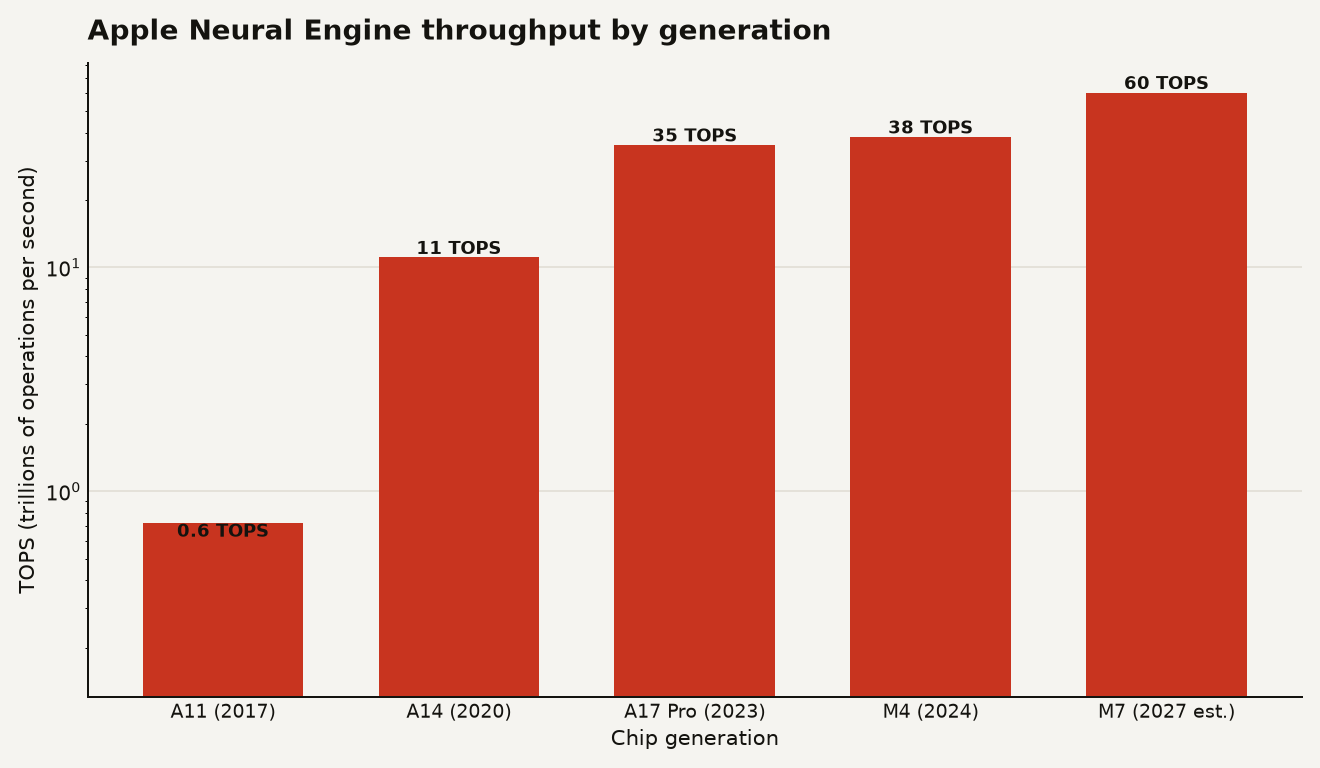
The A11 Neural Engine ran at roughly 600 billion operations per second in 2017, the A17 Pro reached 35 trillion, and the M4 hit 38 trillion. The projected M7 figure is a Data Today estimate based on the growth trend Apple has maintained and Gurman's reporting of significant upgrades.
Apple skips M6 Pro, Max and Ultra for the M7
Gurman reports that Apple is skipping the Pro, Max, and Ultra variants of its upcoming M6 chip and going straight to the M7, which should arrive in the first half of 2027. This is unusual. Apple's M-series cadence has been consistent: a base chip, then Pro, Max, and Ultra tiers roughly six months apart. Skipping tiers suggests Apple wants to compress the timeline to get a meaningful Neural Engine upgrade into the field faster.
The M7 Ultra is the more interesting product. Gurman says it will support up to 1.5TB of RAM and is expected to be the basis for a new server product from Apple. To put that in context, the current M2 Ultra maxes out at 192GB of unified memory. 1.5TB is nearly eight times that ceiling.
That number matters because unified memory is the single biggest constraint on running large models on Apple silicon today. A model needs to fit in RAM to run inference, and Apple's unified memory architecture means the CPU, GPU, and Neural Engine all share the same pool. If you can address 1.5TB, you can hold a very large model entirely in memory without a separate GPU with its own VRAM.
| Chip | Max unified memory | Approximate year |
|---|---|---|
| M2 Ultra | 192GB | 2023 |
| M4 Max (est.) | 128GB | 2025 |
| M7 Ultra (reported) | 1.5TB | 2027 |
Apple's hardware lead despite lagging software
Apple's AI software has lagged the field. Apple Intelligence arrived late, its on-device models are smaller than competitors', and its server-side Private Cloud Compute platform has been limited in capacity. But the hardware tells a different story.
If you are building an AI-powered application for iOS or macOS, Apple's Neural Engine is the reason you can run a 3B parameter model on a phone without melting the battery or paying a cloud inference bill per request. That changes your unit economics. A model that runs locally costs you compute once, at the device level, instead of costing you a per-token API call every time a user opens the app.
The M7 Ultra with 1.5TB of RAM changes the server-side equation. If Apple ships a server product based on this chip, it enters the inference infrastructure market. Today, the dominant players are Nvidia, with its GB300 and H200 GPUs, and the cloud providers who buy them. Apple has historically kept its silicon to itself. A server product would mean Apple is willing to sell compute, or at least host models, using its own architecture.
What this means for you:
- If you build for Apple platforms, the Neural Engine trajectory means on-device models keep getting larger and faster. Plan for models that barely fit today to run comfortably on M7 class hardware.
- If you pay for cloud inference, Apple entering the server market with unified-memory silicon could pressure per-token pricing. 1.5TB of unified memory is enough to hold a 70B parameter model with room to spare, without the complexity of model parallelism across multiple GPUs.
- If you are a privacy-focused product team, Apple's hardware advantage underwrites your pitch. The Neural Engine is what makes on-device processing real, and that is what lets you claim zero data leaves the device. As we noted in our coverage of how Apple's memory pricing hit consumers, the cost of that memory is now a product-level decision.
- If you are hiring, the skill set that matters is increasingly Apple-silicon-aware ML engineering. Knowing how to quantize and schedule inference across the Neural Engine, GPU, and CPU on Apple's architecture is a rarer skill than generic PyTorch competency.
A mixed record on infrastructure services
The honest answer is that Apple's track record on infrastructure services is mixed. The company tends to build infrastructure for itself first, as it did with Private Cloud Compute for Apple Intelligence, and only later consider whether to productize it. The car project is a cautionary tale: Apple can commit billions to a category and still not ship.
But there are reasons to take the M7 Ultra server possibility more seriously than Titan. First, Apple already operates data centers and has built custom silicon for them, including the M2 Ultra-based infrastructure that powers Private Cloud Compute. Second, the unified memory advantage is a structural difference from GPU-based inference. Nvidia's H200 has 141GB of HBM3e memory per GPU. To run a model larger than that, you need multiple GPUs and model parallelism, which adds latency, complexity, and cost. A single M7 Ultra with 1.5TB of unified memory sidesteps that entirely.
Third, Apple's incentive structure has changed. The company collects roughly 30 percent on App Store transactions, but AI is shifting value toward inference compute and model hosting. If Apple does not offer infrastructure, it risks ceding the relationship with AI-first developers to cloud providers. The same logic pushed Apple into building its own maps, search partnerships, and payment infrastructure over the past decade.
The risk is that Apple's server product, if it materializes, will be locked to Apple's ecosystem. Apple sells Apple-shaped compute. If the M7 Ultra server product only runs models within Apple's Private Cloud Compute framework, it is not competing with AWS or Google Cloud for general purpose inference workloads. It is extending Apple's platform.
The M7 as a planning date
If you are shipping an AI product on Apple platforms today, the M7 timeline is a planning input, not a blocking dependency. The M6 generation, when it arrives, will still be a meaningful upgrade for most use cases. But if you are making architecture decisions that assume a certain memory ceiling, revisit them. A product that assumes it can never run a large model locally on Apple silicon might be wrong by 2027.
If you are evaluating inference providers, watch for any Apple announcement about M7 Ultra availability outside its own data centers. That would be the signal that Apple is opening a commercial inference offering. Until then, treat the server product as a possibility, not a roadmap.
If you are building models that need to run on Apple devices, the practical advice is to keep optimizing for the Neural Engine's characteristics. Apple's architecture rewards models that use quantization, that batch sensibly across the GPU and Neural Engine, and that fit within the unified memory budget. The vultronretriever work on on-device RAG is a good example of how much performance you can extract from Apple silicon when you design for it deliberately.
And if you are an investor or strategist watching the inference market, the question is whether Apple's unified memory advantage is enough to overcome Nvidia's software ecosystem moat. CUDA is the reason most model teams build on Nvidia first. Apple has its own ML stack, but it is nowhere near as mature for general-purpose training and inference. The M7 Ultra could be a better inference chip for specific workloads and still lose on ecosystem.
The car that never shipped
Apple killed a car program and got a decade of AI hardware out of it. The Neural Engine is the most consequential piece of silicon Apple has shipped since the original A4, and it exists because someone decided a self-driving car needed to think for itself. Now Apple is pointing that same architecture at the data center, with a chip that could hold a large model in a single pool of memory. Whether that becomes a real business or another project that never quite ships is the question. But the hardware is coming either way, and it changes what you can run, where you can run it, and what it costs.
Sources
- Bloomberg, Mark Gurman Power On newsletter
- The Verge, Apple's failed self-driving car program left a legacy of powerful AI chips
- Apple developer documentation on machine learning and Neural Engine
- Apple, A17 Pro and Neural Engine specifications
- Apple, M4 chip overview
- Nvidia, H200 GPU specifications