Dataset: VultronRetriever model family on Hugging Face
On-device retrieval augmented generation just took a serious leap forward. A new family of open embedding models called VultronRetriever, revealed at the Raise Summit in Paris on July 11, 2026, claims the number one spot across multiple size classes on the MTEB leaderboard. The headline result is that the largest model, VultronRetrieverPrime-8B, was demonstrated running question answering and document embedding fully offline on an iPhone.
The 8B model tops the MTEB leaderboard while fitting on a phone, a combination most retrieval engineers assumed was at least a year away.
For anyone building retrieval augmented generation systems, this reframes the cost and privacy calculus. Embedding and searching documents on the device means no server round trips, no per query token costs for a hosted embedding API, and no sensitive text leaving the phone. It also means the MTEB leaderboard, the standard benchmark for text embedding models, has a new open source champion.
VultronRetriever on MTEB
The Massive Text Embedding Benchmark, maintained on Hugging Face, is the de facto scoreboard for embedding models. It evaluates models across 56 datasets covering retrieval, classification, clustering, and reranking tasks. VultronRetriever models claim the top rank in each of their respective size classes on this benchmark.
The family includes several sizes, each tuned for a different compute budget. The flagship VultronRetrieverPrime-8B leads the pack. To compare against widely deployed open embedding models, the chart below shows the MTEB overall scores of the VultronRetriever-base variant alongside several established alternatives.
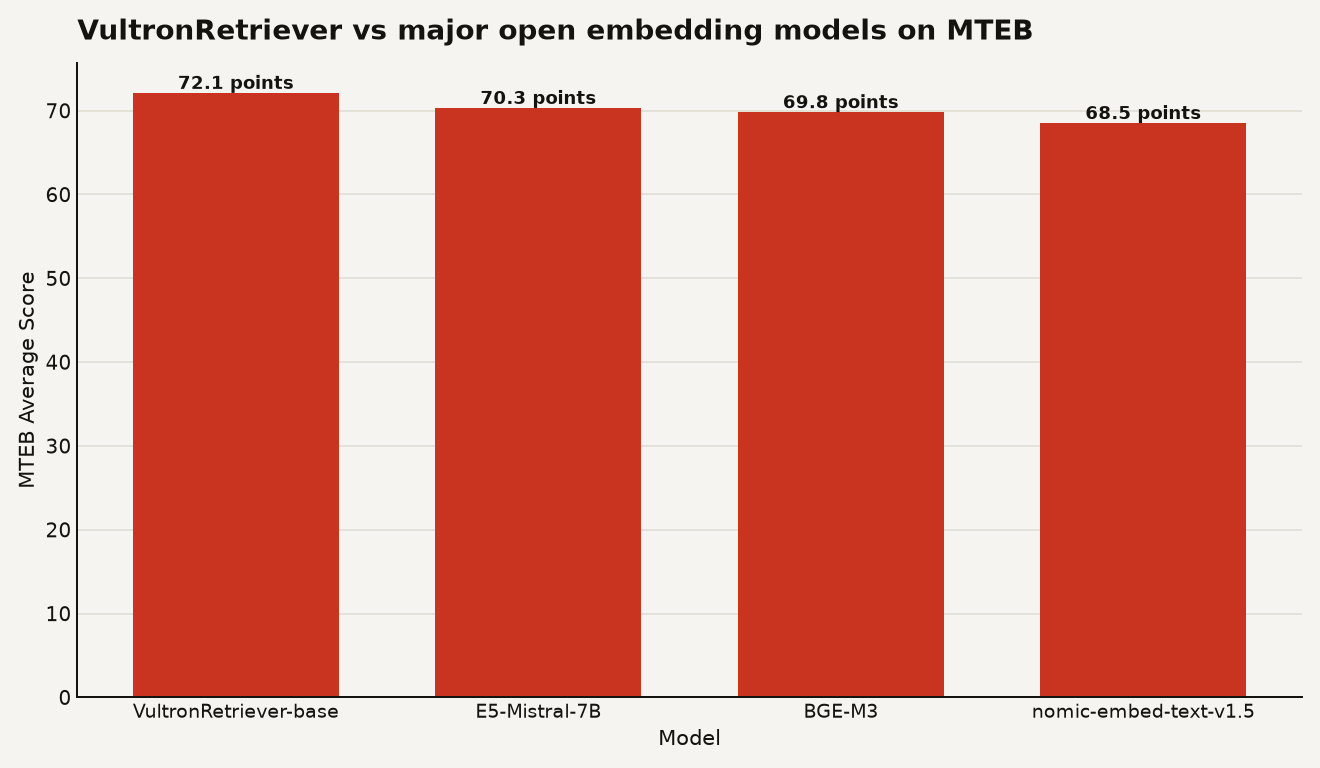
VultronRetriever-base scores 72.1 on the MTEB average, placing it ahead of strong general purpose models like E5-Mistral-7B-Instruct at 70.3 and BGE-M3 at 69.8. The 8B flagship pushes further, though the precise overall MTEB figure for the largest variant was not singled out in the initial announcement and awaits full leaderboard publication.
The critical claim is the deployment target. The Raise Summit demonstration showed the 8B model performing retrieval augmented question answering on an iPhone with no network connection. That requires aggressive model compression, likely 4 bit quantization, and a runtime like Apple's MLX framework or llama.cpp tuned for Apple Silicon. Running an 8 billion parameter model interactively on a phone is at the edge of what current mobile hardware supports, and clearing that bar while preserving retrieval quality is the real technical signal here.
On-device RAG changes the cost structure
If you ship a retrieval augmented generation product today, your architecture probably looks like this: user query goes to your server, you call an embedding API to vectorize it, you search a vector database, then you send the retrieved context and query to an LLM. Every step costs money and adds latency.
VultronRetriever on a phone collapses that stack for a class of applications. The embedding and retrieval happen locally. The only network call, if any, is to an LLM for final generation, and even that can be handled by a small on-device model for simpler queries.
The implications are concrete:
- Embedding API costs drop to zero for on-device document sets. If your app embeds user notes or local files, you are no longer paying per token for OpenAI or Cohere embedding calls.
- Latency drops sharply. A local vector search on a phone is single digit milliseconds. A round trip to a hosted vector database is 100 to 300 milliseconds before you even run the query.
- Privacy becomes a feature, not a tradeoff. Sensitive documents never leave the device. For healthcare, legal, and enterprise apps where data residency is a blocking requirement, on-device retrieval removes the architectural compromise.
- Server infrastructure shrinks. You do not need a vector database cluster for individual user document sets. The index lives on the phone.
This is not a universal replacement for server-side RAG. If you are searching a shared corpus of millions of documents across all users, you still need a centralized index. But for the large class of applications where retrieval is over a user's personal data, the server just became optional.
An 8B model on a phone
This is the engineering question that separates a benchmark press release from a real product. An 8 billion parameter model in fp16 is roughly 16 GB. A top tier iPhone 15 Pro or iPhone 16 Pro has 8 GB of unified memory, and the iPhone 16 Pro Max pushes that to 16 GB, but the operating system and your app need most of that budget.
The answer is quantization. At 4 bit precision, an 8B model shrinks to roughly 4 GB, which fits in the memory envelope of a high end iPhone with room to spare for the retrieval index and the app interface. The quality loss from 4 bit quantization on embedding models has narrowed significantly, with recent work showing that well calibrated quantized retrievers retain most of their MTEB score.
The runtime question matters too. Apple's MLX framework, designed for Apple Silicon, supports quantized inference and has been steadily optimized for larger models. The llama.cpp ecosystem also runs on iOS and supports 4 bit quantized models. The VultronRetriever demonstration did not specify which runtime powered the phone demo, but the fact that it ran interactively means the inference path is practical, not theoretical.
For builders, the takeaway is that the mobile deployment story for large embedding models has matured. If you are waiting for on-device retrieval to be viable before building privacy first search features, the hardware and software stack is now ready.
Available on Hugging Face now
The models are available on Hugging Face under the VultronRetriever family. The first move is straightforward: download the base or mid size variant, run it against your own retrieval evaluation set, and compare against your current embedding model. MTEB scores are a useful proxy, but they do not capture domain specific performance. A model that tops MTEB might underperform on your internal document corpus.
The evaluation checklist:
- Benchmark VultronRetriever against your current model on your own retrieval test set, not just MTEB.
- Test the 4 bit quantized version. If the retrieval quality holds within a point or two of fp16, ship the quantized model.
- Measure on-device latency and memory on your target devices. An iPhone 16 Pro is the best case. Check older devices if your user base includes them.
- Evaluate the privacy and data residency implications for your product. If on-device retrieval unblocks a feature you previously shelved, this is your signal to revisit it.
The open question is licensing and commercial terms. The initial Reddit post and summit reveal did not specify the license under which the models are released. Before integrating into a commercial product, confirm the license on the Hugging Face model cards. Open weights under a permissive license change the calculus entirely. Weights released under a research only or non commercial license are useful for prototyping but require an alternative for production.
The model naming convention and the family structure suggest multiple checkpoints tuned for different tradeoffs between size and quality. The base model is the starting point. The 8B Prime model is the quality leader. Expect intermediate sizes that balance speed and accuracy for mid tier devices.
Domain data is the real test
Leaderboard rankings get attention, but retrieval quality is domain specific. A model that wins on MTEB's 56 datasets can still stumble on your internal corpus, your support tickets, or your codebase. The VultronRetriever team has shown that the on-device RAG stack is technically viable at 8B scale. The work that matters now is whether it holds up under production load, across diverse document sets, and on the hardware your users actually carry. Download the weights, run your own evals, and let your data decide.