Frontier AI companies like to move fast. Biology does not. On June 30, 2026, Anthropic announced at a San Francisco event that it will run its own preclinical drug discovery programs focused on neglected diseases, while also launching Claude Science, an AI workbench for researchers and drugmakers. The move puts one of the world's most visible AI companies into a field where success can take years, cost billions, and still fail. No AI-designed drug has yet made it through clinical trials and FDA approval to reach market. Anthropic drug discovery is now a bet that models can shrink that timeline, but the wet-lab wall remains intact.
Anthropic framed the effort as a way to build better tools by experiencing the drug development grind firsthand. Eric Kauderer-Abrams, Anthropic's head of life sciences, said at the event that the company will focus on discovering treatments for neglected diseases, according to reporting from The Verge. Jonah Cool, Anthropic's head of life sciences partnerships and deployment, told STAT that the company will pursue areas where normal drug development economics do not work, targeting conditions where the biology is often clear but the financial returns are not.
Claude Science and a wet lab
Two things, bundled together. First, Claude Science is a new AI workbench designed to pull fragmented tools and datasets into one environment for scientists. According to Pharmaceutical Technology, the platform comes with more than 60 functions covering genomics, structural biology, proteomics, and cheminformatics. It can assist with CRISPR screen design, single-cell RNA sequencing analysis, and 3D protein structure rendering. It integrates tools like PubMed and R, and it is currently in beta testing.
TechCrunch reported that the workbench uses a main AI assistant acting as a project manager, which can create sub-assistants for specialized tasks. A separate fact-checker AI double-checks citations. Each figure generated includes the exact code and message history that produced it, an approach to reproducibility that matters in regulated research environments.
Second, and more surprising, Anthropic said it will run its own internal drug discovery programs. Kauderer-Abrams said the programs will focus on preclinical work, the stage before a treatment reaches human testing. The company has not named the diseases it will pursue, has not said what it would do if it finds promising drug candidates, and has not clarified whether it would partner with other companies for lab work, animal testing, clinical trials, or manufacturing. Anthropic did not respond to The Verge's requests for more details.
What we do know is that Anthropic has been hiring biologists and building its own wet labs over the past year, with several live job applications for life sciences roles as of writing. Namshik Han, a professor at the University of Cambridge and cofounder of AI biotech startup CardiaTec, told The Verge that Anthropic has been actively recruiting in the area, and that several of his academic colleagues had been approached. He believes Anthropic has successfully hired a few candidates away from Big Pharma and prestigious academic institutions.
Tight feedback loops need a lab
The logic is tight feedback loops. Kauderer-Abrams said at the event that to build the right models, products, and tools to accelerate the industry, Anthropic needs to live it alongside its customers, according to CNBC. The argument is that building useful drug discovery tools requires experiencing the pain of drug discovery firsthand.
That reasoning has precedent in the broader AI drug discovery race. Google DeepMind spun out Isomorphic Labs to apply AlphaFold and related models to drug discovery. AI-first drug companies like Insilico Medicine have built integrated pipelines from target identification through clinical candidates. Big Pharma companies including AstraZeneca, Novo Nordisk, and GSK have all launched AI initiatives across their R&D workflows.
But Anthropic's move is unusual because it puts the company in the position of selling software to drugmakers while potentially competing with them. If Anthropic finds a promising molecule for a neglected disease, it could license it, partner with a pharma company for clinical development, or try to build capabilities in house. The company has not said which path it would take, and that ambiguity matters for any pharma team evaluating Claude Science as a platform.
The focus on neglected and rare diseases is strategically shrewd. Many rare disorders stem from a single damaged gene, which can make the biological cause easier to understand than complex common illnesses like Alzheimer's, diabetes, or heart disease where many genes, tissues, and environmental factors interact. Drug companies often avoid small patient populations because the economics look difficult. Anthropic executives said they will pursue areas that their pharmaceutical customers are not already chasing, which lets Anthropic learn from the data without stepping on the toes of paying clients.
AI in drug discovery hits the wall
This is where the hype meets the wall. AI is already applied across drug discovery, but the term is so broad as to be nearly meaningless on its own. Han told The Verge that AI is a catchall phrase applied at every single stage of drug discovery, from finding new compounds and improving them to supporting research, data analysis, clinical trials, and even manufacturing. Matthew Todd, a professor of drug discovery at University College London, echoed that sentiment, calling it a catchall phrase given its broad array of uses.
What AI can do today is speed up parts of the search. AI can suggest new molecules that could interact with known disease targets, help identify new disease targets, find new uses for existing drugs, and help researchers road test new ideas before committing to expensive lab work. For a pharma team, that means faster hit-to-lead timelines and potentially fewer dead-end experiments.
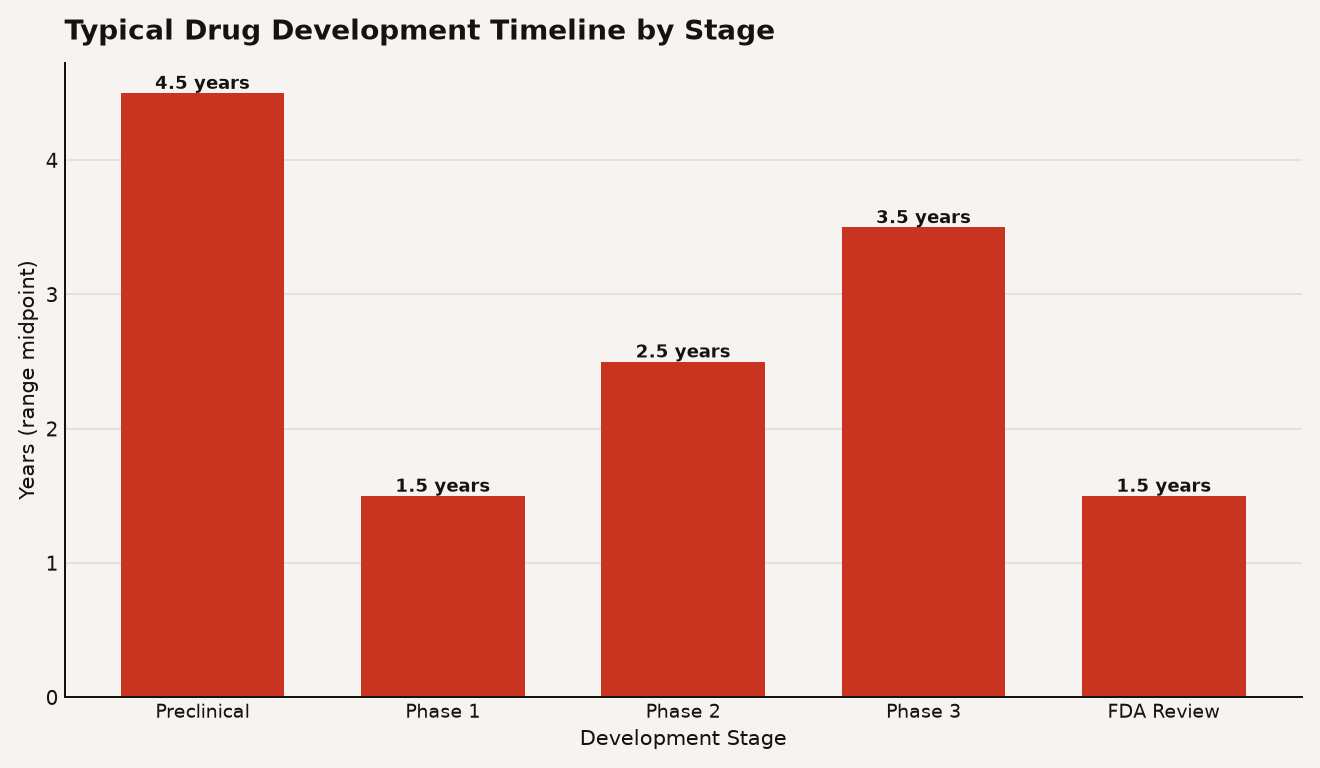
The chart above shows the typical drug development pipeline stages and their approximate durations: preclinical research takes roughly 3 to 6 years, Phase 1 clinical trials take 1 to 2 years, Phase 2 takes 2 to 3 years, Phase 3 takes 3 to 4 years, and FDA review takes 1 to 2 years. The total timeline often exceeds a decade, and AI has so far only meaningfully compressed the earliest preclinical stages.
What AI cannot do is replace the experiments. Frank von Delft, a professor of structural chemical biology at the University of Oxford and head of protein crystallography at the Oxford Centre for Medicines Discovery, told The Verge that drug candidates still have to be tested in the real world for efficacy, toxicity, and whether they have practical properties allowing them to be prepared, stored, and delivered safely as medicines. All of that requires skilled workers, a lot of money, and time, especially clinical work in humans, which is the point when many promising drug candidates fail.
If Anthropic wants to develop a drug, von Delft said, it is going to have to spend a lot on experiments. That is the wet-lab wall. You can generate all the candidate molecules you want with a language model, but you still need pipettes, cell lines, animal models, and eventually human clinical trials to prove anything.
Todd and Han both noted another constraint: the lack of publicly available, high-quality experimental data. Even for well-studied areas of biology, there are still large gaps in our understanding of how things work. Data on how various chemicals behave in the body is often proprietary, fragmented, or simply does not exist. This is a data problem because the data has not been generated yet. Generating it requires the very experiments that AI is supposed to accelerate.
Concrete consequences for pharma tool builders
If you are building AI tools for drug discovery, the implications are concrete. First, Anthropic is now both a platform provider and a potential competitor. If you are a pharma company evaluating Claude Science, you need to think about whether your internal R&D data flowing through Anthropic's platform could eventually inform Anthropic's own drug programs, even if the company says it will target neglected diseases that its customers are not chasing.
Second, the real bottleneck is experimental data and lab infrastructure. A team building AI drug discovery tools should focus on the data pipeline: what experimental data exists, what is missing, and how to close that gap. The models are already good enough to generate plausible candidates. The constraint is testing them.
Third, the timeline matters for any business model built on AI drug discovery. Todd said the field is a long way off from an AI-designed drug being approved by regulators for human use. Any payoff from Anthropic's internal programs is likely at least a decade away, given how long it typically takes a new drug to go through clinical trials. Some AI-developed candidates have entered clinical trials, but it is hard to know how much AI contributed, where in the process it was used, or whether those candidates outperform conventional drugs.
What this means for you depends on where you sit:
- For pharma R&D teams: Claude Science could consolidate fragmented tools into one environment, but evaluate the data sharing implications carefully. The 60-plus functions covering genomics, structural biology, and cheminformatics are in beta, so pilot before committing.
- For AI tool builders: The model layer is commoditizing. The moat is in proprietary experimental data and lab access. If you do not have a wet lab partner, get one.
- For investors: Anthropic building wet labs signals that pure software plays in drug discovery have a ceiling. The companies that will matter own both the compute and the pipettes.
- For patient advocates: Anthropic targeting neglected diseases is genuinely good news for underserved populations, but the timeline is long. Manage expectations accordingly.
As we noted in our earlier coverage of how Claude Science turns lab agents into pharma plumbing, the workflow consolidation story is real and valuable. But the jump from plumbing to drug developer is a different order of magnitude.
Watch the hiring
Watch the hiring. If Anthropic continues pulling senior scientists from Big Pharma and academic institutions, that tells you the wet-lab buildout is serious. If the hiring slows or the job postings shift back toward pure software roles, the internal drug discovery program may be more brand strategy than operational commitment.
Watch the data partnerships. Anthropic will need access to proprietary experimental data to train models that are useful beyond the literature. Any partnerships with academic labs, biotech companies, or clinical research organizations are signals worth tracking.
Watch the first molecule. When Anthropic announces its first drug candidate or target, the choice of disease and the stage of development will tell you how ambitious the program really is. A rare disease with a clear genetic cause is a sensible first target. A complex polygenic disease would be a red flag.
The bets worth making are in the infrastructure layer. Tools that make experiments faster, cheaper, and more reproducible are where AI can have the most impact in drug discovery today. Automated lab platforms, high-throughput screening systems, and data standardization tools are undervalued relative to the attention being paid to molecular generation models.
The bets worth avoiding are claims that AI will compress the full drug development timeline by an order of magnitude. The bottleneck is experiments, and experiments take time. That is the line to remember.
The wet-lab tax
Anthropic's move into drug discovery is a signal that the frontier AI industry has run out of pure software problems to solve in the life sciences. The interesting problems require physical experiments, and physical experiments require labs, people, and time. Anthropic is willing to pay that tax. The question is whether the company can build models good enough to justify the cost, and whether the drug discovery industry will trust a platform provider that also competes in the lab. The wet-lab wall is still standing, and no amount of compute will knock it down alone.