Dataset: The Lean FRO maintains Mathlib, the open formalized mathematics library built on the Lean programming language, publicly available on GitHub.
When an AI agent approves a loan, routes a power grid, or executes a trade, the usual safety net is a test suite. Tests check the cases you thought of. They do not check the ones you did not. Amazon is now betting that the gap between "tested" and "proven" is where the next generation of agentic AI will either earn trust or lose it, and it is putting money behind a programming language called Lean to close that gap. On July 26, 2026, Amazon Science announced that it is providing the single largest donation in the history of the Lean Focused Research Organization, a group that builds and maintains Lean, a functional programming language designed for mathematical proofs of software correctness. The funding is long-term and substantial, though Amazon did not disclose a dollar figure. The stated goal is to make formal verification accessible to every developer, not just specialists in academic theorem proving.
What exactly is Lean, and what did Amazon announce?
Lean is a proof assistant and programming language originally developed by Leonardo de Moura, first at Microsoft Research and now through the Lean FRO, an independent nonprofit. You write specifications and implementations in the same language, and the compiler checks, with mathematical certainty, that the implementation meets the specification. If the proof compiles, the code is correct for all inputs, not just the ones a test happened to cover. The language has spawned a large community in mathematics and computer science, anchored by Mathlib, a collectively maintained library of formalized mathematics that has grown to over 1.5 million lines of Lean code contributed by hundreds of mathematicians and software engineers worldwide.
Amazon's announcement names four concrete production or near-production uses of Lean inside its own stack. Policy in Amazon Bedrock AgentCore uses Lean-based verification to prove the correctness of the policy language that constrains what AI agents can do. SampCert provides mathematical guarantees that differential privacy protections in AWS Clean Rooms are sound. AWS Neuron, the compiler for Amazon's AI acceleration chips, uses Lean for compilation correctness proofs. And most recently, an Amazon scientist combined an LLM with Lean to prove the correctness of Amazon Aurora's segment repair protocol, the database's most durability-critical distributed protocol, in what Amazon describes as a fraction of the time manual proof would have taken.
The chart below shows where each of these four applications sits on a maturity spectrum from exploratory to production:
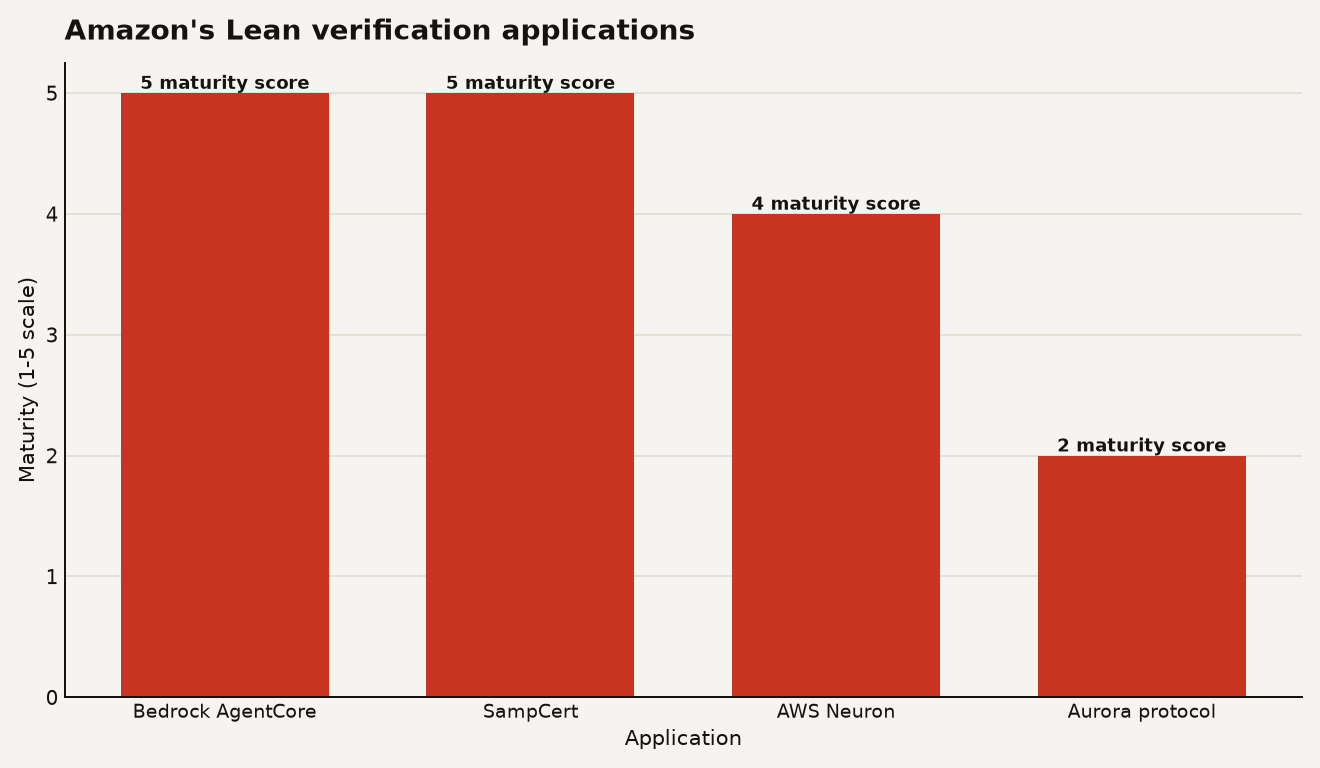
Amazon framed Bedrock AgentCore and SampCert as production systems, AWS Neuron as a mature but evolving use case, and the Aurora protocol proof as a recent research breakthrough that has not yet shipped at scale.
Why does formal verification suddenly matter for AI agents?
The timing is not accidental. The industry is deploying AI agents into higher-stakes environments where the cost of a bad output is no longer a wrong chatbot answer but a wrong financial decision, a privacy violation, or a safety incident. As we have covered, enterprises are already shipping broken agents because their evaluation tooling cannot keep up with the breadth of agent behaviors. Testing cannot enumerate every possible state an agent might reach, especially when the agent chains calls across multiple tools and APIs. Formal verification offers a different bargain: instead of checking many cases, you prove a property holds for all cases.
Amazon's own framing is blunt. The announcement states that "as AI agents increasingly make decisions that move money, approve claims, and operate critical infrastructure, the standard approach to software testing is no longer sufficient." That is a strong claim from a company that runs a meaningful fraction of the world's cloud compute. It is also a claim that aligns with a broader pattern we have tracked: agent security gaps are already hitting enterprises, and the cost of agentic failures is showing up in billing before it shows up in incident reports.
Lean's relevance to AI safety specifically comes through what Amazon calls neurosymbolic AI: coupling generative models with formal proof systems. The idea is that an LLM proposes a proof or a piece of code, and Lean verifies it. If the proof checks, you have a certificate of correctness. If it does not, you try again. This loop matters because it turns the LLM's probabilistic outputs into deterministic guarantees. Amazon says that AI generation of formal proofs in Lean has already been a key method for training models with lower error rates, to the point that models are now producing correct solutions to research-level mathematical problems.
How does this change what builders should do?
If you are building AI agents that operate in regulated environments or handle money, data, or infrastructure, this announcement is a signal that formal verification is moving from academic curiosity to industry infrastructure. Here is what that means in practice:
- Agent safety boundaries become provable. Bedrock AgentCore's use of Lean to verify policy language means the constraints on agent behavior, what tools they can call, what data they can access, what actions they can take, are not just checked at runtime but proven correct at compile time. If you are building agents on Bedrock, this is a different safety posture than guardrails or runtime monitoring.
- Differential privacy gets a mathematical backbone. SampCert's role in AWS Clean Rooms means that privacy guarantees are backed by formal proofs, not just best-effort implementations. For teams building data collaboration products, this reduces the risk that a privacy bug is discovered after deployment.
- LLM-assisted proof is real and accelerating. The Aurora protocol proof, where a scientist used an LLM with Lean to verify a distributed database's repair mechanism, shows the workflow is no longer purely manual. The bottleneck has been the cost of human labor in formal proof. LLMs are starting to break that bottleneck, though Amazon did not quantify the speedup beyond "a fraction of the time."
- Open governance is the trust mechanism. Amazon deliberately funds Lean through the FRO rather than building it internally. The reason is regulatory: customers, auditors, and regulators can independently inspect and validate the proof tools. If you are selling AI systems to enterprises or governments, the ability to point to a community-governed, independently auditable verification framework is a procurement advantage.
For a solo founder or a small team, the practical entry point is not rewriting your codebase in Lean tomorrow. It is identifying the narrow, high-stakes properties of your system that would be catastrophic if violated, and asking whether those properties can be specified formally. A policy that constrains an agent's actions, an invariant in a distributed protocol, a privacy guarantee in a data pipeline: these are the candidates for formal verification. Everything else can stay in the test suite.
What are the limits and what should you watch?
The announcement is heavy on vision and named applications but light on specific numbers. Amazon did not disclose the donation amount, the timeline, or how many engineers are working on Lean internally. The claim that LLM-Lean combinations are producing research-level proofs is attributed to Amazon scientists but not backed by a published benchmark or paper in the announcement itself. The Aurora protocol proof, in particular, would benefit from a technical writeup with quantified results.
There are also structural limits to formal verification that the announcement does not address:
- Specifying the right property is the hard part. Lean proves that your implementation meets your specification. It does not tell you whether your specification is the right one. If you prove that an agent stays within policy boundaries, but the policy itself is wrong, you have a provably incorrect system.
- Proof engineering is still expensive. Even with LLM assistance, writing specifications and proofs in Lean requires expertise that most teams do not have. The talent pool for Lean developers is small, concentrated in academic circles and a handful of companies.
- Coverage is narrow. Amazon's four named use cases are specific, high-value components, not entire systems. Formal verification of a policy language is not the same as formal verification of an entire agent stack. The technique scales to the parts where correctness is most critical, not to everything.
What to watch next is whether Amazon opens up Lean-based verification as an AWS product. Bedrock AgentCore already uses it internally for policy correctness. The natural next step is exposing proof capabilities to customers, either as a managed service or as an API. If that happens, formal verification becomes a cloud feature, not a research tool, and the competitive dynamics shift. Also watch whether other cloud providers, Google, Microsoft, or Meta, make comparable investments in proof assistants. Amazon is the first major cloud to publicly back Lean at this scale, but formal verification is not a proprietary moat. It is an open ecosystem, and Amazon's own commitment to the FRO model reflects that.
The broader question is whether the industry will treat proof the way it treated testing: as an optional best practice that most teams skip under deadline pressure. Amazon's bet is that AI agents raise the stakes high enough to change that calculus. If agents are making decisions that move money and operate infrastructure, "tested" is no longer enough. Whether the rest of the industry agrees, and whether Lean specifically becomes the standard tool or one of several, is the open question that the next 18 months will answer.
The real moat is the specification
Formal verification does not eliminate human judgment. It moves it upstream, from writing tests to writing specifications. The team that can crisply state what their agent must never do, and prove it, has a stronger safety posture than any team relying on test coverage alone. Amazon's investment in Lean is a bet that this upstream shift is where agentic safety will be won or lost. The tooling is catching up. The question for builders is whether their specs are ready.
Sources
- Amazon Science - Amazon is investing in the Lean Focused Research Organization
- Lean FRO - Lean Focused Research Organization
- Mathlib on GitHub - The mathlib repository
- Amazon Bedrock AgentCore - Amazon Bedrock AgentCore documentation
- AWS Clean Rooms - AWS Clean Rooms product page