The cloud has always sold itself as placeless. Your workload runs in a region, your logs land in a bucket, your bill arrives in dollars. Water rarely makes it into the architecture diagram. Amazon just made that harder to ignore.
Amazon data centers used 2.5 billion gallons of water in 2025, according to the company’s new disclosure of global data center water use. Amazon says those facilities ran at 0.12 liters of water per kilowatt hour of IT electricity, down 2 percent in total water withdrawal from 2024 even as its data center footprint grew, in a June 2026 post on how Amazon is making data centers more water efficient.
That number is both big and small. Big because 2.5 billion gallons is a public resource entering the AI balance sheet. Small because Amazon is arguing, with some evidence, that its water usage effectiveness is better than peers and far below a broad industry average. If you build on AWS, or sell AI into customers who care about procurement, this is the line to watch: water is becoming a cloud capacity constraint, not a side note for the sustainability team.
What did Amazon actually disclose about its data center water use?
Amazon disclosed three useful numbers and one useful omission.
The first number is the headline: 2.5 billion gallons withdrawn across its global data center footprint in 2025. The second is the efficiency metric: 0.12 liters per kilowatt hour, usually shortened to WUE. The third is the company’s replenishment progress: Amazon says it returned 3 gallons for every 4 gallons used in 2025 and has announced more than 50 water projects expected to return more than 5.8 billion gallons annually once fully implemented, again in its June 2026 water efficiency post.
The omission matters. Amazon’s figure covers direct data center operations. It does not settle the harder source-to-site question: how much water is consumed by the power plants that feed those sites, the construction supply chain, or chip manufacturing upstream. That boundary choice is normal for corporate sustainability reporting. It is also exactly where local fights get messy, because a community does not experience “WUE.” It experiences aquifers, utility bills, heat, noise, and permit applications.
The chart below shows why Amazon is trying to frame the story around efficiency rather than absolute gallons. Amazon’s 0.12 L/kWh is less than half Microsoft’s reported FY25 global data center WUE of 0.27 L/kWh and about one seventh of the 0.84 L/kWh industry average Amazon cites. Microsoft reports its FY25 global WUE and regional data in its public page on measuring energy and water efficiency.
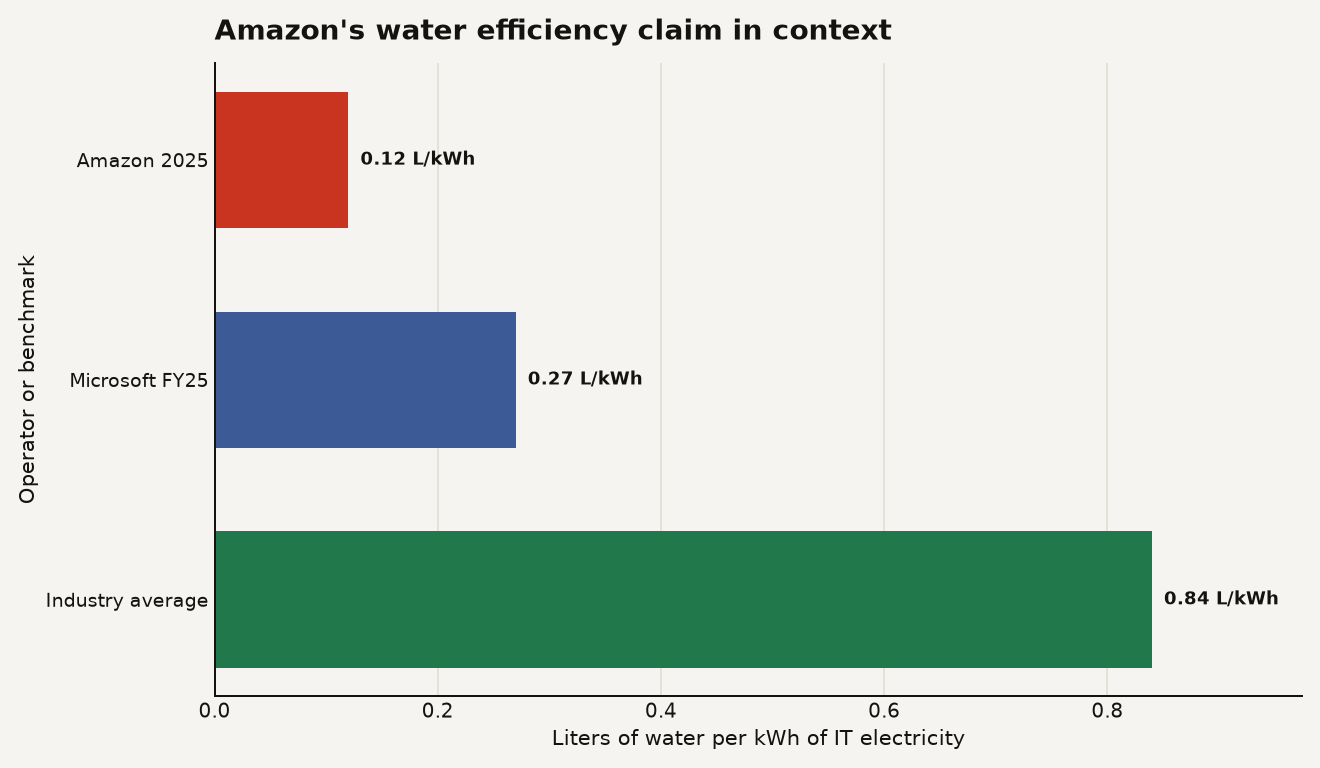
That is the best version of Amazon’s argument: more compute, less water per unit of IT load. It is a fair metric for engineering teams because it rewards better cooling systems, better operating envelopes, and better siting. It is also not a permission slip to build wherever power is cheap and politics are sleepy.
Amazon says its facilities use air cooling about 90 percent of the time and switch to evaporative cooling during the hottest hours of the hottest days. It has also raised server temperature thresholds, using water to cool incoming air only when ambient temperatures exceed roughly 85 degrees Fahrenheit, according to the same Amazon technical explanation. That is a real engineering choice. Running servers hotter can reduce water use, but it forces tighter validation around failure rates, thermal throttling, component life, and emergency conditions.
In plain English: Amazon is sweating the servers a little less often.
Why is this landing right after Seattle hit pause?
The timing is not subtle. On June 9, 2026, Seattle passed Council Bill 121214, an emergency ordinance adopting a moratorium on applications for new or expanded data centers, and the city record shows Mayor Katie Wilson signed it on June 11, 2026. The official legislation says data centers could significantly affect Seattle’s energy and water infrastructure, utility affordability, reliability, public health, and environment in the city’s ordinance record.
Seattle is not some random anti-tech test case. It is Amazon and Microsoft country. That makes the politics more important, not less. When the home market of cloud giants says “pause,” the rest of the country sees a script.
The city had been reacting to proposals for five large data centers. Seattle councilmembers said four companies had approached Seattle City Light about projects with a combined maximum demand of 369 megawatts, enough to power roughly 300,000 homes, in the council’s April 30 announcement on the proposed data center moratorium. That same announcement said the pause would last 365 days, with the option for a six month extension.
This is where the builder story starts. AI infrastructure debates have moved from “can Nvidia ship enough GPUs?” to “can a local utility, water district, and zoning board absorb the load?” We covered the local version of that pressure in Seattle’s data center moratorium, and Amazon’s water disclosure gives that fight a sharper denominator.
A cloud region is no longer just a latency and compliance choice. It is a political surface area.
What does this change for builders shipping AI products on AWS?
If you are building a SaaS product, an agent workflow, or an internal AI platform, you probably cannot negotiate Amazon’s cooling design. You can, however, make fewer dumb infrastructure decisions.
The International Energy Agency estimated that data centers used about 415 terawatt hours of electricity in 2024, about 1.5 percent of global electricity consumption, and projected that data center electricity use could reach around 945 TWh by 2030 in its base case for energy demand from AI. That growth changes the purchasing conversation. Enterprise customers are already asking about model risk, data privacy, residency, and audit logs. Water and power disclosures are next because they map directly to local opposition and long term availability.
For you, that shows up in four places:
- Region selection becomes a product decision. Latency, price, carbon intensity, water stress, and local permitting risk all belong in the same conversation before you commit a data moat to one geography.
- Inference efficiency becomes procurement cover. If you can cut tokens, cache outputs, batch jobs, or route small tasks to smaller models, you can show customers a usage reduction that is more concrete than “we care about sustainability.”
- Cloud concentration becomes a resilience risk. A blocked campus, delayed substation, or water dispute can affect capacity growth in a region even if your own bill never mentions gallons.
- Sustainability claims need scope discipline. Do not tell customers your AI product is water light because your vendor has a low WUE. Say what you measured: tokens, model calls, region, compute hours, and vendor disclosures.
The most underrated point in Amazon’s disclosure is that better efficiency can still coexist with rising absolute demand. A 0.12 L/kWh fleet is impressive. A 2.5 billion gallon annual withdrawal is still a number that regulators, activists, and city councils can put on a slide.
That tension should shape your roadmap. If you are adding AI features because the market expects them, trim the waste before it compounds. The boring work matters: model routing, retrieval quality, prompt length, idle GPU time, eval-driven caching, and abuse controls. The cheapest gallon is the inference you never run. That same logic sat behind our earlier breakdown of AI energy and water per query, but Amazon’s disclosure moves it from abstract math to vendor-level accountability.
Is Amazon’s 0.12 L/kWh number good enough to quiet the backlash?
No. It helps, but it will not end the fight.
Amazon has a strong engineering story. It claims a 52 percent improvement in water efficiency since 2021, uses reclaimed water at 26 facilities running on 100 percent reclaimed water, and has 130 more contracted globally, according to its June 2026 disclosure. It also says Northern Virginia, its largest region by IT load, cut water use 42 percent year over year.
Those are the right moves. They also prove the critics’ point that disclosure changes behavior. If communities had not started asking for hard numbers, hyperscalers would still be able to talk in annual goals and glossy river projects.
Microsoft is moving in a different direction for new builds. It said in December 2024 that it launched a data center design using chip-level cooling that consumes zero water for cooling after an initial fill, and that new projects in Phoenix, Arizona, and Mount Pleasant, Wisconsin, would pilot the design in 2026 with sites starting to come online in late 2027 in its next generation data center announcement. That is the competitive pressure Amazon now faces: a low WUE fleet versus a credible promise of near zero evaporative cooling in new capacity.
Google is also trying to reset the rules. Its 2025 Environmental Report says Google replenished 4.5 billion gallons of water in 2024 and increased replenishment of freshwater consumption to 64 percent, according to Google’s 2025 Environmental Report hub. Different boundary, different fleet, different workloads. Same political direction.
The backlash will not be settled by one metric because the public question is broader than water efficiency. A town wants to know: how much water, from which source, during which months, under what drought conditions, with what power contract, and what happens when the site expands from phase 1 to phase 4?
Builders should take the same lesson. If your AI product depends on an opaque supply chain, opacity is a risk. A procurement team may not ask today. A regulator or customer board can ask next year.
What should teams do before water becomes a cloud constraint?
Start measuring now, even if the numbers feel incomplete.
For small teams, the practical move is not to build a fake carbon dashboard with five decimal places. It is to create a simple usage ledger that connects product behavior to compute demand. Track model, region, input tokens, output tokens, cache hits, batch jobs, retries, and user-facing value. If one workflow burns 40 percent of inference volume and drives 4 percent of retention, you have a roadmap answer.
For larger teams, add vendor questions to your architecture review:
- Which regions run the critical workloads, and are any in water-stressed or politically contested markets?
- Does the vendor publish WUE, PUE, and water withdrawal by region, or only global averages?
- Are backup regions actually capacity ready, or just names in a disaster recovery document?
- Can product teams see cost and resource use at the feature level, not just the account level?
- Are model choices tied to eval scores and business outcomes, or are teams defaulting to the largest available model?
A global average WUE can hide the site-level problem. A region with low annual water use can still hit a public nerve during a heat wave. A model that looks cheap in tokens can become expensive if agents loop, retry, or call tools badly. The infrastructure story and the product story are the same story wearing different badges.
The safest bet is that water disclosure becomes more granular. Seattle’s ordinance explicitly calls out energy and water infrastructure, utility affordability, jobs, public health, and the environment. Amazon’s new data makes that debate harder to dismiss as vibes. Once a company publishes 2.5 billion gallons, the next question is obvious: where, when, and whose water?
Cloud used to hide the machine. AI made the machine too large to hide.
Sources
- Amazon: Amazon's data centers are 7x more water-efficient than the industry average. Here's how we do it.
- Microsoft: Measuring energy and water efficiency for Microsoft datacenters
- Microsoft: Sustainable by design: Next-generation datacenters consume zero water for cooling
- Seattle City Clerk: Council Bill 121214
- Seattle City Council: Councilmembers introducing moratorium on data centers in Seattle
- International Energy Agency: Energy demand from AI
- Google: 2025 Environmental Report