For months, the biggest AI models you could download and run yourself topped out around 1.6 trillion parameters. Parameters are the learned numbers inside an AI model that determine its behavior, similar to how synapses shape what a brain can do. As of July 26, 2026, that ceiling broke. Moonshot AI, a Beijing startup backed by Alibaba, published the full Kimi K3 open weights on Hugging Face, making a 2.8 trillion parameter model available for anyone to download, inspect, and run. The release landed about a day ahead of the announced July 27 target.
If you are new to local AI, this is a genuine milestone. Until now, models this capable sat behind paid APIs from OpenAI, Anthropic, and Google. Kimi K3 changes the picture, but with a catch that matters enormously for hobbyists: the download is roughly 594 gigabytes, and running it locally requires server-grade hardware that almost no one owns. Here is what happened, what it means, and what you should actually do.
What is Kimi K3 and why is everyone excited?
Kimi K3 is a large language model from Moonshot AI, the company behind the Kimi chatbot. A large language model, or LLM, is an AI system trained on massive amounts of text to predict and generate human language. Kimi K3 builds on two earlier generations, Kimi K1 and K2, and represents the company's most capable release.
The excitement comes down to three things. First, the model benchmarks competitively with the best closed models from Western labs. On the Briefcase benchmark, a test of long-horizon knowledge work from Artificial Analysis, Kimi K3 scored 1,687, placing third behind Claude Fable 5 Max at 1,815 and GPT-5.6 Sol Max at 1,747.8, and ahead of Claude Opus 4.8 at 1,600. Second, it scored 91.2 out of 100 on BrowseComp, a benchmark for difficult information-seeking tasks, which is state of the art. Third, and most relevant for beginners, the model is open weight.
Open weight means Moonshot publishes the trained model files for anyone to download. You can run the model on your own hardware, study its architecture, and in many cases fine-tune it for specific tasks. It is distinct from open source in the strict sense: you get the finished model, but not necessarily the training data or the full training pipeline. For a deeper look at what 2.8 trillion parameters means in practice, our Kimi K3 parameter explainer breaks it down in plain terms.
How big is this model compared to other open releases?
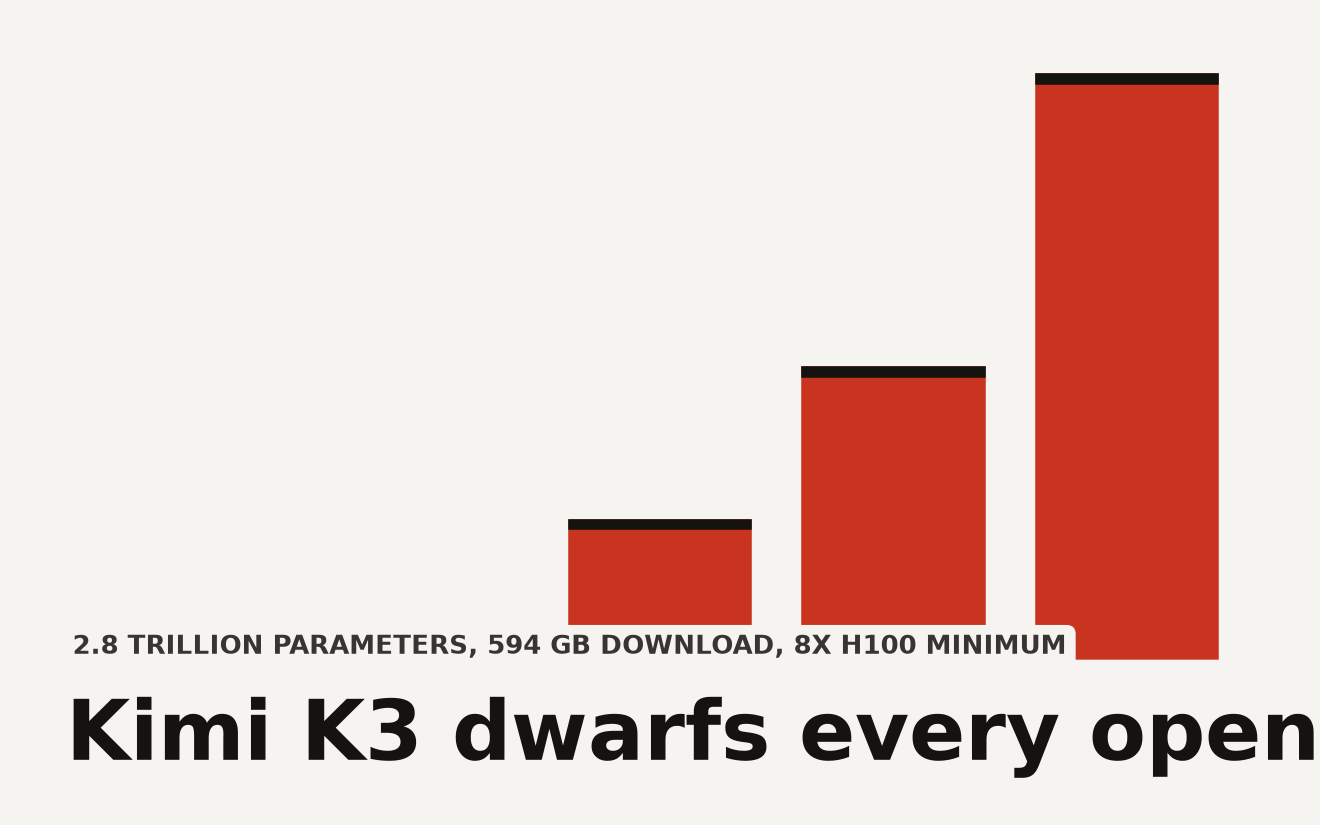
To put Kimi K3 in context, look at how open-weight model sizes have grown over the past year. The chart below shows total parameter counts for recent open models.
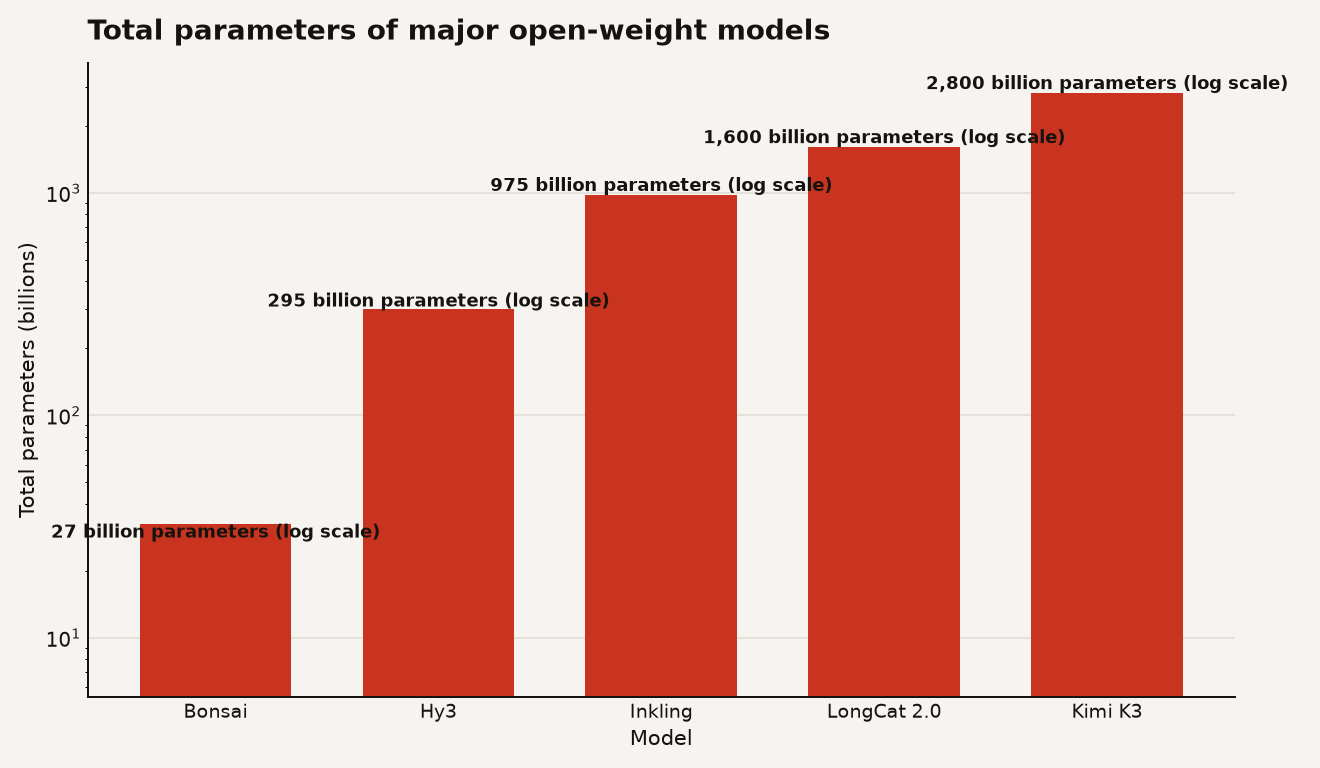
Bonsai, a model designed to run on phones, sits at 27 billion. Hy3, covered in our MoE explainer, reaches 295 billion. Inkling from Thinking Machines hit 975 billion. LongCat 2.0 reached 1.6 trillion. Kimi K3 nearly doubles that at 2.8 trillion.
But raw size is only half the story. Kimi K3 uses an architecture called Mixture of Experts, or MoE. In an MoE model, the full model contains many sub-networks called experts, but only a small subset activates for any given input. Kimi K3 has 896 experts but activates only 16 of them per token. A token is a chunk of text roughly three-quarters of a word. This means the model is enormous in storage but relatively efficient at inference, because it uses a fraction of its total parameters for any single word it generates. The technique is like a hospital with hundreds of specialists on staff but only calling the relevant ones for each patient.
Can you actually run Kimi K3 on your own computer?
Here is where the excitement meets reality. The short answer for most hobbyists is no.
The Kimi K3 weights in their native MXFP4 format, a compressed number representation designed to reduce file size, come in at roughly 594 gigabytes, according to hardware analysis from explainx.ai. Loading the model requires a minimum of 8 NVIDIA H100 GPUs with 80 gigabytes of memory each. That is roughly $300,000 worth of hardware. A single consumer GPU like an RTX 4090, or even a high-end Mac Studio, cannot run the full model even with aggressive compression.
This is the trade-off of open weights at frontier scale. The model is free to download, but the hardware to run it is not. Community re-quantizations in formats like GGUF, which further compress models for smaller hardware, may eventually make K3 runnable on less extreme setups. But at this size even heavily compressed versions will likely need multi-GPU servers or cloud rentals.
For comparison, models like Bonsai at 27 billion parameters can run on a phone. Mid-size open models in the 7 billion to 70 billion range run comfortably on a single consumer GPU. Kimi K3 is in a different class entirely.
Where can you try Kimi K3 without owning a data center?
You have several practical options right now.
Use the free Kimi web app. Head to kimi.com, sign up with a Google account or phone number, and start chatting. No credit card is required. This is the easiest way to experience the model.
Use the API. Kimi K3 is available through Moonshot's API at platform.kimi.ai, and it is compatible with the OpenAI SDK. This matters because if you have already written code that calls OpenAI's API, you can point it at Kimi K3 by changing the base URL and model name. The model ID is kimi-k3. According to pricing details from aireiter.com, input tokens cost $3 per million and output tokens cost $15 per million. Cached input tokens, meaning text the model has already processed and can reuse, drop to $0.30 per million. A promotional rebate running through August 12 offers up to 30 percent back in vouchers for API credits of $1,000 or more.
Use a hosted inference provider. Together AI and Modal both confirmed day-0 access to Kimi K3, meaning you can rent GPU time on their platforms and run the model without buying hardware. This is the middle ground: you pay by the hour for compute, but you control how the model runs.
If you want to understand how model APIs work beyond a simple chat interface, our MCP explainer covers what standard APIs can and cannot do.
How does Kimi K3 compare to the models you already use?
Moonshot claims Kimi K3 approaches the top of the market, and the benchmarks support that claim with some nuance. The chart below shows where K3 lands on the Briefcase benchmark relative to its closest competitors.
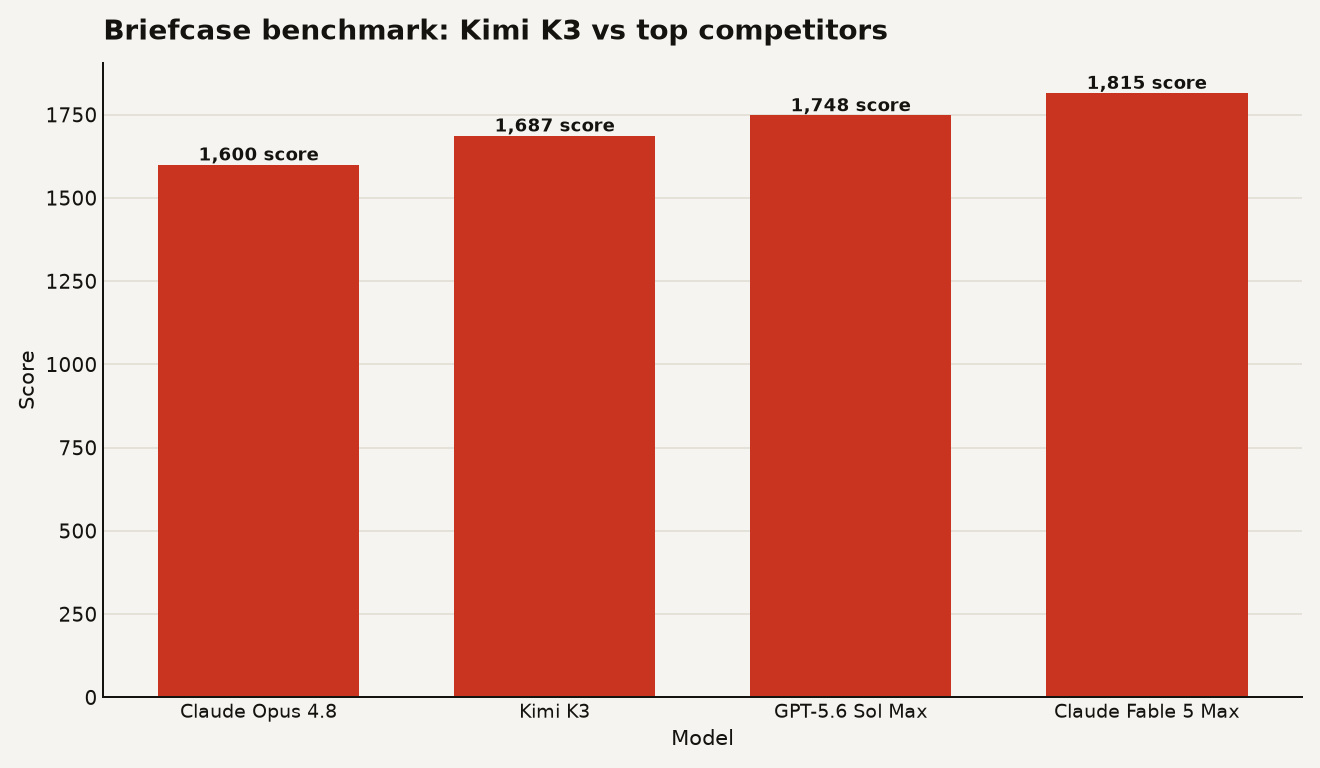
Kimi K3 ranked first in four out of eight benchmarks Moonshot tested, including Automation Bench, SpreadsheetBench 2, and BrowseComp. In most other categories it finished second to Fable 5 or GPT-5.6 Sol. The model also includes native vision capabilities, meaning it can process images alongside text, and a context window of 1 million tokens. A context window is how much text the model can consider at once. One million tokens is roughly 750,000 words, or about the length of the entire Harry Potter series. This makes K3 well suited for tasks that involve analyzing long documents or entire code repositories.
The architecture behind these gains includes two innovations Moonshot calls Kimi Delta Attention and Attention Residuals. Attention is the mechanism LLMs use to decide which parts of the input to focus on when generating each word. These updates improve how information flows across long sequences and deep model layers. The company claims a 2.5 times improvement in scaling efficiency compared to Kimi K2, meaning it converts compute into capability more effectively per dollar spent.
What should a beginner actually do about this?
Here is the honest read for someone starting out with AI development.
If you are learning to build with LLMs, try Kimi K3 through the free web app first. Get a feel for its strengths in long-context tasks and coding. If it works for your use case, the API is cheap and OpenAI-compatible, which makes integration straightforward. $3 per million input tokens is competitive with mid-tier offerings from Western labs, and the 1 million token context window is genuinely useful for codebases and long documents.
If you are interested in running models locally, start smaller. A 7 billion to 13 billion parameter model, like those covered in our Bonsai guide, teaches you the workflow without the hardware headache. Kimi K3 is a goal to aspire to, not a starting point.
Do not download any Kimi K3 files from unofficial sources. The legitimate release lives on Moonshot's official Hugging Face page. Anything else is likely a scam or a different model mislabeled.
Watch for community re-quantizations in the coming weeks. If GGUF versions appear that can run on 4 to 8 consumer GPUs, that opens the door for serious hobbyists with multi-GPU rigs. But do not expect to run this model on a single laptop anytime soon.
The frontier is open, the hardware is not
Kimi K3 proves that open-weight models have caught up with closed labs on capability. The model is free, powerful, and benchmark-competitive with the best systems from Anthropic and OpenAI. It is also too large for almost any individual to run at home. That gap between availability and usability is the defining tension of open AI in 2026. The question for builders is whether inference providers, quantization techniques, or smaller distilled variants will close it before the next frontier model widens it again.
Sources
- kimi.com Kimi K3 Tech Blog: Open Frontier Intelligence
- huggingface.co Moonshot AI Kimi-K3 model page
- venturebeat.com China's Moonshot AI releases Kimi K3, the largest open-source model ever
- explainx.ai Run Kimi K3 Locally, Weights July 27 Prep
- aireiter.com Kimi K3 Open Weights: When They Drop and How to Run It
- platform.kimi.ai Kimi K3 API Quickstart Guide