If you have stared at ChatGPT's mode picker and wondered whether "Work" on your phone means the same thing as "Work" on your laptop, you are not losing your mind. The names genuinely do not line up. The tools that were supposed to make AI simpler have spent the last year multiplying modes with overlapping labels that map onto each other in no helpful way.
The best AI for getting real work done has shifted from chat to agents, and the guide that practitioners trust has rewritten itself to reflect that. On July 27, 2026, developer and AI commentator Simon Willison posted his analysis of Ethan Mollick's evolving guide to which AI to use for tasks. A year ago, Mollick's recommendations were all chat: pick ChatGPT, Claude, or Gemini, talk to it, and you are done. Today, the guide centers on agentic systems, where the AI does the equivalent of many hours of real human work in one go. Gemini has fallen off the recommended list entirely. This AI agent guide breaks down what changed, what each mode actually does, and which tool a beginner should reach for right now.
What changed in Mollick's guide over the past year?
The AI tool landscape completed a phase transition. In mid-2025, Mollick's guide recommended three chat interfaces: ChatGPT with o3, Claude with Claude 4 Opus, and Gemini with Gemini 2.5 Pro, plus a Deep Research mode as a useful alternative. You opened a chat window, typed a question, and got an answer. That was the entire interaction model.
By July 2026, that model looks quaint. Mollick now frames the useful tools as agentic systems that can do many hours of real human work in one go, according to Willison's summary. The distinction matters: a chat model answers your question, while an agent takes a task, breaks it into steps, runs those steps, and hands you a finished result. You are no longer driving every step. The AI is.
The other big change is that Gemini is gone. Willison notes that Google still does not have an established entry in the agent category that Mollick tracks. A product called Gemini Spark exists, but Willison says it "has yet to prove itself." For a company that was one of three recommended chat providers a year earlier, dropping off the list entirely is a meaningful signal about where the work is heading.
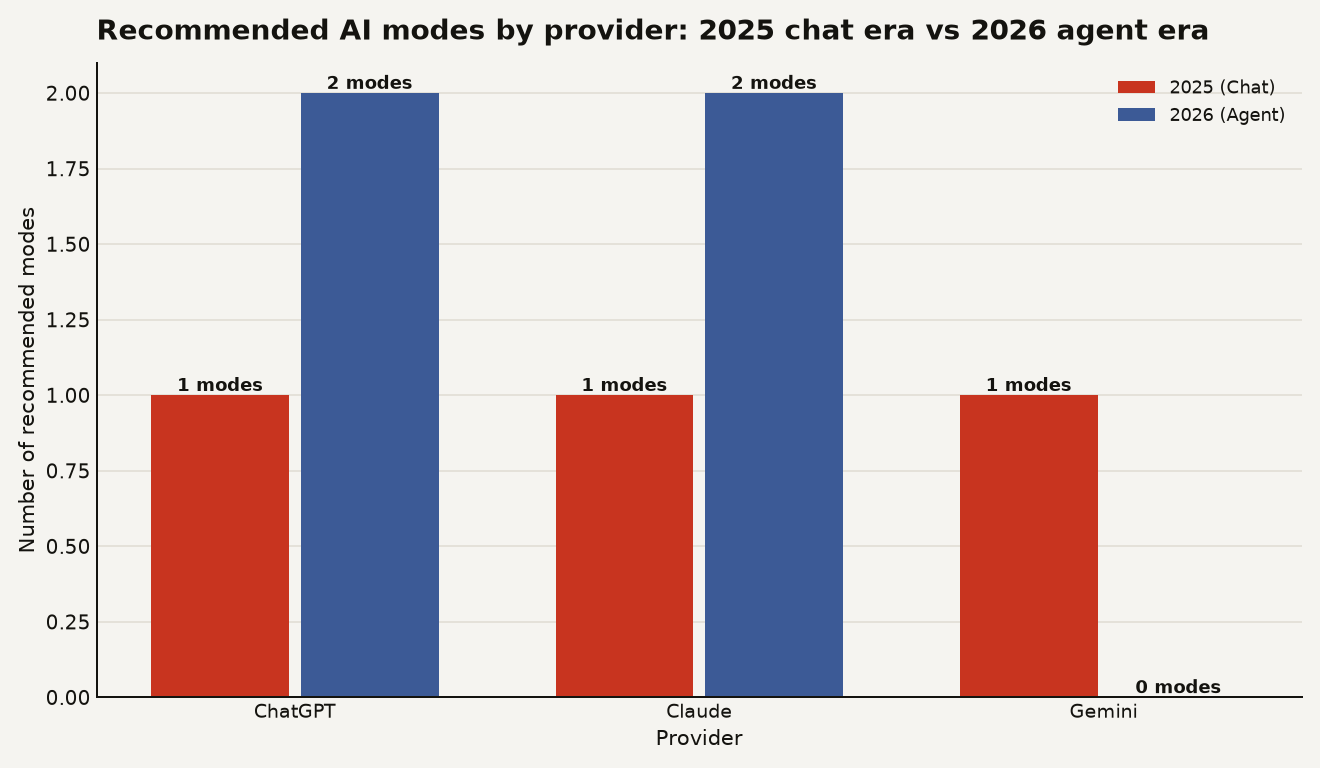
The chart below shows the shift: all three providers had one recommended chat mode in 2025. By 2026, ChatGPT and Claude each offer two agent modes, while Gemini offers zero.
What are all these modes and why are they named so confusingly?
This is where most beginners hit a wall, so let us map it out plainly. There are two layers of agent modes, and they share names in ways that will make you question whether anyone at these companies coordinates.
Cloud-based agent modes run on the AI company's servers. You do not install anything. You pick a mode in the web interface and hand off a task:
- ChatGPT Work: the cloud agent mode in ChatGPT
- Claude Cowork: the cloud agent mode in Claude
Local computer-accessing modes run on your own machine. You download the desktop app, and the AI can touch your files, run your code, and browse the real internet:
- ChatGPT Codex: the local agent mode in the ChatGPT desktop app
- Claude Code: the local agent mode in the Claude desktop app
Here is the comparison at a glance:
| Provider | Cloud agent mode | Local agent mode |
|---|---|---|
| ChatGPT | Work | Codex |
| Claude | Cowork | Code |
| Gemini | None | None |
The problem Willison flags is that ChatGPT also uses "Work" as a mode name on mobile, and it means something different there than on desktop. The cloud "Work" and the mobile "Work" and the desktop "Work" are three things that share a label. Willison's assessment is blunt: the difference between ChatGPT Work on mobile and ChatGPT Work inside the desktop app is "spectacularly unintuitive." On mobile, flipping from "Chat" to "Work" gives you a version where the Code Interpreter container, a sandboxed environment for running code, can access the internet. On desktop, "Work" is effectively a less intimidating skin on top of Codex. Same name, different capabilities, different environments.
Which AI should you actually use right now?
For a beginner who wants to get real work done rather than just chat, here is the practical read.
Think about it this way: chat is for asking a question and getting an answer. Agents are for handing over a job. If your task takes more than five minutes of back-and-forth typing, an agent mode will probably serve you better. If you just need a quick definition or a single code snippet, chat is still faster.
If you want the AI to work on tasks on a server without touching your computer, use ChatGPT Work or Claude Cowork. Both let you hand off a multi-step task, walk away, and come back to a result. You do not need to install anything. This is the lowest-friction way to try agentic AI.
If you want the AI to work inside your computer, touching your files and running code locally, install the desktop app and use ChatGPT Codex or Claude Code. These are more powerful because they can access your actual filesystem, run scripts, and interact with your tools. They are also more risky for the same reason. If you are just starting out, use the cloud modes first, get comfortable with how agents behave, then graduate to local access.
What about Gemini? As of late July 2026, Willison's summary suggests it is not the tool to reach for if your goal is agentic work. Google's chat models remain strong for conversational queries, but the agent category is where real work is moving, and Google does not yet have a credible entry there.
If you want to understand how AI tools connect to external systems more broadly, our explainer on MCP and what it adds beyond a normal API covers the protocol that many of these agents use under the hood to reach files, databases, and services.
What should a beginner do about this shift?
The transition from chat to agents changes what you need to learn. A year ago, the core skill was prompt engineering: how to ask the right question. That skill still matters, but a new skill is gaining value alongside it: task delegation, which means describing a complete job, setting the right boundaries, and verifying the result.
Three things to do now:
- Try a cloud agent mode this week. Open ChatGPT, switch to Work mode, and give it a multi-step task you would normally do yourself. Something like "research these five competitors and build a comparison table" is a good starter task. Watch how it breaks the task into steps and where it asks for your input.
- Do not start with local agent access. Letting an AI touch your files before you understand how it behaves is a recipe for surprise. Spend a few weeks with cloud agents first. When you do move to local, start with a project folder that contains only files you are willing to let the AI modify.
- Track which mode you used and why. The naming is confusing enough that you will forget. Keep a simple note: "Used ChatGPT Work, cloud, for research. Used Claude Code, local, for refactoring the Python script." Future you will thank present you.
One caveat worth stating plainly: this landscape is moving fast. Mollick's guide has rewritten itself substantially in twelve months. The modes that exist today may be renamed, merged, or replaced within months. The specific tool you pick matters less than building the habit of delegating complete tasks and checking the output. If you learn the skill of task delegation on ChatGPT Work today, it transfers to whatever the tool is called tomorrow.
The mode picker is not going to get simpler
The AI companies are competing on features, not on clarity. Every new capability gets a mode name, and the names overlap because nobody is coordinating across companies. You will need to learn the map yourself, and it will keep changing. But the underlying shift is stable: agents are replacing chat as the primary way to get real work done with AI. Learn to delegate complete tasks. Writing clever prompts is still useful, but task delegation is the skill that compounds beyond any single product cycle. The naming mess is a tax you pay for living through a transition, and every beginner is paying it right now.
Sources
- simonwillison.net - Simon Willison on Ethan Mollick's evolving AI guide