AI music royalties just became a product policy problem, which means they became a builder problem too. Tidal is drawing a line around fully synthetic music: it can stay in the catalog, but if Tidal identifies it as wholly AI-generated, it loses royalty attribution.
This is a live test of how platforms price machine-made abundance when the marginal cost of supply collapses to almost zero. Tidal says that, beginning July 15, 2026, it will label music it determines is wholly AI-generated, and its support page says those tracks are not eligible for royalty attribution under the current policy in Tidal's AI policy. Deezer's latest public numbers explain why the issue moved from vibes to infrastructure: the company said in April 2026 that nearly 75,000 fully AI-generated tracks were arriving every day, roughly 44 percent of daily uploads in a Deezer newsroom update.
If you build platforms, creator tools, marketplaces, or agentic workflows, this is the pattern to watch. The hard part is shifting from generation to allocation: who gets visibility, who gets paid, and who gets challenged when a detector is wrong.
Tidal's three-part policy on AI royalties
Tidal's policy has three parts. First, it still allows AI-generated music if the content complies with its AI policy, terms, content guidelines, and other requirements according to Tidal's support page. Second, it defines AI-generated music for current enforcement as music that is wholly generated using generative AI in the same Tidal policy. Third, it says music that Tidal identifies as wholly AI-generated is not eligible for royalty attribution under the royalty section.
The careful word is wholly. Tidal is leaving room for artists who use AI as one tool in a human-led process. That matters because a bright-line ban on any AI involvement would be nearly impossible to enforce in modern production. Stem separation, voice cleanup, mastering, translation, beat ideation, and lyric drafts can all involve AI without turning a record into a prompt dump.
Tidal also admits the detection problem. The company says that because of limits in AI-detection technology and the risk of false positives, it will act only on wholly AI-generated content for now in its explanation of scope. As detection improves, Tidal says it will expand actions to content that is substantially AI-generated in the same policy entry.
That is the most honest sentence in the whole policy. Tidal is launching with a narrower enforcement target because the cost of being wrong is high. Mislabel a synthetic spam track and a distributor complains. Mislabel a working artist and you create a payout dispute, a PR problem, and possibly a rights fight.
The policy also gives Tidal removal authority. It says the platform may block or remove AI-generated music tied to fraudulent activity, including content that deceives listeners, exploits a person's or group's name or likeness, interferes with authentic artists and their audiences, or involves unusual upload or streaming activity in its fraud section. That shifts the policy from a copyright debate to a marketplace integrity regime.
For builders, that distinction matters. Tidal is judging whether the content behaves like fraud once it enters distribution.
Deezer's numbers show the size of the flood
Deezer gives the clearest public time series because it has been publishing AI upload metrics since 2025. In January 2025, Deezer said roughly 10,000 fully AI-generated tracks were delivered to its platform every day, equal to about 10 percent of daily content delivery when it launched its detection tool. By April 2025, Deezer said the number had passed 20,000 tracks per day, or more than 18 percent of uploaded content in a follow-up disclosure.
The curve steepened after that. Deezer said in November 2025 that roughly 50,000 fully AI-generated tracks were being uploaded daily, accounting for 34 percent of daily deliveries in its Ipsos survey release. In January 2026, Deezer reported around 60,000 AI tracks per day, equal to roughly 39 percent of daily intake when it began licensing detection technology. By April 2026, Deezer's figure had reached nearly 75,000 tracks per day, roughly 44 percent of new uploads in its April update.
The chart below shows the upload curve that should worry every marketplace team: the supply problem is compounding faster than human review can scale.
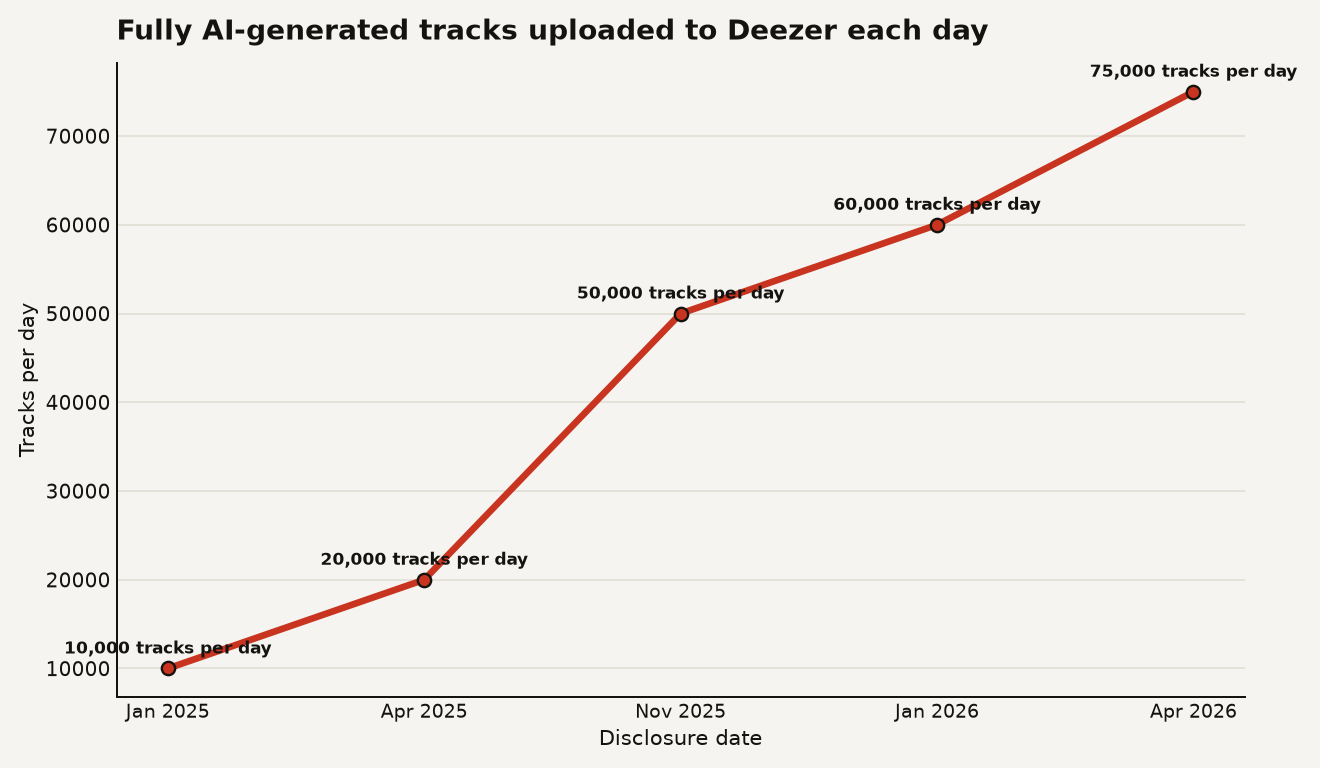
The important point is that upload volume changes the economics of discovery. A platform built for scarcity can rank, recommend, review, and pay from a pool of human-scale submissions. A platform facing tens of thousands of generated tracks every day needs trust systems, distributor accountability, appeal workflows, and payout rules that can run continuously.
Deezer's fraud numbers sharpen the business case. The company said in April 2026 that consumption of AI-generated music on its platform remained between 1 percent and 3 percent of total streams, while 85 percent of those streams were detected as fraudulent and demonetized in the same April disclosure. That is a brutal ratio: huge supply, low listener demand, high fraud signal.
There is also a user transparency problem. Deezer said its Ipsos survey of 9,000 people across 8 countries found that 97 percent could not tell the difference between fully AI-generated music and human-made music in a blind test in its November 2025 survey release. In June 2026, Deezer said 80 percent of people agreed that AI music should be clearly labeled when it launched a playlist detector.
That combination explains Tidal's move. If listeners cannot reliably tell, and uploaders can generate industrial quantities, the platform becomes the enforcement layer.
Permission to publish versus permission to earn
Because Tidal is doing what many AI-era platforms will have to do: separate permission to publish from permission to monetize.
That is the underrated move. Many platforms treat publication, ranking, recommendation, and payout as a single funnel. Upload something legal, let the algorithm sort it, pay based on engagement. Generative AI breaks that because engagement can be faked, supply can be automated, and imitation can be cheap enough to weaponize.
Recorded music is an especially clear case because streaming is already the center of the money stack. IFPI said global recorded music trade revenues reached $29.6 billion in 2024, with streaming revenues of $20.4 billion representing 69.0 percent of the total in its Global Music Report 2025 release. When synthetic uploads touch the royalty pool, they touch the main revenue engine.
The consequences map cleanly to other product categories:
- For code platforms: generated packages, plug-ins, templates, and agents may be allowed in a registry while losing ranking boosts, ad revenue, or certification until provenance is clear.
- For marketplaces: seller identity, upload velocity, and fraud behavior will matter as much as file content because machine-made supply can look harmless in isolation.
- For media apps: labels alone will not solve allocation; feeds, charts, recommendations, and payouts need separate policy switches.
- For AI tool startups: the monetization story has to include rights, disclosure, and audit trails, not just output quality.
That last point connects to the broader music training fight. We have covered why AI music training data needs a searchable provenance layer in the paper trail behind AI music models, and Tidal's policy pushes the same pressure downstream. If the model, distributor, and platform cannot tell which human contributions shaped a track, somebody still has to decide whether money moves.
There is a cost angle too. Every appeal workflow, distributor audit, detector integration, and fraud review becomes recurring platform overhead. Deezer said in June 2026 that its detector has 99.8 percent accuracy for 100 percent AI-generated music and may miss 2 out of 1,000 AI-generated tracks in its detector FAQ. Even if that claim holds under adversarial pressure, a platform handling millions of tracks still faces meaningful edge cases.
The business risk is simple: if you pay everything, fraud drains the pool. If you block too aggressively, legitimate creators lose trust. If you do nothing, your catalog becomes a landfill with a search box.
AI disclosure needs to be more than a badge
The first move is to stop treating AI disclosure as a static badge. A badge is useful for listeners, but the operating system needs richer states: unknown, disclosed by uploader, detected by platform, disputed, verified human-led, blocked for fraud, and cleared after appeal. Tidal's current policy already gestures at this by allowing users to challenge an incorrect AI identification through support in its false-positive process.
Second, platforms should decouple four decisions that often get bundled together:
- Can the content be hosted?
- Can it be recommended?
- Can it appear in charts or editorial surfaces?
- Can it earn royalties or other payouts?
Deezer has already split those decisions. It said in April 2026 that songs detected as AI-generated are removed from algorithmic recommendations and editorial playlists in its notes to editors. Tidal is now making the payout switch explicit for wholly AI-generated tracks.
Third, distributors need obligations with teeth. Tidal's policy says Tidal Upload content is subject to the same AI-generated music standards as catalog content in its Tidal Upload section. That is the right direction, but the industry will need machine-readable declarations before upload, not just cleanup after detection.
Fourth, AI music companies should prepare for a licensing split. Tidal acknowledges debate over whether AI-generated music built from fairly and properly licensed models should earn royalties, and the market has not settled that question. CISAC and PMP Strategy projected that music creators could have 24 percent of revenues at risk in 2028, equal to €4 billion in annual loss under current conditions in the CISAC study summary. That projection is an advocacy-backed forecast, so treat it as a scenario. Still, it captures the fear driving rights holders into harder platform rules.
Spotify's contrasting approach shows where the market may split. Spotify says its Verified by Spotify badge appears when an artist profile meets standards around authenticity and trust, and it says profiles that appear to primarily represent AI-generated or AI-persona artists are not eligible at launch on its support page. That is an identity signal. Tidal's policy is a payout signal. The second one bites harder.
For builders, the bet is clear. Invest in provenance, rate limits, fraud graphs, audit logs, and appeals before you need them. The teams that bolt this on after a policy crisis will ship bureaucracy with bugs.
The moat is moving from generation to allocation
AI made creation abundant. That part is already boring.
The scarce asset is now trusted allocation: attention, ranking, money, and legitimacy. Tidal's AI music royalties policy is early, narrow, and probably messy at the edges. It is also a useful preview of the next platform stack. The winning products will still let people create with AI. They will also know when the machine should stop getting paid.
Sources
- Tidal Support: AI Policy
- Deezer Newsroom: Deezer deploys cutting-edge AI detection tool for music streaming
- Deezer Newsroom: Deezer reveals 18% of all new music uploaded to streaming is fully AI-generated
- Deezer Newsroom: Deezer and Ipsos study: AI fools 97% of listeners
- Deezer Newsroom: Deezer confirms demonetization of up to 85% of AI-music streams due to fraud and moves to sell AI-detection Technology
- Deezer Newsroom: AI-generated tracks now represent 44% of all new uploaded music
- Deezer Newsroom: Deezer launches AI music detector for playlists on all major streaming platforms
- Spotify Support: Verified by Spotify
- IFPI: Global Music Report 2025 revenue release
- CISAC: PMP Strategy/CISAC study on the economic impact of AI in music and audiovisual industries