Europe just got a useful antidote to the laziest AI jobs debate: a map with four buckets instead of one panic button. The AI jobs transition, as OpenAI frames it, puts 27 percent of EU employment in occupations likely to be reorganized by AI, compared with 14 percent in higher automation potential and 12 percent in roles that may grow as AI lowers costs. OpenAI published the EU version of its framework on June 29, 2026, using 2,609 ESCO occupations and Eurostat 2025 employment data.
That matters because the boring middle bucket is where most builders will actually feel the change. Reorganization means workflows, approvals, training, product surfaces, support scripts, QA loops, and compliance gates get rewritten while the headcount spreadsheet remains annoyingly inconclusive. If you sell software into Europe, manage a distributed team there, or build AI tools for regulated work, this is the chart to keep near the roadmap.
OpenAI extends its jobs framework to Europe
OpenAI Economic Research extended its earlier U.S. AI Jobs Transition Framework to Europe by combining technical exposure, human necessity, and demand response rather than ranking jobs by AI capability alone. The report says the EU benchmark splits mapped employment into 47 percent less immediate change, 27 percent likely to reorganize, 12 percent grow with AI, and 14 percent higher automation potential.
The input taxonomy matters. ESCO is the EU classification for skills, competences, and occupations, and the European Commission says the current ESCO version is v1.2.1, last updated on December 10, 2025. Cedefop describes its detailed occupation indicator as covering employed people aged 15 and over, across employment types, with occupations classified using ISCO 2008 and estimates based on Eurostat data.
The framework asks three concrete questions about each occupation. Can AI do a large share of the tasks? Does a person remain necessary because of physical presence, regulation, accountability, or relationships? If AI lowers the cost of the output, does demand expand enough to create more work?
The chart below shows why the EU story is less about mass replacement and more about redesign. Europe has a smaller higher automation share than the U.S. benchmark, 14 percent versus 18 percent, and a larger reorganization share, 27 percent versus 24 percent.
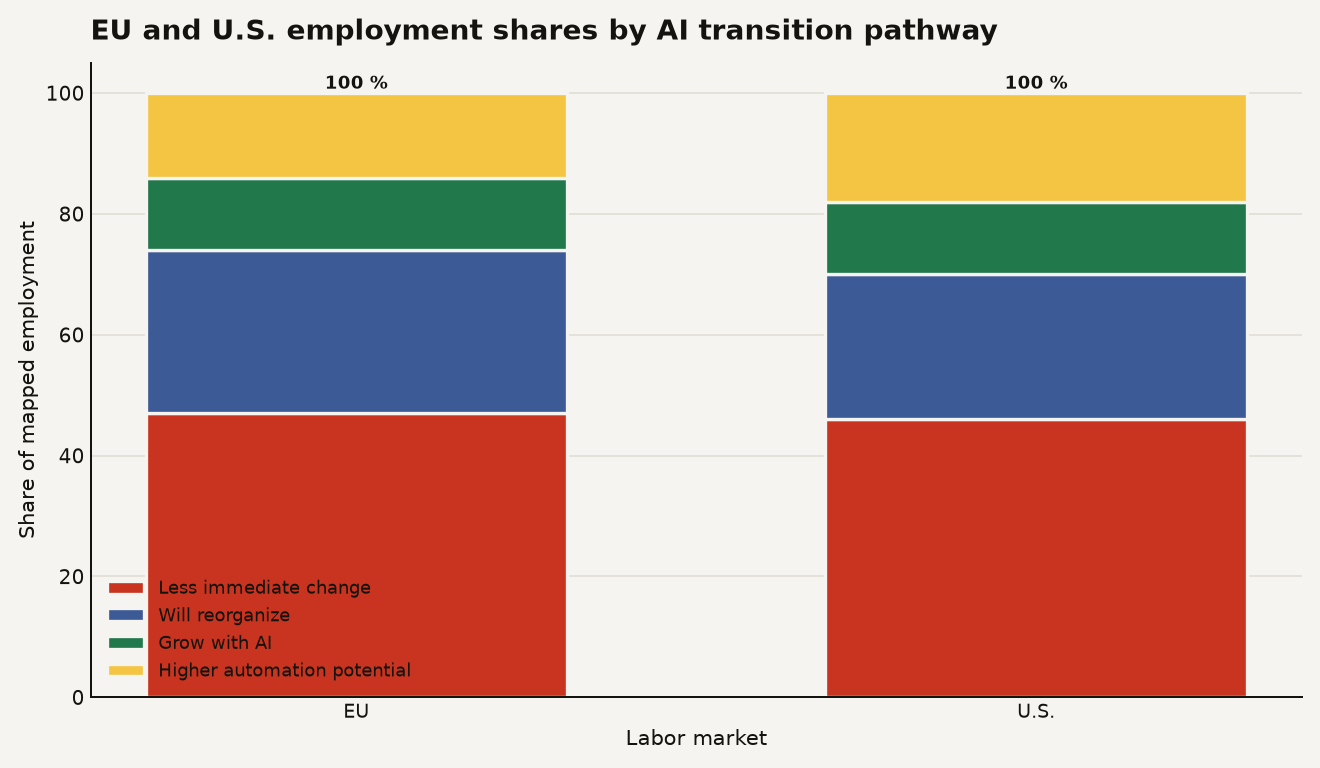
That difference is not a comfort blanket. OpenAI says the EU has more employment in manufacturing, skilled trades, transport, care, education, and public service occupations, where work is often physical, place based, or institutionally constrained. Those jobs can still absorb AI in documentation, scheduling, triage, decision support, translation, procurement, lesson prep, compliance checks, and customer communication. The model sits inside the process instead of replacing the entire process.
The 27 percent redesign bucket is where budgets live
The redesign bucket is where software budgets live. A layoff forecast tells you very little about what to ship next quarter. A reorganization map tells you where buyers will need integrations, audit trails, role based permissions, change management, and training data.
OpenAI says 27 percent of EU employment sits in occupations likely to reorganize, where AI changes tasks and skill needs while people remain central to delivery. That is the same workload shift Data Today called out in agentic AI work moving from chat to delegation: the value moves from a clever prompt to a governed workflow that survives contact with a real organization.
If you build for Europe, the practical consequence is blunt. Your product cannot assume the buyer wants a fully automated job function. Many buyers will want task acceleration under a named human owner. That means the feature checklist shifts:
- Provenance: show what the model used, changed, and ignored.
- Escalation: make it easy to hand uncertain cases to a person.
- Localization: map outputs to national language, labor, and sector rules.
- Role design: separate the person who drafts, approves, audits, and owns the final action.
- Training loops: help teams see which tasks are actually moving, not which ones a demo can impress.
The hidden cost is organizational. A firm can buy AI seats in one week and spend 12 months learning which approval chain should change. That is why a workflow product with dull admin controls can beat a prettier model wrapper. In reorganization work, the moat is the messy path from capability to accountable use.
Country exposure across Europe
The country table is the sharpest part of the report because it refuses to flatten Europe into one labor market. OpenAI says country differences reflect occupational composition rather than national readiness, with less immediate change ranging from 24.9 percent to 58.8 percent across member states and higher automation potential ranging from 8.7 percent to 16.9 percent.
Luxembourg is the extreme case. OpenAI puts Luxembourg at 25 percent less immediate change, 41 percent reorganization, 22 percent grow with AI, and 13 percent higher automation potential. That profile looks like a services economy where AI can make more projects viable while also forcing workflow redesign in professional and digital work.
Germany sits in a different place. OpenAI maps Germany to 44 percent less immediate change, 27 percent reorganization, 12 percent grow with AI, and 17 percent higher automation potential. That 17 percent automation pressure share is the highest rounded country figure in the report, tied with Greece, and it points to a different buyer mood: more scrutiny on labor saving, process control, and worker transition.
Italy combines a large less immediate change share with meaningful pressure. OpenAI puts Italy at 51 percent less immediate change, 24 percent reorganization, 10 percent growth with AI, and 16 percent higher automation potential. For a vendor, that says the AI sale may concentrate in narrower operational pockets rather than broad horizontal transformation.
The demand side is the underused part of the framework. OpenAI estimates that the median European occupation has a price elasticity of about 0.7, meaning a 10 percent price drop raises output by roughly 7 percent under its simplifying assumption. That is enough to create more activity in some services, but weak enough that productivity gains can still reduce labor need in others.
This is where AI hype usually gets lazy. Lower cost creates more work only when buyers can or will buy more. A cheaper renewable energy consulting project can make additional projects financially viable. A cheaper statutory filing may simply clear the same fixed caseload with fewer hours. If your go to market says AI will expand every category, procurement teams will hear the confetti cannon before the business case.
Segment jobs by workflow pressure
Start by segmenting jobs by workflow pressure, not by model capability. OpenAI warns that the framework is a planning map instead of an employment forecast, and that distinction should shape your roadmap. A model that can draft a legal memo does not settle who signs it, stores it, explains it to a regulator, or answers for it in court.
For builders, the EU map suggests three product bets and one trap.
First, build for reorganization. If 27 percent of EU employment is likely to see workflow redesign, the winning products will instrument the before and after state. A Copilot style textbox is a feature. A system of record for who changed the task, what policy applied, and how the exception moved is a product.
Second, price for adoption friction. The St. Louis Fed summary of Bick, Blandin, Deming, Fuchs Schündeln, and Jessen found that 43.0 percent of U.S. workers reported using AI for their jobs in January to February 2026, compared with an average of 32 percent across the surveyed European countries. That gap means European buyers may need onboarding, templates, role design, and security review bundled into the sale instead of treated as services leftovers.
Third, design for institutions. The European Commission says its Apply AI Strategy, last updated on June 3, 2026, includes an AI Observatory to track AI trends and sector impact. If that observatory becomes connected to vacancy, wage, training, and worker flow data, the AI labor story will move from anecdotes to dashboards. Vendors that can emit clean adoption and outcome telemetry will have an easier time in public sector and regulated sales.
The trap is chasing pure automation logos in markets where human necessity dominates. OpenAI classifies 49 percent of ESCO occupation titles as primarily physical for human delivery, 28 percent as regulatory or accountability based, 9 percent as relational, and 14 percent as residual. A product that ignores those anchors will either overpromise or get redesigned by the customer after procurement, which is the expensive version of user research.
Middle indicators before headcount moves
Watch the middle indicators, not just the layoffs. Employment aggregates will move late. The useful early signals are more granular: AI clauses in job ads, training enrollments by occupation, time to complete regulated workflows, exception rates, internal tool telemetry, and wage premiums for people who can supervise AI systems.
OpenAI points toward that monitoring stack directly. Its report argues that Europe should connect occupation, skills, vacancy, wage, training, and worker flow data to AI capability and workplace adoption signals. That is the right instinct, and it is also where the hard product work starts.
For the next 12 months, a serious European AI workforce plan should answer five questions:
- Which job families are in the 14 percent higher automation pressure bucket, and which tasks inside them are already moving?
- Which teams are in the 27 percent reorganization bucket, and which approvals or handoffs slow adoption?
- Which services could see demand expansion if price falls by 10 percent?
- Which workers need basic AI literacy, and which need operator grade supervision skills?
- Which adoption metrics can be shared with workers, auditors, and management without turning the workplace into a surveillance lab?
That last point matters. Europe has a chance to build better labor market instrumentation than the U.S. because its institutions already care about occupations, training systems, and public employment services. It can also smother useful adoption in paperwork if every signal becomes a compliance ceremony. Builders should design for evidence, not paperwork theater.
The map is only useful if you move before the dots do
OpenAI's EU framework is a vendor study, so read it with the usual caution. The company benefits when governments and firms treat AI adoption as inevitable and manageable. Still, the numbers are useful because they push the conversation away from cartoon replacement and toward operating detail.
The big European AI jobs transition is a redesign problem first. If you build tools, sell into enterprises, or run teams, the work starts before layoffs show up in the monthly release. Map the tasks. Name the human owner. Measure the handoff. Price the friction.
The labor market will not wait for your deck to become precise.
Sources
- OpenAI, Mapping Europe’s AI Workforce Opportunity
- OpenAI Economic Research, The AI Jobs Transition Framework for the EU
- European Commission, ESCO homepage
- Cedefop, Employment by detailed occupation
- European Commission, Apply AI Strategy
- Federal Reserve Bank of St. Louis, Mind the Gap: AI Adoption in Europe and the U.S.