AI infrastructure used to sound clean because the dirty parts were hidden: a prompt here, a cloud bill there, a model launch with enough gloss to blind a procurement team. Shelbyville, Indiana, just dragged the whole thing back to earth. The AI data center backlash around a proposed Prologis campus is about whether a 20,000 person city should absorb the land, power, noise, tax policy, and trust burden of a project marketed as the future.
The immediate spark was reported by The Verge: Shelbyville Mayor Scott Furgeson was caught on video saying he saw anti data center signs only in 'shitty houses' and mostly rentals. That line landed because the underlying deal is enormous. The city's draft economic development agreement says Prologis intends to invest about $2 billion in up to 11 data center buildings on roughly 429 acres. It is industrial infrastructure with a cloud logo.
If you build with AI, this fight is your problem too. Your roadmap depends on someone else's substation, someone else's water assumptions, and someone else's council meeting at 10 p.m. Compute is becoming local politics.
Project Hackman and what Shelbyville approved
The cleanest version of the pitch is called Project Hackman. The project site says Prologis would build a multi building data center campus over roughly 10 years, with up to 11 buildings and 330 full time employees at buildout. It also says Prologis would fund 100 percent of required power system upgrades and utility costs, and that the site would use a closed loop, air cooled system with water use comparable to 55 acres of irrigated agricultural land.
The legal paper is more revealing. Shelbyville's economic development agreement with Prologis describes a multi phase data center project with up to 11 buildings, approximately $2 billion in capital investment, and development property that includes about 429 acres. It also commits the company to 25 jobs per building, which means a minimum of 275 jobs if all 11 buildings are constructed.
That job count matters because the number has not been perfectly stable in public materials. The Project Hackman website says 330 full time employees. In Shelbyville Plan Commission minutes from January 7, Prologis data center investment director Mike Kenny is summarized as saying the project would produce 450 full time jobs at buildout, plus 6,700 construction jobs and average salaries above $100,000. The right takeaway is that residents are being asked to bless a project before the public story has settled into a single operating model.
The local process was already contentious before the mayor's video. On January 7, the Plan Commission meeting ran for more than 5 hours. The official minutes record a petition with more than 5,000 signatures opposing the project, 314 homes within 1 mile of the 429 acres, and resident concerns about property values, farmland, power rates, noise, water, and whether the process had moved too fast. The commission's own discussion included frustration that Prologis seemed unprepared to answer some questions.
By April 6, the City Council had moved anyway. Local station Giant FM reported that the council approved annexation, rezoning, and the development agreement by the same 4 to 2 to 1 split, converting nearly 430 acres from agriculture to general industrial use. That is the core governance problem: the project may be legal, lucrative, and still politically fragile.
One city fight reflects a national constraint
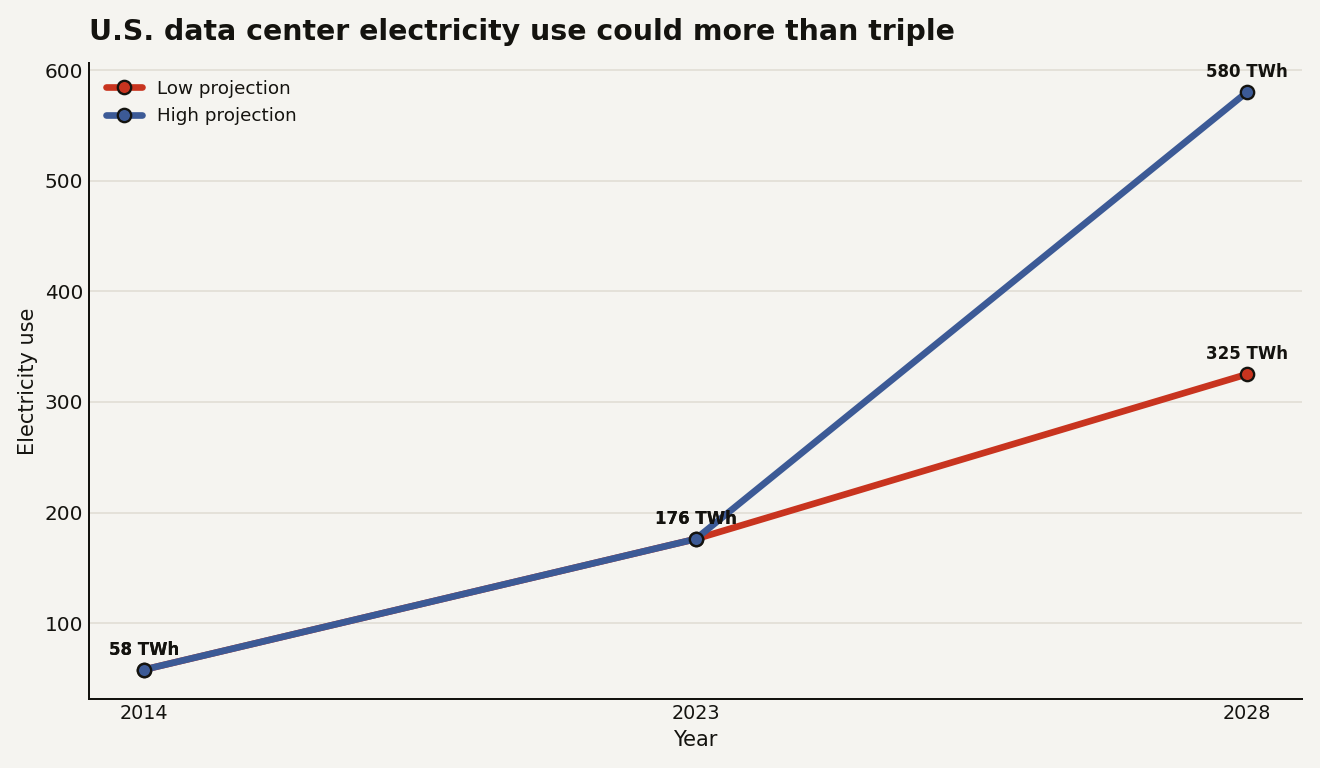
Because Shelbyville is a small example of a national constraint. The Department of Energy, summarizing Lawrence Berkeley National Laboratory's 2024 data center energy report, said U.S. data centers used 176 TWh of electricity in 2023, about 4.4 percent of total U.S. electricity. By 2028, the same report estimates data center use could rise to 325 to 580 TWh, or 6.7 percent to 12 percent of U.S. electricity.
The chart below shows the national demand curve that sits behind the Shelbyville argument. In 2014, U.S. data centers used 58 TWh. In 2023, they used 176 TWh. By 2028, the low case is 325 TWh and the high case is 580 TWh. That is why every local promise about no rate impact now gets parsed like a dependency in production.
The AI industry likes to talk about data centers as generic digital plumbing. The minutes from Shelbyville show why that language fails. A Prologis representative told the Plan Commission that a data center is 'a building with a big computer inside.' That is technically charming and politically inadequate. A 500 MW campus, which Prologis discussed in the January meeting as a possible scale, lands on neighbors as land use, backup generators, road work, utility queues, tax abatements, and the fear that the upside is private while the downside is residential.
This is where AI companies should stop pretending opposition is just NIMBY theater. Some objections will be overstated. Some will confuse backup generators with smokestacks running all day. Some will treat every data center as identical when cooling, water use, grid connection, and load management vary a lot. But the core question is fair: who gets the compute, who gets the bill, and who gets a vote?
Shelbyville's own agreement shows why the question is not abstract. It includes a $25 million initial economic development payment, additional $1 million payments tied to each data center building permit, a 100 percent personal property tax abatement for 30 years, and a 50 percent real property tax abatement for 10 years. Indiana's state program also allows a data center sales tax exemption on qualifying equipment and energy for up to 25 years below $750 million of investment, and up to 50 years above that threshold if awarded by the Indiana Economic Development Corporation.
That is a lot of public policy for a project whose end user may not be known to residents. If the customer is a hyperscaler, a frontier lab, or an enterprise cloud tenant, the town still gets the same civic load. The buyer of compute is often invisible. The neighbor is not.
Compute risk is more than GPU availability
You should treat AI infrastructure risk as more than GPU availability. The old stack question was whether your model fit in memory. The new stack question is whether your supplier's next region survives a planning meeting.
Here is the practical read for founders, product leads, and engineering teams:
- Compute locality is now a product risk. If your roadmap assumes cheap inference from one region or one vendor, watch where that vendor is trying to build capacity. Zoning fights can become price signals months before they become outages.
- Sustainability claims need site level proof. Closed loop cooling, no groundwater, utility funded upgrades, and renewable matching are not interchangeable. Ask for facility specific disclosures, not corporate averages.
- Long term contracts should price civic delay. If a provider promises major capacity in 2027, ask what permits, interconnection studies, transformers, and local approvals remain. A campus that is approved on paper can still be years from useful power.
- Your AI margin may depend on local tax policy. Tax abatements and sales tax exemptions can lower facility economics, but they also create political backlash when residents think they subsidize load without seeing jobs.
There is a hiring angle too. Prologis has talked about hundreds of full time jobs and technical roles with salaries above $100,000. For Shelbyville, those are meaningful numbers. For the AI industry, they are not labor intensive relative to the capital. A $2 billion project with a few hundred permanent jobs will always invite a sharper bargain than a factory employing thousands.
This is also why our earlier reporting on AI's data center power wall keeps aging well. The limiting resource is GPUs, power purchase agreements, transformers, water permits, and public trust all arriving at the same planning counter.
If you are buying AI services, demand better evidence. If you are selling them, stop hiding the industrial footprint behind a cloud abstraction. Your customers may not care where the electrons come from today. Their regulators, insurers, and enterprise procurement teams will.
Lessons for Prologis and other developers
The obvious lesson is not to insult renters. That is the low bar, and apparently we still need it.
The more useful lesson is that community process cannot be bolted on after the deal narrative has hardened. Project Hackman's public site says Prologis has worked with communities for more than 40 years and is committed to being a collaborative partner. Fine. Then collaboration has to look like residents changing the plan, not residents being told the plan more politely.
For a data center campus of this size, developers should publish a plain English local impact packet before asking for rezoning. Not a glossy deck. A real packet with:
- maximum campus power demand in MW, plus ramp timing by year
- who pays for transmission, distribution, substation, and backup generation costs
- expected annual water withdrawal and consumption, even when cooling is air based
- noise modeling at the nearest homes, beyond the property line
- diesel generator count, testing schedule, and emissions permits
- tax abatement value by year, alongside community benefit totals
- binding job commitments with clawbacks that normal residents can understand
Shelbyville's agreement has clawback language for abatements if the company fails to substantially comply with obligations. That is good as far as it goes. But trust is built by making the trade legible before the vote.
Public officials need a different playbook too. A town can support growth and still say no to a bad process. The mayor's office reportedly said Furgeson regretted that his choice of words may have caused offense. That construction misses the point. The damage was confirmation bias with a microphone: opponents heard that their status as renters or working class residents made their objections easier to dismiss.
For AI companies, this is the reputational part of the supply chain. You may never attend a Shelbyville council meeting, but your model might run on a server in a town like it. If the local story becomes extraction, your brand inherits that smell.
Shelbyville will not decide the buildout alone
Shelbyville will not decide the national AI buildout by itself. The U.S. could still add a huge amount of capacity by 2028, especially in places with friendly state policy, available transmission, and officials eager for tax base. But the Shelbyville fight shows how quickly a project can move from economic development story to legitimacy problem.
The underrated signal is the combination of 5,000 opposition signatures, 314 nearby homes, 429 acres, 11 possible buildings, 30 years of personal property tax abatement, and a national power curve headed toward 325 to 580 TWh. Those numbers tell builders what the next phase of AI competition looks like.
The winners will not be the companies that shout loudest about capacity. They will be the ones that can secure power, disclose impacts, keep local officials from freelancing class warfare, and make host communities believe the bargain is real.
Compute is physical. So is resentment.
Sources
- The Verge: The mayor of Shelbyville, Indiana, says only people who live in 'shitty houses' oppose data center
- City of Shelbyville: Economic development agreement with Prologis
- Project Hackman: Shelbyville project overview
- City of Shelbyville: January 7, 2026 Plan Commission minutes
- Giant FM: Shelbyville Common Council approves annexation and rezoning
- U.S. Department of Energy: Report evaluating electricity demand from data centers
- Lawrence Berkeley National Laboratory: 2024 United States Data Center Energy Usage Report
- Indiana Economic Development Corporation: Data Center Sales Tax Exemption
- U.S. Census Bureau: Shelbyville city, Indiana QuickFacts