AI builders are learning a boring infrastructure lesson at very high speed: power that exists on paper is not the same as power you can plug into a campus in 2027. Google's new deal with Voltus puts a sharper shape on the workaround. Instead of waiting only for new plants, substations, and transmission lines, Google is funding virtual power plants, or networks of flexible devices that can reduce demand when the grid is tight. The key number is 100 megawatts in PJM, the largest US grid region.
It is enough to show where the bottleneck is moving.
A virtual power plant is a software coordinated bundle of distributed energy resources: batteries, smart thermostats, EV chargers, commercial loads, and other assets that can either push power back or avoid pulling it for a limited period. Google and Voltus are trying to turn that flexibility into capacity that supports data center growth. If you build or buy AI infrastructure, this matters because the next constraint on your roadmap may be less about GPUs and more about whether a grid operator believes your megawatts will behave.
This is the same power wall we covered in the gigawatt build out behind AI infrastructure, but with a twist. The new race is who can make demand flexible enough to get permission to connect.
Google and Voltus's three-year agreement
Google and Voltus announced a three year agreement on June 2, 2026, to create up to 100 megawatts of flexible distributed capacity in the PJM grid region. Google said the agreement will use resources such as batteries and smart thermostats, with Voltus paying participating homes and businesses when their flexibility is used by the grid through the new Google and Voltus agreement.
Voltus frames this as its Bring Your Own Capacity product. The mechanics are simple enough: a large electricity customer funds a local virtual power plant, Voltus aggregates flexible devices, and that pool can reduce load or dispatch stored energy during grid stress. In its own announcement, Voltus said the Google funded VPP will aggregate up to 100 megawatts of distributed energy resources each year in PJM and pay the customers who participate through the company's June 2026 release.
The phrase "bring your own capacity" sounds like a cloud pricing SKU wandered into utility regulation. But the idea is serious. Data center developers increasingly face interconnection queues, local opposition, equipment delays, and utility concern that a large customer will request hundreds of megawatts and then leave everyone else holding the bill if the project slips.
The chart below puts the scale in context. Texas's large load law uses 75 megawatts as the default threshold for special interconnection standards. Google's first named Voltus deal is 100 megawatts. Duke researchers estimate that roughly 100,000 megawatts of large new load could be integrated nationally if it can be curtailed for small slices of the year.
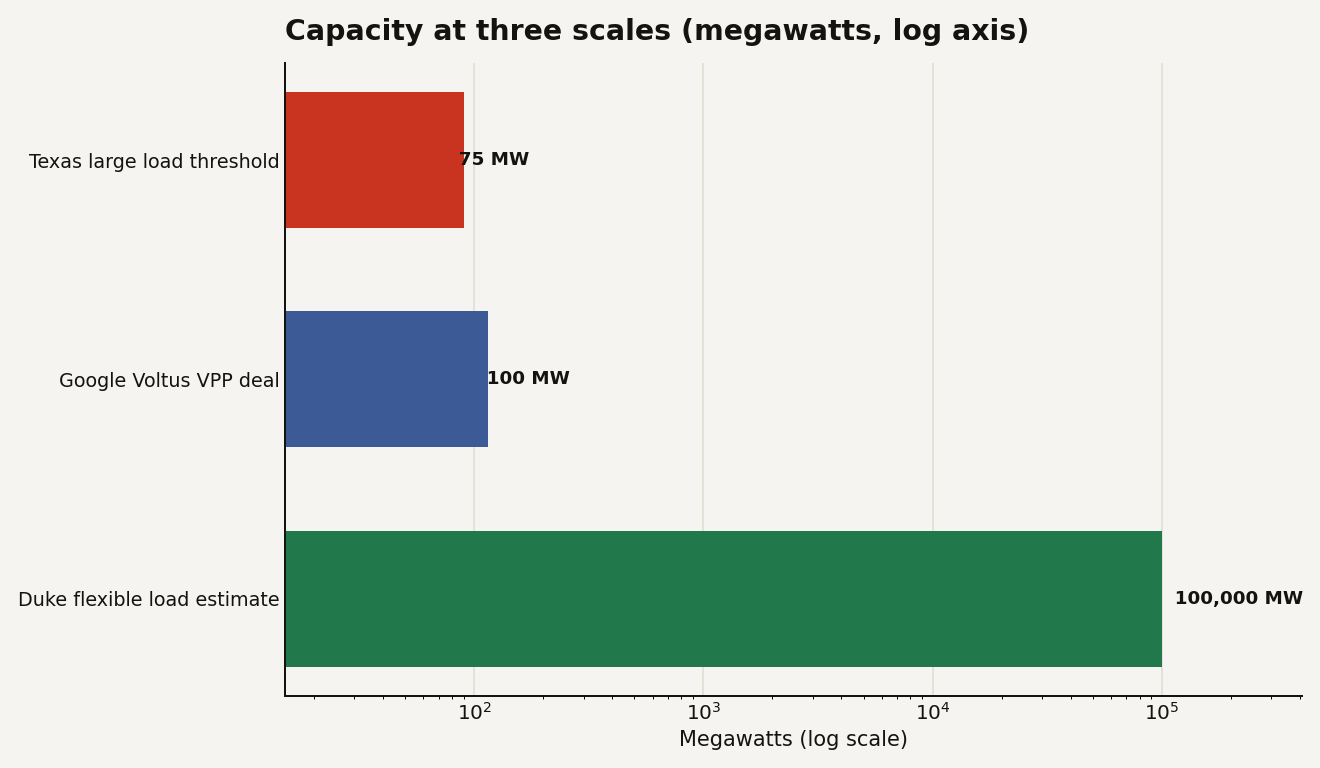
The gap is the story. Google is buying a proof point.
Data centers' own flexibility has limits
Because their own flexibility has limits.
The power grid is built for peak demand, not average demand. The expensive hour is the hot summer evening when air conditioners, industrial equipment, household appliances, and commercial load all pile onto the system. A data center that can avoid adding demand during those few hours is easier to connect than one that insists on full firm service every minute of the year.
Duke University's Nicholas Institute published a 2025 study arguing that the US grid could integrate nearly 100 gigawatts of large new load with minimal impact if those loads accepted modest curtailment during tight periods through its Rethinking Load Growth report page. For context, 100 gigawatts equals 100,000 megawatts, or about 1,000 Google Voltus sized deals.
That does not mean 100 gigawatts of AI campuses can appear tomorrow. It means the grid has hidden capacity if loads can be controlled, measured, and trusted. That trust is the hard part.
The International Energy Agency estimates that global data center electricity consumption will more than double to about 945 terawatt hours by 2030, with US data centers accounting for nearly half of US electricity demand growth through the end of the decade, according to the IEA's Energy and AI report. In the United States, that load is not spread evenly like peanut butter. It concentrates in places with fiber, land, tax deals, water access, and existing power infrastructure.
PJM is exactly the kind of region where this pressure shows up. Google says PJM serves 67 million people, and Voltus calls it the largest grid operator in the United States. PJM's own 2026 load forecast supplement repeatedly identifies utility requests to account for data center growth across zones including APS, ATSI, BGE, COMED, Dayton, Dominion, PEPCO, and others through its 2026 load forecast supplement.
So why pay households and businesses instead of only flexing the data center? Because the AI workload stack is splitting into two energy personalities.
Training, batch inference, analytics, indexing, and low priority jobs can move in time or place. Customer facing inference, storage, networking, and latency sensitive applications are harder to pause. Google has worked on demand response for its own data centers, but even hyperscalers know there is only so much elastic compute inside a facility that customers expect to stay up.
The business response is obvious: if your own load is not flexible enough, buy flexibility around it.
The grid is closer than it looks
If you are a founder, CTO, or product lead, the grid may feel far away from your backlog. Power constraints already shape cloud regions, GPU availability, inference pricing, model placement, and enterprise procurement risk. A 100 megawatt VPP deal in PJM can seem like utility plumbing until your preferred region cannot add the cluster your roadmap assumes.
Here is the practical read.
- Capacity will become a product feature. Cloud vendors will sell chips, networking, and evidence that new capacity can actually interconnect on schedule.
- Flexible workloads will get better economics. If your jobs can tolerate a 2 hour delay, a regional move, or batch scheduling, you should expect lower long run costs than workloads that demand firm power every minute.
- Reliability language will get more precise. "Always on" will remain the default for production paths, but training runs, offline agents, synthetic data jobs, and evaluation pipelines should be tagged by interruptibility.
- Energy posture will affect procurement. Enterprise customers will ask where model serving happens, what happens during grid events, and whether AI capacity is pushing costs onto local ratepayers.
This is not a call to wire your application directly to a thermostat fleet. It is a call to treat compute as a constrained physical resource again. The cloud abstracted away that feeling for a decade. AI brought it back with a utility bill.
The sharpest software consequence is scheduling. If you run your own infrastructure, you should already know which workloads are deferrable, which can checkpoint cleanly, and which can shift regions without violating data residency or latency requirements. If you buy cloud, ask vendors how they classify interruptible AI workloads and whether energy events can affect capacity commitments.
The moat consequence is also clear. Teams that design for flexible compute will have more room to negotiate. Teams that hard code every workload as urgent will pay the firm power tax, even if that tax shows up as GPU scarcity rather than a line item called electricity.
Sign-up is the weak joint
This is the weak joint in the story.
Virtual power plants work beautifully in slide decks because the assets are already there: EVs parked in garages, thermostats on walls, batteries in homes, chillers in commercial buildings. The economic problem is getting enough people to say yes, keep saying yes, and not override the system precisely when the grid needs it.
A recent managed EV charging study is a useful warning label. Researchers studying a Peninsula Clean Energy program in California found that when EV owners were offered no incentive, only 1.0 percent enrolled in managed charging. Even at $40 per month, about 15 percent of the total monthly electricity bill, only 4.6 percent enrolled, according to the working paper If You Build It, They May Not Come.
That was EV charging in San Mateo County, not a Voltus VPP in PJM. The programs differ. The customer base differs. The payout could differ. Still, the behavioral lesson travels well: control is valuable, and people often price it higher than program designers expect.
Now add AI politics. Gallup reported on May 13, 2026, that 71 percent of US adults oppose construction of AI data centers in their local area, including 48 percent who strongly oppose them, based on its March 2 to March 18 survey of 1,000 adults through its data center polling report. Gallup also found 53 percent opposition to local nuclear plant construction in the same survey, which means AI data centers are, at least in this poll, less locally welcome than nuclear plants.
That is a brutal backdrop for a program that asks residents to help data centers connect faster.
The messaging challenge is not impossible. A VPP can pay local participants, reduce peak stress, and avoid some expensive grid buildout. But if the public reads it as "turn down your thermostat so a hyperscaler can run more GPUs," enrollment will be harder than the spreadsheet says.
For Google and Voltus, the compensation level is the missing variable. Neither announcement discloses how much participants will be paid. Without that number, nobody can judge whether this is a scalable capacity product or an elegant pilot that depends on unusually willing customers.
Texas turns flexibility into a requirement
Texas is already turning flexibility from a nice idea into an interconnection condition.
Senate Bill 6, enacted in 2025, requires large load interconnection standards in ERCOT. The enrolled bill sets a default large load threshold of 75 megawatts, requires certain customers to disclose backup generation, defines on site backup generation as able to serve at least 50 percent of on site demand, and allows ERCOT related procedures to require backup generation or load curtailment during energy emergency conditions through the enrolled Texas SB 6 text.
That is the stick version of the Google Voltus carrot.
The market version says: pay for flexibility and maybe connect sooner. The regulatory version says: if you are a huge load, you may be required to prove you will not worsen an emergency. Either way, the old assumption that data centers are sacred, flat, always firm load is cracking.
This matters for site selection. A data center campus that brings flexible demand, backup capability, storage, or a funded VPP may look less risky to a utility than a campus that only brings a purchase order and a press release. In a constrained region, that difference can decide whether a project gets power in 2027 or sits in queue purgatory.
It also matters for accounting. If a hyperscaler funds a VPP, who gets credit for the capacity? The data center? The utility? The customers whose devices actually respond? Those details decide whether the product scales across markets or gets trapped in bespoke bilateral deals.
Software people know this pattern. A hack becomes a platform only when the interfaces stop changing every time.
Learn grid economics before the bill does
Do not wait for your cloud bill to teach you grid economics. The useful move is to make workload flexibility visible inside your own stack now.
Start with a simple classification:
| Workload type | Flexibility posture | What to change now |
|---|---|---|
| Production inference | Usually firm | Measure latency budgets by region and model size |
| Batch inference | Often shiftable | Add queues, deadlines, and checkpointing |
| Training runs | Sometimes shiftable | Design resumable jobs and regional fallbacks |
| Evaluation suites | Highly shiftable | Run on cheaper windows where possible |
| Data processing | Highly shiftable | Separate freshness requirements from habit |
The point is to avoid pretending every workload deserves the same power quality.
Ask vendors three questions in 2026 procurement cycles. First, where is the capacity physically constrained? Second, which AI services can be interrupted, shifted, or deprioritized during grid events? Third, how does the vendor prevent data center growth costs from landing on local households and becoming a political blocker?
Those questions sound unusual today. They will sound normal once more regions copy the Texas posture or once PJM capacity debates start showing up in enterprise risk memos.
Google's Voltus deal is early, modest, and worth taking seriously. 100 megawatts is small beside AI's coming demand, but it is big enough to test whether paid flexibility can become part of the data center permitting and interconnection playbook.
The builders who win this phase will not be the ones who pretend electricity is someone else's problem. They will be the ones who make compute interruptibility, location, and power risk part of the architecture.
The grid is becoming part of the stack
AI infrastructure used to be summarized in chips, memory, networking, and models. Add flexible megawatts to the list.
The next platform advantage may be the ability to say, credibly and with receipts, that your workloads can back off when the grid asks. It is just what shipping looks like when the bottleneck is outside the data center fence.
Sources
- Google: Google and Voltus sign agreement for smart energy capacity
- Voltus: Voltus and Google to Deliver Grid Capacity and Local Economic Benefits Through Bring Your Own Capacity Agreement
- Duke Nicholas Institute: Rethinking Load Growth
- PJM: 2026 Long Term Load Forecast Supplement
- International Energy Agency: Energy and AI executive summary
- Energy Institute at Haas: If You Build It, They May Not Come
- Gallup: Americans Oppose AI Data Centers in Their Area
- Texas Legislature via LegiScan: Texas SB 6 enrolled text