This is the full research report behind the video: every number, source, and chart the script was written from.
A research report on the great AI reckoning of 2026
Finance Research Team July 21, 2026 Report No. 2026-07-21-AI
Executive summary
Microsoft has lost roughly $1.1 trillion in market value from its 52-week high of $555.45, set in early 2026, to its July 20 close of $402.29. The stock is down 16.8% year-to-date and 21.1% over the past twelve months. This is not an isolated event. The VanEck Semiconductor ETF (SMH) has fallen more than 17% in July alone. The Philadelphia Semiconductor Index is down nearly 19% from its all-time high. The Magnificent Seven collectively shed $2.2 trillion in a single rotation that began in late June, according to the Financial Times. Apple has overtaken Nvidia as the world's most valuable company, a shift the Guardian described as evidence that "investors are reassessing the outlook for artificial intelligence."
The proximate trigger was the July 17 release of Kimi K3, a model from Chinese startup Moonshot AI that reportedly matches the performance of leading systems from OpenAI and Anthropic. That single product launch crystallized a fear that had been building for months: that the hundreds of billions being poured into AI infrastructure might not produce a durable competitive moat. The Bank for International Settlements warned in late June that AI "exuberance" risks ending in a "lengthy investment bust." Companies including Amazon, Walmart, and Uber have already started capping or discouraging AI usage internally because the costs are straining budgets, the FT reported on June 19. DoorDash, Siemens, and Airbnb are turning to cheaper Chinese AI models to cut bills.
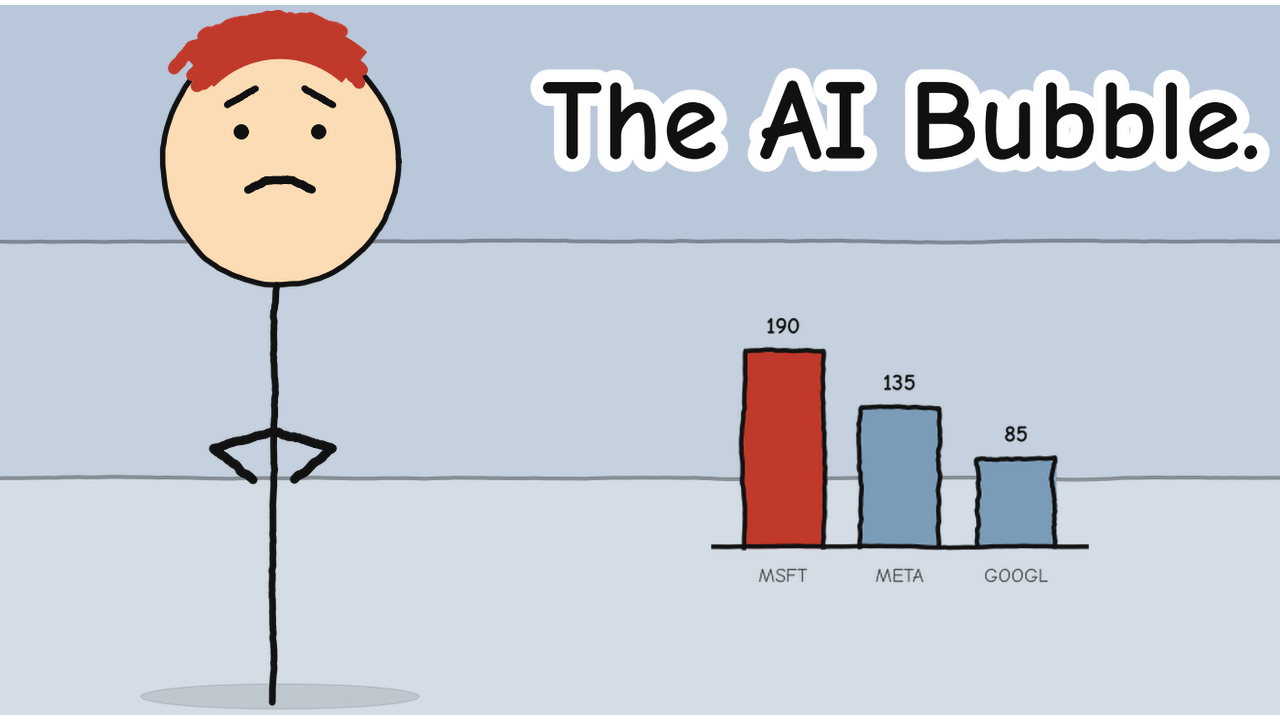
The numbers are staggering. Microsoft alone has forecast $190 billion in capital expenditure for 2026. Meta raised its capex guidance to $125-145 billion. Alphabet sold $85 billion in new stock to fund its AI build-out. Oracle committed $70 billion to data center construction. Combined, Big Tech's AI spending spree totals roughly $725 billion this year, sending free cash flow across the sector to a decade low. The Financial Times described the transformation bluntly: "Big Tech no longer prints money; it needs it."
The historical parallel is the dot-com telecom overbuild of 1996-2002, when companies spent roughly $1 trillion laying fiber-optic cable across the United States, only for roughly 95% of that fiber to sit dark when the bubble burst. Global Crossing, WorldCom, and dozens of other telecom companies went bankrupt. The Nasdaq fell 78% from its peak. The question now is whether the AI data center boom follows the same arc.
Key findings
- Microsoft's market capitalization has fallen approximately $1.1 trillion from its 52-week high, from roughly $4.13 trillion to $2.99 trillion as of July 20, 2026.
- The stock peaked at $481.63 on January 28, 2026 (within the 6-month window), then troughed at $352.83 on June 25, a 26.7% decline, before partially recovering to $402.29.
- Big Tech companies are collectively spending approximately $725 billion on AI infrastructure in 2026, with Microsoft ($190B), Meta ($135B), Alphabet ($85B), and Oracle ($70B) leading the charge.
- The semiconductor sector has been hammered: the SMH ETF is down more than 17% in July 2026, with its third weekly decline in four weeks ending July 17.
- Chinese AI models like Moonshot's Kimi K3 are matching US frontier model performance at a fraction of the cost, threatening the return on massive infrastructure investments.
- The Bank for International Settlements warned in June 2026 that AI "exuberance" risks a "lengthy investment bust" that could threaten the global economy.
- Companies are already pulling back on AI spending: Amazon, Walmart, and Uber have introduced caps on AI usage; DoorDash, Siemens, and Airbnb are switching to cheaper Chinese alternatives.
- Microsoft announced 4,800 job cuts in its Xbox gaming unit on July 7, 2026, as the company redirects resources toward AI infrastructure.
- Warren Buffett told CNBC on July 15 that "it's tough to find values when everybody is preferring gambling," and Jamie Dimon said markets are underestimating risks.
- The FT reported on July 6 that "the real difference between today's market boom and the late 1990s lies in capital expenditure," drawing a direct parallel to the dot-com bubble.
Chapter 1: Your money, their gamble
If you have a 401(k), there is a very good chance you own Microsoft. Not because you chose it, but because you probably own a target-date fund or an S&P 500 index fund, and Microsoft is one of the largest holdings in both. As of July 2026, Microsoft's market capitalization is about $2.99 trillion. That makes it roughly 4% of the entire S&P 500 by weight. If you have $100,000 in a standard S&P 500 index fund, about $4,000 of that is Microsoft stock. When Microsoft falls 21% in a year, your retirement account feels it.
The same is true for Nvidia, Alphabet, Meta, and Amazon. Together these five companies account for roughly 20-25% of the S&P 500's total value. When they all decline at once, as they did in July 2026, your index fund goes down whether you like it or not. The Magnificent Seven (these five plus Apple and Tesla) collectively shed $2.2 trillion in value during a rotation that began in late June, the Financial Times reported on June 30. That is roughly $6,600 for every person in the United States, vaporized from retirement accounts, pension funds, and college savings plans in a matter of weeks.
Here is the part that should make you uncomfortable: the companies doing the losing are also the ones doing the spending. Microsoft has forecast $190 billion in capital expenditure for 2026, a number that its own executives said would "continue to rise" through the second half of the year, according to the FT's live blog on April 29. Meta raised its capex guidance to a range of $125 billion to $145 billion. Alphabet sold $85 billion in new stock, its first equity raise in more than two decades, to fund AI infrastructure. Oracle committed $70 billion to data center construction. These are not small bets. They are wagers so large that the FT's Robert Armstrong wrote that "Big Tech no longer prints money; it needs it."
Where is the money coming from? Partly from you. When Alphabet sells $85 billion in new shares, someone buys those shares. Often that someone is a mutual fund, a pension fund, or an ETF provider, which means the money ultimately comes from ordinary investors' paychecks and retirement contributions. When Microsoft spends $190 billion on data centers, it is spending money that would otherwise have been returned to shareholders as dividends or buybacks. Microsoft announced 4,800 job cuts in its Xbox gaming unit on July 7, the FT reported, as it redirects resources toward AI. The workers who lost those jobs are paying for the AI arms race with their livelihoods.
The spending is also showing up in your grocery bill and your electric bill, though indirectly. Data centers consume enormous amounts of electricity. The FT reported on July 9 that surging data center power demands are "intensifying pressure on transformer supply chains," citing a "century-old device choking the world's AI push." When data centers compete with homes and factories for power, electricity prices rise. When the companies building those data centers raise prices on their own products to cover the cost, as Apple has done, consumers pay more.
Meanwhile, the CNBC All-America Economic Survey released on July 17 found that 61% of the public is pessimistic about the economy, the highest reading since December 2023. Only 25% are optimistic. The survey's margin of error is plus or minus 3.1%. Consumer sentiment improved in July to 54.4, up nearly 10% from June, according to the University of Michigan survey, but that is still down 11.8% from a year ago. People feel worse off, and the stock market, which is supposed to be a forward-looking indicator, is telling them they are right to worry.
The simplest way to understand what is happening: the largest companies in America are pouring hundreds of billions of dollars into a technology that, so far, generates very little revenue. They are funding this spending by cutting workers, raising prices, issuing stock, and taking on debt. Investors are starting to ask whether the bet will pay off. In July 2026, a growing number of them decided the answer is probably no, and they sold.
Chapter 2: Ghosts of 2000
In 1996, the United States had roughly 200,000 miles of fiber-optic cable buried underground. By 2001, it had more than 11 million miles. Telecom companies, drunk on the promise of the internet, spent roughly $1 trillion in five years laying glass strands across the country. The logic seemed airtight: internet traffic was doubling every 100 days, and someone had to build the pipes. Companies like Global Crossing, WorldCom, Qwest, and Level 3 Communications raised tens of billions in debt and equity to lay fiber, build switching stations, and light up the network.
The problem was that everyone had the same idea at the same time. By 2001, the market was oversupplied. Only about 5% of the fiber that had been laid was actually carrying traffic. The other 95% sat in the ground, dark and useless. The Financial Times, writing about the UK telecoms sector in May 2026, described the dynamic with characteristic precision: "a splurge of money can destroy shareholder value but deliver consumer gains." That is exactly what happened. Consumers got cheap broadband. Shareholders got wiped out.
Global Crossing, which had a market capitalization of $40 billion at its peak, filed for bankruptcy in January 2002. It was the fourth-largest bankruptcy in US history at the time. WorldCom, which had a market cap of $180 billion, filed in July 2002, the largest bankruptcy ever. Its CEO, Bernie Ebbers, went to prison for 25 years for accounting fraud. Qwest Communications lost 95% of its value. Level 3 survived, barely, after its founder Walter Scott personally injected cash. The telecom sector shed more than 500,000 jobs. The Nasdaq Composite, which peaked at 5,048 on March 10, 2000, fell 78% to 1,114 by October 9, 2002. It took 15 years to recover.
The parallels to today are not subtle. The FT published an article on July 6, 2026, titled "Investors must be wary of the earnings bubble," which argued that "the real difference between today's market boom and the late 1990s lies in capital expenditure." In the dot-com era, the overinvestment was in fiber-optic cable. Today it is in GPU clusters, data centers, and the power infrastructure to run them. The scale is comparable: $1 trillion in telecom spending over five years then, versus $725 billion in Big Tech AI spending in a single year now, with Meta alone planning a $600 billion infrastructure push over the coming years.
There are also differences, and they matter. The companies spending the money today are not debt-laden startups. Microsoft has $78 billion in cash on its balance sheet and generates $37 billion in annual free cash flow. Nvidia has $53 billion in cash and a 63% profit margin. Alphabet has $127 billion in cash. These are the most profitable companies in the history of capitalism, and they can absorb losses that would have killed Global Crossing in a week. The FT noted on June 12 that "the current stock market boom, with its heavy concentration in companies exposed to AI and data centres, has drawn comparisons to the last years of the dot-com era," but the concentration of spending among cash-rich giants is a meaningful departure from the fragmented telecom boom.
The demand side is also different. In 1999, internet usage was real but the revenue model was not. Pets.com had no way to make money shipping dog food. Today, AI has actual paying customers. Microsoft's Azure cloud business grew 40% year over year in the first quarter of 2026, driven by AI usage. Nvidia's revenue was $253 billion on a trailing basis, with $160 billion in net income. These are not trivial numbers. The technology works, and companies are paying for it.
But the FT's May 20 analysis, titled "The impossible maths of the AI boom," identified the core problem: the spending is running far ahead of the revenue. OpenAI spent $34 billion last year and is planning an IPO. The FT described the coming wave of AI company public offerings as "probably nothing more than a transfer of investment risk to retail investors." The Bank for International Settlements, the central bank for central banks, warned on June 28 that AI "exuberance" risks ending in a "lengthy investment bust" that could threaten the global economy, because "weak returns could trigger sharp pullback in funding."
The dot-com parallel that cuts deepest is this: in 2000, the technology was real, the demand was real, but the investment was too much, too fast, by too many competitors, and the revenue could not keep up. The fiber was eventually used, years later, by different companies than the ones that laid it. The investors who paid for it got nothing. The AI infrastructure being built today may well be used someday, by someone. The question is whether the companies building it will be the ones to profit, and whether the investors funding it will still be holding the bag when the revenue finally arrives.
Chapter 3: The great AI spending spree
To understand how we arrived at a $725 billion annual spending binge, you have to understand the incentive structure. Each of the major players is trapped in a game theory problem that economists call a prisoner's dilemma. If all of them stop spending, they all save money. But if one stops and the others keep going, the one who stopped falls behind in the AI race and loses everything. So they all keep spending, even as the returns diminish, because the cost of dropping out is higher than the cost of continuing.
Microsoft went first. The company invested $13 billion in OpenAI in 2019, a bet that looked eccentric at the time and genius by 2023. When ChatGPT launched in November 2022 and became the fastest-growing consumer application in history, Microsoft's early investment gave it a head start that competitors spent the next three years trying to close. By April 2026, Microsoft's Azure cloud business was growing 40% year on year, and executives were telling investors that capital expenditure would reach $190 billion by December. The FT reported on July 9 that "Microsoft's early AI lead has become a test of faith," noting that "the only certainty is that capital spending is going through the roof."
Alphabet responded by going to the equity market. In June 2026, Google's parent company announced it would sell $80 billion in new stock, its first equity raise in more than two decades. The offering was upsized to $85 billion after strong demand, and included a $10 billion private placement to Berkshire Hathaway, of all buyers. The FT described the move as "a good example of how artificial intelligence has made big numbers all but meaningless." Alphabet is also tapping foreign debt markets at an unprecedented rate, the FT reported on May 15, as it races to finance data center construction.
Meta's approach is the most aggressive. Mark Zuckerberg's company raised its 2026 capex guidance to a range of $125 billion to $145 billion, and the FT reported on June 18 that Meta is exploring a $600 billion infrastructure push over the coming years. To finance this, Meta hired Dina Powell McCormick, a former Goldman Sachs executive, to open doors on Wall Street. The company is even considering launching a cloud computing business, a remarkable pivot for a social media company. On July 17, the New York Times reported that Meta is in talks to lease compute power to Anthropic, a deal that could be worth up to $10 billion. Meta is becoming an infrastructure provider.
Oracle, the quietest of the hyperscalers, committed $70 billion to data center construction. But the costs are already biting. The FT reported on July 20 that Oracle could face a $7 billion collateral bill for its Wisconsin data center, as increased power costs add to the challenges facing the company's AI ambitions amid high spending and mounting debt. Oracle's shares slid after it issued flat revenue guidance alongside the spending announcement on June 10.
The financing of all this is a story in itself. Morgan Stanley has emerged as "the chief architect of financing structures behind the build-out of data centres," the FT reported on July 20. The bank is arranging debt deals, equity raises, and complex financing structures to funnel capital into AI infrastructure. The FT noted that "US tech giants are tapping markets as they race to build AI data centres," and that Big Tech is "dominating bond markets too." The Bank of England has reportedly flagged AI bonds as a systemic risk, with the FT writing about "The BoE vs AI exuberance" and noting that "AI bonds are the new gilts."
The free cash flow numbers tell the story most clearly. The FT reported on May 8 that "Big Tech's $725bn AI spending spree sends free cash flow to a decade low." The article noted that "Silicon Valley giants have transformed from asset-light cash machines to huge infrastructure investors." A decade ago, these companies were famous for their ability to generate cash with minimal capital investment. Apple, Microsoft, and Google were the ultimate asset-light businesses, with profit margins that seemed to defy gravity. Now they are pouring money into concrete, steel, cooling systems, and GPU clusters, transforming themselves into capital-intensive infrastructure companies. The market has noticed.
The spending is not limited to the big five. TSMC, the Taiwanese chip manufacturer that makes most of the world's advanced semiconductors, raised its 2026 capital expenditure guidance to between $60 billion and $64 billion, up from a prior range of $52 billion to $56 billion, CNBC reported on July 16. The company also announced an additional $100 billion investment in its Arizona facilities. SK Hynix, the South Korean memory chip maker, listed on the Nasdaq in July 2026. Micron Technology crossed $1 trillion in market value in May. The entire semiconductor supply chain is expanding capacity at breakneck speed to feed the AI build-out.
Nobody knows if the revenue will come. That is the whole problem. The FT's June 13 analysis, "AI is revolutionising the stock market," put it bluntly: "Big Tech no longer prints money; it needs it. What will that mean when confidence dips?" We are finding out.
Chapter 4: The cracks appear
The sell-off accelerated on July 17, 2026, when a Chinese startup called Moonshot AI unveiled a model called Kimi K3. The company claimed it performs on par with leading systems from OpenAI and Anthropic. CNBC reported that the debut "narrowed the gap between US and China on frontier AI," and the market reaction was immediate and brutal. The VanEck Semiconductor ETF fell more than 4% that day, extending its weekly loss to nearly 9%. Applied Materials, Lam Research, Intel, KLA, and Arm Holdings each dropped about 4%. Micron and Nvidia fell more than 2%. SK Hynix, which had just listed on the Nasdaq earlier in July, slid more than 13%.
The fear was simple: if a Chinese startup can match the performance of models built on hundreds of billions of dollars of American infrastructure, then what exactly did that infrastructure buy? Angelo Kourkafas, a senior investment strategist at Edward Jones, told CNBC that the Moonshot launch "raised fresh concerns about the heavy pace of technology spending." He added: "We are seeing signs of fatigue, with end-user demand for AI becoming more price sensitive and the market starting to penalize companies that are ramping spending too aggressively." His framing was measured: he viewed the volatility as a signal that the AI theme is likely maturing rather than breaking, which he described as a healthy part of how major investment cycles evolve.
Others were less diplomatic. The FT reported on July 13 that companies including DoorDash, Siemens, and Airbnb are already "turning to Chinese AI models to cut costs," seeking to "curb ballooning bills and reduce reliance on US technology." Four days earlier, the FT had published a story headlined "'We created a monster': companies rein in AI usage as costs strain budgets," reporting that Amazon, Walmart, and Uber, among early adopters, "have introduced caps or discouraged wasteful activity." The article detailed how businesses are facing "budget-busting AI bills" as a shift to usage-based pricing makes companies rethink spending. Google even capped Meta's use of its Gemini AI models because demand was straining capacity, the FT reported on June 28.
The semiconductor crash was building before Kimi K3. On July 16, CNBC reported that the SMH ETF slid almost 4% after TSMC raised its spending forecast, which "overshadowed a better-than-expected second-quarter report." The logic was perverse: TSMC's earnings were good, but its decision to spend even more money on capacity expansion spooked investors who were already questioning whether the AI infrastructure build-out was overshooting demand. The same day, Alphabet dropped more than 4% after Bloomberg reported that its Gemini 3.5 Pro model was "months behind schedule." The model, announced at Google I/O in May, was delayed as Alphabet worked to improve its performance.
Nvidia's own CEO, Jensen Huang, contributed to the unease. On July 16, CNBC reported that Huang predicted computing costs would rise from around $50 billion toward $100 billion per gigawatt. Seaport, an equity research firm, called this a "deep contradiction in Nvidia's business model." Analyst Jay Goldberg wrote that the cost increase "implies Nvidia is raising prices" and that the company would need to increase support to smaller data center customers, called neoclouds, so they could afford Nvidia's products. If the customers cannot afford the product, the product does not sell.
The broader market held up better than tech, but only barely. For the week ending July 17, the S&P 500 fell 1.6%, the Nasdaq slid 2.9%, and the Dow dropped 0.9%. The SMH posted its third weekly decline in four weeks. The Philadelphia Semiconductor Index was down nearly 19% from its all-time high, according to the Guardian. South Korea's Kospi plunged 6.4% on July 16, slipping into a bear market, after the Bank of Korea raised interest rates. The South Korean government announced it would stop approving new single-stock ETFs that use borrowing to amplify returns, tied to Samsung and SK Hynix, citing market volatility.
The rotation was visible in unexpected places. Berkshire Hathaway climbed more than 1% on July 17 as investors sought the "relative safety of Berkshire's diversified portfolio of insurance, energy, railroad and industrial businesses," CNBC reported. Barron's estimated that Berkshire may have bought back between $5 billion and $11 billion of its own stock in the second quarter. Warren Buffett, speaking to CNBC on July 15, was blunt about the broader market: "It's tough to find values when everybody is preferring gambling." Jamie Dimon, CEO of JPMorgan, was quoted on CNBC's trending list saying that "markets underestimate risks" and that he "wouldn't buy stocks or Treasurys at current prices."
SpaceX, which went public in June 2026 in a record $86 billion IPO, became a sideshow. Its shares dropped below the $135 IPO price for the first time on July 15. Short sellers piled in, with S3 Partners reporting that about 185 million SpaceX shares were sold short, representing 29% of the public float and $25 billion in bearish wagers. CNBC quoted Matthew Unterman, head of research at S3: "We are seeing continuous demand from short sellers building speculative positions since the IPO."
The signs of fatigue were everywhere. The FT reported on July 15 that "IBM's share plunge is a warning to the IT sector," because "AI demand is starting to crowd out other forms of sector spending." Software buyout deals collapsed to their lowest level since the pandemic, the FT reported on June 8, with the value of private equity software acquisitions falling to $50 billion in the first five months of the year. The AI rout was spreading from semiconductors to software, from equity markets to debt markets, from the United States to Asia.
Chapter 5: The numbers behind the narrative
Let us look at what the data actually says. The chart below shows one-year returns for the major tech stocks and broad market indices as of July 20, 2026.
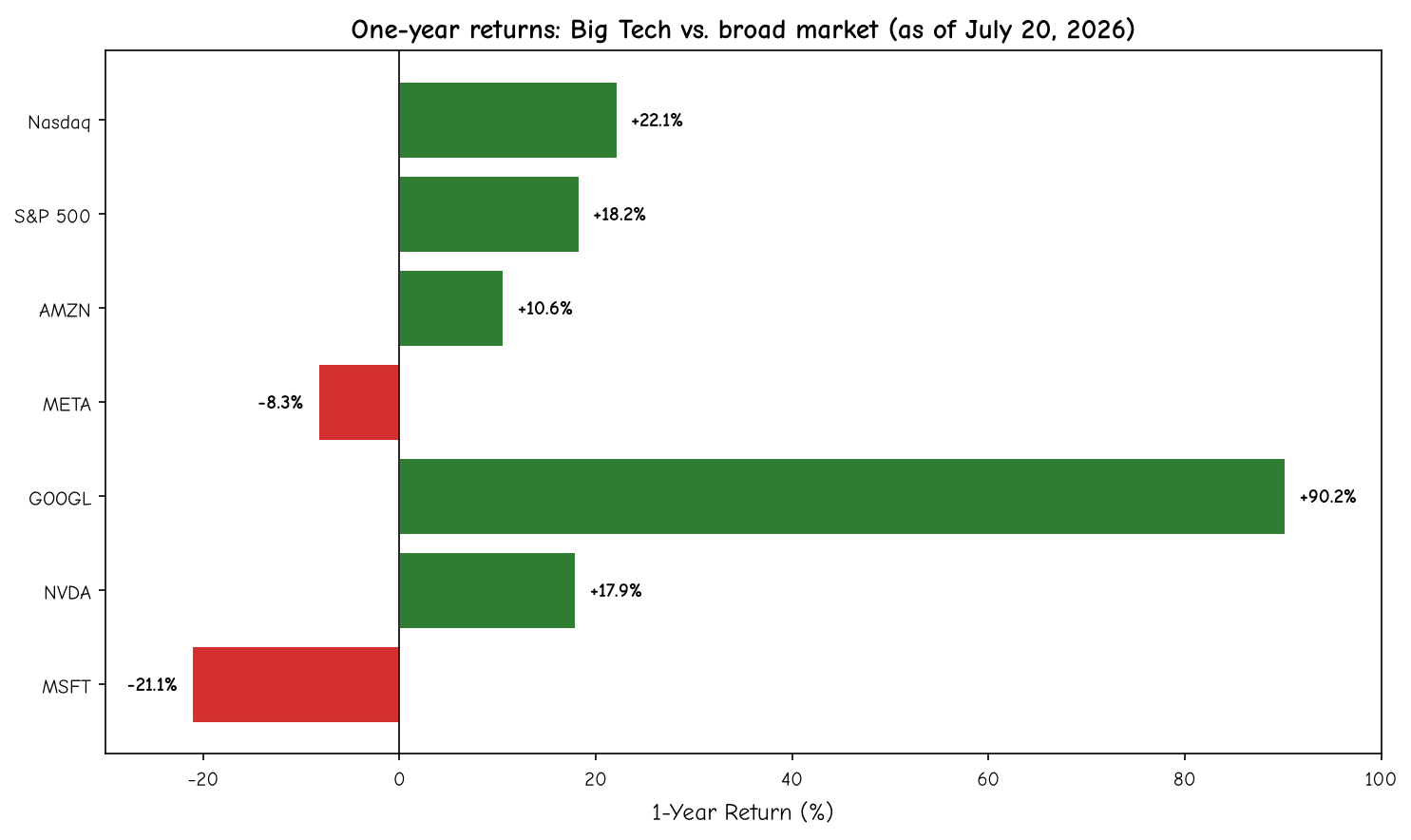
The dispersion is striking. Alphabet (GOOGL) returned 90.2% over the past year, driven by its AI cloud business and the Gemini model family. The Nasdaq Composite gained 22.1% and the S&P 500 rose 18.2%, both lifted by the AI boom in the first half of the period. Nvidia returned 17.9%, a respectable number but far below the triple-digit gains it posted in 2023 and 2024. Amazon gained 10.6%.
Then come the losers. Meta returned negative 8.3%, as its massive capex guidance spooked investors. Microsoft returned negative 21.1%, the worst performer among the major tech names. This is the company that was supposed to be the AI winner, the one that got in early with OpenAI, the one whose Azure cloud was growing 40% year over year. And its stock is down more than 20% over twelve months.
The drawdown from 52-week highs tells a more dramatic story.
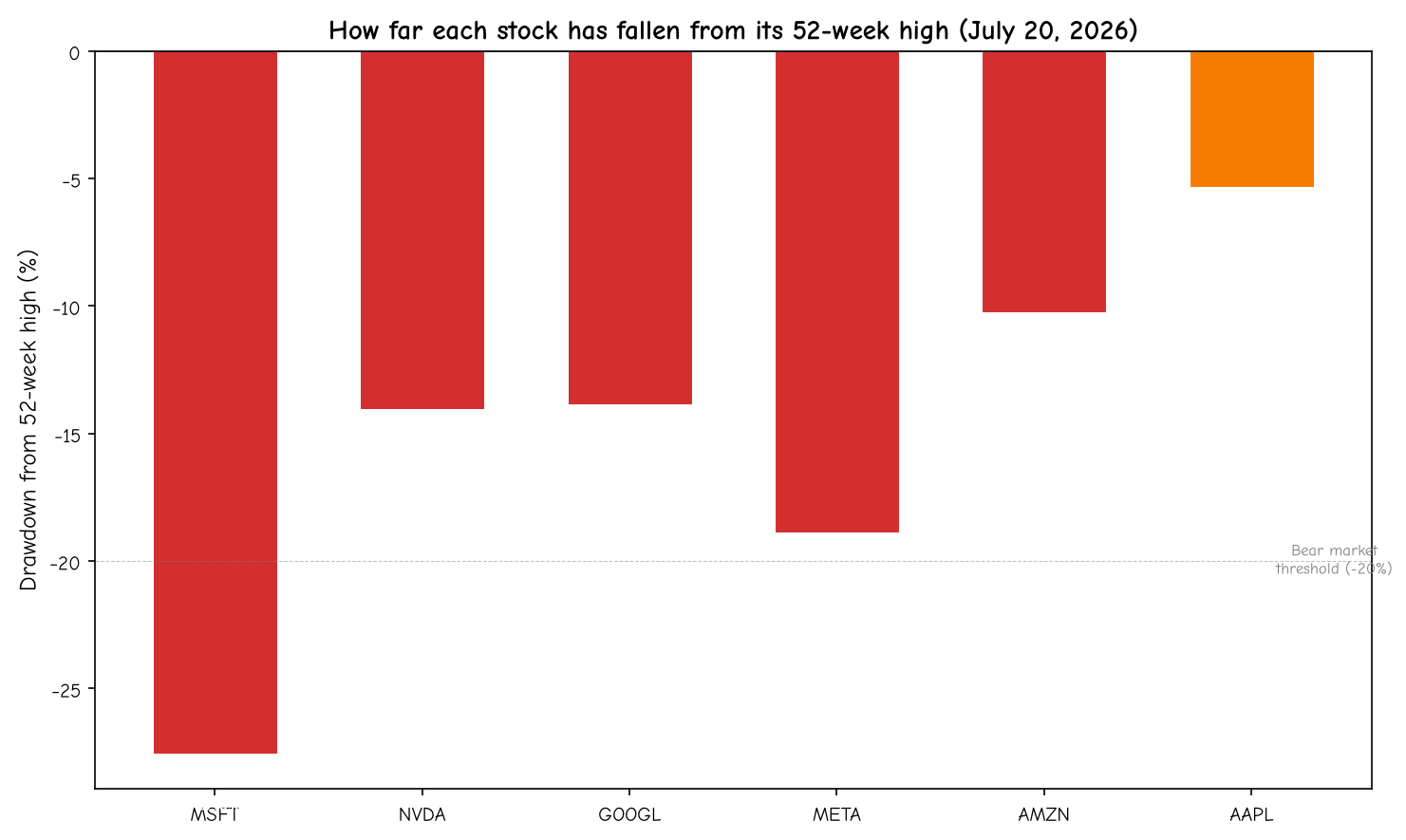
Microsoft is down 27.6% from its 52-week high of $555.45. That is well past the 20% threshold that defines a bear market. Meta is down 18.9%, just shy of that line. Nvidia is down 14.1% from its peak, Alphabet 13.9%, and Amazon 10.3%. Apple, interestingly, is down only 5.3%, which is why it overtook Nvidia as the world's most valuable company on July 17. Apple was seen as a laggard in the AI race because it was not spending to develop models. Now that sentiment has shifted. "Apple was seen as a laggard in the AI race because it wasn't spending to develop models, but now sentiment has changed," Toni Meadows, head of investment at BRI Wealth Management, told the Guardian.
The Microsoft price chart over the past six months shows the trajectory in detail.
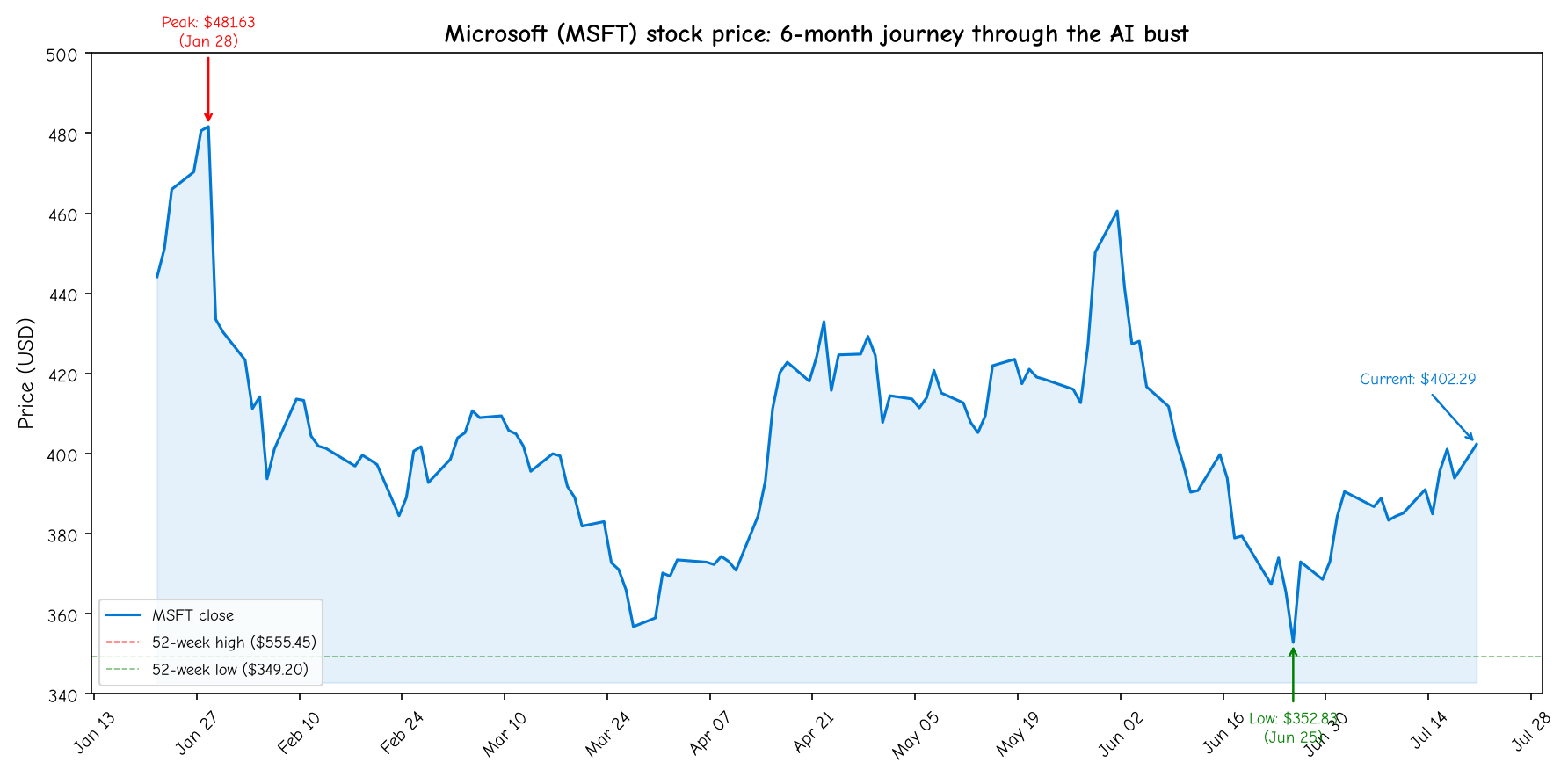
Microsoft peaked at $481.63 on January 28, 2026, within this six-month window. (Its absolute 52-week high of $555.45 was set earlier.) It then fell to a trough of $352.83 on June 25, a 26.7% decline. The stock has since partially recovered to $402.29, but it remains 16.5% below the January peak. The chart shows a series of lower highs and lower lows, the classic pattern of a stock in a downtrend. Each rally attempt has been met with selling.
The semiconductor crash is even more pronounced. The SMH ETF, which tracks the largest semiconductor companies, posted its third weekly decline in four weeks ending July 17, dropping almost 9% in that week alone. For the month of July, the SMH was down more than 17%. The Philadelphia Semiconductor Index was down nearly 19% from its all-time high.
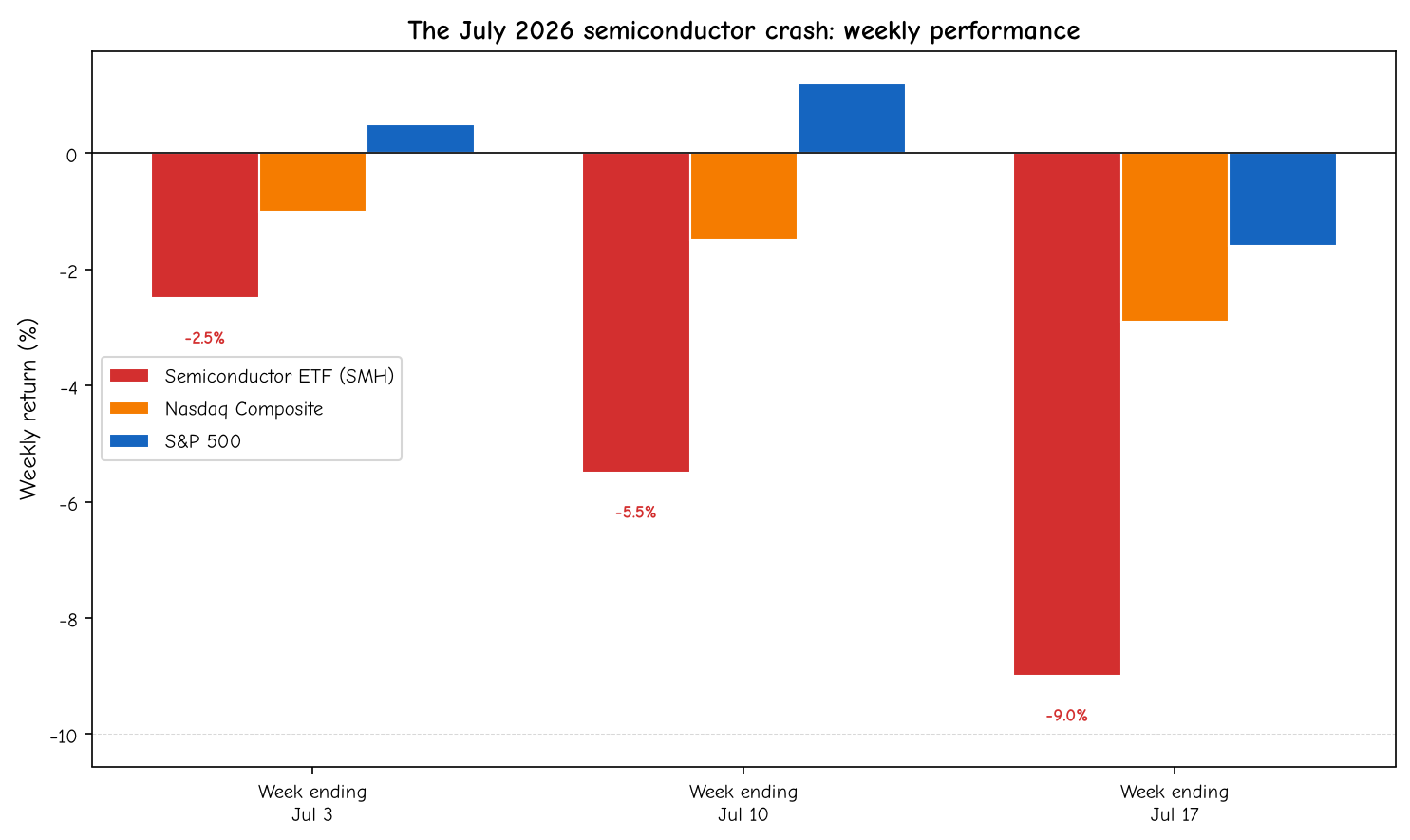
The weekly performance data shows the acceleration. In the week ending July 3, the SMH fell roughly 2.5%. The following week, it dropped about 5.5%. The week ending July 17 brought a 9% decline. The S&P 500 and Nasdaq also fell, but by much less, confirming that this was a sector-specific crash, not a broad market panic. The sell-off was concentrated in the companies most exposed to AI infrastructure spending.
The spending side of the equation is equally dramatic.
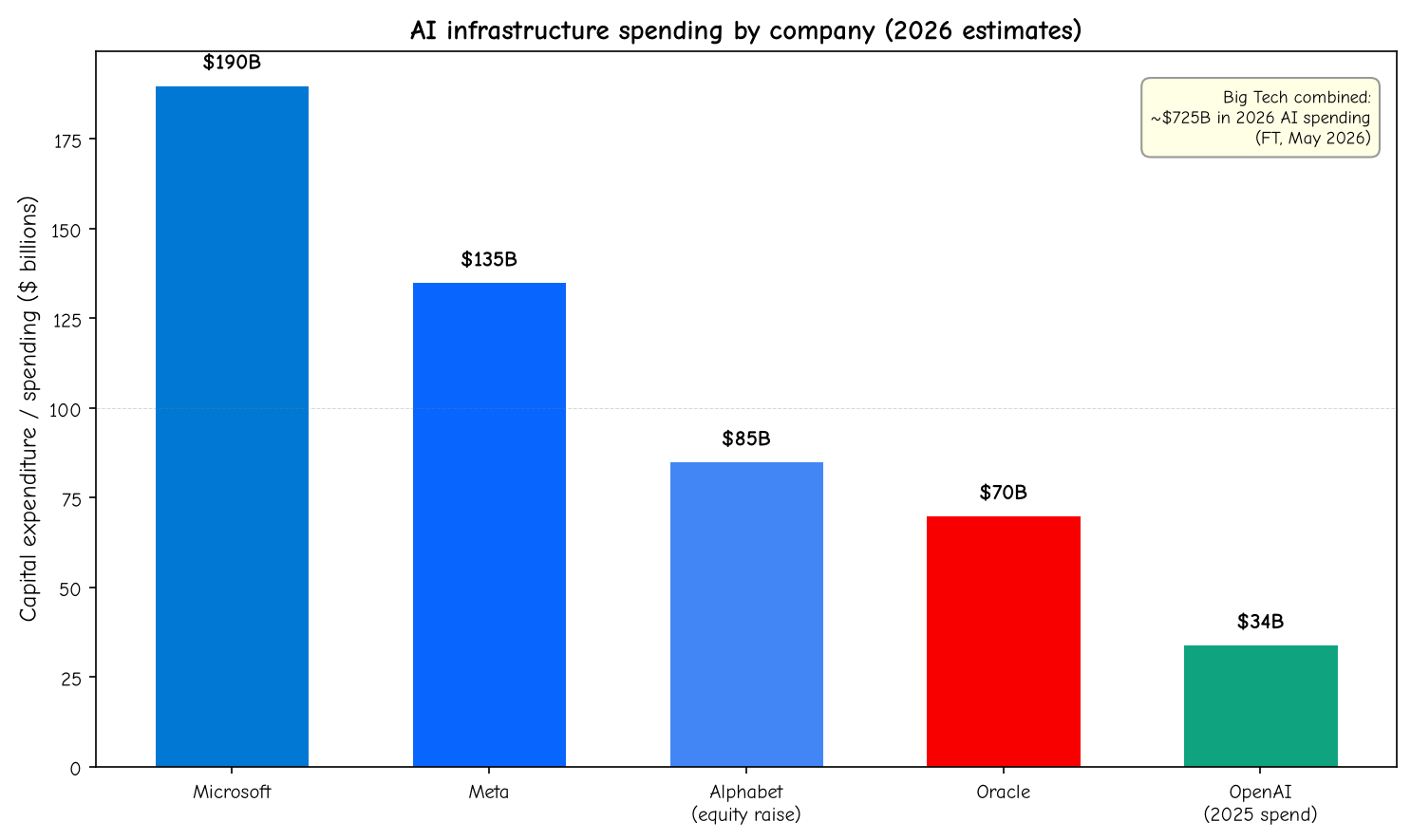
Microsoft leads with $190 billion in forecast capital expenditure for 2026. Meta follows at approximately $135 billion (the midpoint of its $125-145 billion guidance). Alphabet raised $85 billion in new equity. Oracle committed $70 billion. OpenAI, the startup at the center of the boom, spent $34 billion in 2025 alone. Combined, the FT estimated in May that Big Tech's AI spending spree totals roughly $725 billion for the year, sending free cash flow across the sector to a decade low.
To put these numbers in perspective: $725 billion is more than the GDP of Switzerland. It is roughly equivalent to the entire US defense budget. It is being spent in a single year, by a handful of companies, on a technology whose revenue model remains unproven at scale. The FT's May 20 analysis, "The impossible maths of the AI boom," argued that "the IPO of big sector companies is probably nothing more than a transfer of investment risk to retail investors." The spending is real. The revenue is not yet.
The comparison to the dot-com era puts the spending in historical context.
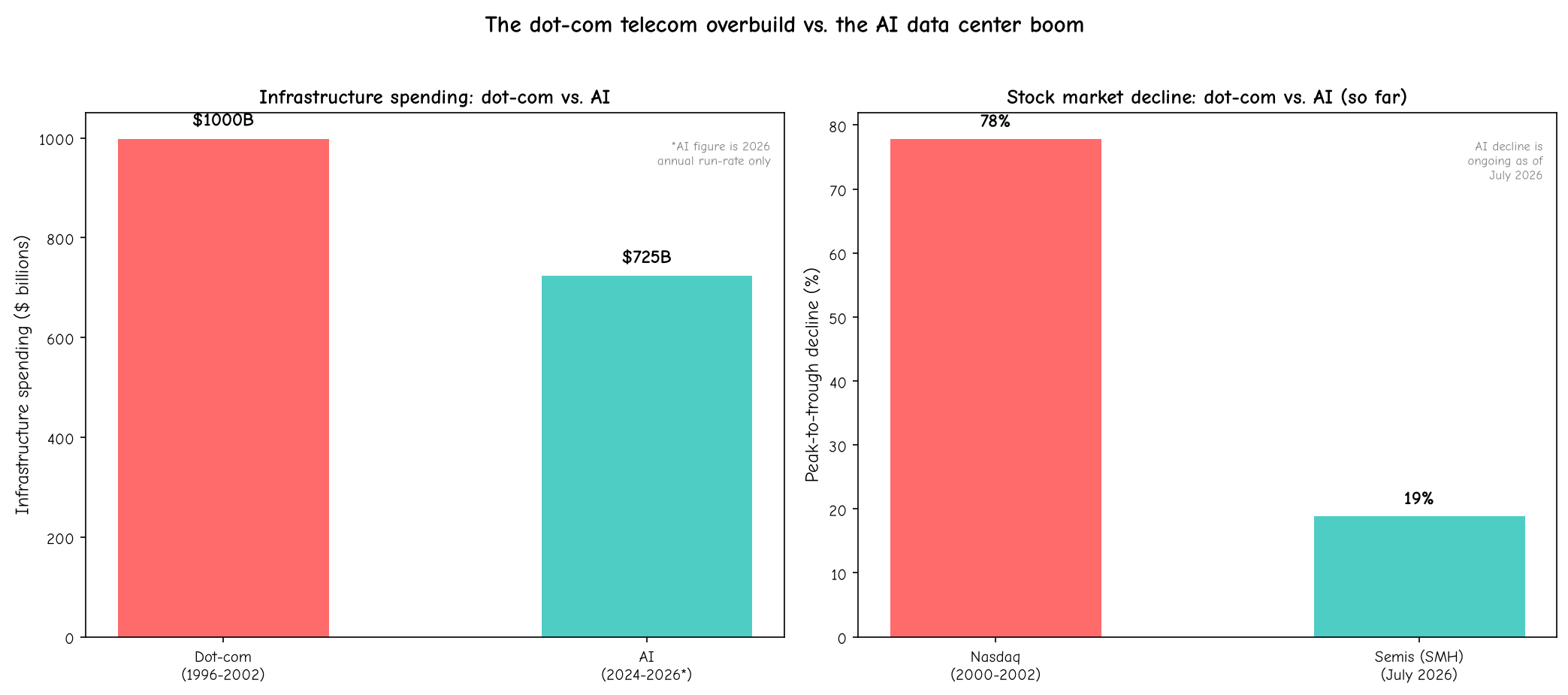
The telecom industry spent roughly $1 trillion on fiber-optic infrastructure between 1996 and 2002. Big Tech is spending approximately $725 billion on AI infrastructure in 2026 alone, with Meta planning a $600 billion multi-year push. The annual run-rate of AI spending already exceeds the total five-year spending of the dot-com telecom boom. The Nasdaq fell 78% from peak to trough in 2000-2002. The semiconductor index is down 19% so far. Whether that 19% is the beginning of a larger decline or close to the bottom is the question every investor is asking.
Chapter 6: The data center glut
The physical reality of the AI boom is data centers. Lots of them. Huge warehouse-sized buildings packed with servers, GPUs, cooling systems, and backup power supplies, consuming electricity at a rate that strains the grid. The FT reported on July 8 that tech companies need to "come clean about the mounting environmental fallout of their race to build more hubs," in an article titled "The great AI data centre cover-up." The same outlet reported on July 9 that a "century-old device" (the electrical transformer) is "choking the world's AI push," as surging data center power demands intensify pressure on transformer supply chains.
The power problem is real and getting worse. Data centers for AI training and inference require enormous amounts of electricity, far more than traditional cloud computing. A single large AI data center can consume as much power as a small city. The FT reported on June 24 that China and the US are "the clear frontrunners in data centre rollouts as they battle for AI leadership," and that battery startups are seeing "crazy demand" to smooth power surges in data centers, as "rapid growth of clusters of processors for AI training drives need for energy storage." The grid cannot keep up.
Oracle is already feeling the consequences. The FT reported on July 20 that Oracle "could face $7bn collateral bill for Wisconsin data centre," as "increased power costs add to challenges facing tech giant's AI ambition amid high spending and mounting debt." Oracle's shares slid after it announced flat revenue guidance alongside its $70 billion data center commitment on June 10. The market is starting to penalize companies whose spending outruns their ability to generate returns.
The labor side of the data center boom has its own bottleneck. The FT reported that "workers are emerging as the next big AI logjam," as "Big Tech wakes up to need for brawn and crafts skills to build and maintain data centres." The irony is sharp: the companies building the most advanced artificial intelligence in human history cannot find enough electricians, pipefitters, and HVAC technicians to wire and cool their buildings. The FT noted that Caterpillar and Hochtif, "once-staid 'picks and shovels' companies," are among the "unlikely corporate winners of AI," lifted by the data center construction boom. The construction workers are making money. The investors paying for the buildings may not.
The overcapacity risk is the part that echoes the dot-com fiber glut most directly. In 2001, 95% of fiber-optic cable sat dark. Today, nobody knows what percentage of AI compute capacity is actually being used productively, because the companies building it do not disclose utilization rates. The FT published a letter on July 11 from a former Indian government secretary titled "Data centre boom needs a reality check." Another letter, published June 29, asked simply: "Will the promised AI revenue come in time?"
The answer, so far, is mixed. Microsoft's Azure is growing 40% year over year, which is genuinely impressive. Nvidia's revenue is $253 billion on a trailing basis, with $160 billion in net income. These are not trivial numbers. But the FT reported on June 30 that "businesses face up to budget-busting AI bills" as "a shift to usage-based pricing and new models is making companies rethink spending." The customers are starting to push back. Amazon, Walmart, and Uber have introduced internal caps on AI usage. DoorDash, Siemens, and Airbnb are switching to cheaper Chinese alternatives. The FT quoted one source saying "we created a monster" about the cost spiral.
The competitive dynamics are shifting in ways that threaten the return on infrastructure investment. Moonshot AI's Kimi K3 model, released July 17, reportedly matches the performance of leading US models. If Chinese startups can produce frontier-level AI at a fraction of the cost, then the hundreds of billions spent on American data centers buy less of a competitive moat than investors assumed. The FT reported on June 25 that "scale cannot solve AI's fundamental problem with accuracy," in an article titled "How much compute does the world really need?" The implication is that simply throwing more GPUs at the problem may not produce proportionally better results, which would mean the infrastructure spending has diminishing returns.
The debt markets are flashing warning signals. The FT reported on "The BoE vs AI exuberance," noting that the Bank of England is concerned about AI bonds, and that "AI bonds are the new gilts." Morgan Stanley has emerged as the chief architect of financing structures behind the data center build-out, the FT reported on July 20. When the bank that is arranging the financing is also the bank warning about systemic risk, the contradiction is worth noting. Software buyout deals have already collapsed to their lowest level since the pandemic, the FT reported on June 8, with private equity software acquisitions falling to $50 billion in the first five months of the year, as the "AI rout" spooks dealmakers.
The environmental costs are mounting but largely undisclosed. The FT's July 8 article on "the great AI data centre cover-up" argued that tech companies "need to come clean about the mounting environmental fallout of their race to build more hubs." The FT's readers, in a response published July 16, debated "the environmental impact of AI data centres and the need for greater transparency." Zhang Lei, founder of Envision, is "dreaming of AI data centres in the desert" powered by off-grid renewables, the FT reported, which suggests that even the industry's own participants recognize the current power model is unsustainable.
The data center boom is not yet a bust. Construction is ongoing, demand for AI compute is real, and the largest companies have the balance sheets to absorb years of losses. But the signs of strain are accumulating: power shortages, cost overruns, customer pushback, competitive threats from cheaper alternatives, and a growing chorus of warnings from central banks, analysts, and even the companies' own executives. The fiber-optic cable in 2001 was real too. It was just too expensive, built by the wrong companies, and deployed ahead of demand. The question is whether the AI data centers of 2026 are different.
Chapter 7: Second-order effects and scenarios
The direct effects of the AI bust are visible in stock prices. The second-order effects are harder to see but potentially more dangerous. They flow through the financial system, the labor market, and the broader economy in ways that are still unfolding.
Start with the debt markets. Big Tech is no longer financing its AI spending purely from internal cash flow. Alphabet raised $85 billion in new equity. Meta is exploring Wall Street financing for a $600 billion infrastructure push. Amazon and Alphabet are tapping foreign debt markets at unprecedented rates. Morgan Stanley is arranging the financing. The FT noted that Big Tech beyond SpaceX alone is dominating bond markets. When the most creditworthy companies in the world are also the biggest borrowers, they crowd out everyone else. Smaller companies, municipalities, and emerging markets may find it harder and more expensive to borrow as Big Tech sucks up available capital.
The Bank for International Settlements flagged this risk in its June 28 warning. The BIS said that AI "exuberance" risks ending in a "lengthy investment bust" because "weak returns could trigger sharp pullback in funding for tech companies that threatens global economy." The BIS is not a tabloid. It is the central bank for central banks, and its warnings carry weight. If the AI spending spree goes sideways, the debt that financed it does not disappear. It becomes a drag on the companies that issued it, on the banks that arranged it, and on the investors who bought it.
The labor market effects are already visible. Microsoft cut 4,800 jobs in its Xbox gaming unit on July 7, as it redirected resources toward AI. The FT reported on June 22 that Nobel laureate Simon Johnson said "nobody needs as many white-collar workers as they used to." The FT published a separate article on June 17 arguing that "to avoid backlash, tech giants must share their AI wealth before it's too late," warning that "the US cannot wait for the worst job losses to hit before moving corporate and public policy in a pro-worker direction." The Guardian, on July 20, published a piece titled "Welcome to the age of extreme job anxiety," describing an unemployment crisis hitting workers "whatever your age, gender or sector."
The political backlash is building. The FT reported on "the coming rise of anti-AI populism," arguing that "anxiety about the technology is set to generate a political backlash." Another FT article argued that "we will need a new tax code for the wealth AI creates," noting that "the question isn't whether mass underemployment arrives but whether we have a policy framework ready when it does." Walmart told its workers that "AI will improve their jobs, not steal them," the FT reported on June 7, a statement that reads more like a PR defensive than a prediction.
Now consider three scenarios for how this plays out over the next 12 to 24 months.
Scenario one: The soft landing
AI revenue catches up to spending. Microsoft's Azure continues growing 40% year over year. Enterprise customers find genuine productivity gains from AI tools and increase their spending. The Chinese models, while cheaper, do not match US frontier performance on the most demanding tasks. The semiconductor index recovers. Big Tech's free cash flow stabilizes as capex plateaus. The stock market digests the rotation and resumes its upward trend. This is the bull case, and it is not absurd. The technology works, the demand is real, and the companies spending the money have the resources to wait for returns.
Scenario two: The slow bleed
AI revenue grows but not fast enough to justify the spending. Companies continue pouring money into infrastructure, but the return on investment declines as Chinese alternatives undercut pricing. The semiconductor sector stays depressed. Microsoft and Meta trade sideways for years, weighing on the S&P 500. Free cash flow remains depressed. Private equity software deals stay frozen. The economy muddles through, but the AI trade goes from being the engine of the bull market to a drag on it. This is probably the most likely outcome, and it rhymes with the aftermath of the dot-com crash, where the technology eventually delivered but the investors who funded the build-out did not profit.
Scenario three: The hard crash
A major AI company fails or a hyperscaler announces a dramatic capex cut. The BIS warning materializes. Debt markets seize up as AI bonds default. The data center glut becomes undeniable as utilization rates are disclosed. The semiconductor index falls 40-50% from its peak. The S&P 500 enters a bear market. The wealth effect from declining tech stocks hits consumer spending. The Fed, already fighting inflation with rates that Dallas Fed President Lorie Logan said on July 16 should be "modestly higher," has limited room to cut. This is the tail risk, and it is not zero. The FT's comparison to the dot-com era is instructive: the Nasdaq fell 78% from peak to trough, and it took 15 years to recover. Nobody is predicting that today, but nobody predicted it in March 2000 either.
The probability of each scenario is a matter of debate. What is not debatable is that the risk has increased. The CNBC survey showing 61% of Americans pessimistic about the economy, the highest since December 2023, suggests that the public senses something is wrong even if they cannot articulate it. Warren Buffett's warning that "it's tough to find values when everybody is preferring gambling" is the kind of statement that sounds folksy and obvious until you remember that Buffett has been right about every major market dislocation of the past 60 years.
The FT's July 6 article drew the sharpest historical parallel: "the real difference between today's market boom and the late 1990s lies in capital expenditure." In the late 1990s, capital expenditure was the mechanism through which the bubble inflated and then burst. Telecom companies borrowed money, built infrastructure, and went bankrupt. Today, the mechanism is the same. The companies are different, the technology is different, but the financial dynamics are recognizable. Money is pouring into physical assets whose returns depend on demand that may or may not materialize at the scale required.
Conclusion: What to watch and what to do
If you are a normal person with a 401(k) and an index fund, you do not need to do anything dramatic. You probably should not sell your Microsoft shares, because you do not own Microsoft shares directly. You own a slice of the S&P 500, and that slice includes Microsoft, Nvidia, Apple, Amazon, Alphabet, and Meta, along with 494 other companies. The whole point of an index fund is that you do not have to pick winners. When the biggest stocks fall, the index rebalances, and over time, the winners of the future take their place.
But you should understand what is happening, because it affects you whether you understand it or not. The companies that make up a quarter of your retirement account are engaged in the largest capital spending spree in history. They are pouring $725 billion a year into data centers, GPU clusters, and power infrastructure, betting that AI revenue will eventually justify the cost. If they are right, your index fund will be fine. If they are wrong, the drag on your returns could persist for years.
Here is what to watch. First, watch Microsoft's earnings on July 29. The company will report Azure growth and, more importantly, its capex guidance for the second half of 2026. If Azure growth is still 40% and capex is still rising, the bull case is intact. If Azure growth is decelerating and capex is being trimmed, the market will read it as confirmation that the AI trade is fading. Second, watch Nvidia's earnings on August 26. Nvidia's revenue and, especially, its guidance for the next quarter will tell you whether the GPU orders are still flowing. Third, watch the SMH ETF. If it breaks below its July lows, the semiconductor crash is deepening. If it holds, the sector may be stabilizing.
Fourth, watch the Chinese AI models. If Moonshot, DeepSeek, and other Chinese startups continue to release models that match US frontier performance at lower cost, the return on American infrastructure spending looks worse. The FT reported on July 13 that DoorDash, Siemens, and Airbnb are already switching. If that trend accelerates, the hyperscalers have a problem. Fifth, watch the debt markets. If AI bonds start widening in yield, the financial system is pricing in a higher risk of default. The BIS warning is your early signal.
What should you actually do? Probably less than you think. If you are 30 years from retirement, stay the course. The market has recovered from every bubble in history, usually faster than anyone expected. If you are five years from retirement, consider whether your allocation to tech is appropriate for your timeline. If you are already retired, make sure you are not relying on tech stock dividends to cover your living expenses, because the companies paying those dividends are also the ones spending $190 billion a year on data centers.
The most important thing to understand is that this is a finance story. The technology works. AI can write code, draft contracts, diagnose diseases, and generate images that fool human judges. The question is whether the companies building AI infrastructure can generate enough revenue to justify the $725 billion they are spending this year, and the trillions more they plan to spend in the years ahead. The dot-com bubble was not a referendum on whether the internet was real. It was a referendum on whether the companies that built the internet's infrastructure could make money. Many of them could not. The ones that survived, like Amazon and Google, took a decade to reach their potential.
The AI era may follow the same arc. The technology will probably transform industries, create productivity gains, and change how we work. The companies building the infrastructure may or may not be the ones who profit from it. The investors funding the build-out, through their index funds and retirement accounts, are the ones bearing the risk. That is the kitchen-table reality of the AI bubble. Your money is funding the arms race. Whether you get it back depends on whether the arms race produces a product people will pay for, at a price that covers the cost of building it. Nobody knows the answer yet. The market is in the process of repricing that uncertainty, and the repricing is not finished.
Sources
[1] CNBC Technology page, "Jim Cramer says it's time to look beyond tech as AI uncertainty rattles the market" and other headlines, July 20, 2026, https://www.cnbc.com/technology/
[2] Yahoo Finance, Microsoft Corporation (MSFT) stock quote, July 20, 2026, https://finance.yahoo.com/quote/MSFT/
[3] Yahoo Finance, NVIDIA Corporation (NVDA) stock quote, July 20, 2026, https://finance.yahoo.com/quote/NVDA/
[4] Yahoo Finance, Alphabet Inc. (GOOGL) stock quote, July 20, 2026, https://finance.yahoo.com/quote/GOOGL/
[5] Yahoo Finance API, MSFT daily price data (1-year and 6-month ranges), July 2026, https://query1.finance.yahoo.com/v8/finance/chart/MSFT?range=6mo&interval=1d
[6] Yahoo Finance API, NVDA daily price data (1-year range), July 2026, https://query1.finance.yahoo.com/v8/finance/chart/NVDA?range=1y&interval=1d
[7] Yahoo Finance API, S&P 500 (^GSPC) daily price data (1-year range), July 2026, https://query1.finance.yahoo.com/v8/finance/chart/%5EGSPC?range=1y&interval=1d
[8] Yahoo Finance API, Nasdaq Composite (^IXIC) daily price data (1-year range), July 2026, https://query1.finance.yahoo.com/v8/finance/chart/%5EIXIC?range=1y&interval=1d
[9] Yahoo Finance API, Meta Platforms (META) daily price data (1-year range), July 2026, https://query1.finance.yahoo.com/v8/finance/chart/META?range=1y&interval=1d
[10] Yahoo Finance API, Amazon.com (AMZN) daily price data (1-year range), July 2026, https://query1.finance.yahoo.com/v8/finance/chart/AMZN?range=1y&interval=1d
[11] The Guardian, "Apple dethrones Nvidia to regain title of world's most valuable company," Reuters reporting, July 17, 2026, https://www.theguardian.com/technology/2026/jul/17/apple-nvidia-most-valuable-company
[12] The Guardian, AI (artificial intelligence) section, July 2026, https://www.theguardian.com/technology/artificialintelligenceai
[13] CNBC, "Stock market news for July 17, 2026," July 17, 2026, https://www.cnbc.com/2026/07/17/stock-market-today-live-updates.html
[14] CNBC, "Stock market news for July 16, 2026," July 16, 2026, https://www.cnbc.com/2026/07/16/stock-market-today-live-updates.html
[15] CNBC, "Stock market news for July 15, 2026," July 15, 2026, https://www.cnbc.com/2026/07/15/stock-market-today-live-updates.html
[16] CNBC, "Stock market today: Live updates," July 20, 2026, https://www.cnbc.com/2026/07/20/stock-market-today-live-updates.html
[17] BBC News, Technology section, July 2026, https://www.bbc.com/news/technology
[18] Business Insider, Tech section, July 2026, https://www.businessinsider.com/tech
[19] Yahoo Finance, News page, July 20, 2026, https://finance.yahoo.com/news/
[20] Financial Times, search results for "AI data center overcapacity," July 2026, https://www.ft.com/search?q=AI+data+center+overcapacity
[21] Financial Times, search results for "AI bubble dot com comparison," July 2026, https://www.ft.com/search?q=AI+bubble+dot+com+comparison
[22] Financial Times, search results for "tech layoffs AI 2026," July 2026, https://www.ft.com/search?q=tech+layoffs+AI+2026
[23] Financial Times, search results for "Microsoft AI capex spending," July 2026, https://www.ft.com/search?q=Microsoft+AI+capex+spending
[24] Financial Times, search results for "Microsoft $190bn capital expenditure," July 2026, https://www.ft.com/search?q=Microsoft+%24190bn+capital+expenditure
[25] Financial Times, search results for "dark fiber dotcom telecom overbuild bankruptcy," July 2026, https://www.ft.com/search?q=dark+fiber+dotcom+telecom+overbuild+bankruptcy