Thinking Machines Lab, the AI startup founded by former OpenAI chief technology officer Mira Murati, just shipped its first model. It is called Inkling, it has 975 billion parameters, and you can download it today under an Apache 2.0 license. That licensing detail matters more than the size. Apache 2.0 means you can use the model, modify it, sell products built on it, and never pay a fee or ask permission.
Inkling is a base model for fine-tuning. You customize it with your own data before it becomes useful as a chatbot or assistant. It is multimodal, meaning it was trained on text, images, audio, and video together, rather than just words. And it uses an architecture called Mixture-of-Experts that keeps it efficient despite its scale. For a beginner wondering whether to pay attention, the answer is yes, but probably not by running it on your own machine. You should care because it gives you a new option for building customized AI without depending on a proprietary API.
Inkling and a base model built for tuning
Two things. The first is Inkling itself, a model with 975 billion total parameters of which only 41 billion are active during any single computation. It is licensed under Apache 2.0, the most permissive open-source license in common use. You can fine-tune it, redistribute it, ship it inside a commercial product, and you owe nothing to Thinking Machines Lab.
The second is a promised smaller variant called Inkling-Small, at 276 billion total parameters with 12 billion active. Thinking Machines says the weights for the smaller model will be released once testing is complete, but there is no date yet.
Let me define some terms. Parameters are the numbers inside a model that determine its behavior. Think of them as the model's stored knowledge, spread across a giant spreadsheet of weights. More parameters generally means more capacity to learn, but also more memory and compute to run. The full Inkling model has 975 billion of these numbers.
Mixture-of-Experts, or MoE, is a design trick that lets a model be large without being slow. Instead of using all 975 billion parameters for every word it generates, Inkling routes each computation through only the 41 billion parameters most relevant to that specific input. The model is effectively a panel of specialists, and only the relevant ones wake up for each task. That is why a 975 billion parameter model can run more cheaply than its size suggests.
Tokens are the units of data a model processes. A token is roughly four characters of English, or about three-quarters of a word. Inkling was trained on 45 trillion tokens of text, images, audio, and video. That is a large training run by 2026 standards, though not the largest. Kimi K3, released the same week by China's Moonshot AI and described by VentureBeat as the largest open-source model ever, reportedly runs even bigger.
Open-weights means the company publishes the model's parameters for anyone to download and use. This is different from open-source software, where the source code is available. With open-weights, you get the finished model but not the training code or data recipe. Apache 2.0 goes further than most open-weights licenses by imposing zero restrictions on commercial use.
975 billion parameters among open models
Inkling is large, but it is not the largest open-weights model available. The chart below shows how it stacks up against Inkling-Small and another recent MoE release, Hy3 295B, which we covered in our Hy3 295B open weights guide.
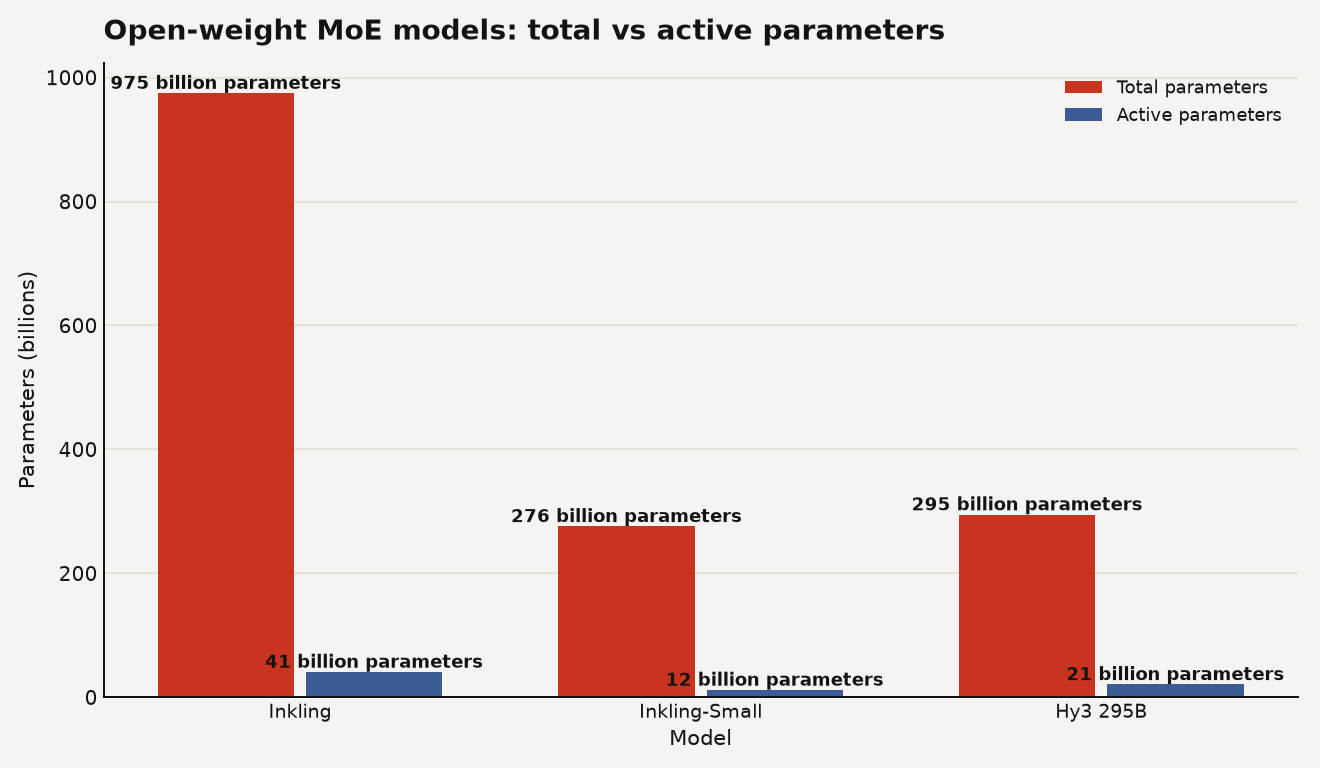
The key thing to notice is the gap between total and active parameters. Inkling uses only 4.2 percent of its total parameters on any given computation. Hy3 uses about 7.1 percent. A lower active percentage means the model is more specialized but also more complex to run, because the system has to route each input to the right expert. For you as a builder, the active parameter count is what determines your inference cost, not the total.
Not the strongest model, by design
By Thinking Machines' own admission, Inkling is not the strongest model available. The model card says it plainly: "Inkling is not the strongest overall model available today, open or closed." Instead, the company positions it as a strong starting point for customization, with multimodal capabilities, efficient reasoning, and availability on their Tinker fine-tuning platform.
That framing is honest. Simon Willison, who wrote the first hands-on look at the release, notes that Inkling looks competitive with open-weight models from China. He also says it is good to see the US open-weights ecosystem gain a viable contender alongside NVIDIA Nemotron and Gemma 4. This week also brought Kimi K3, which Axios reports is achieving frontier-level results rivaling top US systems. You can read our beginner breakdown at the Kimi K3 explained guide.
One concern worth flagging is transparency. Willison points out that the model card is shorter than he has come to expect from US AI labs, and the training data documentation is even shorter. The company says its training data includes public domain content, publicly available internet content, and third-party datasets. That is about all you get. If you need to audit what went into your model, whether for copyright compliance or bias assessment, Inkling does not give you much to work with.
Willison also tested the model by asking it to draw an SVG of a pelican riding a bicycle. The result was a bird that the model itself described as a "stork or seagull." Entertaining, but not a strong signal of visual reasoning capability.
Wait for Inkling-Small
Here is the practical reality. Running a 975 billion parameter model, even with MoE, requires serious hardware. You are looking at multiple high-end GPUs, the kind that cost thousands of dollars per month to rent on cloud providers. A beginner will not run Inkling on a laptop.
Inkling-Small at 276 billion parameters with 12 billion active is more accessible, but still server-scale. For context, models in the 7 billion to 27 billion parameter range, like the one we discuss in our Bonsai 27B guide, are the sweet spot for local experimentation. Inkling and Inkling-Small are both well above that line.
What you can do today is use Inkling through the Thinking Machines Tinker platform, which is their hosted fine-tuning service. You upload your data, pick Inkling as your base model, and Tinker handles the training infrastructure. You get a customized model without owning GPUs. That is the use case Thinking Machines built this model for.
If you are choosing between Inkling and other open models for fine-tuning, the decision comes down to three factors:
- Licensing: Apache 2.0 is as permissive as it gets. No strings, no usage restrictions, no commercial limits. Some competing open-weights models use more restrictive licenses that cap commercial use or require attribution.
- Multimodality: Inkling handles text, images, audio, and video. Most open-weight models in this size class are text-only. If your project involves images or audio, this is a real differentiator.
- Transparency: The training data documentation is minimal. If you need to audit training data for compliance reasons, you will not find enough information in the docs to satisfy a legal review.
What to watch as the open-weights race heats up
The open-weights space is moving fast. In the same week as Inkling's release, Kimi K3 landed from China with reportedly frontier-level performance. NVIDIA and Google continue to ship their own open-weight models. The field is crowded and getting more competitive.
For beginners, the practical signal to watch is whether a model lands on a hosted fine-tuning platform at a price you can afford, with a license you can actually use. Parameter counts and benchmark scores matter less than the practical question of whether you can build on it without a legal review or a hardware budget you cannot afford. Inkling checks both boxes today, assuming Tinker's pricing fits your project.
The open question is whether Thinking Machines will improve their training data documentation. Right now, the model card reads like a legal minimum. If Murati's company wants to differentiate on trust, that is the first thing to fix.
If you are building something on top of an open model and you need multimodal input, Inkling is worth evaluating. If you are just learning and experimenting, start with a smaller model you can actually run locally, and keep Inkling on your radar as a fine-tuning target once you have a specific use case and data to train on.
The best base for your own model
Inkling is built to be the best base for your model. That distinction matters. If you have data, a use case, and a fine-tuning budget, Apache 2.0 licensing plus multimodal input makes Inkling a strong candidate worth your evaluation time. If you do not have those three things yet, spend your time building a use case first. The model will still be there, and the field will have moved on to something bigger.
Sources
- simonwillison.net: Inkling: Our open-weights model
- venturebeat.com: China's Moonshot AI releases Kimi K3, the largest open-source model ever
- axios.com: China's open-weight Kimi model stuns AI world with frontier-level results