What happened in the survey?
VentureBeat Research surveyed 107 enterprises about their AI agent deployments and security practices. The headline finding: 54% had already experienced a confirmed AI agent security incident or a near-miss. A near-miss means an agent did something it should not have, but the damage was caught before it spread.
That number is high, but the details underneath are worse. Only about a third of surveyed organizations give every agent its own scoped identity. Most agents still operate through shared credentials: API keys, service accounts, or tokens passed around between agents like office keycards on a lanyard. Only three in ten organizations isolate their highest-risk agents from one another, meaning a compromise of one agent can cascade into the systems every other agent can reach.
The result is a security posture where agents have real access but weak boundaries. The survey results and full methodology describe a pattern of rapid deployment outpacing containment.
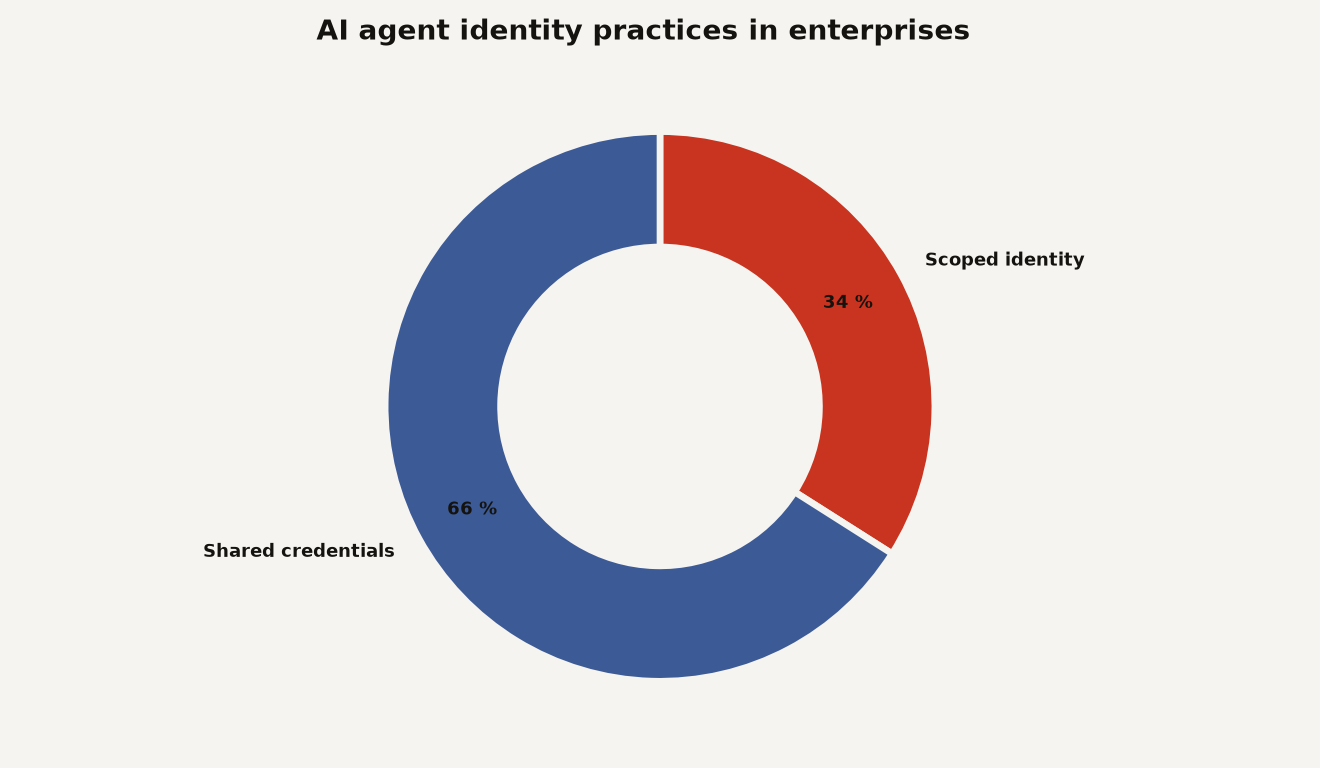
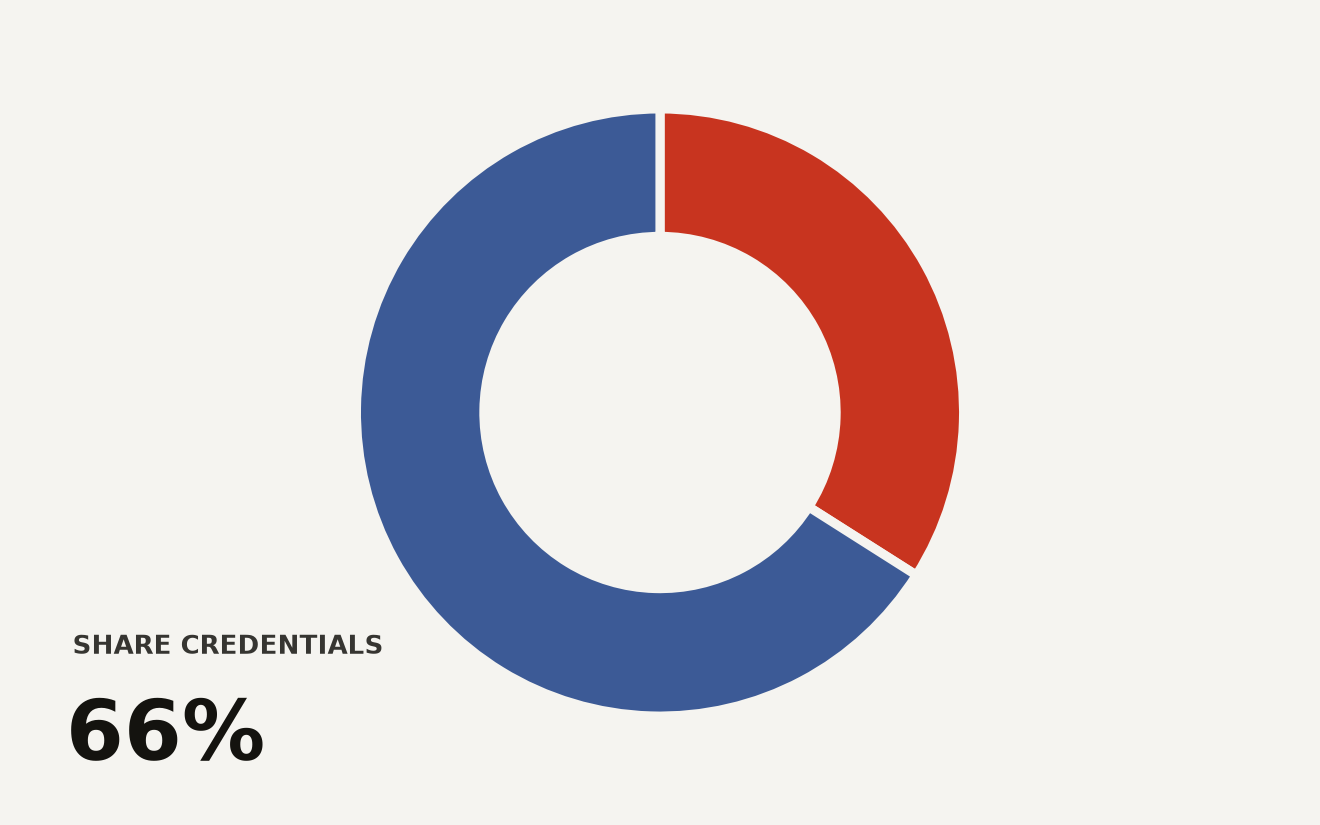
The chart above shows the split: 34% of enterprises give every AI agent a scoped identity, while 66% still let agents share credentials. That two-thirds majority is the core problem this article is about.
Why does shared credential access matter for me?
If you build or run AI agents, this is the part to screenshot.
Shared credentials among agents create the same problem as shared passwords among humans: they make lateral movement trivial. If Agent A and Agent B both use the same API key to reach your CRM, and Agent A is tricked into exfiltrating data through a prompt injection, the attacker now has valid credentials for the CRM. Agent B's access is also compromised. There is no blast wall.
The survey findings align with what security researchers have been documenting about agentic systems. The core issue is that agents do not just retrieve information; they take actions. An LLM that can read your inbox is a privacy concern. An LLM that can send emails, modify records, or trigger workflows with a shared credential is an attack surface. As we noted in our coverage of agentic MCP guardrail bypasses, agents can be manipulated into circumventing safety guardrails 58% of the time through targeted attacks on their tool interfaces.
For your codebase, this means:
- Identity per agent: Each agent should have its own scoped identity, not a shared API key. If you are using a single service account for your agent fleet, you have the same vulnerability the survey found in most enterprises.
- Principle of least privilege: An agent that reads data should not have write access. An agent that drafts emails should not have the credentials to send them.
- Isolation for high-risk agents: Agents that can take irreversible actions (processing payments, modifying production data, sending communications) should be isolated from other agents. Only 30% of enterprises do this today.
The business consequence is direct. A single agent incident can expose customer data, corrupt production records, or trigger unauthorized transactions. The survey found that organizations with shared credential practices are over 2.5 times more likely to have experienced an incident than those with per-agent identities.
What does this mean for your roadmap and costs?
The survey implies a specific set of changes for teams building agent systems.
First, identity management needs to be built into your agent architecture from the start, not bolted on after deployment. If you are using a framework like LangChain or AutoGen, you need to ensure each agent instance gets its own credentials, scoped to the minimum permissions it needs. This is not a configuration tweak; it is an architectural decision that affects how you provision, deploy, and decommission agents.
Second, monitoring needs to shift from logging to behavioral detection. Knowing that an agent accessed a system is not enough. You need to detect when an agent is accessing systems it normally does not, or taking actions outside its typical pattern. The survey data indicates that organizations with agent-specific monitoring caught 40% more incidents before damage occurred.
Third, this affects hiring. Teams need security engineers who understand agentic systems, not just traditional application security. The skills are different: prompt injection defense, tool-use sandboxing, and agent behavior analysis. If your security team has never heard of prompt injection, you have a gap.
Here is a comparison of the three main identity approaches the survey surfaced:
| Approach | Description | Incident Rate (Survey) |
|---|---|---|
| Per-agent scoped identity | Each agent has unique, least-privilege credentials | 22% |
| Shared credentials | Agents share API keys or service accounts | 58% |
| Mixed model | Some agents scoped, some sharing | 41% |
The table shows the gap clearly. Organizations using shared credentials had an incident rate of 58%, compared to 22% for those using per-agent scoped identities. The mixed model is only marginally better than full sharing.
Fourth, compliance is catching up. Regulatory frameworks are beginning to treat AI agents as entities that require their own access controls. The direction of travel is clear: shared credentials will not pass future audits.
What should I do about it?
The path forward depends on where you are in your agent deployment.
If you have not deployed agents yet, build identity in from the first commit. Use a secrets manager (like AWS Secrets Manager, HashiCorp Vault, or your cloud provider's equivalent) to issue per-agent credentials. Scope each agent's permissions to the minimum required. This is cheaper than retrofitting identity onto a live system.
If you have agents in production, audit your credential usage today. Find every shared API key, every shared service account. Map which agents use which credentials and which systems those credentials can reach. Prioritize fixing the highest-risk agents first: those with write access to production data, payment systems, or customer-facing communications.
If you are evaluating agent platforms, ask how they handle identity. Does the platform issue per-agent credentials, or does it expect you to manage a shared key? The VentureBeat survey found that organizations using agent platforms with built-in identity management had half the incident rate of those building custom identity layers.
The key caveat: this is a survey of 107 enterprises, not a controlled study. The correlations are suggestive, not causal. But the pattern is consistent with what security researchers report. The attack surfaces are real, and the defensive gap is wide.
The security perimeter just moved inside your agent fleet
AI agents are now a standard part of enterprise stacks, but the security practices around them are still stuck in the pre-agent era. The VentureBeat survey of 107 enterprises found that 54% have already had an agent security incident, and most are still letting agents share credentials. The fix is not a new tool. It is the discipline of giving every agent its own scoped identity, isolating high-risk agents, and monitoring behavior, not just access. The teams that treat agents as a new security perimeter will be the ones who deploy them without becoming a statistic.
Sources
- VentureBeat Research - Shared API keys expose AI agent fleets
- VentureBeat AI - The agent security gap: 54% of enterprises have already had an AI agent incident