The most important AI distribution fight this week is not in a model card. It is in a messaging app your parents already use.
WhatsApp AI assistants are now a test of whether Europe can stop a platform owner from using an inbox monopoly as an AI moat. On June 9, 2026, the European Commission ordered Meta to restore free WhatsApp access for rival general-purpose AI assistants while an antitrust investigation continues. The key number is 5 working days: that is how long Meta has to comply with the interim measures order.
This is not a niche Brussels process story. It is a warning to anyone building on someone else’s chat surface. If the app owns the identity graph, the notification rail, and the daily habit, your AI product can be demoted from product to tenant with one terms update.
Meta says WhatsApp Business is a paid product built for business messaging, not a free distribution pipe for giant AI companies. That argument has bite. The uncomfortable part for Meta is that WhatsApp is not just another API. The Commission says Meta has held a dominant position in the EEA consumer communications app market since at least January 2023, and that WhatsApp had been open to these assistants before Meta changed the rules.
What did Brussels actually order Meta to do by June 2026?
The Commission’s order is narrow, fast, and aggressive. It tells Meta to reinstate access for third-party general-purpose AI assistants to the WhatsApp for Business API on the same terms that existed before October 15, 2025, when the access was notably free of charge. The Commission also says Meta must maintain those terms until it adopts a final decision in case AT.41034.
The sequence matters. In December 2025, the Commission opened a formal antitrust investigation into Meta’s WhatsApp policy for AI providers. In February 2026, it sent Meta a Statement of Objections. In April 2026, it sent a supplementary charge sheet after Meta revised the policy on March 4, 2026, to allow third-party AI assistants back only under a pricing framework.
The Commission’s preliminary view is blunt: charging a fee can be equivalent to a ban if the fee makes the route economically unusable. That is the part builders should underline. In platform markets, access is rarely binary for long. The owner does not need to close the door. It can move the door to the VIP floor.
This is only the second interim measures decision under Regulation 1/2003, after the Broadcom decision in 2019. That rarity is the signal. Brussels is saying normal antitrust timelines are too slow for AI assistants because the market could tip before the paperwork is done.
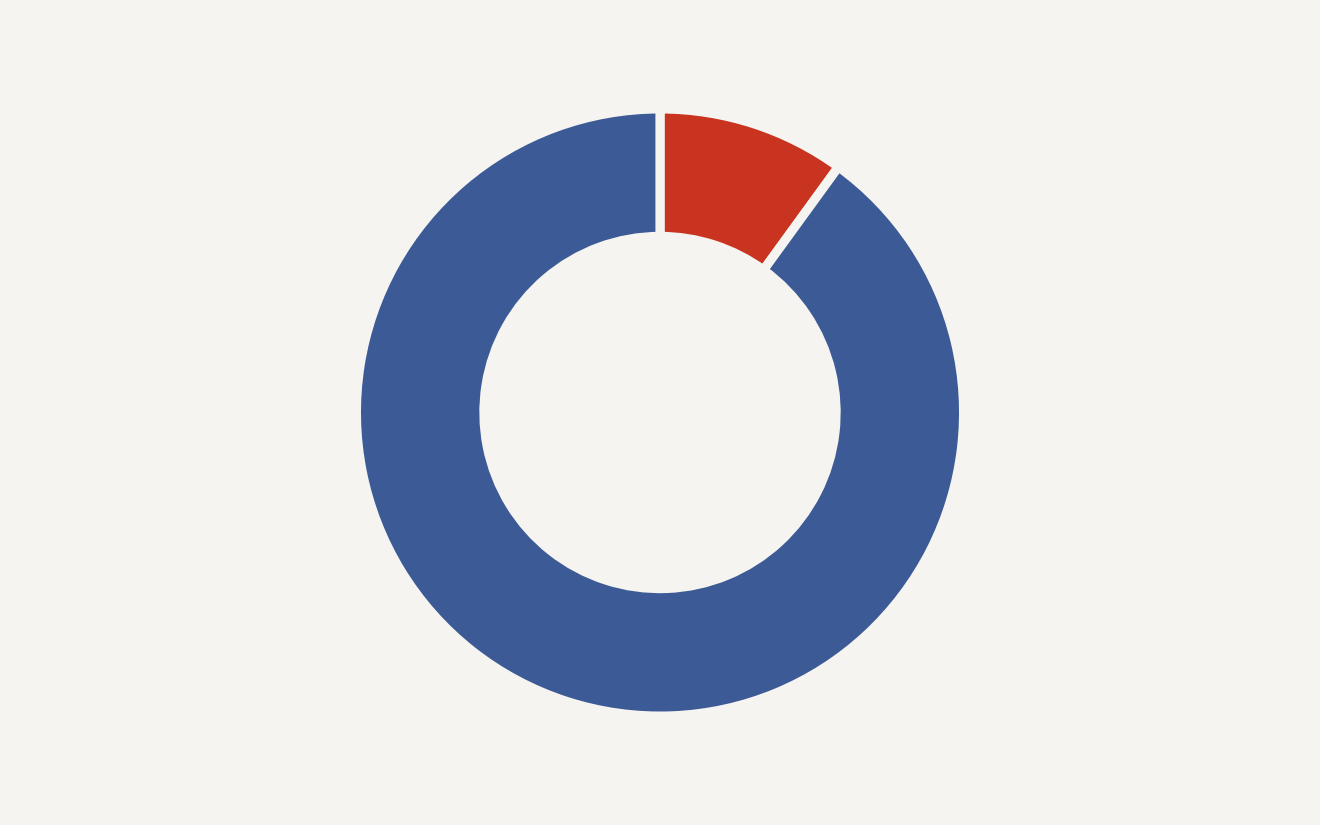
The order also carries real money. The Commission says a company that breaches an interim measures decision can be fined up to 10 percent of turnover from the prior business year, and it can face daily periodic penalties up to 5 percent of average daily turnover. Meta reported $200.966 billion in 2025 revenue, so the headline fine ceiling is about $20.1 billion.
The chart below shows the scale. The possible fine ceiling is 10 percent of Meta’s 2025 revenue, leaving about $180.9 billion outside that ceiling.
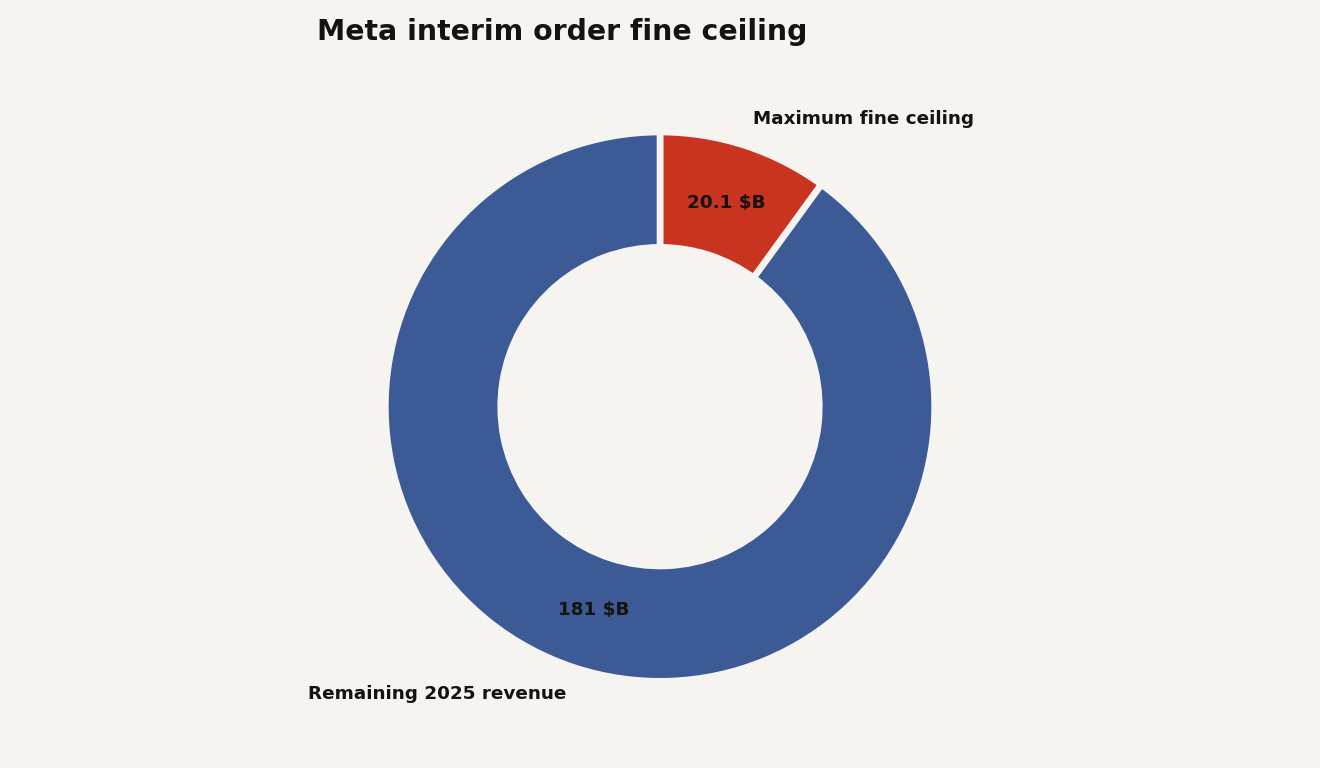
A $20.1 billion maximum fine is not the expected outcome. Regulators rarely jump straight to the ceiling. But the ceiling changes negotiation behavior. It makes noncompliance a board-level question, not a policy team scuffle.
Why does WhatsApp matter so much to AI assistant distribution?
AI assistant distribution is moving toward the places where users already ask small, messy questions. Search is one place. The browser is another. The inbox is the most underrated one because it carries contacts, context, reminders, photos, receipts, family logistics, and a habit loop that opens dozens of times a day.
WhatsApp sits in that habit loop. Meta has said WhatsApp crossed 3 billion monthly users in 2025, and the Commission separately designated WhatsApp Channels as a very large online platform under the Digital Services Act after Channels reached the EU threshold of at least 45 million users. Private messaging is outside the DSA online platform designation, but the number still tells you what regulators see: WhatsApp is infrastructure, not just an app icon.
That is why this case is different from a normal API dispute. If you build an assistant and users can summon it inside WhatsApp, you inherit an existing relationship surface. You do not need to teach users a new app, new login, new notification model, or new sharing pattern. You just need a chat thread.
For smaller assistant companies, that matters more than a benchmark lead. A model that is 8 percent worse but present in the inbox can beat a better model hiding behind a cold start. Distribution compresses model differences.
Meta knows this because Meta AI benefits from the same rail. If Meta AI is the only general-purpose assistant available inside WhatsApp, Meta gets default placement inside one of the world’s highest-frequency consumer apps. The Commission’s theory is that excluding rivals at this moment could shape the AI assistant market before users form habits and before smaller entrants can scale.
This is the same structural fight we covered in Google’s AI opt out fight with publishers: the interface owner can turn distribution rules into market structure. In search, the question was whether publishers can control how their content feeds AI answers. In WhatsApp, the question is whether rival assistants can reach users through the messaging surface where many users already live.
Why should builders treat this as a platform risk warning?
If your roadmap assumes that a platform API remains stable because your use case is popular, this case should make you nervous. Meta changed WhatsApp Business Solution terms in October 2025, the Commission says those terms effectively banned third-party general-purpose AI assistants as of January 15, 2026, and the remedy did not arrive until June 2026.
That is roughly five months of uncertainty for any product whose main customer acquisition channel was a WhatsApp thread. Five months is a lifetime for a startup with 12 months of runway.
The developer consequence is simple: platform policy is now part of your architecture. Treat it like latency, unit cost, or data retention. If a single host controls the user identity, message delivery, and policy interpretation, your assistant has a hidden dependency that your status page cannot monitor.
What this means for you:
- If you are building a consumer assistant, do not make one messaging platform your only activation surface. Ship WhatsApp if it is available, but keep web, mobile, email, and at least one other messaging rail alive.
- If you are selling to businesses, separate general-purpose assistant behavior from task-specific customer support flows. Meta’s own policy debate distinguishes broad assistants from business support functions, and that distinction will show up in procurement reviews.
- If you rely on WhatsApp Business pricing, model policy shocks as well as message costs. WhatsApp’s own Business Platform pricing page now frames pricing around message categories including marketing, utility, authentication, and service, but regulatory access rules can sit above that price card.
- If you are an investor or acquirer, ask how much of growth comes from borrowed distribution. A company with 1 million users through one platform API may have less durable demand than a company with 250,000 users across four surfaces.
There is also a business model lesson hiding in Meta’s complaint. A platform can argue that free access for rivals forces paying customers to subsidize AI companies. That is not absurd. Hosting, moderation, spam controls, customer support, abuse review, and messaging delivery are real costs. The sharper question is whether the platform can charge cost-based access without setting the price so high that only its own assistant survives.
That line will matter across AI. Expect more fights where the platform says it is pricing infrastructure and rivals say the price is exclusion with a receipt.
What should you change if your assistant depends on a giant inbox?
Start with a boring map. List every external surface where a user can invoke your assistant, then mark who can change the rules without your consent. If the same company owns the surface, the payment mechanism, the identity layer, and the ranking or notification system, color that dependency red.
Then change three product decisions.
First, make account portability real. If a user starts on WhatsApp, they should be able to continue on the web or your app without losing memory, preferences, files, or billing status. This sounds obvious until the export flow becomes a backlog item nobody wants to touch. In a platform lockout, that backlog item becomes your lifeboat.
Second, keep channel-specific features modular. WhatsApp has message templates, service windows, and category rules. Email has deliverability rules. Mobile apps have push permissions. Do not bury those assumptions in your core agent logic. Put channel adapters at the edge so losing one channel does not break planning, retrieval, billing, or customer records.
Third, track policy deltas with the same seriousness as API deprecations. The October 15, 2025 WhatsApp terms change was not a server outage. It was more dangerous because it looked like a legal update until it became a product shutdown. Assign one owner to platform terms, especially when your assistant is close to a platform owner’s strategic product.
A practical rule: if your assistant’s primary loop happens inside a platform that has its own assistant, assume you are competing with the landlord.
What happens next if Meta appeals and the probe drags on?
Meta can appeal, and the underlying antitrust investigation has no legal deadline. The Commission says the interim measures stay in place until the final decision, which means the temporary remedy could matter more than the final ruling for product teams shipping in 2026.
Watch three things.
First, watch whether Meta restores access at the old price and old conditions, or restores access with new operational constraints. The Commission focused on free access, but product reliability can be shaped by rate limits, approvals, abuse flags, and support queues.
Second, watch whether the Commission clarifies what a fair AI assistant access fee would look like. Free access is a clean emergency remedy. It is less likely to be the permanent equilibrium if rival assistants drive high message volume or support costs.
Third, watch whether other gatekeepers copy or avoid Meta’s move. Apple, Google, Microsoft, and Meta all have surfaces where an assistant can become the default way to act. If Brussels succeeds here, future platform access fights may move faster. If Meta wins on appeal, platform owners will read that as permission to price rivals away from the user.
The best bet is not that Europe makes every inbox an open commons. The better bet is that AI distribution becomes a regulated bottleneck category. Builders should plan for access, portability, and compliance as first-class product work, not legal cleanup after launch.
The inbox is the new app store
The old platform tax was a 30 percent fee at checkout. The new one may be subtler: access to the conversation where the user was already going to ask the question.
That is why the WhatsApp order matters. It does not decide who has the best model. It decides whether the best model gets to knock on the door.
Sources
- European Commission: Commission imposes interim measures on Meta to preserve free access to WhatsApp for rival AI assistants
- European Commission: Commission sends Meta fresh charge sheet on possible interim measures
- European Commission: Commission opens antitrust investigation into Meta's new policy regarding AI providers' access to WhatsApp
- European Commission: Commission designates WhatsApp as Very Large Online Platform under the Digital Services Act
- Meta: Meta Reports Fourth Quarter and Full Year 2025 Results
- WhatsApp: WhatsApp Business Platform Pricing