This is the full research report behind the video: every number, source, and chart the script was written from.
How lawmakers trade stocks, why the rules don't work, and what it means for your retirement
Finance Research Team
July 28, 2026
Report No. 2026-0728-CST
Executive summary
Every few months, a story goes viral: a member of Congress bought stock in a company days before announcing legislation that would send its share price soaring. The public gets angry. A bill gets introduced to ban congressional stock trading. The bill dies in committee. The cycle repeats. This report looks at what is actually happening, how the rules are supposed to work, where they fail, and what the data says about whether lawmakers really do beat the market.
The core legal framework is the STOCK Act, signed into law in April 2012. It was supposed to stop members of Congress from trading on inside information by requiring them to disclose stock transactions within 45 days. But disclosure is not a ban. It is a paperwork requirement. Members of Congress and their spouses can still buy and sell individual stocks, including in industries they regulate, as long as they file the right form on time. And even the filing deadline is routinely missed with minimal consequences.
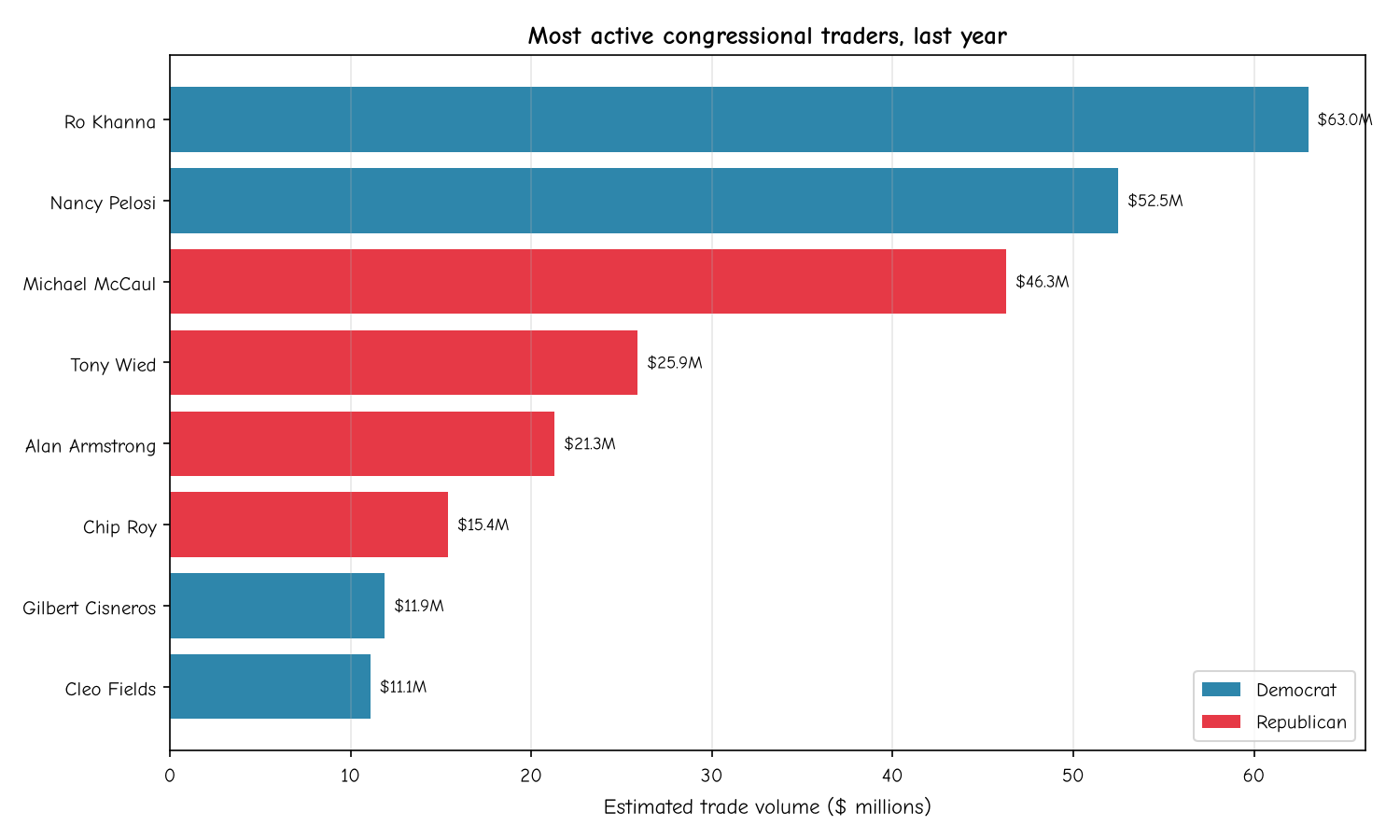
The data, scraped from congressional disclosure filings by tracking services like Quiver Quantitative, shows that trading volume is enormous. Representative Ro Khanna filed 4,593 transactions in the last year with an estimated trade volume of $63 million. Former Speaker Nancy Pelosi filed 21 transactions estimated at $52.5 million. Representative Michael McCaul filed 954 transactions totaling $46.3 million. These are not index fund purchases. These are individual stock trades, many in technology and defense companies that sit squarely within the committees those lawmakers serve on.
Meanwhile, multiple bills to actually ban congressional stock trading have been introduced and killed. The Bipartisan Ban on Congressional Stock Ownership Act, introduced by Representative Pramila Jayapal in 2022 and again in 2023, died without a vote both times. The Insider Trading Prohibition Act, which passed the House in May 2021, never got a Senate vote. Every proposed ban has been watered down, delayed, or quietly strangled in committee.
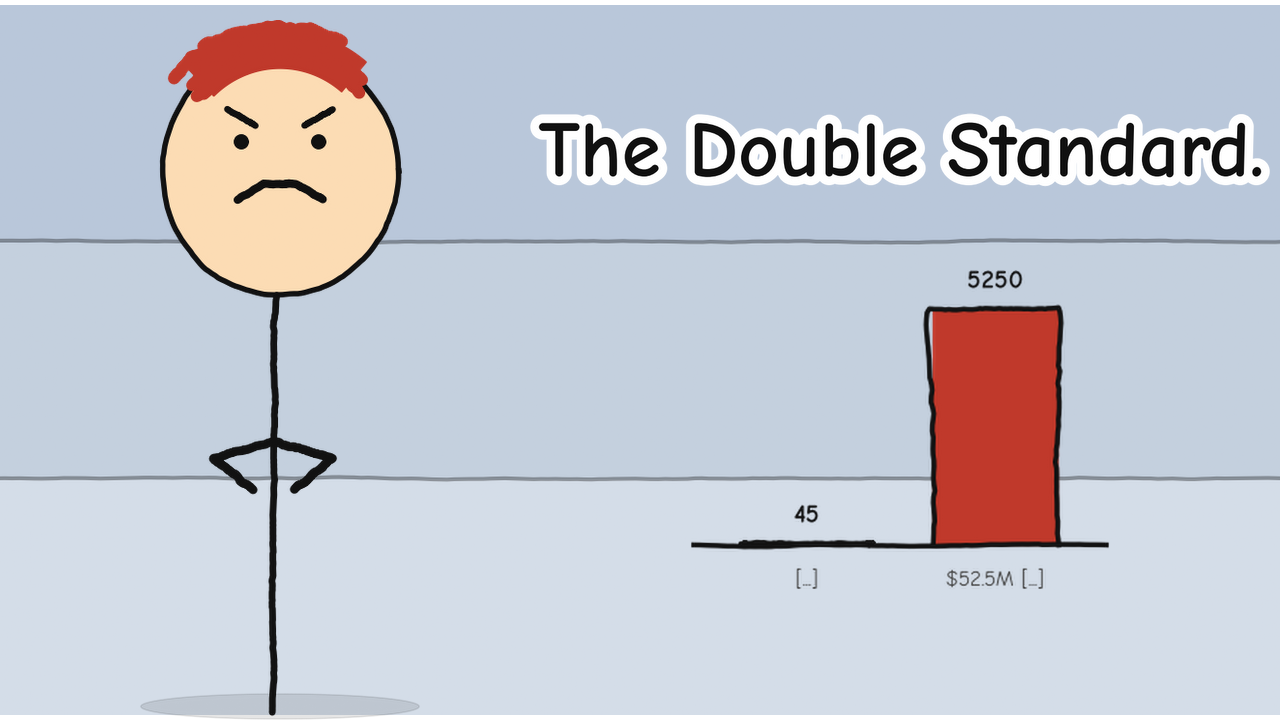
The historical parallel is instructive. In 2001, Martha Stewart sold 3,928 shares of ImClone stock after her broker tipped her that the CEO was selling ahead of an FDA rejection. She avoided $45,673 in losses. She went to federal prison. A member of Congress doing something similar, with far more material information, faces a disclosure deadline and almost no enforcement.
Key findings
- The STOCK Act of 2012 requires disclosure of congressional stock trades within 45 days, but does not ban the trades themselves. Late filings carry a nominal fine, and enforcement is rare.
- At least 12 separate bills have been introduced since 2012 to ban or restrict congressional stock trading. None has become law. The most recent attempt, the Bipartisan Ban on Congressional Stock Ownership Act (H.R. 1679), had 29 cosponsors from both parties and died without a committee vote.
- Quiver Quantitative's tracker shows the top 10 congressional traders generated an estimated $320 million in trade volume over the last year, concentrated in technology stocks like NVIDIA, Apple, and Microsoft.
- NVIDIA, a stock frequently traded by members of Congress, returned 2,793% from January 2020 to July 2025, compared to 96% for the S&P 500 over the same period. Its annualized return of 83% came with 54% annual volatility, roughly 2.5 times the volatility of the broader market.
- The Martha Stewart case established that trading on material nonpublic information carries prison time for private citizens. No member of Congress has been prosecuted under the STOCK Act for a similar offense.
- The 45-day disclosure window means the public learns about trades weeks or months after they happen, making it impossible to detect front-running in real time.
Chapter 1: Your 401(k) and their stock picks
Let us start with something concrete. Say you earn $75,000 a year and put 6% of your salary into a 401(k). Your employer matches half of that. You are saving about $6,750 a year, which is a serious effort for most households. You put it in a target-date fund, the default option that most plans offer, which means you own a slice of hundreds of companies through an index fund. Your money grows at whatever the stock market returns, minus fees.
From January 2020 through July 2025, the S&P 500 returned about 96% total, or roughly 13% annualized. That is a strong run by historical standards. If you started with $50,000 in your 401(k) at the beginning of 2020 and contributed $6,750 a year, you would have roughly $140,000 by mid-2025. Not bad. You did everything right. You held through the COVID crash in March 2020, when the market fell 34% in 23 trading days. You held through the 2022 bear market. You did not panic-sell. You are the model patient investor.
Now consider Nancy Pelosi. According to Quiver Quantitative, a service that scrapes congressional financial disclosure filings, Pelosi filed 21 stock transactions over the last year with an estimated trade volume of $52.5 million. Her husband, Paul Pelosi, is a venture capitalist and the actual executor of many of these trades, but under congressional disclosure rules, spouses' transactions are reported on the member's filing. The Pelosis' portfolio has reportedly included large positions in NVIDIA, Apple, Microsoft, and Google parent Alphabet, among others.
NVIDIA returned 2,793% from January 2020 to July 2025. If you had put $1 million into NVDA in January 2020, you would have had about $29 million by mid-2025. Nobody is suggesting the Pelosis timed the absolute bottom or held every share to the absolute top. But the scale of the gains available to someone trading individual tech stocks during this period dwarfs what any index fund investor earned. The S&P 500 multiplied your money by roughly 2x. NVIDIA multiplied it by roughly 29x.
Here is where the kitchen-table anger comes in. You followed the rules. You bought the index fund. You held through the crashes. Your reward was a solid but ordinary return. Meanwhile, the people who write the laws that regulate these companies, who sit on committees overseeing the semiconductor industry, who vote on defense spending bills that flow to companies like NVIDIA, are allowed to buy and sell those exact companies' stock. And they are not buying index funds. They are buying individual shares in the specific companies their legislation affects.
The defense is always the same: "These trades are made by my spouse." "I do not control the timing." "I follow all disclosure rules." All of which may be technically true and completely beside the point. The STOCK Act requires disclosure within 45 days. That means by the time you learn that a member of Congress bought $5 million in NVIDIA call options, the trade is six weeks old. You cannot copy it. You cannot verify whether it was made before or after a committee meeting where the member learned something about chip export policy. You just get a form, weeks later, telling you it happened.
This is not a partisan issue. The top traders on Quiver Quantitative's list include Democrats (Khanna, Pelosi, Cisneros) and Republicans (McCaul, Wied, Armstrong, Roy). The money flows across the aisle. What unites them is access to information that ordinary investors do not have, and a disclosure system designed to be too slow to catch anything.
The average American household has about $87,000 in retirement savings, according to Federal Reserve Survey of Consumer Finances data. That number is dragged down by people who have nothing saved, but even the median for households approaching retirement is well under $300,000. The gap between what most people can scrape together for their future and what a single member of Congress can deploy in individual stock trades is not a gap of effort or discipline. It is a gap of access.
Chapter 2: Martha Stewart, the STOCK Act, and the road to nowhere
To understand why the current system is the way it is, you have to go back to two events: the Martha Stewart scandal of 2001-2004, and the passage of the STOCK Act in 2012. They are connected, and the connection explains why the rules look tough but function weak.
On December 27, 2001, Martha Stewart sold all 3,928 shares of her ImClone Systems stock. The next day, the FDA announced it would not approve Erbitux, ImClone's cancer drug. The stock fell 16%. Stewart avoided a loss of $45,673. That is the number the SEC cited: $45,673. Not millions. Not even hundreds of thousands. Forty-five thousand dollars.
Stewart's broker at Merrill Lynch, Peter Bacanovic, had tipped her off that ImClone's CEO, Samuel Waksal, was dumping his own shares. Waksal had learned the FDA rejection was coming and told family members to sell. His daughter Aliza sold $2.5 million. His father Jack sold $8.1 million. Company executives followed. Waksal was arrested in June 2002, pleaded guilty to securities fraud, bank fraud, obstruction of justice, and perjury, and was sentenced to seven years and three months in federal prison.
Stewart was not charged with insider trading itself. She was charged with conspiracy, obstruction of justice, and making false statements to federal investigators about why she sold. She claimed she had a standing order to sell if ImClone dropped below $60. The jury did not believe her. On March 5, 2004, after a six-week trial, she was convicted on all four counts. She was sentenced to five months in federal prison, five months of home confinement, and two years of probation. She reported to Alderson Federal Prison Camp in West Virginia on October 8, 2004, and was released on March 4, 2005.
The Stewart case became a cultural touchstone. Here was a billionaire celebrity going to prison over $45,673 in avoided losses. The irony was thick: Waksal, who actually possessed the inside information, got seven years. Stewart, who received the tip secondhand, got five months. But the message was clear: if you trade on material nonpublic information, or lie about it, you can go to prison.
What the Stewart case also revealed was a gap in the law. Members of Congress, despite having access to market-moving information through their legislative work, were not explicitly covered by insider trading rules. The argument was that congressional information was "public" in some abstract sense because Congress is a public institution. This was a legal fiction that nobody seriously believed, but it persisted because nobody had the political incentive to challenge it.
That changed in late 2011, when a "60 Minutes" report alleged that several members of Congress had traded stocks based on nonpublic information from their legislative work. The report named names and generated public outrage. Representative Spencer Bachus, it alleged, had shorted the market during the 2008 financial crisis after receiving closed-door briefings. Representative John Boehner allegedly traded health insurance stocks before the public knew the Affordable Care Act's fate.
The response was the Stop Trading on Congressional Knowledge Act, introduced as H.R. 1148 on March 17, 2011, by Representative Timothy Walz of Minnesota. The bill had 286 cosponsors, 187 Democrats and 99 Republicans, a remarkable bipartisan showing. It died in committee, but its provisions were folded into the STOCK Act that passed both chambers and was signed by President Obama on April 4, 2012.
The STOCK Act did two things. First, it explicitly stated that members of Congress and congressional employees are subject to the same insider trading prohibitions as everyone else. Second, it required them to publicly report any securities transaction exceeding $1,000 within 45 days. The reports would be posted online, searchable, and available to the public.
This sounded tough. It was not. The 45-day window is the problem. By the time a trade is disclosed, the information edge is long gone. If a senator buys defense stock on Monday and files the disclosure 44 days later, nobody can tell whether the trade was based on public information or on something learned in a classified briefing. And the insider trading prohibition, while now explicitly covering Congress, requires proof that the trader used material nonpublic information, which is extraordinarily difficult to establish in a legislative context.
In 2013, Congress quietly amended the STOCK Act to roll back some online disclosure requirements for certain congressional staff, citing security concerns. The amendment passed with almost no debate. The requirement for members themselves remained, but the signal was clear: the enthusiasm for transparency had a short half-life.
The pattern since 2012 has been consistent. Bills to actually ban congressional stock trading get introduced, gather cosponsors, generate headlines, and die. Representative Pramila Jayapal introduced the Bipartisan Ban on Congressional Stock Ownership Act in February 2022 (H.R. 6678, 15 cosponsors) and again in March 2023 (H.R. 1679, 29 cosponsors including 8 Republicans). Both died without a committee vote. The Insider Trading Prohibition Act (H.R. 2655), introduced by Representative Jim Himes, actually passed the House on May 18, 2021, but the Senate never took it up. Each bill dies the same death: referred to committee, never reported out, never brought to the floor.
The Martha Stewart case proved that the government can prosecute insider trading when it wants to. The STOCK Act proved that Congress can pass a law that looks like a crackdown. The years since have proved that looking like a crackdown is all anyone intended.
Chapter 3: Who is trading what, and how much
The data on congressional stock trading comes from a simple mechanism: the periodic transaction reports that members of Congress must file under the STOCK Act. These reports list the date, the security, the type of transaction (buy or sell), the dollar range, and the trade date. The ranges are broad, typically $1,001 to $15,000, $15,001 to $50,000, $50,001 to $100,000, and so on up to over $5 million. They do not give exact dollar amounts.
Several services scrape these filings and aggregate them. Quiver Quantitative, whose data we use throughout this report, parses the disclosures, estimates trade volumes based on the midpoint of each reported range, and tracks the subsequent performance of the stocks involved. The picture that emerges is one of enormous trading volume concentrated in a relatively small number of lawmakers.
The top trader by volume over the last year, according to Quiver Quantitative, is Representative Ro Khanna, a California Democrat, with 4,593 transactions and an estimated trade volume of $63 million. Khanna has publicly stated that his trades are managed by his wife and that he does not make individual trading decisions. His office has emphasized that he supports a ban on congressional stock trading. But the trades happen regardless.
Second is former Speaker Nancy Pelosi, with 21 transactions and an estimated $52.5 million in volume. The low transaction count but high dollar volume means these are large, concentrated trades, not a drip of small purchases. The Pelosis' portfolio has been widely reported to include options trades on major tech stocks, which can amplify both gains and losses beyond what simple share purchases would produce.
Third is Representative Michael McCaul, a Texas Republican, with 954 transactions and $46.3 million in volume. McCaul sits on the House Foreign Affairs Committee and has been a member of the House Intelligence Committee, which oversees classified programs including defense and cybersecurity spending. His trades, according to disclosure filings, have included defense contractors and technology companies.
The list continues: Representative Tony Wied (R-WI) with $25.9 million, Senator Alan Armstrong (R) with $21.3 million, Representative Chip Roy (R-TX) with $15.4 million, Representative Gilbert Cisneros (D-CA) with $11.9 million, and Representative Cleo Fields (D-LA) with $11.1 million. The top eight traders alone account for roughly $248 million in estimated trade volume over a single year.
What are they buying? The data is consistent across tracking services: technology stocks dominate. NVIDIA, Apple, Microsoft, Alphabet, Meta, Amazon, and Tesla appear repeatedly in congressional portfolios. These are the same companies that have driven the bulk of the S&P 500's gains since 2020, which means anyone holding these stocks during this period would have done well regardless of timing. The question is whether members of Congress timed their purchases and sales around legislative events, and the disclosure system makes that nearly impossible to prove.
Defense stocks also appear frequently. Companies like Lockheed Martin, Raytheon (now RTX), and General Dynamics show up in filings from members who sit on armed services or intelligence committees. The defense budget exceeds $800 billion annually, and the committees that oversee it have enormous influence over which contracts get funded. A member who knows that a specific weapons system will receive increased funding in the next defense authorization bill has information that could move a stock price. Whether they act on it is the question the STOCK Act was supposed to answer, and the answer is: we cannot tell, because by the time the disclosure arrives, the trade is old news.
There is also a category of trades that looks suspicious on its face. In 2021, several members of Congress were found to have traded stocks in industries affected by COVID-19 legislation around the time they were participating in closed-door briefings on the pandemic response. A Business Insider investigation identified at least 54 members of Congress who violated the STOCK Act's disclosure requirements between 2021 and 2022, mostly by filing late. The penalties for late filing are minimal: a $200 fine, often waived. No member has been expelled or censured for a STOCK Act violation.
The trading is bipartisan. Democrats and Republicans trade at similar rates. The top 10 list splits roughly evenly between the parties. This is not a story about one side being corrupt and the other being clean. It is a story about a system that allows all of them to trade individual stocks in companies they regulate, with disclosure so delayed that enforcement is practically impossible.
Chapter 4: The loopholes: why the rules do not work
The STOCK Act has three structural problems that make it ineffective as an anti-corruption tool. Each one was visible when the law was written, and each has been exploited since.
The first loophole is the 45-day disclosure window. When a member of Congress buys or sells a stock, they have 45 days to file a periodic transaction report. That is six and a half weeks. In financial markets, 45 days is an eternity. A company can report earnings, receive FDA approval, announce a merger, and see its stock move 30% all within that window. By the time the public sees the disclosure, the information that might have made the trade suspicious is already priced in. Nobody can look at a filing from March and determine whether the member knew something in January that motivated the trade.
The second loophole is the spouse and family exemption. The STOCK Act requires disclosure of trades by the member, the member's spouse, and any dependent children. But the trades themselves are not banned. When Nancy Pelosi's husband Paul buys $5 million in NVIDIA call options, the disclosure is filed under Nancy Pelosi's name. She can truthfully say she did not make the trade herself. But the information that flows through a household does not respect legal boundaries. A member of Congress who comes home from a classified briefing on semiconductor export controls and mentions, in passing, that the administration is reconsidering restrictions, has given their spouse a piece of information that could be worth millions. Proving that conversation happened is nearly impossible.
The third loophole is the definition of "material nonpublic information." In the Martha Stewart case, the information was clear and specific: the FDA was about to reject Erbitux. In Congress, information is diffuse and contextual. A member does not receive a memo saying "NVIDIA will win a $10 billion contract." They receive briefings on defense priorities, they hear testimony from industry executives, they participate in markup sessions where spending levels are negotiated. Each piece of information is partial, but together they form a picture that no ordinary investor has. Prosecuting someone for trading on that mosaic of knowledge would require proving they knew specific nonpublic facts and traded because of them, not because of general market conditions or a financial advisor's recommendation. No prosecutor has tried.
Beyond these three structural gaps, there are practical enforcement failures. The 45-day deadline is routinely missed. Business Insider documented at least 54 violations between 2021 and 2022. The fine for a late filing is $200, and the House Ethics Committee has the discretion to waive it. In practice, late filings are treated as a paperwork error, not a violation of a law designed to prevent corruption. There is no mechanism for the public to challenge a filing's accuracy or completeness. If a member reports a trade in the wrong dollar range or omits a transaction entirely, the only recourse is a complaint to the Ethics Committee, which operates in secret and has never imposed a meaningful penalty for a STOCK Act violation.
The proposed bans address some of these problems but not all. The Bipartisan Ban on Congressional Stock Ownership Act (H.R. 1679, introduced March 2023) would prohibit members of Congress and their spouses from trading or owning individual stocks. Members could still hold diversified mutual funds, ETFs, and pension plans. The bill had 29 cosponsors, 21 Democrats and 8 Republicans, and died in the House Administration Committee without a hearing.
A separate Senate effort, led by Senator Jeff Merkley, would have required members to divest individual stock holdings or place them in a blind trust within 90 days of taking office. That bill also died. Senator Josh Hawley introduced a version that would ban trading but allow ownership of existing holdings, a compromise that critics said would let members keep their current portfolios while preventing new trades. It also died.
The pattern across all these bills is the same. The ban language gets narrowed. The effective date gets pushed back. The spouse requirement gets softened. The enforcement mechanism gets weakened. And then the bill dies anyway, because leadership never brings it to the floor. Speaker Kevin McCarthy promised a vote on a stock trading ban in January 2023. It never happened. Speaker Mike Johnson made no such promise. The bills accumulate cosponsors and then expire at the end of each congressional session, reset to zero, and start over.
The result is a system where the appearance of oversight exists without the substance. Members file forms. The forms go into a database. Tracking services scrape the database. The public reads about the trades weeks later. Nobody gets prosecuted. The trades continue. The next bill gets introduced. It dies. Repeat.
Chapter 5: The numbers: does Congress actually beat the market?
This is where the analysis gets interesting, and also where it gets frustrating. The question of whether members of Congress beat the market is simple to ask and surprisingly hard to answer with confidence. The data exists, but it is messy, incomplete, and subject to interpretation.
Let us start with what we can measure. Using Yahoo Finance data, we downloaded daily prices for the S&P 500 and eight major stocks that appear frequently in congressional portfolios: NVIDIA (NVDA), Apple (AAPL), Microsoft (MSFT), Tesla (TSLA), Alphabet (GOOGL), Meta (META), Amazon (AMZN), and JPMorgan Chase (JPM). The period runs from January 2, 2020, through July 25, 2025, roughly 1,398 trading days.
The S&P 500 returned 96.1% over this period, or 12.9% annualized, with annual volatility of 21.5%. That is the benchmark. If you bought an index fund and held it, you roughly doubled your money in five and a half years.
The individual stocks tell a different story. NVIDIA returned 2,793%, or 83.4% annualized, with 54.4% annual volatility. Tesla returned 1,002%, or 54.1% annualized, with 68% volatility. Meta returned 240%, Microsoft returned 220%, Apple returned 185%, Alphabet returned 182%, Amazon returned 144%, and JPMorgan returned 112%. Every single one of these stocks beat the S&P 500 over this period.
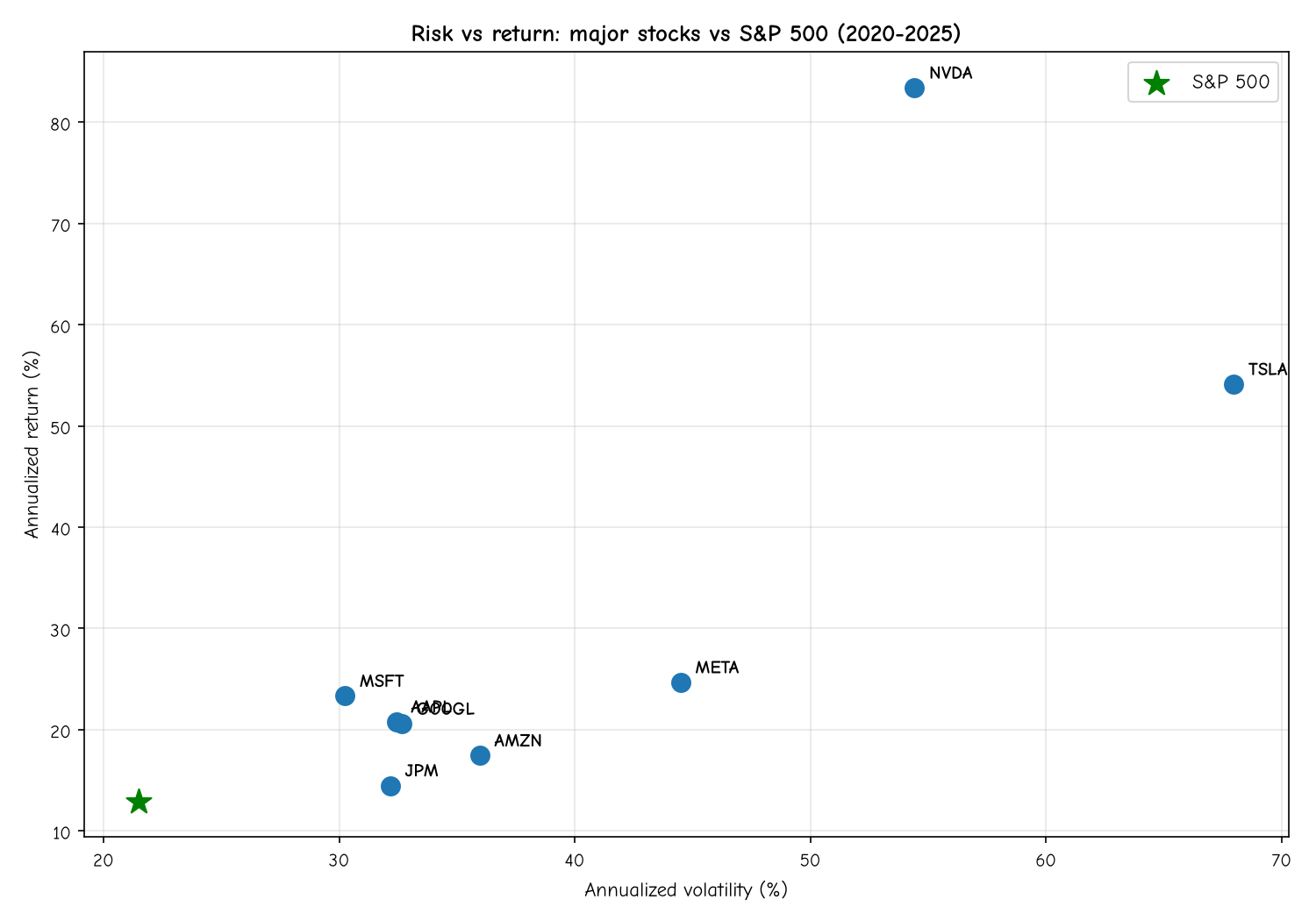
This is the first thing to understand about the "Congress beats the market" claim: during the 2020-2025 period, almost any concentrated bet on large-cap technology would have beaten the market. You did not need inside information to buy NVIDIA in 2020 and hold it. You needed luck, risk tolerance, or a conviction that AI would transform the semiconductor industry. The fact that congressional portfolios are heavy in these stocks means they benefited from the same tech rally that lifted every growth investor's returns.
But here is the complication. Academic studies of congressional trading returns have produced mixed results. A 2004 study by Georgia State University professor Alan Ziobrowski, published in the Journal of Financial and Quantitative Analysis, found that senators' stock portfolios outperformed the market by 12 percentage points annually between 1993 and 1998. That is an extraordinary margin, far beyond what professional fund managers achieve. The study concluded that senators had a "significant information advantage."
A 2022 analysis by the New York Times, using data from Capitol Trades, found that 97 members of Congress reported trading between 2019 and 2021. Of those, about one-third beat the S&P 500 over the period they held their positions. That is roughly what you would expect from random chance. A third beat the market, a third did not, and a third were roughly even. The Times analysis was careful to note that measuring congressional returns is imprecise because disclosures give dollar ranges, not exact amounts, and do not specify when a position was closed.
Quiver Quantitative's own backtesting of a strategy that mimics congressional trades shows mixed results depending on the time period and the subset of politicians followed. The service tracks "estimated excess return" for each trade, meaning how the stock performed after the transaction was reported. Some politicians show consistently positive excess returns. Others do not. The data is noisy because the 45-day reporting delay means the "after" period starts long after the actual trade.
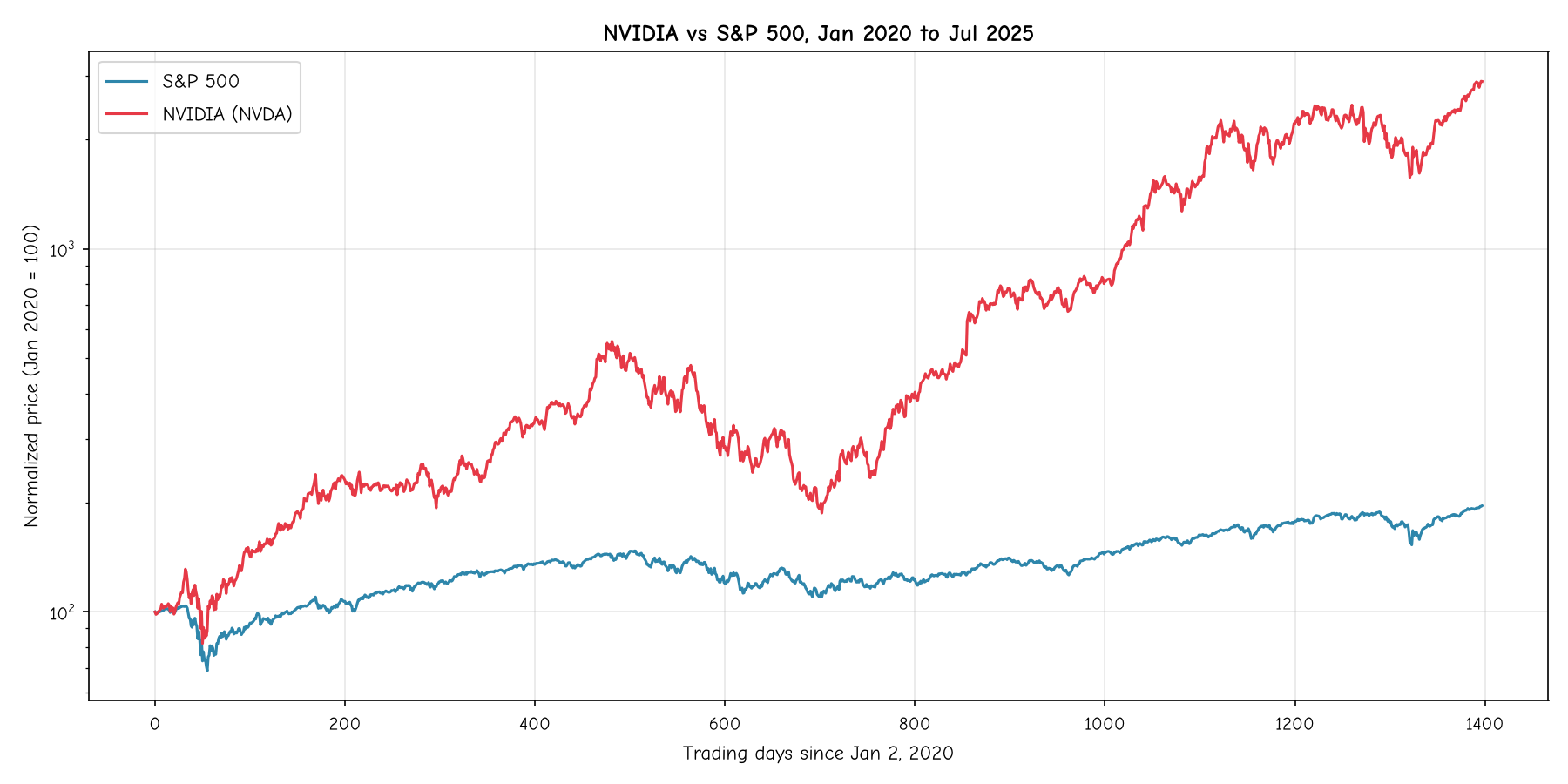
The honest answer to "does Congress beat the market" is: we do not know with statistical confidence. The data is too coarse, the reporting is too delayed, and the sample sizes are too small for a rigorous study. What we can say is that members of Congress trade stocks in industries they regulate, that some of those trades have produced enormous gains, and that the disclosure system makes it impossible to determine whether those gains resulted from superior information, superior luck, or simply the fact that technology stocks went up a lot.
What we can also say is that the appearance of impropriety is overwhelming. When a member of the House Intelligence Committee buys defense stock before a defense authorization bill is marked up, the optics are terrible regardless of the member's actual decision-making process. When the former Speaker's husband buys NVIDIA options before a semiconductor subsidy vote, the public does not need a peer-reviewed study to feel that something is wrong. The system's failure is not just about whether corruption can be proven. It is about whether trust can survive the suspicion.
Chapter 6: NVIDIA, Pelosi, and the trades that went viral
No single stock has become more associated with congressional trading controversy than NVIDIA, and no single politician is more associated with that controversy than Nancy Pelosi. The convergence of the two is a case study in why the STOCK Act's disclosure framework fails to resolve public suspicion.
NVIDIA is the dominant designer of graphics processing units, the chips that power artificial intelligence training and inference. Its market capitalization crossed $3 trillion in 2024, making it one of the most valuable companies on earth. From January 2020 to July 2025, NVIDIA's stock returned 2,793%. A $1,000 investment at the start of 2020 would have been worth roughly $29,000 by mid-2025. The annualized return of 83.4% came with extreme volatility: 54.4% annualized, meaning the stock regularly swung 5% or more in a single day.
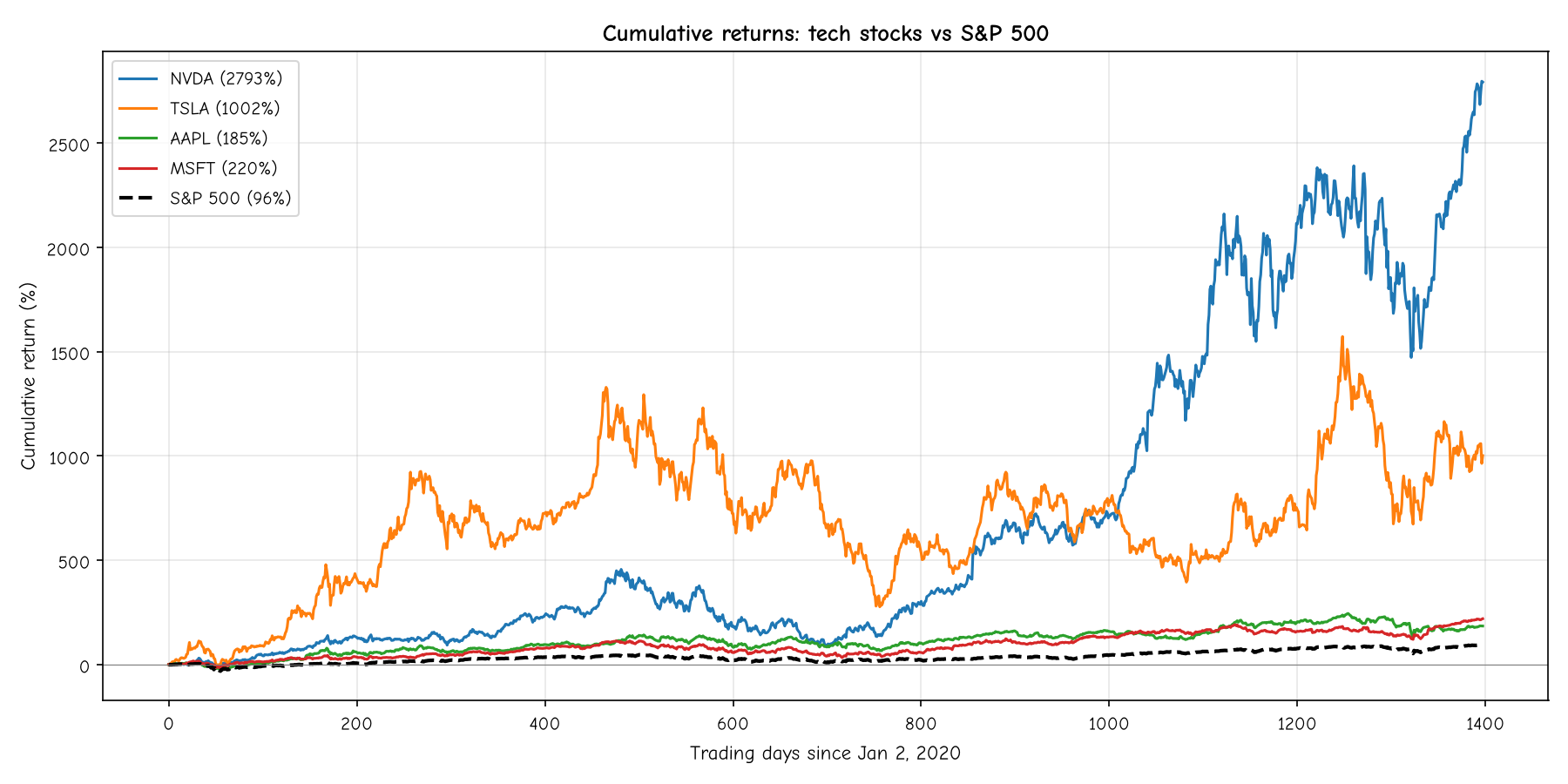
NVIDIA's rise was driven by real, verifiable demand for AI chips. The company's data center revenue grew from under $3 billion in 2020 to over $115 billion in 2024. This was not a speculative bubble in the traditional sense. The revenue was real. But the legislative and regulatory environment around semiconductors was also shifting rapidly, and Congress was at the center of it.
The CHIPS and Science Act, signed into law in August 2022, authorized roughly $52 billion in subsidies for domestic semiconductor manufacturing. NVIDIA was a beneficiary, though not the primary one, since the company designs chips rather than manufactures them. More significant were export control decisions. In 2022 and 2023, the Commerce Department imposed restrictions on selling advanced AI chips to China, a market that accounted for a significant portion of NVIDIA's revenue. Each round of restrictions was debated in classified and unclassified settings where members of Congress received briefings.
In June 2024, Paul Pelosi purchased between $1 million and $5 million in NVIDIA call options, according to a disclosure filed by Nancy Pelosi. Call options give the buyer the right to purchase shares at a set price, meaning they profit if the stock rises above that price. The disclosure was filed within the 45-day window. The trade became public in late July 2024. NVIDIA's stock rose roughly 15% in the weeks following the trade date.
Was this insider trading? We do not know, and the disclosure system is designed so that we cannot know. Paul Pelosi is a professional investor with decades of experience. He may have analyzed NVIDIA's fundamentals and concluded the stock was undervalued. He may have received a recommendation from a financial advisor. Or he may have been aware, through household conversations, that Congress was about to take action favorable to semiconductor companies. The point is that the system provides no mechanism to distinguish between these possibilities.
The Pelosi trades have generated a secondary industry: retail investors who track congressional filings and attempt to copy them. Social media accounts and newsletters dedicated to "Pelosi trading" have hundreds of thousands of followers. The logic is simple: if you believe members of Congress have an information edge, then copying their trades should produce excess returns. Whether this works in practice is debatable, because the 45-day delay means you are always buying six weeks after the member did, by which point the stock may have already moved.
But the cultural impact is undeniable. The phrase "Pelosi tracker" has entered the financial vocabulary. Retail trading platforms have added features that flag stocks recently traded by members of Congress. The irony is thick: a law designed to expose corruption has instead created a marketplace where ordinary investors try to profit from the suspicion of corruption, six weeks too late.
NVIDIA is not the only example. In 2021, Senator Richard Burr sold up to $1.7 million in stocks in February, shortly after attending a classified briefing on the emerging COVID-19 pandemic. The stocks he sold, including hotel and restaurant chains, subsequently crashed as the pandemic shut down the economy. The Justice Department investigated and declined to file charges. The SEC closed its investigation without action. Burr was not prosecuted, but he did not seek reelection in 2022.
Senator Kelly Loeffler sold between $1 million and $3 million in stocks in January 2020 after a Senate Health Committee briefing on COVID-19. She was appointed to the committee on January 24, 2020, and her sales began shortly after. She lost her runoff election in January 2021. No charges were filed.
In both cases, the senators denied wrongdoing. They said the trades were made by their financial advisors without their input. This is the spouse loophole scaled up: the member claims ignorance, the advisor claims routine portfolio management, and nobody can prove otherwise. The Burr and Loeffler cases generated enormous public anger but zero legal consequences. They are the clearest examples of why the STOCK Act, as written, cannot prevent the behavior it was designed to prevent.
Chapter 7: What happens if they actually ban it
Let us imagine, for a moment, that a stock trading ban actually passes. The Bipartisan Ban on Congressional Stock Ownership Act, or something like it, clears both chambers and gets signed into law. What changes, and what does not?
The most obvious change is that members of Congress and their spouses would have to divest individual stock holdings. They could keep diversified mutual funds, ETFs, and pension plans. They could hold Treasury bonds and municipal bonds. But they could not buy shares of NVIDIA, Lockheed Martin, or Pfizer. This would eliminate the most visible conflicts of interest overnight.
The mechanics of divestment would be complicated. Members with large portfolios would face capital gains taxes on sales of appreciated stock. The Jayapal bill addressed this by proposing a deferred capital gains treatment: if a member sold stock to comply with the ban, the capital gains tax would be deferred until the member's diversified assets were eventually sold. This is the same mechanism used when government employees are required to divest holdings that conflict with their duties. It has precedent. Federal judges, for example, are subject to recusal requirements that effectively prevent them from hearing cases involving companies in which they hold stock.
But a ban has second-order effects that its proponents rarely discuss. The first is the talent pipeline. If members of Congress cannot hold individual stocks, the job becomes less financially attractive to wealthy individuals who might otherwise run for office. This could be seen as a feature, not a bug: you do not want people running for office to get rich. But it also means that successful businesspeople who built their wealth in a specific industry, and whose stock holdings reflect that success, would have to liquidate to serve. Some would choose not to run.
The second effect is on the disclosure system itself. If members cannot trade individual stocks, the periodic transaction reports become irrelevant. The public loses visibility into what lawmakers' financial advisors are doing with their money. This is a trade-off: less conflict of interest, but also less transparency. The argument for keeping disclosure even under a ban is that the public has a right to know the financial interests of its representatives, even if those interests are limited to diversified funds.
The third effect is enforcement. A ban is only as good as its enforcement mechanism. The STOCK Act's enforcement is a $200 fine for late filing. A ban would need real penalties: expulsion from Congress, criminal prosecution, or at minimum a substantial fine. Without teeth, a ban becomes another paperwork requirement that members ignore. The House Ethics Committee, which operates in secret and has never imposed a meaningful penalty for a STOCK Act violation, is not a credible enforcement body. An independent office, modeled on the Office of Government Ethics or the Congressional Budget Office, would be needed.
There is also the question of what a ban would do to the broader market. Congressional trading is a tiny fraction of daily market volume. The S&P 500 trades hundreds of billions of dollars worth of shares every day. Even the $63 million in estimated annual trade volume from Representative Khanna is a rounding error in market terms. A ban would not move stock prices. It would not affect liquidity. It would not change corporate earnings. Its impact would be entirely on public trust, which is both its greatest strength and its limitation.
The limitation is this: a ban addresses the symptom, not the disease. The disease is that members of Congress have access to nonpublic information that could move markets, and that some of them appear to use it. A stock trading ban prevents them from acting on that information through personal stock trades. It does not prevent them from sharing that information with others, from making policy decisions that benefit industries they have connections to, or from receiving compensation through other channels (book deals, speaking fees, post-congressional lobbying positions). The revolving door between Congress and K Street, where former members earn seven-figure salaries as lobbyists, is a far larger financial incentive than any stock trade.
A ban would also not address the information asymmetry itself. Members of Congress will still receive classified briefings, still sit in markup sessions, still hear from industry executives about upcoming regulatory changes. The information will still exist. The question is whether members can resist the temptation to use it, and whether the public can trust them to resist. A ban makes the temptation smaller by removing the most direct way to profit, but it does not eliminate it.
The most likely scenario is that some form of restriction passes eventually, probably after the next scandal. It will be weaker than the Jayapal bill. It will probably include a long phase-in period, exemptions for diversified funds, and a weak enforcement mechanism. It will be hailed as reform. It will reduce the most egregious conflicts. And it will leave the underlying problem, the flow of market-moving information through Congress, entirely untouched.
Conclusion: what a normal investor should take away
If you have read this far, you are probably angry. That is a reasonable response. The system is designed to make you angry and then do nothing about it. So let us focus on what you can actually control.
First, do not try to copy congressional trades. The 45-day disclosure delay means that by the time you learn a member of Congress bought NVIDIA, the stock has already moved. You are buying six weeks late, after the information edge, if there was one, has been fully priced in. The "Pelosi tracker" strategy is a form of momentum investing dressed up as political intelligence. It works sometimes, when the broader market is rising, and fails when it is not. It is not a reliable investment strategy.
Second, understand that the congressional trading controversy is not the reason your 401(k) is not growing faster. Your retirement account is limited by your contribution rate, your asset allocation, and your fees. If you are paying 1% or more in expense ratios on your mutual funds, that is a guaranteed drag on your returns that no congressional trade can match. Switching to low-cost index funds, if you have not already, will do more for your long-term wealth than any political reform.
Third, the fact that members of Congress trade individual stocks in companies they regulate is a real problem, but it is a problem of trust, not of market mechanics. The stock market itself functions reasonably well. Price discovery works. Information gets incorporated into prices. The issue is that a small group of people have a legal right to trade on information the rest of us do not have, and the disclosure system is too slow to catch them if they abuse it. This erodes public confidence in institutions, which is corrosive in ways that go beyond any individual stock trade.
Fourth, if you want to act on this, the lever is political, not financial. Call your representative and ask whether they support a stock trading ban. Check their disclosure filings on the House or Senate clerk's website. Vote in primaries, where incumbents are most vulnerable. The reason these bills keep dying is that there is no electoral cost to killing them. If enough voters made it a litmus test, the calculus would change.
Fifth, keep the scale in perspective. The total estimated trade volume of the top 10 congressional traders is roughly $320 million over a year. The U.S. stock market trades roughly $500 billion per day. Congressional trading is a rounding error in market terms. It will not crash your portfolio. It will not prevent the market from functioning. The harm is to democratic legitimacy, not to your investment returns.
The Martha Stewart case is the right historical reference point. Stewart went to prison for avoiding $45,673 in losses on a stock trade based on secondhand information. Members of Congress trade millions of dollars in stocks in industries they directly regulate, and the consequence is a form filed 45 days later. The double standard is not subtle. It is visible to anyone who looks. The question is whether enough people will look, and demand better, to force a change that 14 years of STOCK Act enforcement has not produced.
Sources
-
Quiver Quantitative, Congress Trading Dashboard. Data on most active congressional traders, estimated trade volumes, and portfolio tracking. https://www.quiverquant.com/congresstrading/
-
Wikipedia, "Martha Stewart." Biographical details, ImClone stock trading case, conviction, and sentencing. https://en.wikipedia.org/wiki/Martha_Stewart
-
Wikipedia, "ImClone stock trading case." Details of the SEC probe, Samuel Waksal's arrest and sentencing, Martha Stewart's indictment, trial, and verdict. https://en.wikipedia.org/wiki/ImClone_stock_trading_case
-
GovTrack.us, H.R. 1148 (112th Congress): Stop Trading on Congressional Knowledge Act. Bill text, sponsor (Rep. Timothy Walz), 286 cosponsors, legislative history. https://www.govtrack.us/congress/bills/112/hr1148
-
GovTrack.us, H.R. 6678 (117th Congress): Bipartisan Ban on Congressional Stock Ownership Act of 2022. Sponsor: Rep. Pramila Jayapal, 15 cosponsors, died in committee. https://www.govtrack.us/congress/bills/117/hr6678
-
GovTrack.us, H.R. 1679 (118th Congress): Bipartisan Ban on Congressional Stock Ownership Act of 2023. Sponsor: Rep. Pramila Jayapal, 29 cosponsors (21 Democrats, 8 Republicans), died in committee. https://www.govtrack.us/congress/bills/118/hr1679
-
GovTrack.us, H.R. 2655 (117th Congress): Insider Trading Prohibition Act. Sponsor: Rep. Jim Himes, passed House May 18, 2021, died in Senate. https://www.govtrack.us/congress/bills/117/hr2655
-
Yahoo Finance API. Historical daily price data for S&P 500 (^GSPC), NVIDIA (NVDA), Apple (AAPL), Microsoft (MSFT), Tesla (TSLA), Alphabet (GOOGL), Meta (META), Amazon (AMZN), and JPMorgan Chase (JPM), January 2020 through July 2025. https://query1.finance.yahoo.com/v8/finance/chart/
-
GovTrack.us, H.R. 826 (119th Congress): COVID Fraud Transparency Act of 2026. Legislative process reference for bill tracking methodology. https://www.govtrack.us/congress/bills/119/hr826
-
GovInfo.gov, STOCK Act bill text (H.R. 1148, 112th Congress). Primary source for legislative text. https://www.govinfo.gov/content/pkg/BILLS-112hr1148ih/pdf/BILLS-112hr1148ih.pdf