Microsoft's public GitHub issue tracker for VS Code has always been a firehose. Thousands of bug reports, community requests, and duplicate filings bury anything useful. But filter for open issues created by Microsoft team members that propose new features, and a pattern emerges: the editor is becoming an agent orchestration platform.
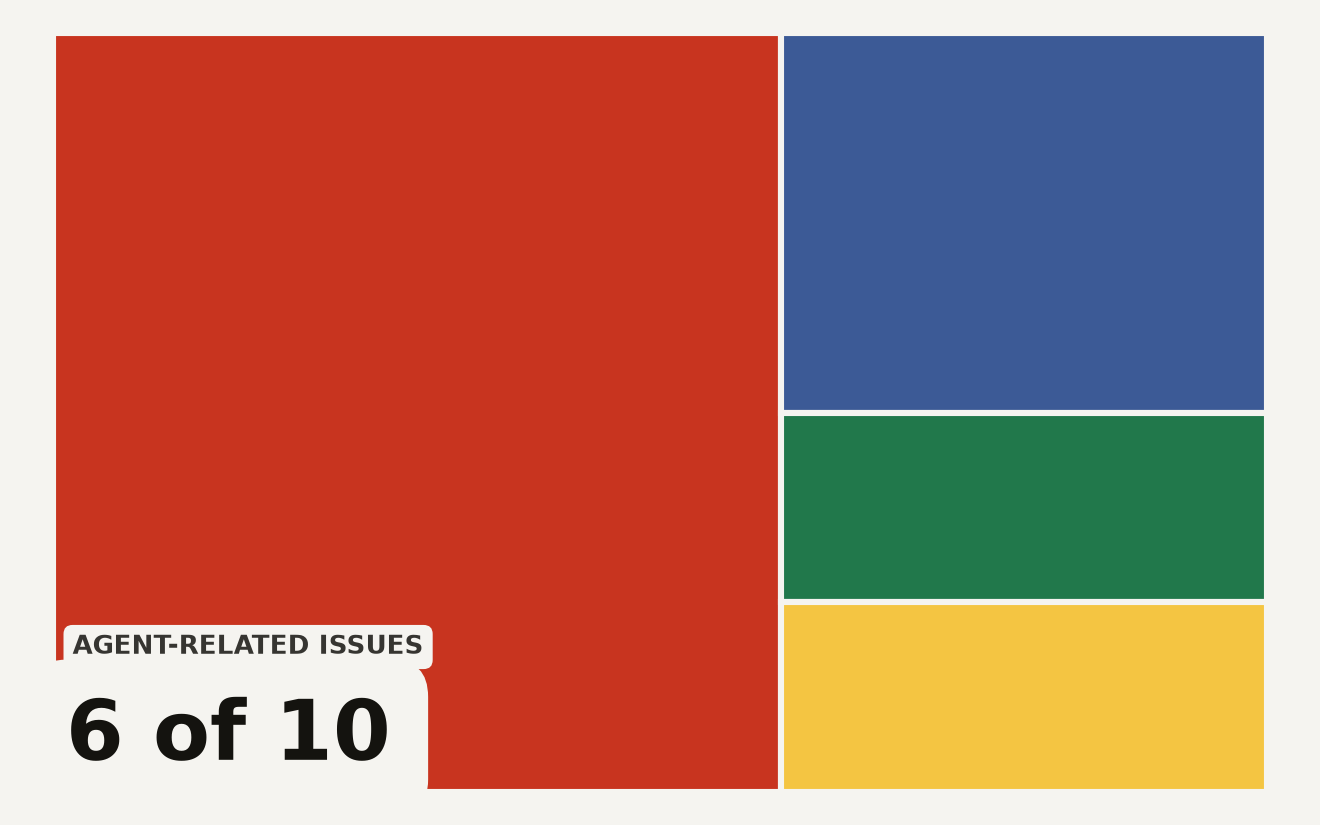
VS Code AI agents are the focus of 6 of 10 open feature-request issues filed by VS Code team members, according to a survey of the tracker published by Visual Studio Magazine on September 25. The proposals cover agent session management, multi-agent coordination, commit-level code review of agent work, and bring-your-own-key model access without Copilot authentication. One of them, a multi-agent judging system, went from a GitHub issue to an Insiders feature in roughly two weeks.
That velocity is the story. If you build coding tools, ship AI features, or manage a development team, the tracker tells you where Microsoft is investing engineering hours before anything reaches release notes.
How did a GitHub issue become an Insiders feature in two weeks?
On September 8, Microsoft engineer Megan Rogge opened a feature-request issue proposing that VS Code run multiple implementation attempts for the same coding task in isolated Git worktrees and then help developers compare the results. The proposal pointed to Cursor's multi-agent judging and OpenAI Codex's Best of N approach as related prior art. Roughly two weeks later, the implementation was merged. By September 24, the capability had surfaced in the VS Code 1.140 Insiders release notes as "Run Multiple Agents...", a command that sends the same prompt to multiple agents and uses a judge agent to recommend the best result.
The two-week window from public proposal to testable feature is unusually fast for a project the size of VS Code. The same survey notes that open issues are not roadmap commitments. Some may change substantially, linger in the backlog, or never ship at all. But the multi-agent feature shows that ideas move fast when they align with where the team is already headed.
The Agent Host architecture, introduced in August 2026, is the foundation these proposals build on. Because the Agent Host owns the session, you can start working with an agent in an editor window and continue with the same live session in the Agents window. Both surfaces stay synchronized. That architecture decision is what makes features like commit-by-commit review and multi-agent comparison tractable: the session is a first-class object that can be enumerated, inspected, and branched.
What do the 10 open issues reveal about VS Code's direction?
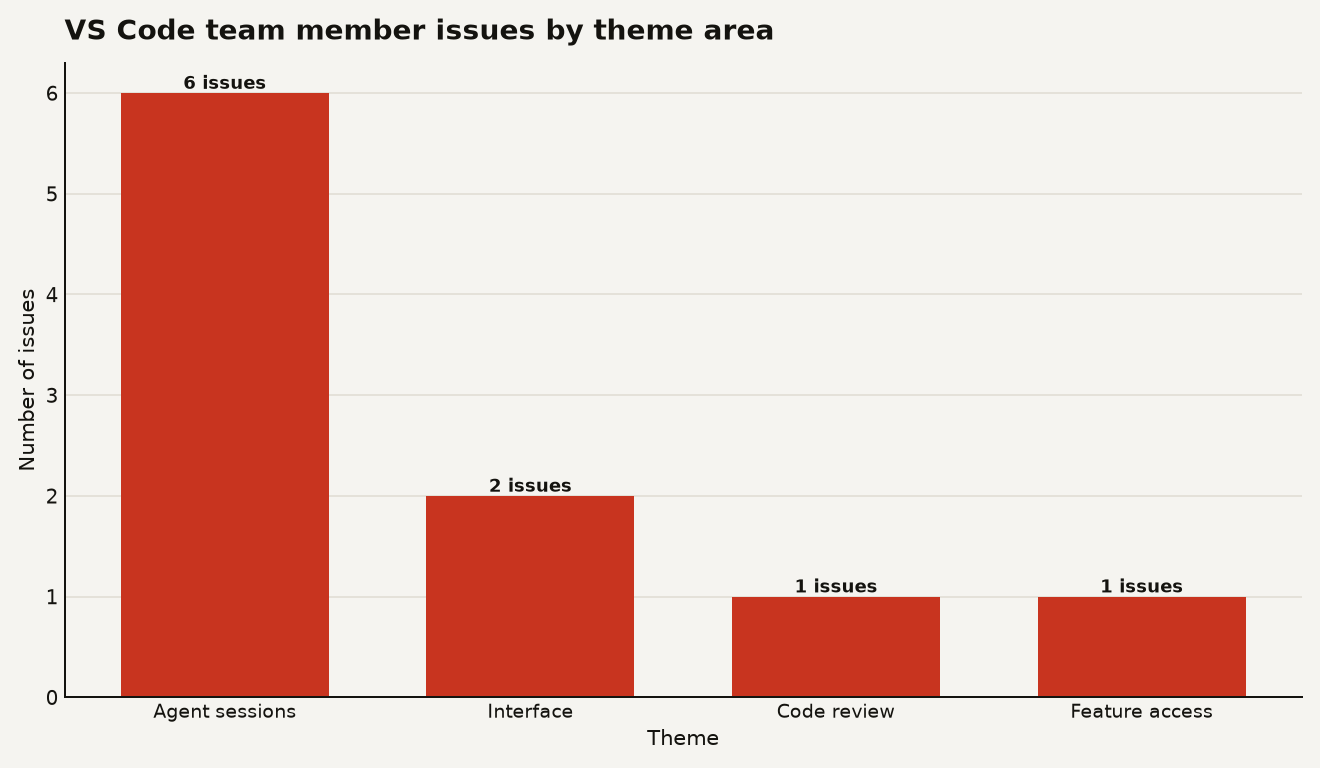
The 10 issues break down into four theme areas. Six deal with agent sessions, two target the VS Code interface, one addresses code review, and one covers feature access controls. The chart below shows the distribution.
Agent session proposals dominate the list. According to the Visual Studio Magazine survey, Ulugbek Abdullaev filed an issue asking the Agents window to show changes organized by individual commits rather than treating everything an agent changed as one aggregate result. Brigit Murtaugh filed three: one on how new agent sessions should be presented to first-time users, one proposing a "Send Prompt to Coding Agent" entry point directly from prompt files, and one asking for cancelled sessions to get a distinct status instead of displaying the same completed indicator as successfully finished work.
Tyler Leonhardt's BYOK proposal would let a developer run an agent session against a separately configured model without GitHub Copilot sign-in, requesting GitHub authentication only when a Copilot-hosted model or GitHub operation actually requires it. Ross Wollman's "AHP Client UI Library" issue proposes a shared set of UI components for clients built around the Agent Host Protocol, so that conversation basics like user and agent messages, tool calls, and reasoning displays do not need to be reimplemented by every client.
The two interface issues from Lee Murray track broader changes. One describes continuing work on density, tabs, customization, and rendering performance, and says Microsoft plans to eventually move everyone to the new UI and remove the Classic UI, though no removal date has been set. The other tracks refreshed light and dark themes built around reduced visual noise and more selective accent colors, with work-in-progress versions already being iterated on in Insiders.
Beyond the 10 issues in the survey, the GitHub tracker reveals more ambitious agent infrastructure. A session-management proposal exposes host-owned tools that let an agent enumerate, create, and manage other sessions programmatically, with a client-rendered "Open Session" pill that lets the user jump to what was created. The proposal includes recursion guards: create_session refuses beyond a maxSessionSpawnDepth, and process-wide backstops limit how many sessions can be created. A separate multi-root workspaces proposal would support cross-repo change tracking with worktrees, letting agents work across multiple repositories in parallel.
Why does this matter for builders shipping AI coding tools?
VS Code is becoming an agent runtime, not just an editor. The Agent Host architecture already lets you start an agent session in one surface and continue it in another. The proposals in the tracker push further: agents that create and manage other agent sessions, multi-agent workflows that run the same task in parallel and judge the results, and commit-level review of agent-generated code.
If you ship a coding agent or build on top of one, here is what the trajectory means for you:
- Multi-agent judging changes your cost calculus. Running N agents on the same task costs N times the tokens, plus the cost of a judge agent. For a task that takes 50,000 tokens to complete, a 3-agent comparison run with a judge could cost 200,000 tokens or more. The quality improvement has to justify that multiple.
- BYOK without Copilot sign-in loosens vendor lock-in. If you can run agent sessions against your own API key without GitHub authentication, you can swap the underlying model without changing your workflow. That makes it easier to test new models as they ship and harder for any single provider to own your agent stack.
- Agent-created sessions enable orchestration but introduce recursion risk. The session-management proposal already includes depth and breadth guards. If you are building agent systems, you need the same: unbounded session spawning is a denial-of-service vector, not just a UX problem.
- The Classic UI retirement is a migration to plan for. No date is set, but the direction is clear. Extensions and custom themes that depend on the Classic UI will need updating.
The competitive context matters here. Cursor's multi-agent judging was referenced in Rogge's proposal. Anthropic shipped parallel agent coordination in Claude Code Projects earlier this year. The VS Code Agents App preview, available in Insiders since April, already lets you kick off agent sessions across multiple repos in parallel, each isolated in its own worktree. Microsoft is not inventing the multi-agent category. It is shipping it into the editor that already has the distribution, and that distribution is the moat.
What should you do about it?
The tracker is public. You can build your own feature radar with a simple GitHub search:
repo:microsoft/vscode is:issue is:open label:feature-request
Then narrow by author handles like author:meganrogge, author:sandy081, author:roblourens, author:dbaeumer, author:TylerLeonhardt, or author:ulugbekna. Adding terms like agent, voice, terminal, or review focuses the results.
Here is what to bet on and what to avoid:
- Bet on multi-agent comparison becoming standard. Rogge's proposal already shipped to Insiders. If you build coding tools, start thinking about how your agent handles being one of N parallel attempts. Your evaluation pipeline needs to account for judge-agent selection, not just single-agent output quality.
- Bet on BYOK agent sessions. The pressure from open-source models and cheaper API providers makes lock-in to a single hosted model harder to justify. Leonhardt's proposal aligns with that direction. Test your agents against multiple providers now.
- Do not bet on specific issue numbers shipping as described. The Visual Studio Magazine survey is clear that open issues are not commitments. Murtaugh's first-time-user and cancelled-session issues both sit in the Backlog. They could ship next month or never.
- Watch the Agent Host Protocol. Wollman's shared UI components proposal and the session-management tools both build on AHP. If AHP becomes a real standard, third-party clients could plug into VS Code's agent infrastructure the way LSP clients plug into its language features. That would be a bigger deal than any single feature in the list.
One caveat: the survey covers 10 issues, not the full backlog. VS Code's repository contains thousands of issues. The pattern is real, but it is a sample, not a census.
The editor is becoming the agent runtime
VS Code spent a decade winning developers by being a fast, extensible text editor. The next phase is different. The Agent Host architecture makes sessions first-class objects. The multi-agent feature makes parallel implementation a menu command. The session-management proposal lets agents create other agents. The Classic UI is going away. Each of these, alone, is incremental. Together, they describe an editor that wants to own the agent workflow end to end: launch, run, review, judge, coordinate, and ship. If your roadmap assumes VS Code is just where developers write code, you are reading the wrong tracker.
Sources
- Visual Studio Magazine: What's Next for VS Code? 10 Open GitHub Issues Offer Clues
- Visual Studio Code Blog: Introducing the Agent Host for persistent, portable agent sessions
- Visual Studio Magazine: Hands On with Microsoft's New VS Code Agents Preview
- GitHub: microsoft/vscode issue #325051, session-management tools for Agent Host sessions
- GitHub: microsoft/vscode issue #311148, multi-root workspaces with cross-repo change tracking