The strange thing about infrastructure lock-in is that it looks boring until the bill arrives. Then the hypervisor becomes a board topic, the renewal date becomes a migration deadline, and the phrase “perpetual license” starts doing more work than anyone expected.
VMware migration has moved from forum grumbling to grocery-scale execution: Tesco says it is moving 40,000 server workloads off VMware after accusing Broadcom of “abusive conduct” in UK court filings, according to Ars Technica’s report on the case. That number matters because Tesco is not a lab, a startup, or a clean-sheet cloud shop. It is a £73.712 billion retailer whose infrastructure touches tills, logistics, stores, and online operations, based on Tesco’s 2025 to 2026 preliminary results.
This is the enterprise software story hiding behind the Broadcom and VMware fight. If a vendor can change the economics of a core platform faster than you can leave it, your architecture is also a procurement bet. Builders should read Tesco’s move as a warning label on every “standard platform” decision, including the AI and data systems now being wired into production. We have seen the same default-risk pattern in model choices, where brand gravity becomes technical gravity. VMware is the older, harder version: decades of tooling, backup, skills, and operational muscle memory wrapped around one vendor.
What actually happened between Tesco and Broadcom?
Tesco’s dispute starts with a contract and ends with a migration plan. In January 2021, Tesco bought perpetual licenses for VMware vSphere Foundation and VMware Cloud Foundation, Tanzu subscriptions, support services through 2026, and an option to extend support for four more years, according to The Register’s earlier account of the court documents. Broadcom completed its acquisition of VMware on November 22, 2023, and said VMware Cloud Foundation would sit at the core of its private and hybrid cloud strategy in Broadcom’s acquisition announcement.
The licensing world changed quickly after that. VMware by Broadcom said on December 11, 2023 that it would complete the transition to subscription licenses and end the sale of perpetual licenses and Support and Subscription renewals for perpetual offerings, according to Broadcom’s licensing announcement. That sentence is the fulcrum of the whole mess. A customer can still believe it owns software, while the vendor controls the paid path to support, patches, upgrades, and commercially acceptable risk.
Tesco alleges Broadcom refused to honor the prior deal and tried to make it buy duplicative subscription licenses to get support for software it had already paid for, according to The Register’s September 2025 report. In the newer filing reported by Ars, Tesco says Broadcom stopped supporting its VMware products in January 2026 and that Tesco has since paid for third-party support while trying to migrate away.
The price claims are blunt. Tesco says one Broadcom offer charged $23.5 million for one year of VMware Cloud Foundation 9.0 plus mainframe software and support, with the VMware portion allegedly around 175 percent above what Tesco says it should have paid, according to Ars Technica’s summary of the latest filings. Tesco also says the mainframe offer represented a 350 percent price hike, and the filings describe the prices as “manifestly unfair and excessive,” according to the same report.
That is why the 40,000 workload figure lands so hard. Tesco says it can be fully off VMware by the end of 2027 at the earliest if it moves at “exceptional pace,” according to Ars Technica’s report on the late May filings. The case itself is expected to be heard between November 1, 2027 and February 25, 2028, according to the same report. The migration clock may beat the legal clock. That is rarely a good sign for the customer.
Is Tesco an outlier or the loudest version of a larger VMware migration?
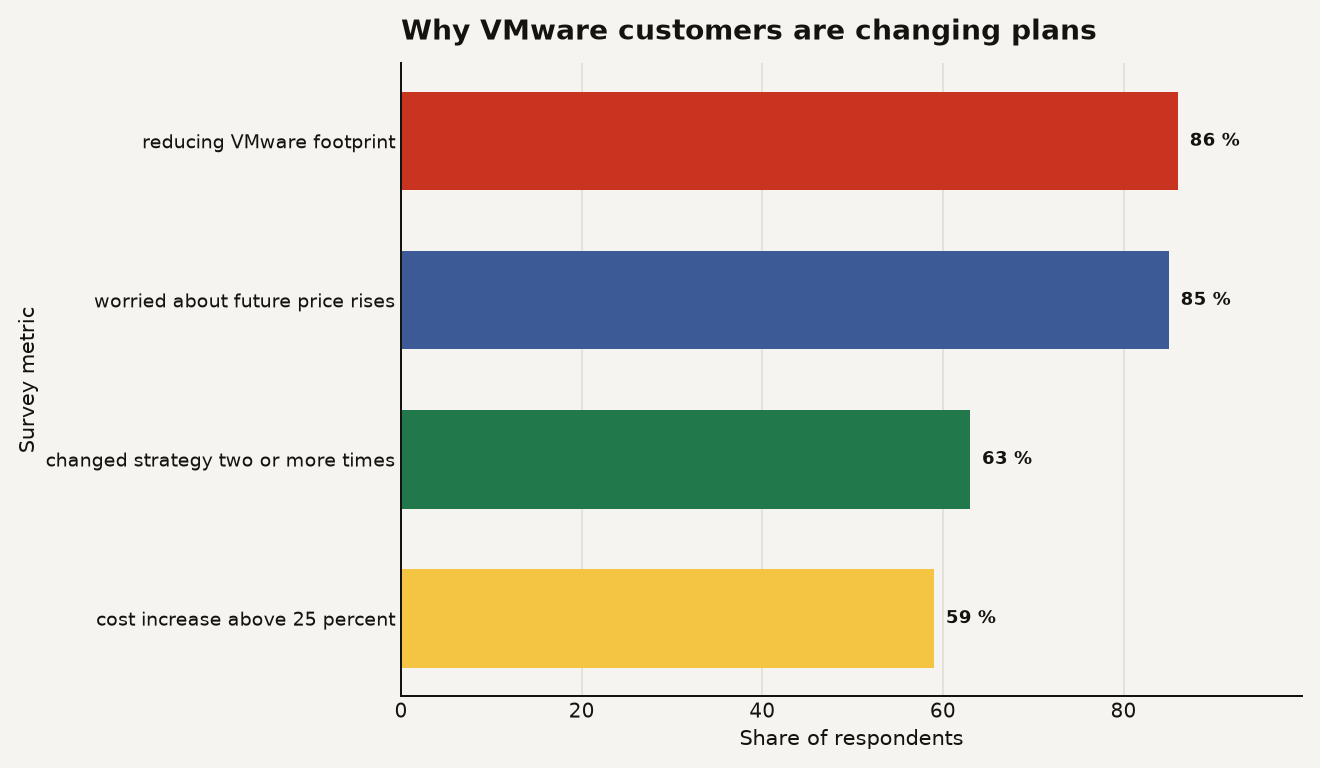
Tesco is unusually visible, but the underlying pressure is widespread. CloudBolt’s January 2026 survey of 302 North American enterprise IT decision-makers found 86 percent were actively reducing their VMware footprint, according to CloudBolt’s report page. The same survey says 85 percent remained worried about future Broadcom price increases, 63 percent had changed VMware strategy two or more times since the acquisition, and 59 percent had experienced cost increases above 25 percent.
The chart shows why “just migrate” is the kind of advice that sounds clean only from far away. The biggest number is intent, 86 percent reducing footprint. The more revealing number is churn in the plan itself: 63 percent changing strategy at least twice.
Broadcom’s side of the story is simple and commercially rational. The company wants VMware customers on a smaller set of subscription bundles, especially VMware Cloud Foundation. Broadcom said nine of the top 10 Fortune 500 companies had committed to VCF and that customers had licensed more than 100 million VCF cores worldwide in an August 2025 VMware Cloud Foundation announcement. In other words, the strategy is not obviously failing.
Broadcom’s financials back that up. In its second quarter fiscal 2026 results, Broadcom reported $22.187 billion in total revenue and $7.178 billion in infrastructure software revenue, according to Broadcom’s June 3, 2026 earnings release. The company also guided for approximately $29.4 billion in third quarter fiscal 2026 revenue in the same release. Customer anger can coexist with vendor success. In enterprise software, that is almost the business model.
The underrated fact is that both things can be true. VMware can remain valuable, deeply embedded, and technically strong, while the renewal experience pushes customers to shrink exposure. A platform can be worth keeping for the hardest workloads and worth escaping for everything else. That is the split builders should expect.
Why should builders care if they are nowhere near 40,000 workloads?
Because the Tesco case puts a price on architectural convenience. When you standardize on a platform, you are buying more than a product. You are buying its contract model, its partner ecosystem, its patch policy, its certification map, its support queue, and its future owner.
For a developer or platform lead, the painful part is dependency depth. VMware sits under backup tooling, disaster recovery, observability, network policy, identity, image pipelines, compliance evidence, runbooks, and thousands of “temporary” exceptions that have survived five reorgs. Tesco’s filings reportedly say its unnamed replacement software is incompatible with Veeam and Zerto products it uses, according to Ars Technica’s account of the migration risks. That is the real migration bill: the hypervisor move is only the front door.
For a founder or business owner, the lesson is about negotiating power. If your architecture makes exit slow, your renewal is less of a negotiation. A supplier can price against your switching cost, your outage fear, and your audit anxiety. Tesco is big enough to sue, pay third-party support, and run a multi-year migration. A 200-person SaaS company with three platform engineers usually has fewer moves.
The practical consequences land in four places:
- Roadmap drag: every quarter spent unwinding infrastructure is a quarter where platform teams are not improving deployment speed, reliability, or developer experience.
- Cost opacity: subscription bundles can make unit economics harder to explain, especially when teams use only a slice of a full-stack suite.
- Hiring risk: a narrow platform bet creates a skills moat until the market turns, then it becomes a recruiting constraint.
- Operational blast radius: backup, recovery, compliance, and security tools often depend on platform-specific hooks that vendors rarely model in a neat migration calculator.
The mistake is treating vendor risk as a legal problem for procurement. It is a systems design problem. Procurement sees the renewal date. Engineering sees the dependency graph. Finance sees the run rate. Security sees the patch exposure. Someone has to make those views meet before the quote lands.
What should you do before your own renewal becomes a migration plan?
Start with a boring inventory, then make it politically useful. Count workloads, owners, business criticality, data gravity, compliance constraints, backup method, recovery objective, license dependency, and the nearest plausible landing zone. The first usable output should fit on one page: how much can leave in 90 days, how much can leave in 12 months, and what probably stays for three years.
Then split the estate. Do not make “leave VMware” the only plan. Tesco’s scale makes a full exit newsworthy, but most companies need segmentation more than slogans. Some workloads belong on a cheaper virtualization stack. Some should be rebuilt onto managed cloud services. Some should be containerized because the current VM is really a packaging habit. Some should stay put until the replacement risk is lower than the renewal pain.
A good exit plan has three numbers attached:
- Renewal exposure: the annual and multi-year spend if you accept the new model.
- Migration capacity: the number of workloads a team can safely move per month after the factory is built.
- Residual dependency: the percentage of workloads that remain vendor-bound after the first wave.
CloudBolt’s survey says 63 percent of respondents changed VMware strategy two or more times, which is a polite way of saying many companies discovered their first plan was theater. Tie your plan to tests. Move 20 representative workloads before promising 2,000. Restore from backup on the new stack before you talk about resilience. Run a security patch drill before you count the risk as retired.
Also rewrite your enterprise software checklist. If a vendor is becoming a foundation layer for AI, data, observability, or developer workflow, ask for contract language that covers support continuity, renewal mechanics, product bundling, audit process, assignment after acquisition, and exit assistance. The questions feel adversarial until the acquisition happens. Then they feel late.
What happens next for Broadcom, VMware customers, and the rest of the market?
The court fight will move slowly. Tesco’s reported hearing window starts on November 1, 2027, which means the technical migration may be far along before a judge says anything definitive about the contract. That timing matters for other customers. Legal clarity may arrive after renewal decisions, not before them.
Broadcom has little reason to reverse the broad strategy while the numbers work. Its infrastructure software segment grew 9 percent year over year in Q2 fiscal 2026, according to Broadcom’s quarterly results. The company can lose some angry customers and still improve revenue quality if the largest accounts commit to longer, broader subscriptions.
Competitors will feast on the opening, but they should resist the easy pitch. Nutanix, Red Hat, Microsoft, HPE, Proxmox service providers, and cloud platforms can win workloads, yet few can offer a one-click replacement for the full VMware operating model. The buyer who believes otherwise is volunteering for a second lock-in story with a different logo.
For builders, the right bet is optionality. Design new systems so they can run on at least two plausible substrates. Keep backup and recovery as portable as the budget allows. Prefer APIs and automation that survive a platform swap. Track platform-specific features as debt, even when they are useful. Debt is fine when it is priced honestly.
The AI angle is coming fast. Broadcom is positioning VCF as a private cloud base for AI workloads, and its August 2025 announcement said VMware Private AI Services would become a standard component of VCF 9.0, according to Broadcom’s VCF update. If your inference stack, vector databases, model gateways, and data governance all settle onto one private cloud control plane, the switching cost compounds. Tesco is showing what that movie looks like after the sequel.
The lock-in tax has a receipt
Tesco’s VMware migration is a rare enterprise infrastructure story with a clean number at the center: 40,000 workloads. The number is large, but the lesson is ordinary. Platforms become powerful because they remove decisions. Later, the missing decisions return as switching costs.
If you are choosing a foundation layer this quarter, ask one question before the demo gets too glossy: how ugly would it be to leave in 2027? The vendor’s answer matters less than whether your team can produce its own.
Sources
- Ars Technica: Tesco moving 40,000 server workloads off VMware amid Broadcom's “abusive conduct”
- The Register: Supermarket giant Tesco sues VMware, warns lack of support could disrupt food supply
- Tesco PLC: Preliminary Results 2025/26
- Broadcom: Broadcom Completes Acquisition of VMware
- Broadcom: VMware by Broadcom Dramatically Simplifies Offer Lineup and Licensing Model
- CloudBolt: The Mass Exodus That Never Was
- Broadcom: Broadcom Inc. Announces Second Quarter Fiscal Year 2026 Financial Results
- Broadcom: VMware Cloud Foundation becomes an AI native platform