This is the full research report behind the video: every number, source, and chart the script was written from.
Executive summary
On July 30, 2026, Tim Cook delivered his final earnings call as Apple's CEO and used a phrase that nobody in the financial press had heard before: he called the current spike in memory chip prices a "hundred-year flood." Apple had just posted record fiscal third-quarter revenue of $109.4 billion, up 16 percent year over year, with diluted earnings per share of $2.02 beating Wall Street's estimate of $1.88 by fourteen cents. By any normal measure, it was a blowout quarter. The stock dropped 7 percent in after-hours trading anyway.
The reason is that Cook spent a large portion of the call talking about something that has nothing to do with how Apple performed last quarter and everything to do with what it will cost to build products next quarter and the quarter after that. Memory chips, the DRAM and NAND flash that go into every iPhone, Mac, iPad, and Apple Watch, have gotten dramatically more expensive and harder to source. The cause is AI. Data center operators, building out the infrastructure for large language models and generative AI systems, are buying up high bandwidth memory (HBM) at a pace that has crowded out the production capacity for the ordinary memory chips that consumer electronics depend on. According to data compiled from Wikipedia's coverage of the DRAM market, prices for commodity DRAM and NAND have risen more than 200 percent since early 2025, and Micron Technology has noted a 3-to-1 conversion ratio between HBM and DDR5 wafer capacity, meaning every shift toward HBM production directly compresses the supply of general-purpose memory.
Apple is not the only company affected. Amazon, which reported earnings the same day, flagged similar cost pressures. But Apple is the most visible consumer electronics company on earth, and Cook's choice of words, on his final call before handing the CEO role to John Ternus in September, turned a supply chain problem into a headline. The market's reaction was swift and bifurcated: Apple fell, while memory chipmakers Micron (MU), Sandisk (SNDK), and Western Digital (WDC) surged in after-hours trading, with SNDK gaining nearly 26 percent and MU gaining over 18 percent on the day.
Key findings:
- Apple's Q3 FY2026 revenue was $109.4 billion (up 16 percent YoY), with EPS of $2.02 (up 29 percent YoY), but Q4 guidance of $111.7 to $113.7 billion fell below the $114.3 billion consensus.
- Tim Cook warned that memory chip price increases represent a "hundred-year flood" and that iPhone prices are "not immune" to rising memory costs.
- DRAM and NAND prices have risen over 200 percent since early 2025, driven by AI data center demand for HBM crowding out commodity memory production capacity.
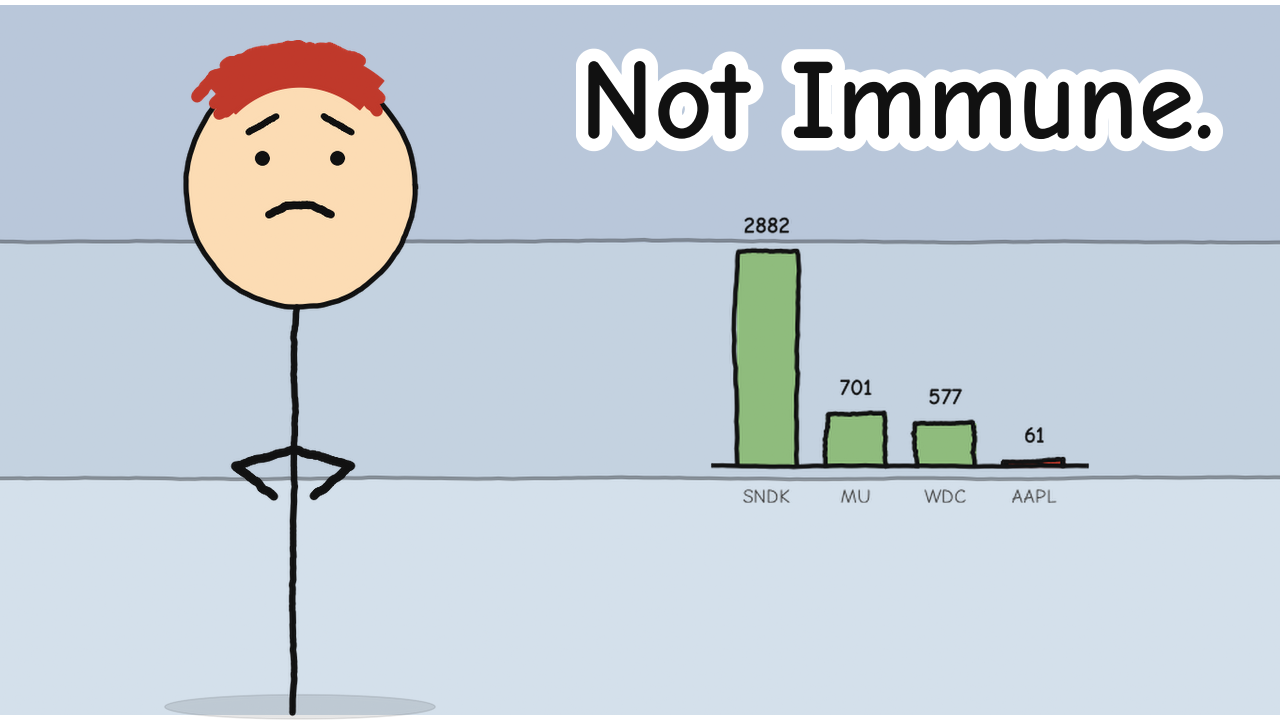
- Memory chip stocks have been the best-performing sector of the past year: SNDK returned 2,882 percent, MU returned 701 percent, and WDC returned 577 percent, versus Apple's 61 percent and the S&P 500's 17 percent.
- Apple's daily return correlation with Micron over the past year is essentially zero (-0.007), meaning the two stocks are moving on entirely different drivers.
- The 2020-2023 global chip shortage, which cost the automotive industry an estimated $210 billion in lost revenue, offers a structural parallel but differs in cause: that shortage was driven by pandemic demand shifts and supply disruptions, while this one is driven by AI infrastructure investment deliberately crowding out consumer chip supply.
1. What this means for your next phone, and your wallet
If you are planning to buy a new iPhone in the next six months, Tim Cook just told you something you probably did not want to hear. On Apple's earnings call on July 30, 2026, he said that iPhone prices are "not immune" to the rising cost of memory chips. In plain English: the price of the memory inside your phone has gone up so much that Apple is either going to raise what it charges you, or it is going to eat the cost and watch its profit margins shrink. Cook did not say which option Apple will pick, but the fact that he used the phrase "not immune" on a call with analysts, rather than reassuring them that Apple would absorb the costs, tells you the direction this is heading.
Here is the kitchen-table version of what is happening. Every electronic device you own, your phone, your laptop, your watch, your TV remote, contains memory chips. There are two main kinds. DRAM (dynamic random-access memory) is the working memory, the stuff that holds data while the device is running. NAND flash is the storage memory, where your photos and apps live when the device is off. Both have gotten dramatically more expensive since early 2025. According to data compiled from industry sources cited in Wikipedia's coverage of the DRAM market, some categories of memory have seen price increases exceeding 200 percent in roughly eighteen months.
The reason is not a factory fire or a trade war or a pandemic, though those things have happened before. The reason is that companies building AI data centers, the massive computing facilities that run ChatGPT-style systems and the AI features now baked into every tech product, are buying up a specialized type of memory called HBM (high bandwidth memory) at a rate the industry has never seen. The problem is that HBM and the ordinary memory in your phone are made on the same production lines, using the same silicon wafers, in the same factories. When the factories shift capacity to HBM because AI companies will pay premium prices for it, there is less capacity left for the memory that goes into consumer electronics. Micron, one of only three companies in the world that makes these chips (the others are Samsung and SK Hynix), has noted a 3-to-1 conversion ratio: for every unit of wafer capacity shifted to HBM, you lose three units of DDR5 output.
What this means for you, concretely, is probably one of three things. First, the next iPhone could cost more. Apple has raised prices before, but usually with some new feature as justification. This time the price increase would be driven by a component cost that Apple does not fully control. Second, you might wait longer. Apple is already stockpiling inventory, according to TechCrunch's reporting on the earnings call, bracing for what the company called "significant supply constraints." If memory runs short, Apple will have to allocate what it has across its product lines, and some configurations or models could face delays. Third, Apple could absorb the cost, but that would mean lower profit margins, which is why the stock dropped 7 percent after hours. Investors do not like the idea of Apple's famously fat margins getting squeezed by a component it buys from three suppliers half a world away.
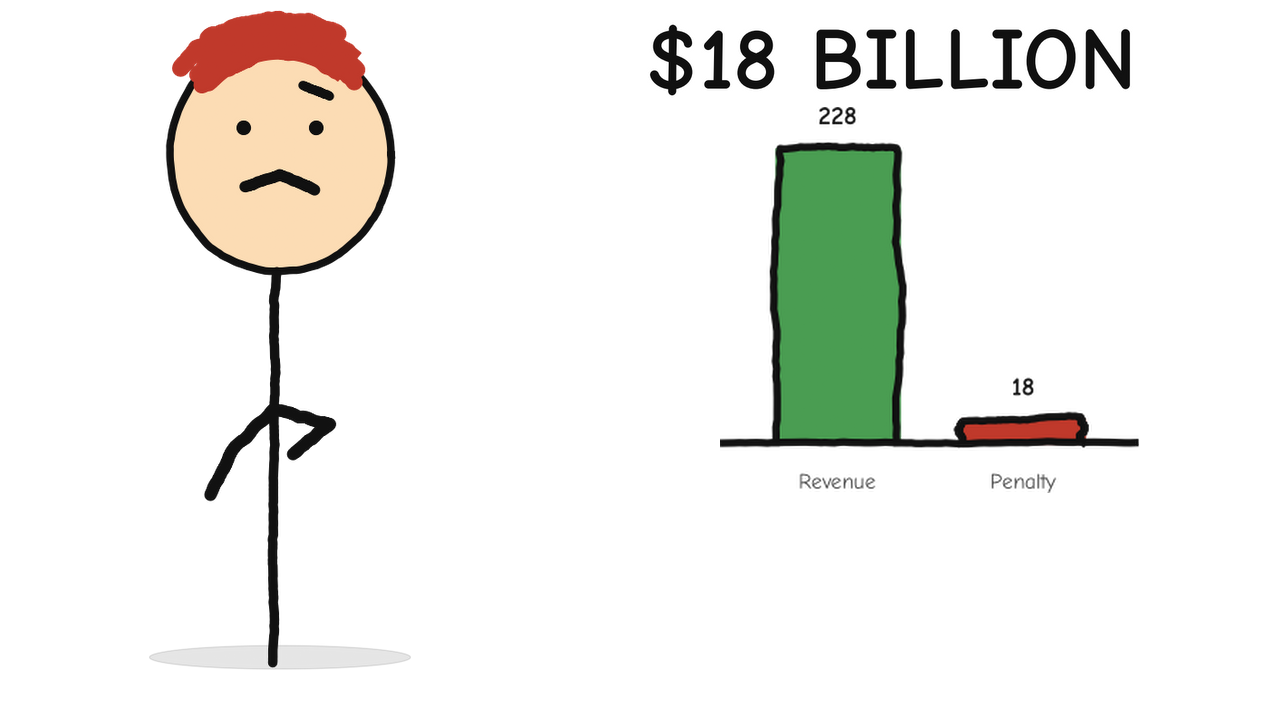
There is also a subtlety here that matters if you own Apple stock or an S&P 500 index fund. Apple is now a roughly $5 trillion company trading at about 40 times earnings. At that valuation, investors have priced in the expectation that Apple will keep growing revenue and maintaining its profit margins. A memory shortage threatens both. If Apple raises prices to cover higher memory costs, some consumers may hold off on upgrading, which slows revenue growth. If Apple absorbs the costs, margins fall. Either way, the math that supports a $5 trillion valuation gets harder to justify. This is why a record-breaking quarter, $109.4 billion in revenue and $2.02 in earnings per share, was met with a stock sell-off. The quarter was about the past. The memory shortage is about the future.
2. The last time chips went missing: 2020-2023, and what actually carried over
To understand what is happening now, it helps to look at the last time the world ran out of chips. The 2020-2023 global semiconductor shortage was, until this year, the most disruptive chip supply crisis in modern history. According to Goldman Sachs analysis cited in Wikipedia's coverage of the shortage, at least 169 industries were affected. The automotive sector alone was projected to lose $210 billion in revenue in 2021. Toyota planned to cut global vehicle production by 40 percent in September 2021. General Motors halted production at nearly all its North American plants for one to two weeks that same month. Ford parked thousands of unfinished vehicles at the Kentucky Speedway, waiting for chips that never arrived on time.
The shortage started with a miscalculation. When COVID-19 hit in early 2020, car manufacturers predicted that sales would collapse and canceled their chip orders. They were wrong. Demand for cars recovered faster than expected, but by then the chip foundries had shifted their production lines to serve the surge in demand for laptops, tablets, and gaming consoles, as hundreds of millions of people shifted to remote work and remote learning. PC sales grew 26.1 percent in the fourth quarter of 2020 alone. When automakers tried to reorder chips, they found themselves at the back of a very long line.
The crisis was compounded by a cascade of disruptions. In September 2020, the US Commerce Department restricted China's largest chipmaker, SMIC, forcing companies to redirect orders to TSMC and Samsung, which were already running at maximum capacity. In February 2021, a severe winter storm in Texas shut down three chip plants in Austin owned by Samsung, Infineon, and NXP. In March 2021, a fire at a Renesas Electronics plant in Japan, which supplied 30 percent of the global market for microcontroller units used in cars, knocked out production for at least 100 days. Taiwan experienced its worst drought in over half a century in 2021, threatening the water supply that chip fabs depend on (TSMC's facilities alone used more than 63,000 tons of water per day). Cryptocurrency miners were buying up graphics cards faster than Nvidia and AMD could make them, with scalpers reselling GPUs at markups of up to 300 percent above retail price.
The consumer experience during that shortage was miserable in a way that feels familiar now. If you tried to buy a PlayStation 5 or an Xbox Series X in 2021, you probably could not find one. If you tried to buy a graphics card for a PC build, you either paid a scalper's premium or you waited months. If you were shopping for a car, you paid above sticker price for a used vehicle because new cars were not available. Lead times for semiconductors from Broadcom extended to 22.2 weeks by April 2021, up from 12.2 weeks in February 2020. The shortage mostly subsided by 2023, as demand cooled and capacity expanded, but the automotive industry's production numbers had still not fully recovered to pre-pandemic levels by 2024.
So what carries over to today's memory crisis? Several structural parallels are worth noting. First, both shortages involve a capacity reallocation problem. In 2021, foundries shifted from auto chips to consumer electronics chips because consumer demand was stronger and more profitable. In 2026, memory makers are shifting from commodity DRAM to HBM because AI demand is stronger and more profitable. The mechanism is the same: the supplier follows the money, and the customer left behind has to wait or pay more.
Second, both shortages reveal how concentrated the supply chain has become. In 2021, the world's dependence on TSMC became a geopolitical flashpoint. In 2026, the world's dependence on three memory makers (Samsung, SK Hynix, and Micron) is doing the same thing. When only three companies make a product that everyone needs, any disruption to any one of them ripples through the entire economy.
Third, both shortages created winners and losers in the stock market in ways that were not immediately obvious. In 2021, used car dealerships and scalpers made fortunes while automakers bled. In 2026, memory chipmakers are the winners while consumer electronics companies like Apple face margin pressure.
What does not carry over is the cause. The 2021 shortage was an accident, a cascade of misfortunes and misjudgments. The 2026 memory shortage is a deliberate economic calculation. Memory companies are choosing to make HBM instead of commodity DRAM because AI companies will pay more for it. This is not a supply chain that broke. It is a supply chain that was redirected, and that distinction matters for how long it lasts and how it resolves.
3. The hundred-year flood: timeline, players, and the money
Tim Cook chose his words carefully. A "hundred-year flood" is an insurance term for a disaster so extreme that it is supposed to happen only once a century. By using it on an earnings call, Cook was telling analysts two things at once: this memory price spike is not normal, and Apple does not expect it to be a recurring event. Whether that reassurance is warranted is an open question.
The timeline of how we got here starts well before July 30, 2026. The memory market has been cyclical for decades, swinging between gluts and shortages as manufacturers build capacity, oversupply the market, cut back, and then get caught short when demand picks up. The current cycle began turning in late 2024, when AI infrastructure spending started accelerating. According to the data compiled from Wikipedia's DRAM and HBM entries, DRAM and NAND prices began their compounded increases in early 2025, with some categories exceeding 200 percent price growth over the following eighteen months.
The mechanism is specific. AI training and inference require enormous amounts of memory bandwidth. The chips that do this work, primarily Nvidia's GPU accelerators and a growing fleet of custom AI ASICs from companies like Amazon, Google, and Meta, need HBM stacked alongside them to feed data fast enough to keep the compute cores busy. HBM is manufactured by stacking DRAM dies vertically and connecting them with through-silicon vias, a process that is technically demanding and yields are lower than for standard DRAM. According to Wikipedia's HBM entry, the world's largest HBM manufacturers in 2025 were SK Hynix, Samsung Electronics, and Micron Technology, the same three companies that dominate the broader DRAM market.
The capacity problem is mathematical. Micron has noted a 3-to-1 conversion ratio between HBM and DDR5 wafer capacity. This means that for every wafer allocated to HBM production, the output of standard DDR5 memory drops by a factor of three. As AI companies order more HBM, the supply of commodity DRAM contracts. The price of commodity DRAM rises because there is less of it. NAND flash, used for storage, faces a similar dynamic because some NAND capacity is also being redirected toward AI-related solid-state drives for data centers.
The players in this story fall into three camps. The first camp is the memory makers: Micron (MU), Sandisk (SNDK, spun off from Western Digital in early 2025), Western Digital (WDC), Samsung Electronics (005930.KS), and SK Hynix (which trades over the counter in the US as SKHY). These companies are the direct beneficiaries. Their stock prices have been extraordinary. Over the past twelve months, SNDK returned approximately 2,882 percent, MU returned 701 percent, WDC returned 577 percent, and Samsung returned 249 percent. These are not normal stock returns. They reflect the market's belief that memory pricing will stay elevated for an extended period.
The second camp is the big AI infrastructure spenders: Nvidia, Amazon, Google, Meta, and Microsoft. These companies need HBM for their AI chips and are willing to pay whatever it costs because the return on AI investment, so far, has justified the spending. Amazon reported earnings the same day as Apple and, according to Stocktwits' coverage, its management also flagged soaring memory costs and supply constraints. The difference is that Amazon can pass those costs through to its cloud customers, who are businesses, more easily than Apple can pass them through to individual consumers.
The third camp is the consumer electronics companies, with Apple as the largest and most visible. Apple does not make its own memory chips. It buys DRAM and NAND from Samsung, Micron, SK Hynix, and others. When those suppliers raise prices, Apple's cost of goods sold goes up. Apple's gross margin in the June quarter was 50.1 percent, but the company disclosed that approximately 2 percentage points of that came from tariff refunds, a one-time benefit that will not recur. Strip that out and the underlying margin was closer to 48 percent, already under pressure before the memory shortage fully hits.
The money flow is straightforward. AI companies pay premium prices for HBM. Memory makers shift capacity to HBM. Commodity DRAM and NAND supply shrinks. Consumer electronics companies pay more for the memory they need. Either they raise prices or they eat the cost. Apple, so far, is signaling that it will do some of both. Cook said iPhone prices are "not immune," which is corporate-speak for "we are going to raise them." But he also said Apple is stockpiling inventory, which suggests the company is buying ahead at current prices to avoid paying even more later. That strategy has limits. If memory prices keep rising, the inventory Apple buys today will be cheaper than what it buys in six months, but it will still be far more expensive than what it paid a year ago.
4. Who gets rich, who gets squeezed: the supply chain economics
The memory chip shortage is creating one of the most extreme wealth transfers in the technology sector in recent memory. To see it clearly, you have to understand the supply chain economics, which are simpler than most people think.
The global DRAM market is an oligopoly. Three companies, Samsung Electronics, SK Hynix, and Micron Technology, control the vast majority of production. According to Wikipedia's DRAM entry, a 2018 industry analysis noted that these three suppliers were "keeping a pretty tight rein on their capacity," a characterization that remains accurate in 2026. When three companies control supply, they have significant pricing power. They do not need to collude (which would be illegal) to raise prices. They simply need to allocate their capacity to the highest bidder, and right now the highest bidder is the AI industry.
The economics of HBM versus commodity DRAM are where the story gets interesting. HBM sells at a substantial premium to standard DRAM. According to the capacity conversion data, every wafer devoted to HBM produces roughly one-third the volume of standard DDR5 output. If a memory company can sell HBM at three times the price of DDR5, it makes economic sense to shift as much capacity as possible to HBM. The AI companies, in turn, can afford those prices because an Nvidia H200 or B200 GPU paired with HBM can generate revenue for a cloud provider that dwarfs the memory cost. A single AI training run might cost millions of dollars in compute, and the memory is a fraction of that. The AI companies do not care about memory prices the way Apple does, because memory is a small line item in a very large budget.
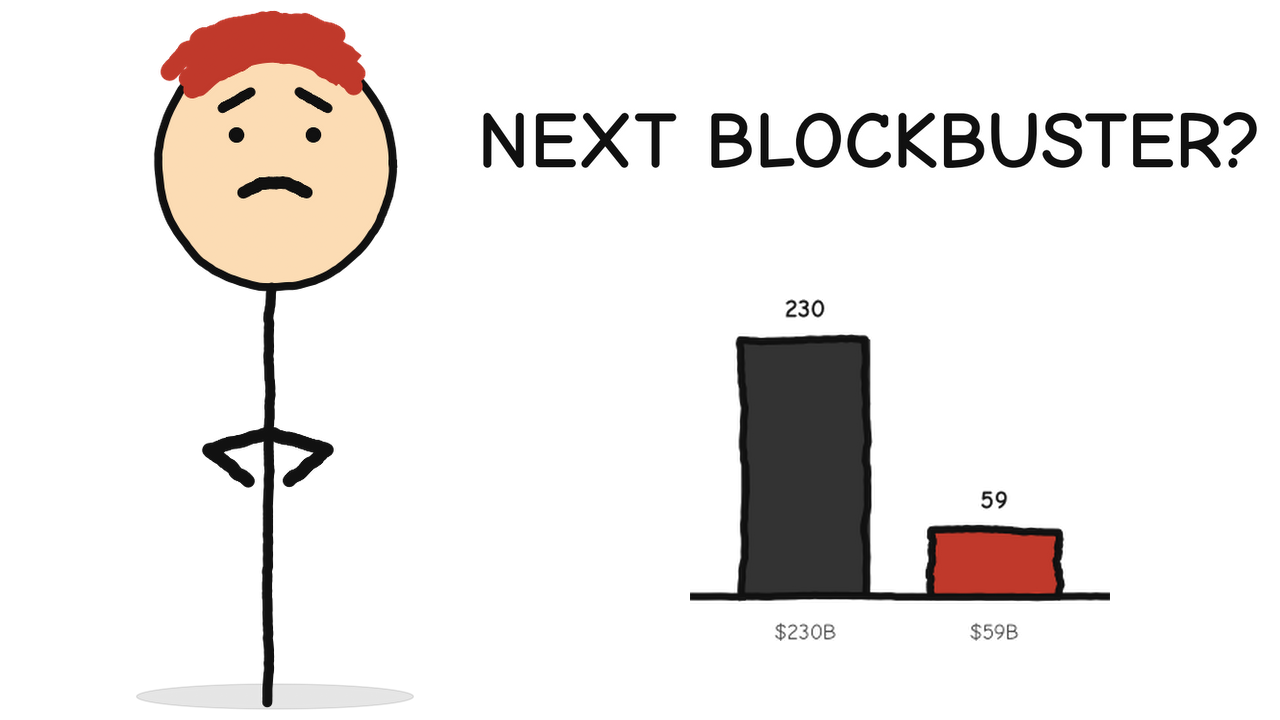
Apple, by contrast, is a volume buyer of commodity memory. An iPhone 17 Pro might contain 8 or 12 gigabytes of LPDDR DRAM and 256 gigabytes or more of NAND flash. At pre-2025 prices, the memory in a flagship iPhone might cost Apple $30 to $50 per unit. If memory prices have doubled or tripled, that same memory might now cost $60 to $150 per unit. Apple sells roughly 230 million iPhones per year. A $50 per-unit increase in memory costs, if Apple absorbs it entirely, would reduce operating profit by over $11 billion annually. That is not catastrophic for a company that generated $122.6 billion in net income over the trailing twelve months, but it is enough to move the needle on margins, and at a 40 times earnings valuation, margin compression gets punished.
The question is who absorbs the cost. There are four possibilities, and the outcome will likely be a combination of all of them. First, Apple raises iPhone prices. A $50 to $100 price increase on a $1,099 phone is noticeable but not necessarily deal-breaking for Apple's core customer base, which skews affluent. Second, Apple reduces the amount of memory in some configurations, offering fewer base-model options or pushing consumers toward higher-priced tiers. Third, Apple's suppliers give Apple preferential pricing because of its volume and long-term relationships. Samsung, in particular, is both a memory supplier to Apple and a smartphone competitor, which creates a complex dynamic. Fourth, Apple's profit margins compress, and shareholders eat the cost.
The market is already pricing in some combination of these outcomes. Apple's stock fell 7 percent in after-hours trading on July 30, closing the regular session at $333.43 before dropping to approximately $312 in extended trading. The after-hours decline of roughly $21 per share, on a stock with roughly 15 billion shares outstanding, represents about $315 billion in market capitalization evaporated in a few hours. That is more than the entire market cap of companies like Coca-Cola or Netflix. It reflects investor anxiety about margins, guidance, and the leadership transition from Tim Cook to John Ternus, all hitting on the same day.
Meanwhile, the memory makers are being rewarded. On the same day Apple fell, Micron gained 18.36 percent to close at $874.66, Sandisk gained 25.99 percent to close at $1,279.96, and Western Digital surged as well. The Zacks #1 Rank list for July 30 showed Sandisk and Micron among the top momentum movers, with Sandisk up 25.99 percent and Micron up 18.36 percent. Silicon Motion Technology (SIMO), a maker of NAND flash controllers, gained 21.66 percent. Aehr Test Systems (AEHR), which makes testing equipment for memory chips, gained 17.54 percent. The entire memory supply chain, from the chipmakers to the equipment vendors, is being repriced on the assumption that the shortage will persist.
This is the wealth transfer in action. Money that would have gone to Apple's bottom line, or to consumers in the form of lower prices, is being redirected to the memory makers. Apple is the largest consumer electronics company on earth, but it is a price-taker in the memory market. It does not make DRAM. It does not make NAND. It does not make HBM. It buys those things from three companies that do, and right now those three companies have all the leverage.
5. The data: memory stocks, Apple, and what the numbers say
The stock market has been telling the memory shortage story for months before Tim Cook named it. The data makes the scale of the repricing clear.
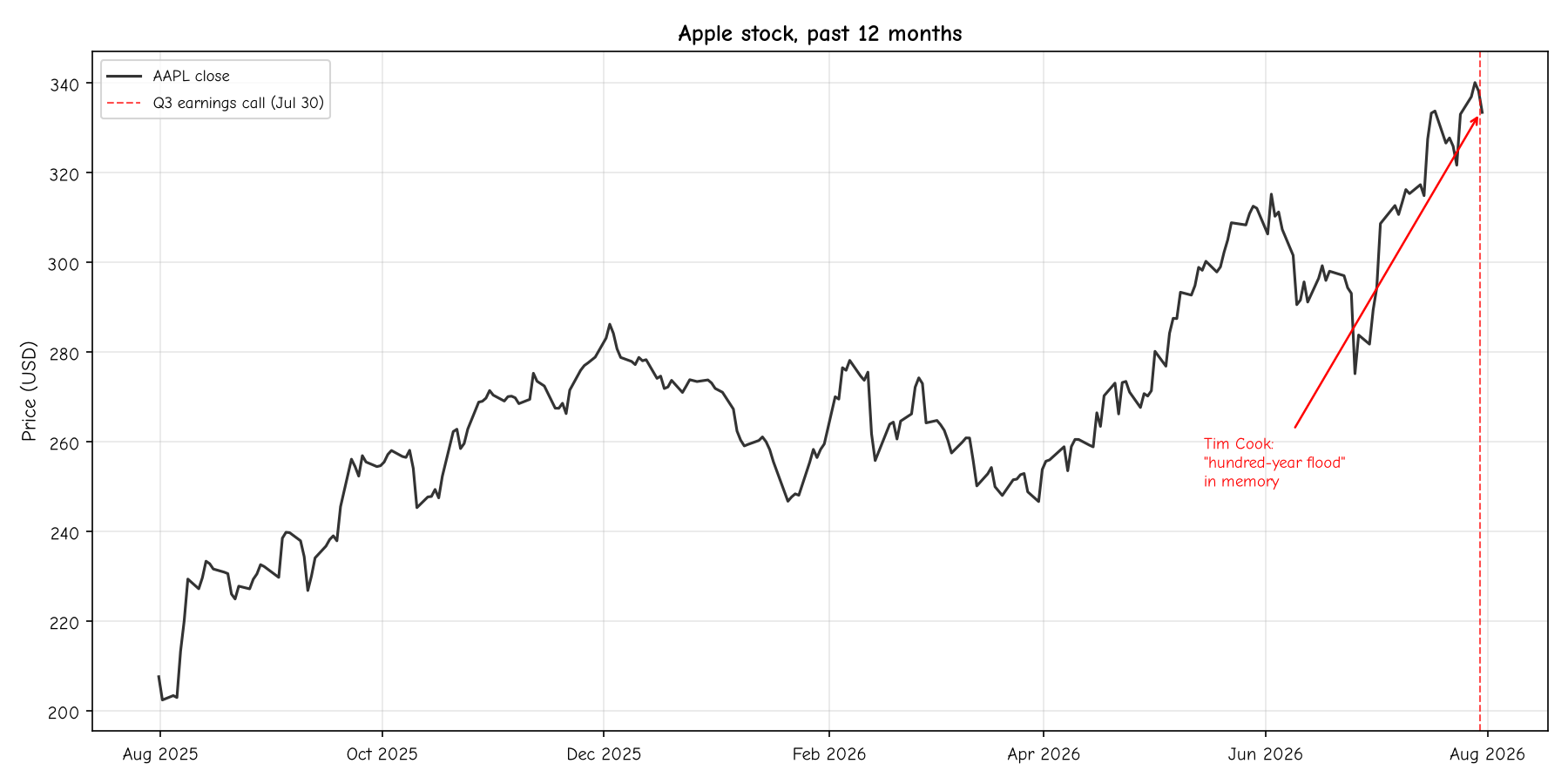
Apple's stock has had a strong year by any normal standard, rising 60.6 percent over the trailing twelve months from roughly $208 to $333. The chart shows a steady climb with a sharp pullback at the end, coinciding with the July 30 earnings call. The S&P 500 returned 17.3 percent over the same period, so Apple outperformed the broader market by a factor of roughly 3.5 times. But that outperformance looks modest next to what happened in the memory sector.
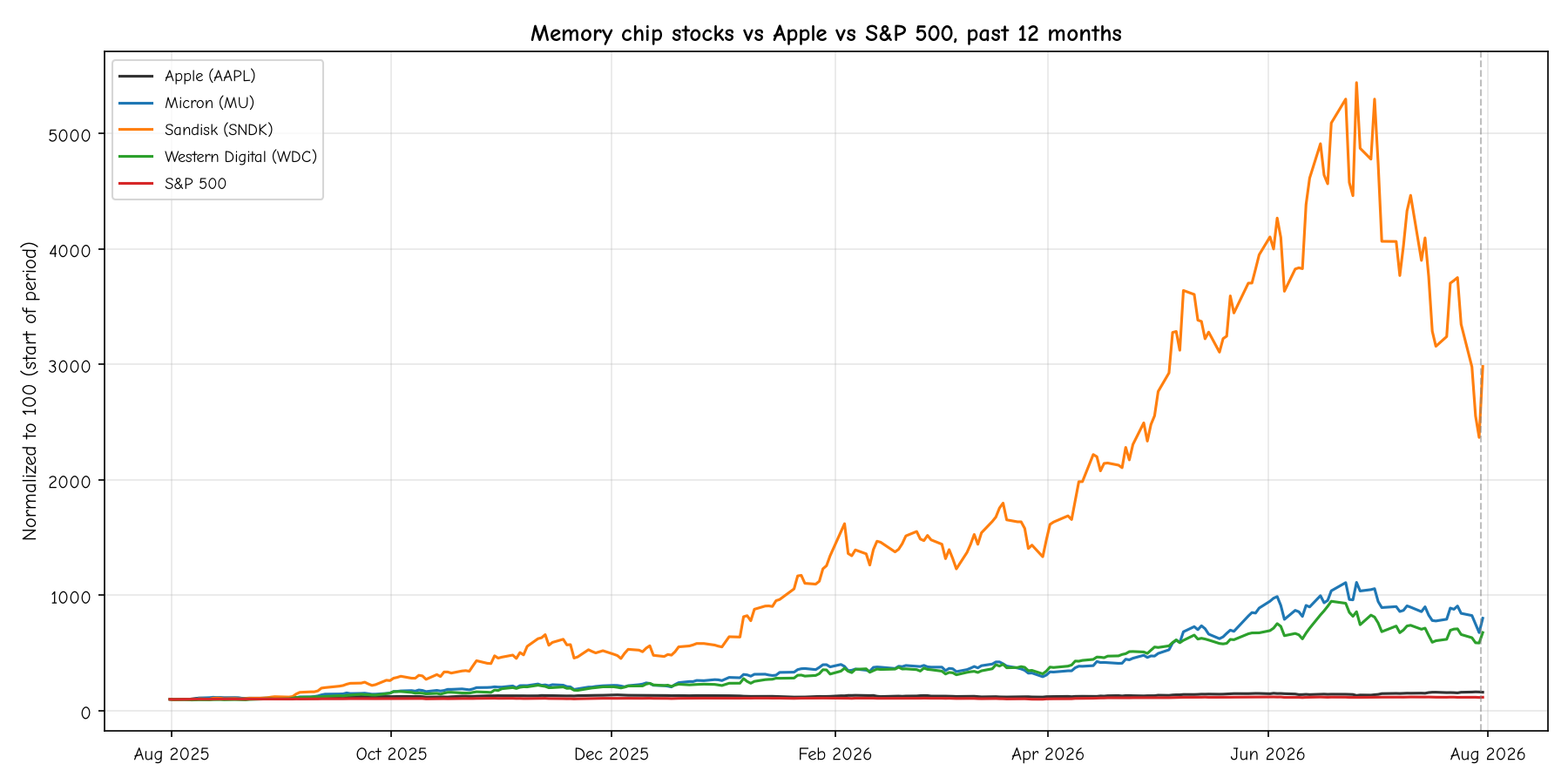
When you normalize all five stocks to a starting value of 100, the divergence is extreme. Sandisk, which was spun off from Western Digital and began trading as an independent company in early 2025, went from roughly $43 to $1,280, a return of 2,882 percent. Micron went from $109 to $875, a return of 701 percent. Western Digital went from $79 to $533, a return of 577 percent. Samsung Electronics, trading in Korean won on the Korea Stock Exchange, went from 71,400 KRW to 249,500 KRW, a return of 249 percent. Apple, at 61 percent, and the S&P 500, at 17 percent, are barely visible at the bottom of the chart by comparison.
These are not normal returns for semiconductor stocks. To put it in perspective, Micron's 701 percent one-year return exceeds what Nvidia returned during its most explosive phase of the AI boom. Sandisk's 2,882 percent return is the kind of number usually associated with a microcap biotech stock that just got FDA approval, not a company that makes flash memory for data centers.
The volatility tells you these stocks are being traded on speculation about the future, not on current earnings. Micron's annualized volatility over the past year was 80.8 percent. Sandisk's was 115.2 percent. Western Digital's was 76.9 percent. For context, the S&P 500's annualized volatility was 12.9 percent, and Apple's was 24.8 percent. Sandisk's volatility is nearly nine times that of the broad market. Its maximum single-day gain was 27.56 percent, and its maximum single-day loss was 20.33 percent. This is a stock that can move 20 percent in either direction on a single day's news.
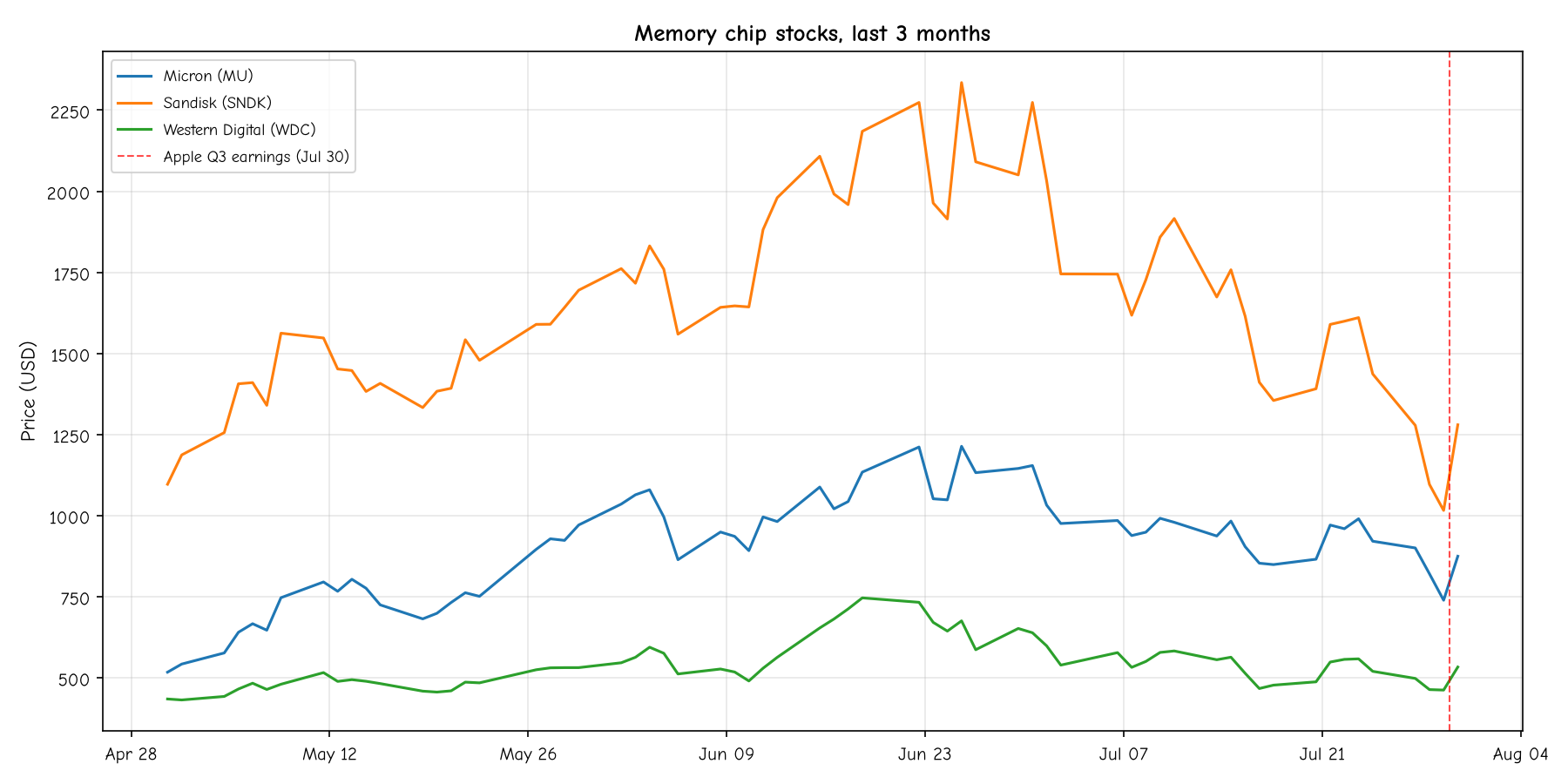
Zooming in on the last three months of trading for the three US-listed memory stocks shows the acceleration. All three stocks were already in strong uptrends, but the period around Apple's earnings call on July 30 produced sharp moves. Sandisk, which had been trading above $1,400 in late July, dropped to around $1,016 on July 29 before surging back to $1,280 on July 30 as the Apple and Amazon earnings calls confirmed the supply shortage narrative. Micron followed a similar pattern, dipping before the earnings calls and then surging as the market priced in the confirmation that memory pricing pressure is real and persistent.
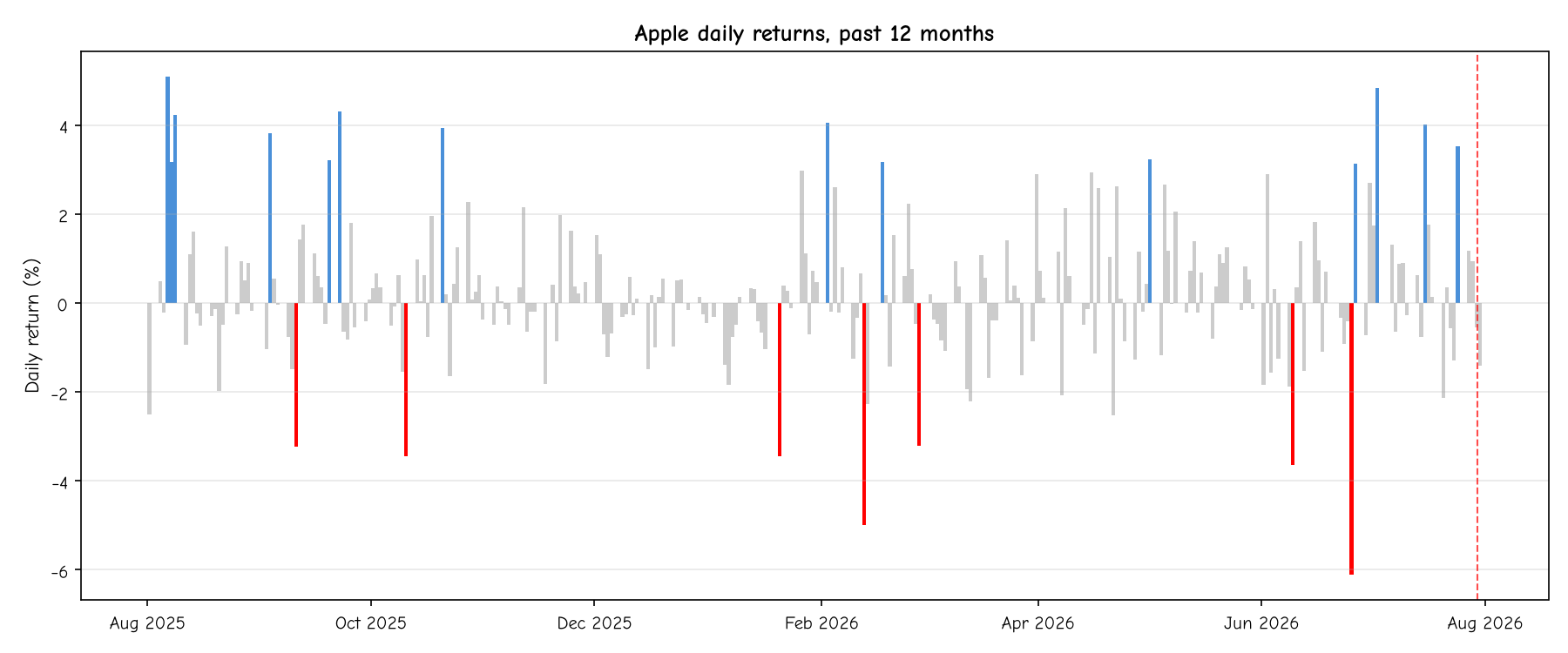
Apple's daily return chart shows a stock that has been relatively calm by comparison, with most days producing moves of less than 3 percent. The standout red bar at the far right of the chart is the earnings day, where the stock's regular-session decline of 1.41 percent was followed by a much larger after-hours drop. The after-hours price of approximately $312 represented a 6.3 percent decline from the regular close, which would be one of Apple's worst post-earnings drops in recent years. MarketWatch reported that Apple's stock could see its worst post-earnings drop in over a decade.
One of the most striking statistical findings from the data is the correlation between Apple and the memory stocks. Over the past year, the daily return correlation between Apple and Micron was -0.007, essentially zero. Apple and Sandisk had a correlation of -0.050. Apple and Western Digital had a correlation of -0.021. This means that on any given day, there is no meaningful relationship between what Apple's stock does and what the memory stocks do. They are being driven by entirely different forces. Apple moves on product cycle news, consumer demand signals, and its own earnings. The memory stocks move on DRAM pricing data, HBM allocation news, and AI capital expenditure announcements.
The memory stocks, by contrast, are highly correlated with each other. Micron and Sandisk had a correlation of 0.762. Micron and Western Digital had a correlation of 0.710. Sandisk and Western Digital had a correlation of 0.713. This tells you they are all trading on the same underlying factor: memory pricing. When DRAM prices go up, all three go up together. When there is news about HBM supply, all three react. They are a basket bet on the memory cycle, and right now that cycle is in a massive upswing.
The Sharpe ratios, which measure risk-adjusted returns, are also notable. Micron's Sharpe ratio over the past year was 3.01, Sandisk's was 3.56, and Western Digital's was 2.90, all calculated with a risk-free rate of zero. Apple's was 2.05, and the S&P 500's was 1.32. On a risk-adjusted basis, the memory stocks have been better investments than Apple, despite their much higher volatility, because their returns have been so large that they more than compensate for the risk. Whether that continues depends entirely on whether memory prices stay elevated.
6. Why AI is eating memory: HBM, capacity, and the 3-to-1 problem
To understand why this shortage is different from previous memory cycles, you have to understand what HBM is and why it is consuming the industry's production capacity.
High Bandwidth Memory, or HBM, is a specialized type of DRAM designed for processors that need to move enormous amounts of data at very high speeds. According to Wikipedia's HBM entry, it was initially developed by Samsung, AMD, and SK Hynix, with the first HBM chip produced by SK Hynix in 2013. The technology works by stacking DRAM dies vertically, connecting them with through-silicon vias (microscopic vertical electrical connections that pass through the silicon), and placing them close to the processor on a silicon interposer. The result is memory that can deliver bandwidth of over 1,200 gigabytes per second in the latest HBM3E generation, compared to roughly 100 gigabytes per second for standard DDR5.
The reason HBM matters so much right now is that AI training and inference are memory-bandwidth-bound, not just compute-bound. A GPU can have thousands of processing cores, but if it cannot feed them data fast enough, those cores sit idle. Nvidia's H200 and B200 GPUs, which are the workhorses of AI data centers, each use multiple HBM stacks. A single B200 can contain 192 gigabytes or more of HBM3E. When you multiply that by the hundreds of thousands of GPUs that companies like Meta, Microsoft, Amazon, and Google are buying, the HBM demand numbers become staggering.
The problem is that HBM is made on the same production lines as standard DRAM. The silicon wafers, the fab equipment, the clean rooms, and much of the process technology are shared. When a memory company decides to produce HBM instead of standard DDR5, it is making a zero-sum allocation decision. Micron's 3-to-1 conversion ratio means that for every wafer devoted to HBM, the company produces one-third as many standard DRAM chips as it would have otherwise. This is not a temporary bottleneck that can be solved by running the factories harder. The factories are already running at capacity. The constraint is how many wafers exist and how they are allocated.
The market dynamics this creates are unusual. In a normal memory cycle, prices rise when demand exceeds supply, manufacturers add capacity, supply catches up, and prices fall. The cycle typically lasts 18 to 24 months. What is different now is that the demand driver, AI infrastructure spending, is not a consumer fad that will fade. It is a capital expenditure cycle by the largest companies on earth, funded by some of the highest free cash flow margins in business history. Microsoft, Amazon, Google, and Meta are collectively spending hundreds of billions of dollars per year on AI infrastructure. They are not price-sensitive on memory because memory is a small fraction of their total AI spend. A cloud provider that pays $30,000 for a GPU and $10,000 for the HBM to go with it is not going to balk if the HBM price rises to $15,000. The GPU is useless without the memory.
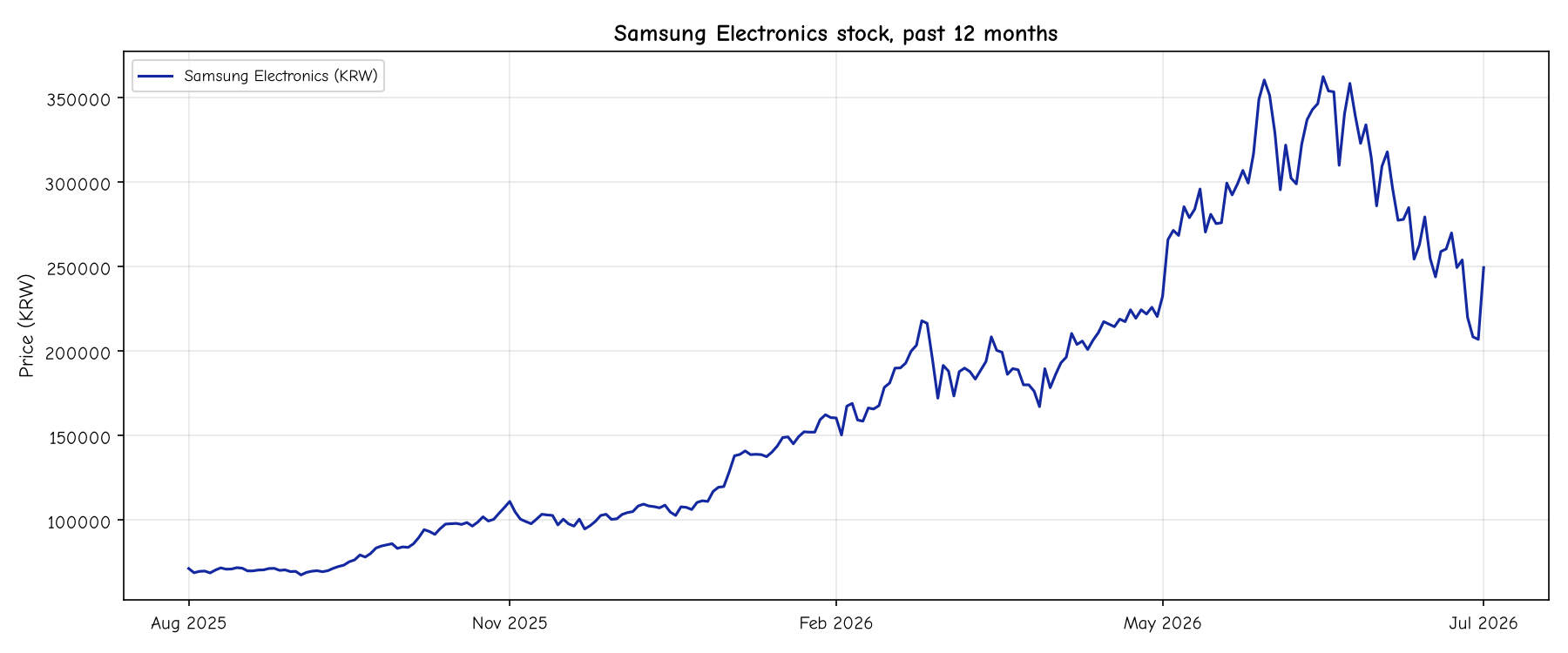
Samsung Electronics, the world's largest memory maker, has seen its stock rise 249 percent over the past year, from 71,400 KRW to 249,500 KRW. Its 52-week high of 374,500 KRW, reached earlier in 2026, shows that the stock has already experienced a significant pullback from its peak. Samsung's position is unique because it is both the largest memory supplier and a major smartphone manufacturer. It competes with Apple in the phone market while selling Apple the memory chips that go into iPhones. This creates a dynamic where Samsung has an incentive to keep memory prices high (benefiting its semiconductor division) while also needing to manage its own smartphone margins. The fact that Samsung's stock has pulled back from its highs suggests the market may be anticipating some normalization of memory pricing, or at least a less extreme rate of increase.
The HBM standard continues to evolve. According to Wikipedia, JEDEC announced the HBM4 standard in April 2025, with 16 dies per stack and a maximum capacity of 64 gigabytes per stack, doubling the bandwidth of HBM3E. Each new generation requires more complex manufacturing, which means lower yields and more wafer capacity consumed per unit of output. The technology roadmap, in other words, is moving in a direction that will continue to strain commodity DRAM supply. As long as AI companies are willing to pay for the latest HBM generation, the memory makers will keep allocating capacity to it, and the supply available for consumer electronics will remain tight.
This is the structural reason why Tim Cook called it a hundred-year flood. He is not just describing a price spike. He is describing a fundamental reallocation of the world's memory production capacity away from consumer electronics and toward AI infrastructure. That reallocation will not reverse unless one of two things happens: AI spending collapses, or new memory manufacturing capacity comes online that is dedicated to commodity DRAM rather than HBM. The first is possible but, given the current trajectory of AI investment, not imminent. The second takes years, because building a new memory fab costs billions of dollars and takes 18 to 36 months from groundbreaking to production.
7. Second-order effects, risks, and three scenarios
The memory shortage will not just affect Apple. It will ripple through the entire consumer electronics industry and beyond. Here are the second-order effects worth watching, followed by three scenarios for how this plays out.
The most immediate second-order effect is on Apple's competitors. Samsung, Xiaomi, and Google's Pixel line all buy memory from the same three suppliers. If Apple is stockpiling inventory and securing preferential allocation, smaller manufacturers will face even tighter supply. A company that buys 10 million memory modules per quarter does not have the negotiating power of one that buys 100 million. The result could be a consolidation of market share, where the largest players survive the shortage and smaller players are squeezed out or forced to raise prices more aggressively. This happened during the 2021 chip shortage, when smaller automakers like Stellantis paused production at plants while Toyota and Volkswagen used their scale to secure supply.
A second effect is on the used and refurbished electronics market. If new iPhones and Macs get more expensive or harder to find, demand for used and refurbished devices will rise. Companies that trade in used electronics, and the secondary market more broadly, will benefit. During the 2021 shortage, used car prices surged as consumers who could not find new cars turned to the used market. A similar dynamic could play out in consumer electronics, though the magnitude will be smaller because the shortage is less severe and consumer electronics have more substitution options than cars do.
A third effect is on Apple's services revenue, which is already showing signs of strain. Apple's services segment missed expectations in the June quarter, with the company citing a slowdown in gaming and the effects of App Store changes. If hardware prices rise and consumers delay upgrades, the installed base grows more slowly, which limits the addressable market for services. Apple's services revenue is its highest-margin business, and any slowdown there compounds the margin pressure from higher memory costs. The company hinted at a potential offset, with Tim Cook suggesting that a revamped Siri AI could eventually become a paid service for heavy users. That is a future revenue stream, not a current one.
A fourth effect is geopolitical. US Senators have set an August 21, 2026 deadline for Apple to swear off Chinese AI chips, according to reporting surfaced via TipRanks and aggregated on MarketBeat. If Apple is forced to source more of its components from non-Chinese suppliers, and those suppliers are already capacity-constrained by the memory shortage, the cost and logistics challenges multiply. Apple has committed more than $30 billion to US manufacturing, but memory fabs are not part of that investment. Apple makes its own silicon (the A-series and M-series processors) through TSMC, but it does not make its own memory, and building memory fabs in the US would take years and tens of billions of dollars.
Now, three scenarios.
Scenario one: the flood recedes (probability roughly 30 percent). Memory prices stabilize in late 2026 as new fab capacity comes online and AI spending growth slows. Apple's margins recover, the stock rebounds, and the memory stocks give back a significant portion of their gains. This is the scenario Tim Cook is implicitly betting on when he calls it a hundred-year flood, implying it is a once-in-a-lifetime event that will pass. The risk to this scenario is that memory capacity expansion takes longer than expected and AI spending does not slow down.
Scenario two: the new normal (probability roughly 50 percent). Memory prices stay elevated for 12 to 24 months but stop accelerating. Apple raises iPhone prices by $50 to $100 on flagship models and shifts some product configurations to use less memory. Consumers absorb the increase with modest grumbling but continue to buy. Apple's gross margin compresses from 50 percent to roughly 46 to 48 percent, which is still excellent by any standard but enough to keep the stock under pressure at its current valuation. The memory stocks plateau at high levels, rewarding early investors but not generating the returns of the past year. This is the scenario the market is currently pricing in, based on the mixed reaction to the earnings calls.
Scenario three: the flood worsens (probability roughly 20 percent). Memory prices continue to rise through 2027 as AI spending accelerates and no new commodity DRAM capacity comes online. Apple is forced to raise prices significantly, delay product launches, or both. Consumer demand for upgrades falls sharply as the price-to-value proposition deteriorates. The memory stocks continue their extraordinary run, but Apple's stock enters a sustained correction as margins compress and revenue growth slows. The broader market is dragged down because Apple's weight in the S&P 500 means its weakness affects index returns. Michael Burry, who according to Yahoo Finance has been warning that Big Tech's AI spending is dragging down the S&P 500, would be vindicated. This scenario is the tail risk, but it is not negligible. The 2021 chip shortage lasted nearly three years and was only resolved by a combination of capacity expansion and demand destruction (the crypto crash killed GPU demand). If this memory shortage follows a similar arc, it could persist well into 2028.
The honest answer is that nobody knows which scenario will play out. The memory market has been cyclical for four decades, and every shortage eventually ends. But the structural shift toward HBM is new, and the scale of AI infrastructure spending is unprecedented. What is different this time is that the shortage is not an accident. It is a choice, made by three companies, to serve their most profitable customer at the expense of everyone else. That choice will not reverse unless the economics change.
8. Conclusion: what a normal person should watch for
If you have read this far, you know more about the memory chip market than most people who own Apple stock. Here is what to actually do with that information.
If you are shopping for a new iPhone or Mac in the next six months, buy sooner rather than later. Apple is stockpiling inventory now, which means the current crop of devices was built with memory purchased at older, lower prices. The next generation of products, launching in September and October 2026, will be built with memory purchased at the new, higher prices. If Apple raises prices, the increase will show up in the new product lineup. If you can buy the current model at the current price, do it. If you are waiting for the new model, budget for the possibility that it costs $50 to $100 more than you expected.
If you own Apple stock, the question is whether you believe Tim Cook's hundred-year flood framing. If you think the memory shortage is temporary and will resolve within a year, the post-earnings dip is a buying opportunity. Apple is still generating $109 billion in quarterly revenue and $122 billion in annual net income, with an installed base at an all-time high. The company is not in trouble. It is facing a cost pressure that will compress margins and possibly slow growth for a few quarters. If you think the shortage is structural and will persist for two years or more, the risk is that Apple's 40 times earnings multiple is too high for a company facing sustained margin pressure, and the stock could drift lower until the valuation adjusts.
If you are tempted by the memory stocks, understand what you are buying. Micron, Sandisk, and Western Digital have returned 700 percent, 2,882 percent, and 577 percent respectively over the past year. Those returns are extraordinary, and they reflect a market consensus that memory pricing will stay elevated. If you buy now, you are buying at the top of a cycle that has already been heavily repriced. The volatility on these stocks is extreme: Sandisk's annualized volatility is 115 percent, meaning the stock can easily move 20 percent in a single day. If memory prices stabilize or decline, these stocks will fall hard and fast. They are a leveraged bet on the memory cycle, not a long-term hold.
If you own an S&P 500 index fund, you are exposed to all of this whether you like it or not. Apple is roughly 7 percent of the S&P 500, and the memory stocks, while individually smaller, are part of the semiconductor weighting that has driven the index's gains. The S&P 500's 17 percent return over the past year is partly a story of AI and semiconductor stocks carrying the market. If the memory shortage pushes Apple lower and the memory stocks eventually correct, the index will feel it.
The thing to watch is DRAM pricing data. Several firms, including TrendForce and Gartner, publish monthly memory pricing reports. If DRAM spot prices start declining, the memory stocks will be the first to react, and Apple's margin pressure will begin to ease. If they keep rising, the scenario three risk increases. The second thing to watch is Apple's next earnings call in October 2026, which will be John Ternus's first as CEO. If Ternus continues Cook's language about supply constraints and margin pressure, the market will take that as confirmation that the problem is persisting. If he strikes a more optimistic tone, it could signal that Apple has secured better pricing or that the shortage is easing.
Tim Cook called it a hundred-year flood. The phrase was vivid, and it was meant to be. It was his last earnings call as CEO, and he wanted to set expectations low enough that his successor has room to beat them. Whether the flood recedes or becomes the new waterline is the single biggest question facing the consumer electronics industry in 2026. For now, the water is still rising.
Sources
- Apple Inc., "Apple reports third quarter results," Apple Newsroom, July 30, 2026, https://www.apple.com/newsroom/2026/07/apple-reports-third-quarter-results/
- Yahoo Finance, Apple Inc. (AAPL) stock quote and earnings summary, July 30, 2026, https://finance.yahoo.com/quote/AAPL/
- MarketBeat, Apple (AAPL) news headlines and earnings analysis, July 30, 2026, https://www.marketbeat.com/stocks/NASDAQ/AAPL/news/
- MarketBeat, Apple (AAPL) stock analysis and financial metrics, July 30, 2026, https://www.marketbeat.com/stocks/NASDAQ/AAPL/
- Wikipedia, "2020-2023 global chip shortage," accessed July 31, 2026, https://en.wikipedia.org/wiki/2020%E2%80%932023_global_chip_shortage
- Wikipedia, "High Bandwidth Memory," accessed July 31, 2026, https://en.wikipedia.org/wiki/High_Bandwidth_Memory
- Wikipedia, "Dynamic random-access memory (DRAM)," accessed July 31, 2026, https://en.wikipedia.org/wiki/DRAM
- Yahoo Finance API, historical daily price data for AAPL, MU, SNDK, WDC, ^GSPC, and 005930.KS, accessed July 31, 2026, https://query1.finance.yahoo.com/v8/finance/chart/
- Stocktwits, AAPL trending news and memory chipmaker after-hours moves, July 30, 2026, https://www.stocktwits.com/AAPL
- Zacks Investment Research, Zacks #1 Rank top movers for July 30, 2026, https://www.zacks.com/stock/news/2384945/apple-aapl-q3-earnings-2026
- Yahoo Finance, "Apple stockpiles inventory as it braces for significant supply constraints," TechCrunch, July 30, 2026 (headline aggregated via Yahoo Finance)
- Yahoo Finance, "Apple forecasts slower growth as AI build-out strains tech supply chains," Financial Times, July 30, 2026 (headline aggregated via Yahoo Finance)
- Yahoo Finance, "Apple's stock could see its worst post-earnings drop in over a decade," MarketWatch, July 30, 2026 (headline aggregated via Yahoo Finance)
- Yahoo Finance, "Tim Cook sees Apple's hybrid AI strategy as a competitive weapon," CNBC, July 30, 2026 (headline aggregated via MarketBeat)
- Yahoo Finance, "Tim Cook says Apple may charge for AI Siri," Axios, July 30, 2026 (headline aggregated via MarketBeat)
- TipRanks, "US Senators set August 21 deadline for Apple to swear off Chinese AI chips," July 30, 2026 (headline aggregated via MarketBeat)
- Yahoo Finance, "Apple commits more than $30 billion to US manufacturing," July 30, 2026 (headline aggregated via Yahoo Finance)