Siri AI is the most Apple way possible to admit that the old assistant was not good enough: rebuild the product, wrap it in privacy language, ship it deep in the operating system, and put Google in the engine room.
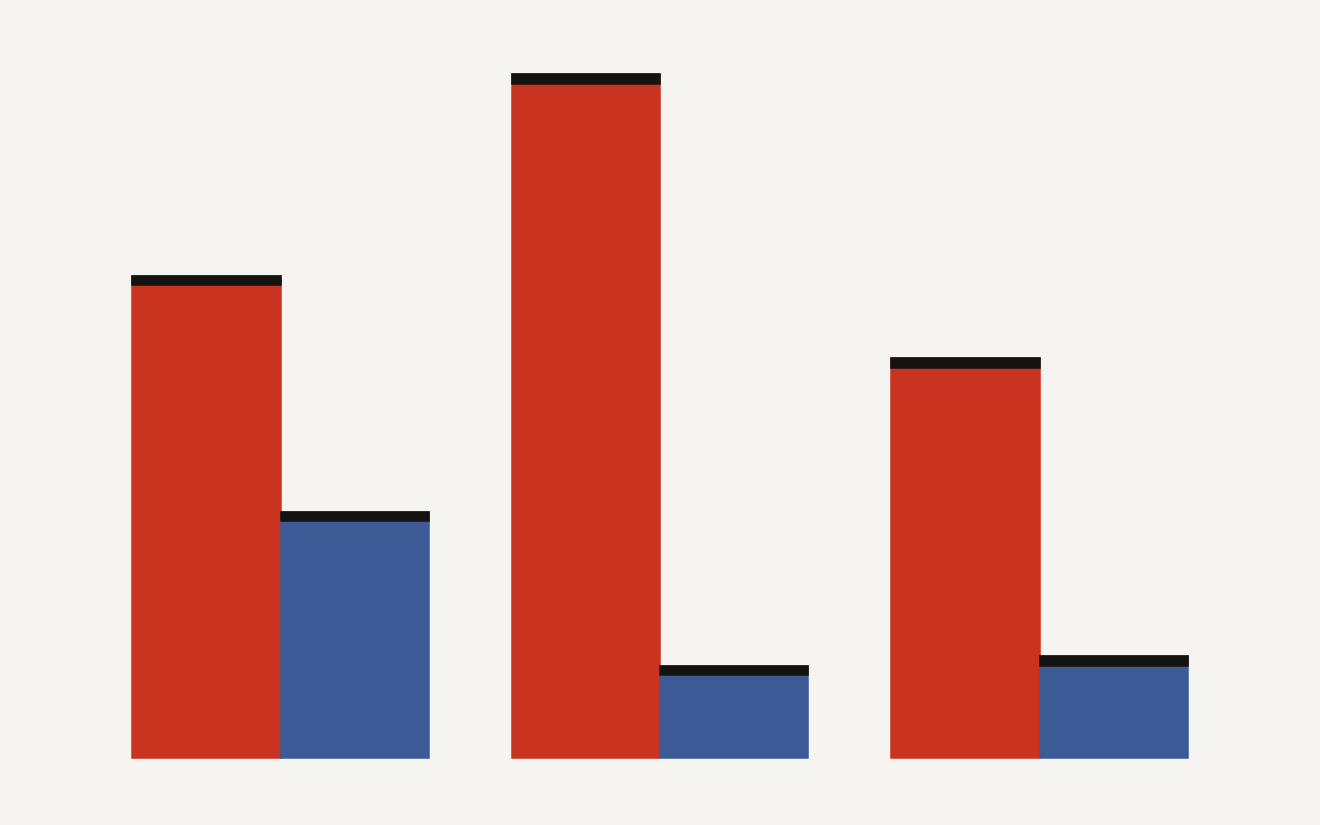
The news from WWDC26 is not just that Siri can finally hold a richer conversation. Apple says Siri AI can use personal context from messages, mail, photos, and onscreen content, then take actions across apps. The key number is stranger than the demo: in Apple’s own human preference testing, the new server model, AFM 3 Cloud, won 64.7 percent of general text comparisons, while the 2025 AFM Server baseline won 8.7 percent. Apple also says the third generation Apple Foundation Models were custom-built in collaboration with Google.
That is the story builders should care about. Siri AI is not only an assistant launch. It is a platform reset, a model-sourcing concession, and a regulatory rollout split packed into one keynote. If you build for Apple’s ecosystem, the question is no longer “Will Siri get smarter?” It is “Which Siri will my users actually have?”
What did Apple actually ship at WWDC26?
Apple introduced Siri AI on June 8, 2026 as a rebuilt assistant that is both a system feature and a dedicated app. In the company’s launch language, Siri AI can answer current web questions, surface information from messages, emails, and photos, reason over what is on screen, and carry out cross-app tasks from inside iOS 27, iPadOS 27, macOS 27, watchOS 27, and visionOS 27. Apple’s Siri AI announcement says developer testing started the same day, with a user beta later in 2026.
The product design is classic Apple. Siri lives everywhere, but now also gets a standalone place where users can revisit conversations. On iPhone, Apple says you can open Siri from the side button or Dynamic Island. On Mac and iPad, it sits inside Spotlight. On Vision Pro, it gets spatial placement. That is not a chatbot bolted onto a phone. It is Apple trying to make the assistant the operating layer between user intent and app behavior.
For developers, the important plumbing is App Intents and Spotlight. Apple’s WWDC26 macOS developer guide says Siri can connect to app content through entity schemas, take action through intent schemas, and use view annotations so people can refer to what is on screen conversationally. The same guide says the Foundation Models framework now lets developers work with Apple Foundation Models, cloud models such as Claude and Gemini, or any provider that conforms to the Language Model protocol, and it offers no-cost Private Cloud Compute access for Small Business Program apps with fewer than 2 million total first-time App Store downloads.
That no-cost tier matters. Apple is not asking small developers to become AI infrastructure buyers on day one. It is trying to make the operating system the cheapest place to add agentic features, then make Siri the interface that calls them.
There is a catch, because of course there is a catch.
Siri AI availability is sharply limited at launch. Apple says the beta is for supported devices set to English, with more languages to follow. Apple lists compatible hardware including iPhone 16 models or later, iPhone 15 Pro and Pro Max, iPad mini with A17 Pro, iPads with M1 or later, Macs with M1 or later, Apple Vision Pro, and newer Apple Watch models when paired with an Apple Intelligence-enabled iPhone.
That is a lot of footnotes for a supposedly universal assistant.
How much did Google change the model story?
Apple’s model announcement is the part that should change your priors. The company says its third generation Apple Foundation Models are a family of five models, spanning on-device and Private Cloud Compute server models, custom-built in collaboration with Google. Apple’s machine learning research note does not frame this as outsourcing Siri to Gemini wholesale. It frames it as Apple Foundation Models with Google collaboration.
Still, the numbers show why Apple made the deal. The chart below uses Apple’s own human preference results. AFM 3 Cloud won 64.7 percent of general text comparisons, while the 2025 AFM Server baseline won 8.7 percent. AFM 3 Core won 45.6 percent, while the 2025 core baseline won 23.3 percent. In image understanding, AFM 3 Cloud won 37.8 percent, while the 2025 baseline won 9.6 percent.
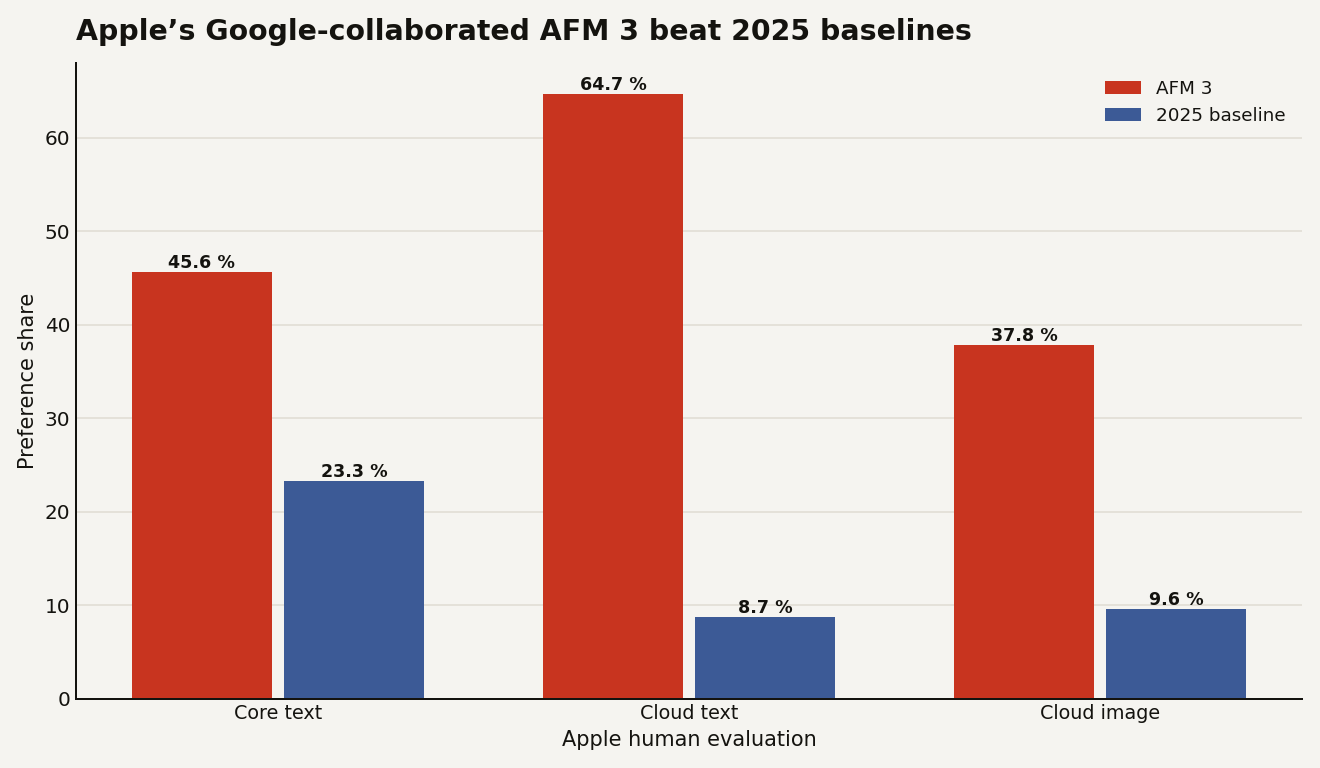
Those are not small deltas. They are the shape of a company that tried to catch up internally, then paid the tax of reality. For years, Apple’s argument was that deep integration, privacy, silicon, and on-device execution could compensate for being behind the frontier labs on raw model capability. Siri AI keeps that architecture story alive. But the capability jump now carries a Google label in the supply chain.
That does not make Apple weak. It makes Apple pragmatic.
The underrated move is the orchestrator. Apple says Siri AI uses an architecture that includes Apple Foundation Models on device and on Private Cloud Compute, plus a system orchestrator that can tap Spotlight and an App Toolbox. If you are building an app, the model brand matters less than where the agent can act. A slightly weaker model with native access to app state, screen context, permissions, and user history can beat a stronger standalone chatbot for everyday tasks.
The overhyped part is the idea that this proves every company can build a sovereign assistant by licensing one frontier model. Apple has custom silicon, a private cloud architecture, OS privileges, a developer platform, and more than 150,000 employees, according to its own boilerplate. Most companies have a SaaS bill, a backlog, and a Slack channel named ai-experiments.
The business lesson is blunt: if Apple needed Google to make Siri AI credible in 2026, your moat probably is not “we fine-tuned a model.” Your moat is data access, workflow ownership, distribution, evaluations, and trust.
That is the same lesson behind Apple’s new app platform toll: once AI lives inside the platform, independent software has to decide whether to plug in, route around, or become an ingredient.
Why is the rollout map the product strategy?
Apple’s launch map says as much as the model chart. In the European Union, Siri AI will be available on macOS 27 and visionOS 27, but not initially on iOS 27 or iPadOS 27. Apple also says watchOS 27 access in the EU depends on a paired iPhone with Siri AI, so EU users will not get the new Siri AI on Apple Watch at launch either. In China, Apple says Siri AI and the other new Apple Intelligence features will not be available while it works through regulatory requirements.
Here is the practical availability picture from Apple’s statements:
| Market or platform | Siri AI launch status | Builder consequence |
|---|---|---|
| United States, supported device set to English | Beta later in 2026 | Safe place to test consumer flows first |
| EU on Mac and Vision Pro | Available when set to a supported language | Useful for desktop and spatial workflows, not iPhone-scale adoption |
| EU on iPhone and iPad | Not available initially | Do not promise Siri-first iOS features to EU users |
| EU on Apple Watch | Not available at launch because it requires paired iPhone Siri AI | Watch flows inherit the iPhone gap |
| China mainland | Not available while regulatory work continues | Treat as a separate roadmap, not a delayed checkbox |
Apple blames the EU delay on the Digital Markets Act. In its June 8 DMA update, Apple says regulators would require other virtual assistants to get direct access to private data and app control once Siri AI ships, and says there is no timeline for iOS and iPadOS availability in the EU. The European Commission pushed back the next day, with spokesman Thomas Regnier saying the decision was Apple’s alone and that “nothing in the DMA prohibits Apple from introducing new products in the EU,” according to the Associated Press.
You do not need to referee Brussels versus Cupertino to see the consequence. Siri AI will fragment by platform, geography, language, and device class. That fragmentation is the opposite of what made iPhone development so attractive in the first place.
Apple Intelligence already supports a broader language set. Apple’s support page lists English, Danish, Dutch, French, German, Italian, Norwegian, Portuguese, Spanish, Swedish, Turkish, Chinese, Japanese, Korean, and Vietnamese for iOS 26.1, iPadOS 26.1, and macOS 26.1. Siri AI starts narrower: English first.
That means the new assistant is not one market. It is several.
For a product team, the cost shows up in QA and promise management. You need feature flags by region. You need fallback flows when Siri cannot invoke your App Intent. You need documentation that does not assume the assistant exists. You need support scripts for users who bought an eligible device, updated to iOS 27, and still do not see the thing your app page advertised.
The platform is getting smarter. The platform matrix is getting uglier.
What should builders do before betting on Siri AI?
Build for Siri AI, but do not bet your 2026 roadmap on Siri AI as the only front door.
The useful path is to treat Apple’s assistant layer as a distribution channel for actions you already expose cleanly elsewhere. If you already have well-modeled entities, permissions, search, and intent-like actions, Siri AI becomes another interface. If your app state is a swamp, Siri AI will not rescue it. It will simply make the swamp conversational.
Here is the builder checklist:
- Model your app’s nouns. Apple’s developer guide puts entity schemas at the center of Siri and Spotlight integration. If your app cannot clearly define a customer, invoice, project, file, meal, workout, or ticket, the assistant has little to grab.
- Make actions reversible. A cross-app assistant that can draft, edit, send, book, or delete needs undo paths and confirmation gates. The higher the user trust, the lower your support cost.
- Keep a non-Siri path. EU iPhone users, China users, non-English users, older-device users, and enterprise-managed devices may not have Siri AI in 2026. Your core workflow cannot depend on it.
- Instrument assistant failures. Track when an App Intent is invoked, where it fails, and whether users recover manually. Agent logs will become product analytics, not just debugging exhaust.
- Write regional release notes. “Available on iOS 27” is not specific enough anymore. Say which countries, languages, and device classes actually get the feature.
The biggest engineering shift is testing. Apple’s WWDC26 guide points to an App Intents Testing framework and an Evaluations framework. Use them. Natural-language entry points expand your test surface because users do not click one button in one order. They ask messy questions, refer to previous context, and expect the system to infer what “that file” means.
If you have a small team, start with the workflows where Siri AI can remove three or more taps and where mistakes are tolerable. Photo sorting, note creation, search, drafts, and status lookups are good candidates. Payments, account deletion, medical advice, legal commitments, and irreversible admin actions deserve more friction.
For business owners, the decision is less technical. Siri AI may change where discovery happens inside Apple’s ecosystem. If users can ask the OS to “find the contract Alex sent last week and summarize the renewal risk,” the app that owns the document is no longer the only place value is surfaced. That can help you if your data is clean and attributed. It can hurt you if Apple’s interface turns your app into backend storage with a monthly churn problem.
The smart move is to decide which parts of your product should be callable by an assistant and which parts should remain differentiated inside your own UI. Give Siri the chores. Keep the judgment, collaboration, and domain-specific controls where your product earns its keep.
The assistant is now a distribution problem
Siri AI may be the best version of Siri Apple has ever shown. It is also a reminder that capability alone does not ship a platform.
Apple had to solve model quality with Google, privacy with Private Cloud Compute, developer access with App Intents, and politics with a rollout map that excludes EU iPhones and China at launch. That is the new assistant stack: model, OS, regulation, region, language, hardware, trust.
For builders, the clean take is this: integrate early, depend slowly. Siri AI is going to matter because Apple controls the surface where hundreds of millions of users start tasks. But in 2026, the winning apps will not be the ones that simply “support Siri.” They will be the ones that can survive when Siri AI is present, absent, blocked, English-only, or delegated to a model Apple did not build alone.
The future of assistants is not one magic voice. It is a routing problem with a very expensive accent.
Sources
- Apple via Business Wire, Apple introduces Siri AI, a profoundly more capable and personal assistant
- Apple Machine Learning Research, Introducing the Third Generation of Apple’s Foundation Models
- Apple Developer, WWDC26 macOS guide
- Apple, Due to DMA, Siri AI delayed in EU for iOS 27 and iPadOS 27
- Apple Support, How to get Apple Intelligence
- Associated Press, Apple and Brussels blame each other for delaying European Union rollout of Siri AI