If you build for Apple platforms, Xcode just stopped being only the place where your Swift code compiles. It is becoming the place where your AI stack, your coding agent, your app actions, and your cloud inference bill all get negotiated.
Xcode 27 is Apple's AI development reset: the company is putting agentic coding into the IDE, expanding the Foundation Models framework into a single Swift API for on-device and server models, and giving small App Store developers access to Private Cloud Compute with zero cloud API cost if they stay under a 2 million first-time download threshold. Apple announced the package on June 8, 2026, alongside developer betas for iOS 27, iPadOS 27, macOS 27, watchOS 27, tvOS 27, visionOS 27, and Xcode 27 in its developer tools announcement.
The move is easy to misread as another IDE feature dump. Apple is trying to make AI feel native on its platforms in two places at once: inside your app and inside your workflow. That matters because the App Store is still a giant distribution surface. Apple said the App Store ecosystem facilitated $1.4 trillion in developer billings and sales in 2025, with more than 850 million average weekly users across 175 countries and regions in its App Store ecosystem update.
The bullish read: Apple is lowering the cost of shipping useful AI features on iPhone, iPad, and Mac. The skeptical read: Apple is moving the AI control plane closer to its own frameworks. Both can be true.
Three linked bets from Apple
Apple shipped three linked bets, and the connective tissue is control.
First, the Foundation Models framework now reaches beyond its 2025 shape. Apple says it is a single native Swift API that supports more capable on-device models, image input, server models, and custom skills. It also lets developers use Apple Foundation Models, models such as Claude and Gemini, or any provider that implements Apple's new language model protocol in the same framework announcement.
That sounds like openness. In practice, it is platform shaped openness. If you adopt the framework, you get a Swift interface, Apple Intelligence integration, and routing choices that make sense inside Apple's operating systems. You also accept Apple's abstractions around availability, privacy, model choice, and system behavior. That trade is the AppKit and UIKit story with a probabilistic backend.
Second, Xcode 27 turns coding agents from sidecars into IDE citizens. Apple says Xcode 27 can work with agents and models from Anthropic, Google, and OpenAI, and its conversations support planning, multiturn Q&A, a canvas for Markdown, code changes, and previews. More important, agents can validate their own work by writing and running tests, trying ideas in Playgrounds, checking visual changes with previews, and interacting with simulators through Device Hub, according to Apple's Xcode 27 details.
That last part is the one builders should underline. A coding agent that can edit code is useful. A coding agent that can run the simulator, inspect previews, write tests, and loop through failures inside the blessed IDE is a different workflow. It moves agent work from chat transcript theater toward build system participation.
Third, Apple added economic bait for small teams. Developers in the App Store Small Business Program with fewer than 2 million first-time App Store downloads can use Apple Foundation Models running on Private Cloud Compute at no cloud API cost, if they have the entitlement and meet Apple's distribution conditions, according to Apple's Private Cloud Compute developer page. If an app later crosses the 2 million threshold, Apple says the developer gets 6 months to migrate.
That is generous, but it is also a meter with a future cliff. If your feature only works because Apple absorbs the server inference bill, you need to know what happens when you graduate from indie economics to scale economics.
AFM 3 against Apple's 2025 models
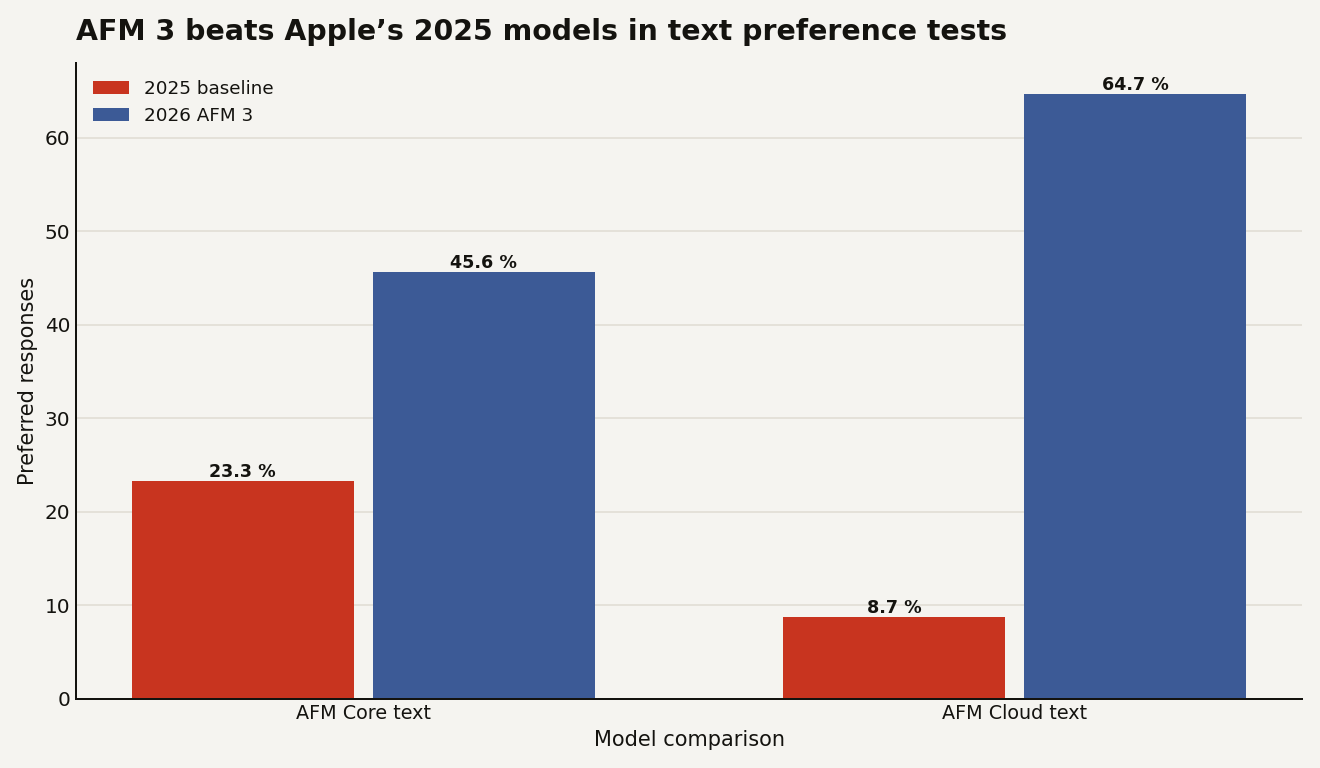
Apple's public model data says the 2026 models are meaningfully better than its 2025 generation, especially on the server side. The headline: AFM 3 Cloud was preferred on 64.7 percent of general text prompts in side by side human evaluations, compared with 8.7 percent for the 2025 AFM Server model. AFM 3 Core, the on-device model, was preferred on 45.6 percent of general text prompts versus 23.3 percent for the prior model, according to Apple Machine Learning Research's AFM 3 overview.
The chart below shows the gap in the simplest form. Apple did not publish that kind of comparison here. Apple's own baseline moved enough to make native AI features less embarrassing for everyday app use.
Apple also disclosed the shape of the model family. AFM 3 includes two on-device models and three server models. The on-device lineup includes AFM 3 Core, a 3 billion parameter dense model, and AFM 3 Core Advanced, a 20 billion parameter sparse model that activates 1 billion to 4 billion parameters depending on the request. On the cloud side, Apple listed AFM 3 Cloud, ADM 3 Cloud for image generation and editing, and AFM 3 Cloud Pro for agentic tool use and complex reasoning in the same research post.
The important builder takeaway is routing. Apple is presenting a tiered system: small local model, larger local sparse model, server model, image model, pro cloud model. That maps to product decisions you already make: privacy sensitive tasks on device, heavier reasoning in cloud, image features in a specialized path, and expensive agentic flows gated behind a bigger compute target.
Apple's privacy claim also changed shape. AFM 3 Cloud Pro runs on more than Apple silicon in Apple data centers. Apple says it worked with Google and NVIDIA to extend Private Cloud Compute to Google Cloud systems using NVIDIA GPUs, while keeping PCC privacy protections. Apple's security team says the Google Cloud version uses NVIDIA Confidential Computing, Intel CPUs with TDX, Google's Titan chip, and a cryptographically verifiable ledger of Google Cloud hardware in its PCC expansion post.
That is technically interesting and politically awkward. Apple wants the privacy halo of PCC, the scale of cloud GPUs, and the quality boost of Gemini derived work. Builders should treat this as a serious architecture, not a magic invisibility cloak. If your app's selling point is privacy, you still need to explain where inference runs, what leaves the device, and which regions support the feature.
Two blockers for app developers fall
Because Apple's AI stack now attacks the two biggest blockers for app teams: implementation cost and marginal inference cost.
For a small team, a native Swift API plus free PCC access under 2 million first-time downloads can turn an AI feature from a business model question into a product question. That does not mean every journaling app needs a chatbot. It means teams can test features like summarization, classification, guided input, search refinement, lightweight tutoring, and user specific automation without first signing up for an unpredictable cloud bill.
This is where the trap sits. Free inference can make a weak feature look economically viable. A feature that users tolerate at zero marginal cost may not survive a paid provider migration, a 6 month threshold clock, or a model quality mismatch across regions.
For developers, the practical consequences are clear:
- Your app architecture needs a model routing layer. Do not scatter Foundation Models calls across view controllers and SwiftUI views. Wrap them so you can swap local Apple models, PCC, and third party providers without rewriting product code.
- Your product analytics need feature level cost signals. Even if Apple's PCC tier costs you nothing today, track request counts, task types, latency, fallback rates, and user retention by AI feature from day 1.
- Your hiring plan shifts toward integration discipline. The scarce skill is less prompt poetry and more shipping guarded, testable AI features inside an Apple codebase with privacy, offline behavior, and UI fallback handled.
- Your moat gets thinner if the feature is generic. If Apple gives every small developer cheap summarization and classification, your advantage must come from workflow, data, trust, distribution, or taste.
The internal link to watch here is the same one coding teams have been wrestling with outside Apple's ecosystem: vibe coding rarely survives contact with production. Xcode 27 may make agent aided development more convenient, but convenience does not remove the need for review, tests, observability, and rollback.
There is also a platform strategy angle. By embedding agent hooks, MCP access, provider choice, and simulator aware validation inside Xcode, Apple is making the IDE the safest place for Apple platform agents to operate. That will help teams that already live in Xcode. It will annoy teams whose toolchains span Cursor, VS Code, Bazel, custom CI, and external agent runners.
The build system always wins eventually.
Availability is the first risk
The first risk is availability. Apple says Apple Intelligence features are available only in supported regions, and developer betas started on June 8, 2026. If your roadmap assumes global AI behavior on iOS 27 launch day, you are betting against the footnote. Region, language, device class, entitlement status, and OS version can all turn into product surface area.
The second risk is silent dependency sprawl. Xcode 27 supports bringing everyday tools into Xcode through Model Context Protocol and connecting agents compatible with Agent Client Protocol, while GitHub and Figma are the first to offer one-click installation with Xcode, according to Apple's developer announcement. MCP is useful because it standardizes how assistants connect to external systems, and Anthropic introduced it in November 2024 as an open standard for connecting AI assistants to repositories, business tools, and development environments in its MCP launch post.
That same power expands the blast radius. An agent that can see your repository, design files, issue tracker, simulator, and build logs can do better work. It can also propagate bad assumptions faster. If you are connecting Xcode agents to GitHub, Figma, internal docs, and secrets adjacent systems, your permission model matters more than your prompt.
The third risk is evaluation mismatch. Apple's AFM 3 data is useful, but it is mostly Apple evaluating Apple's models against Apple's prior models. It is normal for a platform release. But it means you should not infer that AFM 3 Cloud Pro is the right model for every reasoning task, or that AFM 3 Core Advanced will match the cloud experience on devices that can run it.
The fourth risk is product sameness. If the same framework makes it easy for 10,000 apps to add a private summary, a smart search bar, and an AI compose button, the novelty evaporates. The good AI features will be the ones that know your app's domain, respect the user's context, and fail gracefully when the model is wrong.
Start with a small experiment
Start with a boring experiment, not a keynote shaped rewrite.
Pick one workflow where an Apple native model could remove friction in less than 10 seconds: tagging a note, drafting a short response, extracting fields from an image, summarizing a customer message, or turning a user request into an App Intent. Build it behind a feature flag. Log latency, completion rate, edit distance, fallback use, and whether the user comes back. If the feature only looks good in a demo, kill it early.
Then design your AI integration as if the free tier will end. That does not mean avoiding Apple's stack. It means isolating it. A healthy architecture has:
- A provider interface that can route to on-device AFM, PCC, or a third party model.
- A policy layer that decides which tasks can leave the device.
- A test suite with fixed inputs and expected structured outputs.
- A cost dashboard, even when the current cost is zero.
- A user facing fallback when Apple Intelligence is unavailable in a region or on a device.
For Xcode 27 agents, set a different bar. Let agents write tests before you let them write migrations. Let them run previews before you let them touch payment flows. Give them narrow MCP access first. A coding agent with simulator access is useful. A coding agent with broad write access and vague instructions is a very confident intern with root privileges.
The strongest bet is to use Apple's stack for Apple native experiences where privacy, latency, offline behavior, and App Intent integration matter. The weaker bet is to rebuild your whole product around Apple's server model economics before you know pricing, quotas, launch regions, and quality on your own task mix.
Apple is making AI part of the Apple platform contract. If you build inside that contract, Xcode 27 gives you a lot. Just do not confuse a subsidized ramp with a permanent road.
Sources
- Apple Newsroom, Apple accelerates app development with new intelligence frameworks and advanced tools
- Apple Machine Learning Research, Introducing the Third Generation of Apple's Foundation Models
- Apple Developer, Accessing Private Cloud Compute
- Apple Security Research, Expanding Private Cloud Compute
- Apple Newsroom, App Store ecosystem reaches record $1.4 trillion
- Apple Developer, Xcode
- Anthropic, Introducing the Model Context Protocol