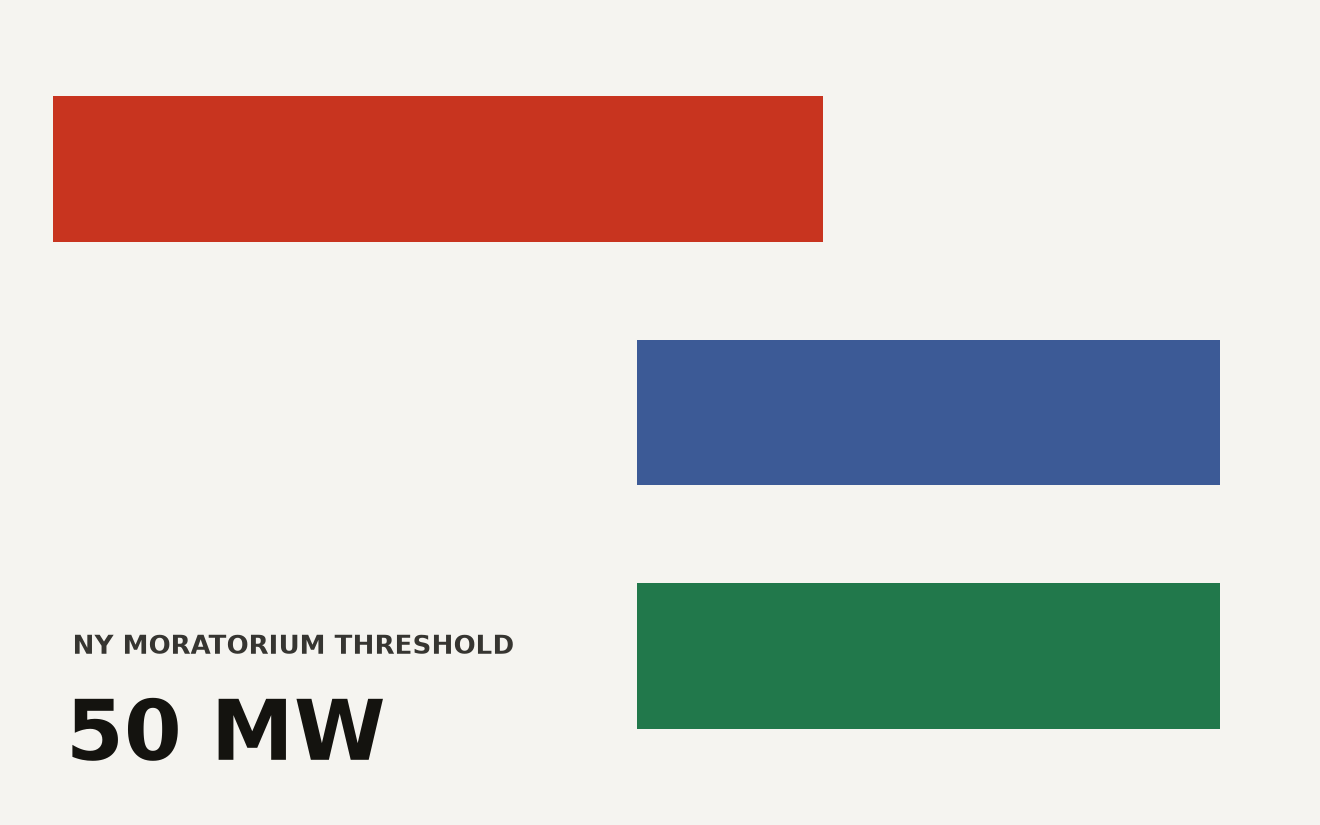
New York just became the first state in the country to hit pause on data center construction. On July 14, 2026, Governor Kathy Hochul signed an executive order blocking new environmental permits for data centers drawing more than 50 megawatts of power. The pause can last up to a year while the state's Department of Public Service develops standards for assessing the environmental impact of data center construction and operation, including water use and air quality.
This is the first statewide data center moratorium in the US, and it arrives at a moment when AI is driving a historic wave of infrastructure buildout. Hyperscale operators are racing to lay down capacity for training and inference workloads. New York just told the biggest of them to wait.
The order blocks new permits for facilities over 50 MW, while a separate bill passed by the state legislature would lower that threshold to 20 MW. Hochul has not yet said whether she will sign the legislative version, which would catch far more projects in its net.
What exactly did New York's moratorium do?
The executive order signed by Hochul on July 14 takes effect immediately. It blocks the issuance of new environmental permits for data centers with a power capacity exceeding 50 megawatts. The governor's office says the 50 MW threshold is designed to avoid disrupting smaller data centers used by institutions like hospitals and universities, which typically draw far less power.
The moratorium can last up to 12 months. During that window, the Department of Public Service is tasked with developing standards to assess the expected environmental impacts of data center construction and operation, including effects on water use and air quality. Hochul also asked the department to consider creating a mechanism for data centers to invest in the state's energy infrastructure, and charged the state's economic development arm with building a framework to help local communities negotiate benefits when data center developers come knocking.
Hochul framed the move as a response to mounting pressure on residents. "As data center development threatens to hike up utility bills, deplete our natural resources, and create uncertainty for New Yorkers, it's my responsibility to take action and lead," she said in a statement reported by The Verge.
The executive order is not the only action in play. The New York state legislature passed a separate bill that would impose a moratorium with a threshold of 20 megawatts, a far lower bar that would capture a much wider range of facilities. Hochul has not yet indicated whether she will sign that bill. The executive action allows her to enact the pause immediately while the legislative version remains under review.
She also said she plans to push the legislature to roll back sales tax exemptions for large data centers when lawmakers return to session next year. That would remove a financial incentive that has helped attract data center investment to the state.
How does New York's move compare to what other states have tried?
New York is the first state to actually enact a moratorium, but it is not the first to try. Maine's legislature passed a similar bill earlier in 2026, but Governor Janet Mills vetoed it in April. The Maine bill would have paused data center development while the state studied the environmental and energy impacts.
The pattern is emerging in states where residents and local officials have raised concerns about the pace of data center buildout. Communities across the country have been grappling with a wave of infrastructure construction they fear could raise energy prices, strain water supplies, and degrade air quality. Government subsidies for data center development, including tax breaks and utility rate structures that shift costs to residential customers, have become a flashpoint in local politics.
The concern is not abstract. Data centers are among the most power-intensive facilities in the country. A single hyperscale data center can draw tens or hundreds of megawatts, roughly equivalent to a small city. As AI training and inference workloads scale, the energy demands are growing fast enough to strain grid capacity in multiple regions.
New York's action is notable because it goes beyond local zoning fights and establishes a statewide policy pause. Other states watching this space will see whether the moratorium produces workable standards or simply pushes data center investment to neighboring states with fewer restrictions.
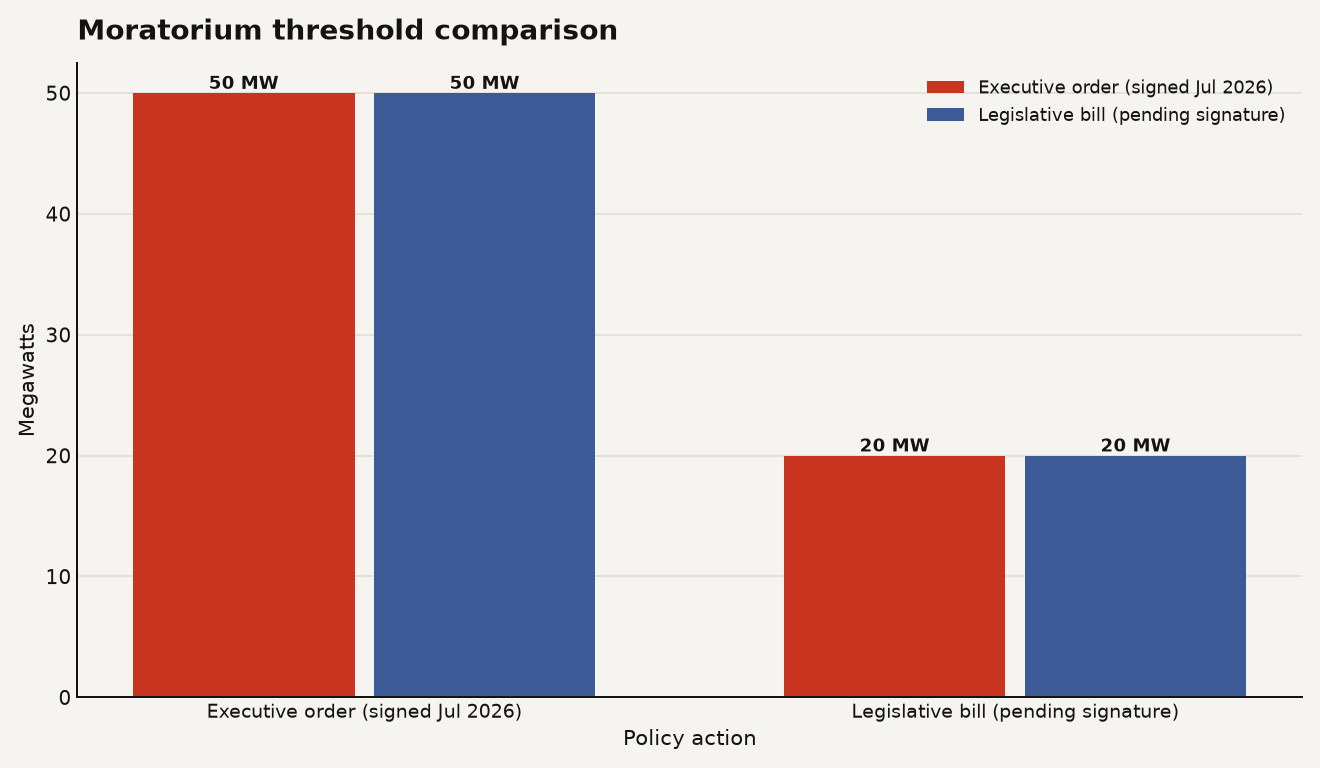
The chart above shows the gap between the two thresholds. The executive order signed by Hochul sets the bar at 50 MW. The legislative bill sitting on her desk would drop it to 20 MW, more than doubling the number of facilities that would need permits the state is not issuing.
What does this mean for AI builders and cloud users?
If you are building AI products and relying on cloud infrastructure, the direct impact is limited for now. The moratorium applies to new permits, not existing facilities. If your cloud provider already has capacity in New York or in adjacent regions, your workloads are not immediately affected.
But the indirect effects matter more:
- Capacity planning gets harder. Cloud providers factor state-level regulatory risk into their capacity roadmaps. A moratorium in a major market like New York signals that other states may follow. If you are planning capacity for 2027 or 2028, assume that permitting timelines in multiple states could stretch.
- Costs could rise. If data centers face new requirements to invest in local energy infrastructure, or lose sales tax exemptions, those costs will flow through to cloud pricing. Hyperscalers do not absorb regulatory costs; they pass them on.
- The 20 MW bill is the one to watch. If Hochul signs the legislative version, the threshold drops from 50 MW to 20 MW. That catches mid-tier facilities, not just hyperscale builds. Colocation providers and enterprise data centers in the 20 to 50 MW range would suddenly need permits that are not being issued.
- Geographic diversification becomes a strategy. If you are choosing cloud regions for latency-sensitive workloads, the regulatory environment of the region now matters alongside latency and price. A region with a moratorium or pending legislation is a risk factor.
For teams running inference at scale, the moratorium is a reminder that compute capacity is not just a technical constraint. It is a political one. The same forces that turned AI model launches into a permit race are now turning data center siting into a political negotiation.
Which projects are actually at risk under the 50 MW threshold?
The 50 MW threshold in the executive order is aimed squarely at hyperscale facilities. These are the massive campuses built by AWS, Google, Microsoft, Meta, and a handful of other operators. A typical hyperscale data center ranges from 50 MW to well over 200 MW. The largest campuses under development in the US are approaching 1,000 MW.
The 20 MW threshold in the legislative bill would cast a much wider net. Facilities in the 20 to 50 MW range include mid-tier colocation centers, enterprise data centers for large financial institutions, and some AI inference sites that do not need hyperscale capacity but still draw substantial power.
Hochul's office could not immediately identify the number of proposals that would be impacted by the executive order, according to The Verge's reporting. That uncertainty itself is a signal: the state does not yet have a clear picture of how many projects are in the pipeline, which makes it harder for builders to assess their own exposure.
The moratorium also creates a bifurcation. Facilities below 50 MW can proceed, at least under the executive order. Facilities above 50 MW cannot get new permits. If you are a developer planning a facility that sits near the threshold, the design choice between a 45 MW and a 55 MW build just became a regulatory decision, not just an engineering one.
What should builders watch for in the next 12 months?
The most important signal is whether Hochul signs the legislative bill. If she does, the threshold drops to 20 MW and the moratorium extends through the legislative process, which could last longer than the executive order's one-year window. If she does not, the executive order stands at 50 MW and expires within a year unless renewed.
Watch for these specific developments:
- The Department of Public Service's standards. The moratorium is a pause, not a ban. The standards that emerge will determine what data centers need to do to resume getting permits. If the standards require expensive energy infrastructure investments or community benefit agreements, the effective cost of building in New York goes up permanently.
- The sales tax exemption rollback. Hochul said she will push for this when the legislature returns. If it passes, large data centers lose a financial incentive that has been part of the pitch for building in New York. That changes the economics for any operator weighing New York against Pennsylvania, Virginia, or other alternatives.
- Other states. Maine's veto was a near miss. Other states with active data center buildout, including Virginia, Texas, and Georgia, have seen local opposition but no statewide action yet. If New York's moratorium produces workable standards without driving away too much investment, it becomes a template. If it produces a year of delay and no clear standards, it becomes a cautionary tale.
- Cloud provider responses. Watch where AWS, Google, and Microsoft announce new capacity in the next six months. If New York drops off their expansion maps, that tells you the moratorium is biting. If they keep announcing New York capacity, it tells you they had permits in hand before the pause.
The infrastructure layer is now a political layer
The moratorium in New York is a one-year pause, not a permanent ban. But it establishes a precedent that every state legislature in the country can now reference. Data center siting used to turn on land, power, and fiber. Now it also turns on political consent. For anyone building AI infrastructure or depending on it, that is a new variable in the planning model, and it is not going away.
Sources
- The Verge - New York becomes the first state to enact a data center moratorium