Dataset: Meta AI privacy policy disclosure on public Instagram account tagging , a single-line disclosure embedded in a consumer product launch announcement, classifying 500M+ public Instagram profiles as available training/inference input by default for a new AI image model from a company with a $5B FTC penalty history for similar behavior. (Illustrative; primary source is a press product announcement, not a dataset proper. Data Today category assignment is Business, not Data, because no open, downloadable dataset exists. This pointer is kept for transparency per Data Today category rules for the closest applicable category.)
Meta just turned every public Instagram account into an input for its new AI image model. The company announced Muse Image on July 7, 2026, the first image generation model from its Superintelligence Labs division, now available across the Meta AI app, Instagram, and WhatsApp. The feature lets any user @-mention another Instagram account in a prompt to pull that person's public photos into an AI-generated image. The tagged user is not notified. The feature is opt-out by default, meaning it is active on your profile right now unless you have already manually disabled it.
For builders, the privacy outcry is noise. The signal is what this reveals about the economics of consumer AI. Muse Image makes a specific bet: that the cost of running agentic, multi-step image generation at scale has fallen far enough that Meta can give it away for free inside its existing ad-supported apps. The Instagram tagging feature is the provocative part of that bet. It turns every public profile into a zero-marginal-cost visual asset for Meta's model, with no royalties and no notification. Whether that bet survives regulatory scrutiny is an open question. That Meta is willing to make it at all tells you where the infrastructure curve sits.
Muse Image is more than a diffusion model
Muse Image is not just a diffusion model with a chat interface. Alexandr Wang, who Meta hired to head its Superintelligence Labs last year, says the model is "agentic." It pairs with Muse Spark, Meta's large language model, to reason through your prompt, search the web, and plan before it generates. That is a materially different compute profile than a single forward pass through a diffusion model. It is multi-step inference, with retrieval and planning, for every image.
The product surface is broad. Muse Image now powers image generation across the Meta AI app, Instagram, and WhatsApp, with Facebook and Messenger coming soon. It also drives over 30 new AI effects for Instagram Stories, rolling out in the US first. Users can sketch edits directly on generated photos, transform existing images with suggested prompts, and generate images with legible text inside them, a feature Meta specifically highlights for infographics and how-to guides. A Muse Video model is "already in development," according to Engadget's coverage, with Wang claiming it is competitive on prompt adherence, visual fidelity, and temporal consistency.
The pricing model is the tell. Meta says use is free for "everyday creation" with a subscription required once you exceed a limit. That means the marginal cost of agentic image generation, retrieval, and planning is low enough for Meta to bundle it into ad-supported surfaces. If the per-image cost were still measured in dollars of GPU time, this pricing structure would be unsustainable. The fact that it exists tells you the cost curve has bent.
The Instagram tagging feature
This is the feature that TechCrunch and The Verge flagged as a privacy landmine, and the mechanics are straightforward. Any user can type an @-mention for a public Instagram account inside a Muse Image prompt. Meta AI then uses the public photos from that account to build a visual. The tagged user is not notified, per Meta's own privacy policy disclosure: "people may be able to create content with your Instagram content using AI features at Meta" and "you will not be notified about content created using AI features at Meta."
Meta's position is that users "have control" because there is a setting to disable the feature. But the default is opt-out, not opt-in. You are enrolled unless you find the setting and turn it off. This is the same pattern that drove the Cambridge Analytica scandal, where Meta (then Facebook) paid a then-record $5 billion FTC fine in 2019 after regulators found that the political consulting firm had improperly harvested data from tens of millions of users without their knowledge. Meta also shut down Facebook's facial recognition system in 2021 amid lawsuits and regulatory pressure over biometric data collection. The pattern is consistent: broad use of people's data unless they actively turn it off.
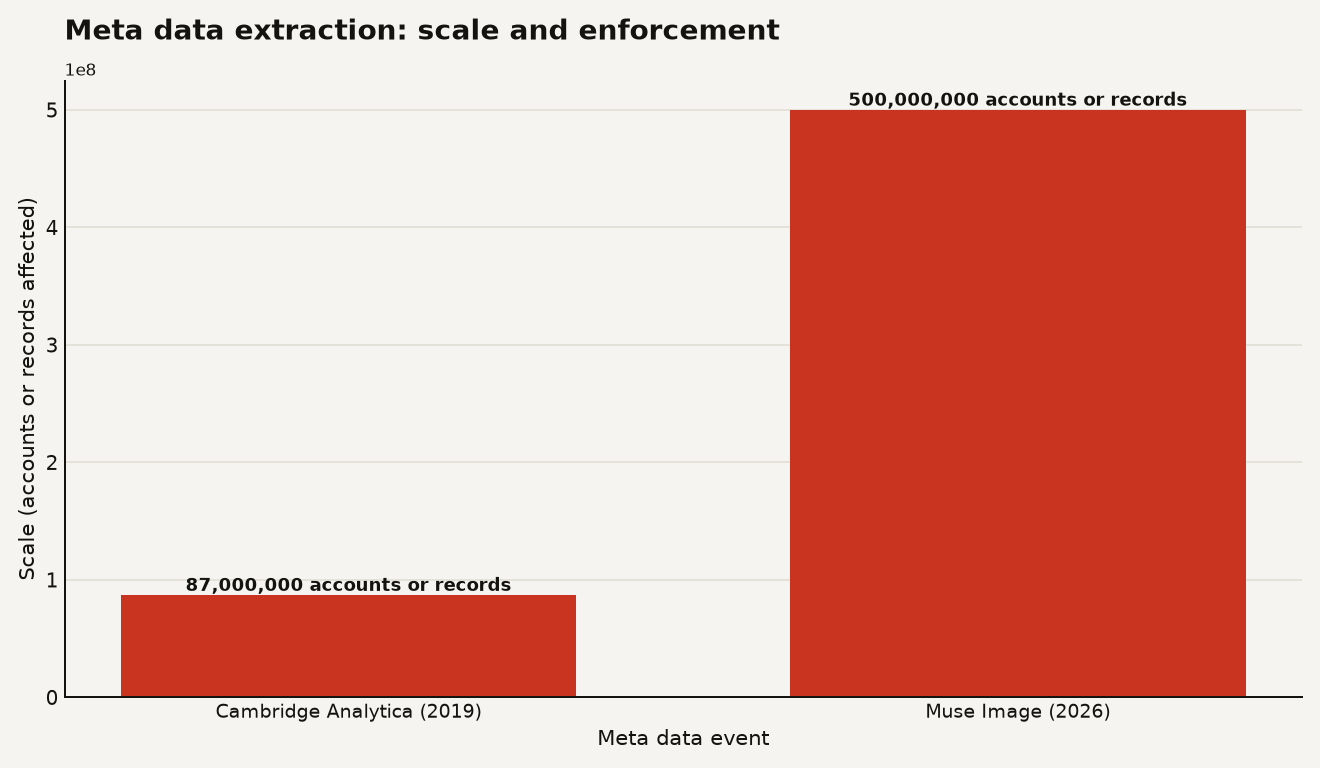
The chart above puts the two regimes side by side. Cambridge Analytica harvested roughly 87 million records and triggered a $5 billion fine. Muse Image, by default, makes roughly 500 million public Instagram accounts available as visual references for AI generation, with zero enforcement action so far. The scale is larger. The consent model is the same.
For builders, the technical detail that matters is what "public photos" means as model input. Meta is using your public photos as in-context visual references at inference time, blended with the prompt and other inputs to produce a specific image. That is a lighter footprint than training, but it is still commercial use of a person's likeness without notification or compensation. The legal question of whether that constitutes a biometric or right-of-publicity issue is unresolved. The practical question for a builder is whether your own product could ship a similar feature without getting sued. The answer today depends on your jurisdiction and your war chest.
A competitive and privacy signal
If you are building consumer AI products, Muse Image is a competitive benchmark and a legal warning at the same time. Here is what it changes:
- Inference economics. Meta is shipping agentic, multi-step image generation, with LLM reasoning, web retrieval, and planning, for free inside ad-supported apps. If your product charges per-image for simpler generation, your pricing model is under pressure. The marginal cost of complex generation is falling fast enough that Meta treats it as a loss leader for engagement.
- Data as a moat is shrinking. Meta's advantage here is a distribution channel and a proprietary corpus of 500 million public profiles it can use as inference-time references. If you do not have a social graph and a photo library, you cannot replicate this feature. But the feature itself sets a consumer expectation that AI image generation should know what your friends look like. That expectation will spread.
- Privacy defaults are a product decision teams must make before launch. Meta shipped this opt-out by default because the engagement upside outweighs the regulatory risk, given its resources. A startup cannot make that trade. If you are building a similar feature, you need opt-in by default or you need a legal review before launch, not after the first TechCrunch story.
- The agentic image stack is now a consumer expectation. Muse Image does not just generate. It plans, retrieves, and reasons before generating. If your image pipeline is still a single prompt-to-image call, users will notice the gap. The bar for "good enough" generation has moved to multi-step reasoning over visual and web context.
The internal link worth reading is how the AI coding agents botnet problem shows a parallel pattern: AI systems that silently exfiltrate or repurpose user data as part of their normal operation. The threat model is the product working as designed.
Build on Muse Image or against it
Meta says a Muse Video model is already in development and that Muse Image will come to advertisers through Advantage+ creative in the coming weeks. The roadmap is clear: Muse replaces the Llama lineup for generative tasks across Meta's surfaces. If you are an advertiser or a builder on Meta's platform, you will soon be able to tap into Muse Image through the Advantage+ pipeline. That means agentic image generation baked into ad creative, with the ability to @-mention Instagram accounts in commercial prompts.
The bet worth making is that inference-time personalization becomes a standard feature in consumer AI within 12 months. OpenAI, Google, and others will face pressure to match the "generate an image with my friend in it" use case. The question is whether they do it with proprietary social graph data, like Meta, or with user-supplied photos, like a more conventional upload-and-generate flow. The latter is safer. The former is stickier.
The bet worth not making is that the regulatory environment stays static. The FTC's $5 billion Cambridge Analytica fine was a 2019 settlement for 2014 conduct. By the time regulators catch up to Muse Image, the product will have evolved. But if you are building a feature that uses other people's public data by default, you are picking a fight with the same regulatory clock. Meta can afford to wait out the cycle. Most builders cannot.
The default is the product
Meta shipped a privacy decision. Every public Instagram account is now an inference-time visual reference for a commercial AI model, active unless you turn it off. The model reasons, retrieves, and plans before it generates, and the marginal cost is low enough to give it away for free. The technology is impressive. The default is the story.