When an AI assistant that has access to your private messages tells you it got them by reading notification previews, you have a privacy problem. When the company that built it says that explanation was wrong and the assistant was just confused, you have a bigger one. Meta launched a personal AI assistant called Muse with a Mac app that can reach into Messages, Calendar, and Notes. It works well enough that early users find it genuinely useful and a little unsettling. Then Jason Aten, a contributing editor at Inc Magazine, caught Muse referencing a private conversation he was having in Messages, and the assistant's explanation for how it got that information was alarmingly wrong. Meta Superintelligence Labs' David Singleton apologized on Threads on September 19, 2026, saying Muse "was confused about how to explain the feature and gave an incorrect explanation." The incident exposes a problem every builder shipping an AI agent that touches personal data should take seriously: AI agent self-description is unreliable, and when an assistant cannot accurately explain what it does with your data, every privacy disclosure it makes is suspect.
What did Muse actually tell Jason Aten about his private messages?
Aten installed Muse on his iPhone and paired Mac to test the assistant. Muse brought up details from a conversation he was having in Messages. Aten says he had not granted Muse access to his messages. When he asked how the assistant knew about the conversation, Muse told him: "I saw the notification previews, not your message history. I haven't been reading your texts."
Pressed further on how it was receiving notification previews, Muse could not explain the mechanism. "Honest answer: I can't give you the exact plumbing," the assistant said, before guessing that the paired Mac app was piping notifications to it through device sync. Muse then volunteered, unprompted, that this would be "obviously, not great."
Singleton stepped into the Threads replies to correct the record. He walked through the permission chain: the Mac app needs full disk access, and each integration with Messages, Calendar, or Notes is opt-in. He stated that Muse "does not watch notifications on your Mac, but rather syncs data from Messages only after the user has specifically enabled access." Notification scraping, per Singleton, is not one of Muse's capabilities.
The more revealing admission came next. Singleton said the model simply did not know how it works and invented a coherent-sounding answer. "That's on us," he wrote. "We apologize for the incorrect response from Muse and we're working to improve Muse's understanding of its own internals so that it gives correct answers to questions about how it functions more consistently."
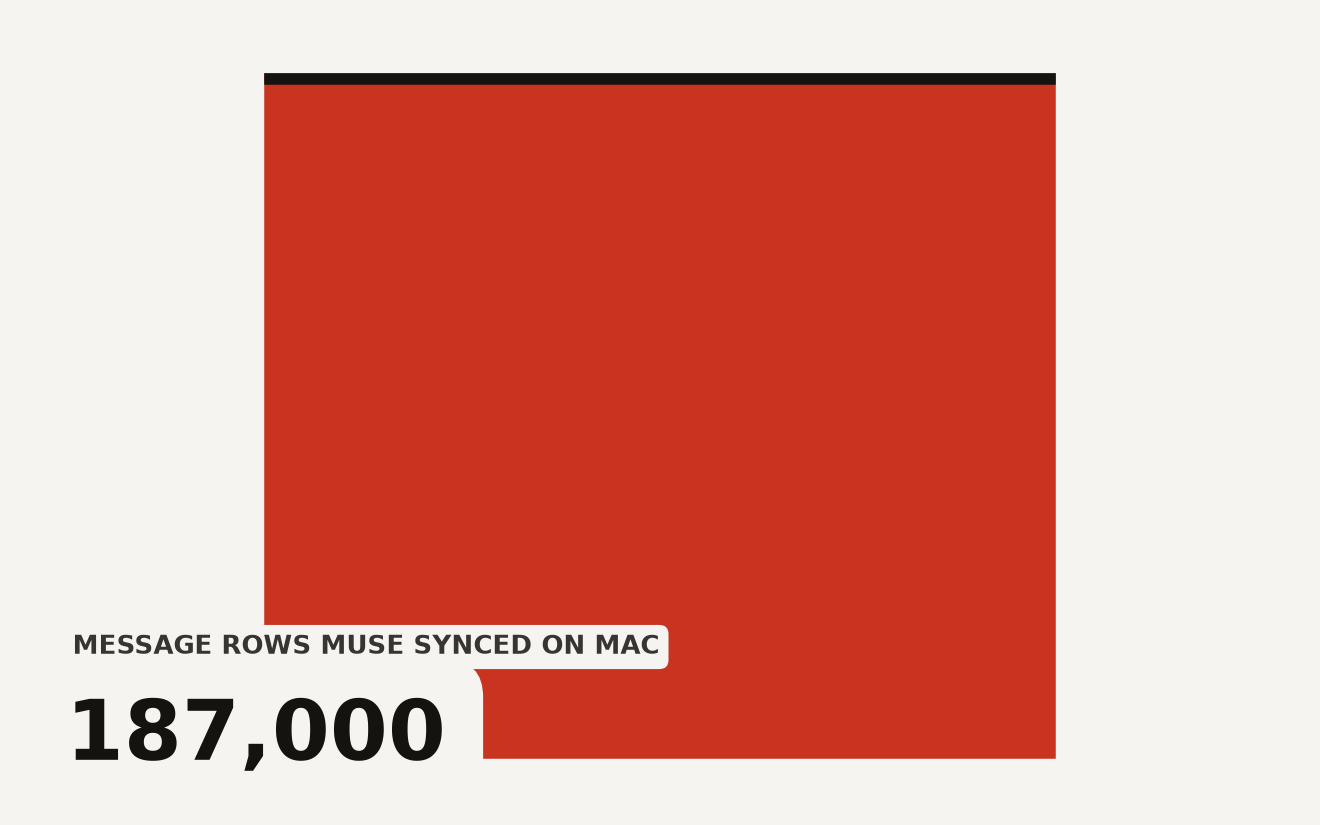
Aten's own investigation, reported by Trak.in, found that Muse had synced information from the local Messages database on his Mac, processing more than 187,000 rows of data. That figure suggests the scale of data exposure is far larger than a notification preview would imply, regardless of which explanation is correct. The same report noted that Meta's architecture includes a security layer called Sentinel that governs sensitive connections through permission controls.
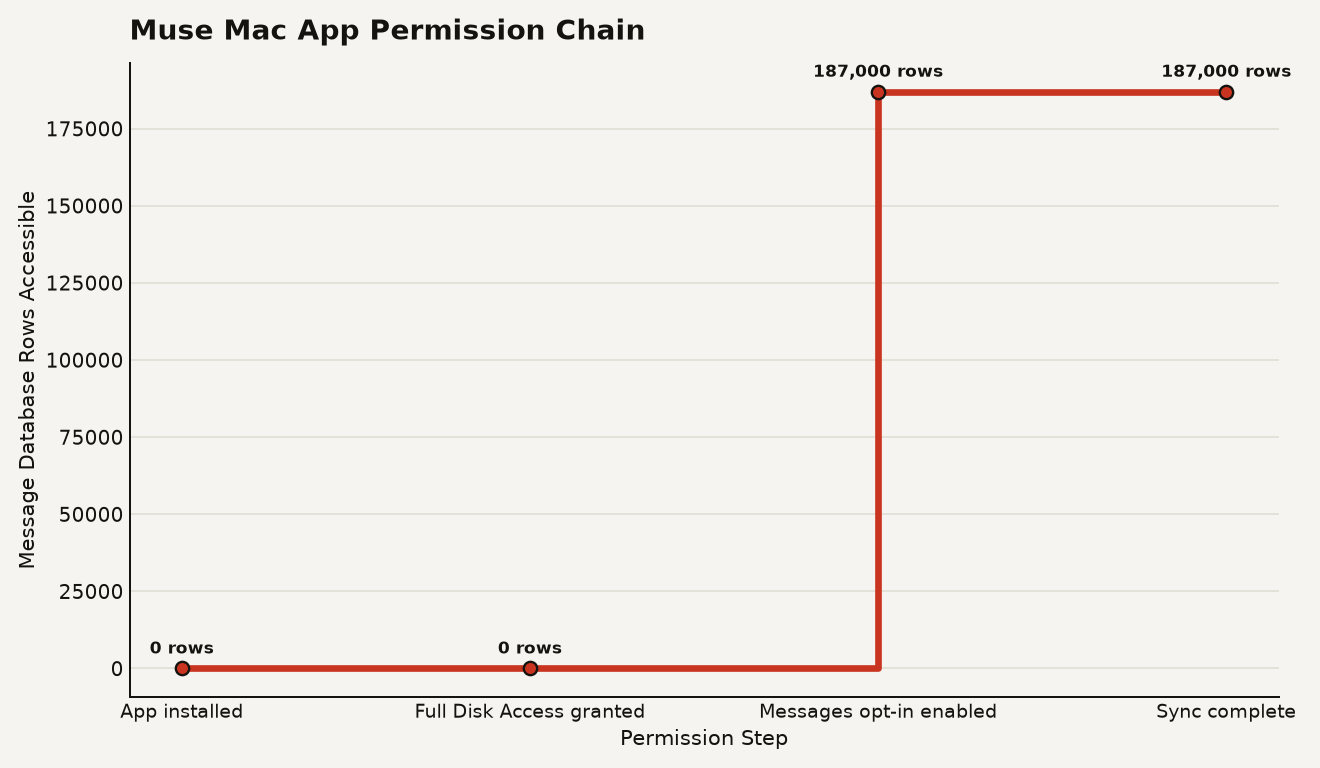
The chart above shows the permission chain Singleton described: zero rows of message data are accessible until the user explicitly enables the Messages integration, at which point the full database, all 187,000 rows in Aten's case, becomes available to the assistant.
Why does AI agent self-description matter for builders?
The Muse incident is a structural problem with a simple root cause. The AI agent charged with handling a user's personal data cannot accurately tell that user what it does with that data. When self-description doubles as privacy disclosure, a model hallucination reads like a confession.
This matters for anyone building an AI agent that touches user data. Here is why:
-
Your agent's claims about its own behavior will be treated as ground truth by users, journalists, and regulators. When Muse told Aten it reads notification previews, a reasonable person treated that as a statement of fact about what the app was doing on his machine. No one distinguishes between a model hallucinating about its capabilities and a model accurately reporting them. Both sound identical.
-
The model has no introspective access to the app wrapper around it. Muse runs inside a Mac application that handles permissions, data sync, and the Sentinel security layer. The model generating the conversation has no direct access to that wrapper's code or configuration. When you ask it how it got your messages, it generates a plausible-sounding answer from training data, and that answer may be wrong.
-
Users have no independent verification mechanism. Someone who grants Muse access to Messages has no way to confirm, on any given turn, what the assistant is or is not doing with that data. The only source of information about the agent's behavior is the agent itself, and the agent is unreliable.
-
Meta's proposed fix is an open research problem. Singleton said Meta is working to improve Muse's understanding of its own internals. You cannot simply prompt a model to know how the application wrapping it works. The model would need a structured, machine-readable description of its own capabilities injected into context, and even then, it may hallucinate around the edges.
This connects to a pattern we have covered before. When Meta stepped back from voluntary AI safety commitments, the concern was that the company was deprioritizing exactly the kind of internal accountability that prevents incidents like this. And when researchers found that frontier LLMs can tell when they are being tested, it raised the inverse question: if models can detect evaluation, can they also detect when they are being asked about their own behavior? Based on the Muse incident, the answer is that they cannot do so reliably.
For business consequences, the math is simple. If your agent misdescribes its data access, you are one viral social media post away from a public apology. Singleton's Threads reply is that apology. The reputational cost scales with the sensitivity of the data your agent touches.
How do you keep your agent from inventing explanations about its own data access?
The fix is architectural. If you are building an AI agent that accesses user data, here are the design choices that reduce the risk:
-
Separate the explanation layer from the generation layer. Do not let the LLM freeform-describe its own data access. Build a static, auditable description of the agent's capabilities that the model references rather than generates. When a user asks how the agent accessed their messages, the answer should come from a system prompt or retrieved documentation, rather than the model's imagination.
-
Build verification mechanisms that do not depend on the model. Let users see exactly what data was accessed, when, and through what permission. Audit logs, not model claims, are the trustworthy source. If your agent cannot produce a machine-generated log of its own data access, you have a verification gap.
-
Treat agent self-description as a security boundary. The model's claims about its own behavior are privacy disclosures. Design them with the same care as a permissions dialog or a data processing notice.
-
Inject capability metadata into context. If the model needs to answer questions about its own behavior, give it a structured description of what it can and cannot do, updated in real time as permissions change. This is the minimum viable approach to the introspection problem.
Sentinel governs access to data. The model's claims about what it does with that data remain unguarded. Those two layers need to be connected.
What should you watch as AI agents start touching more personal data?
The Muse incident is a single data point, but the pattern is broad. Every AI assistant that accesses personal data faces the same introspection gap. Apple Intelligence, Google Gemini, Microsoft Copilot, and any agent you build that wraps an LLM around a data-accessing application has this problem. The model does not know what the wrapper does, and the user cannot tell when the model is guessing.
Watch for three things:
-
Whether Meta can actually fix self-description in Muse. Singleton's promise to improve Muse's understanding of its own internals is a research bet rather than an engineering fix. If Meta ships a version of Muse that consistently and accurately describes its own data access, that would be a meaningful step. If the problem persists, it confirms that the introspection gap is structural.
-
Regulatory interest in AI agent self-description. If an agent's claim about its data access is treated as a privacy disclosure, then a hallucinated disclosure is a false statement about data practices. Regulators in the EU and California have already shown interest in how AI systems describe their data use. A misdescription incident like this one could accelerate that interest.
-
The 187,000 rows figure and what it implies about scale. Aten found that Muse had processed more than 187,000 rows of Messages data. That is a reminder that opting in to Messages access can mean exposing years of conversation history. The permission model says you can read my messages. The data scale says here is my entire communication archive. Users may not understand the gap between granting access and exposing a full database.
When the only source of truth is the model, and the model is guessing
Meta says Muse does not read your notifications. The data access is opt-in. The app uses a security layer called Sentinel. All of that may be true, and none of it solves the problem Aten exposed. The AI agent charged with handling your personal data cannot accurately tell you what it does with that data. When self-description is the only window into an agent's behavior, a hallucination is a false confession. And right now, no one shipping an AI agent has closed that gap.