The cleanest AI metric right now is not tokens per second, benchmark score, or valuation. It is the AI trust gap: people are using the tools and still bracing against the institutions shipping them.
Pew Research Center put a number on that gap this week. In a national survey conducted from February 17 to 23, 2026, 49% of U.S. adults said they use AI chatbots, while 63% said AI is advancing too quickly, according to Pew's Americans and AI 2026 report. That combination matters more than another demo of an agent booking a dentist appointment. Adoption is no longer the bottleneck. Permission is.
If you build AI products, the message is blunt. The public has moved past awareness. Pew found that 87% of U.S. adults have heard at least a little about AI chatbots, according to the report's age breakdown. People know what these systems are. Many have tried them. Many use them at work. They still do not trust the pace, the companies, or the data bargain.
That is the market you are shipping into.
What did Pew actually find about the AI trust gap?
Pew's survey is useful because it separates use from attitude. The report surveyed 5,119 U.S. adults and put the full sample's margin of sampling error at plus or minus 1.6 percentage points, according to Pew's methodology. This is not a vibes poll from a vendor trying to sell an AI transformation package. It is a broad public opinion snapshot.
The first finding is adoption. Pew says 49% of U.S. adults now use AI chatbots such as ChatGPT, Gemini, or Copilot, up from 33% in 2024 in the same report's main adoption chart. That is a 16 point jump in roughly two years. Consumer behavior has moved faster than most enterprise approval workflows.
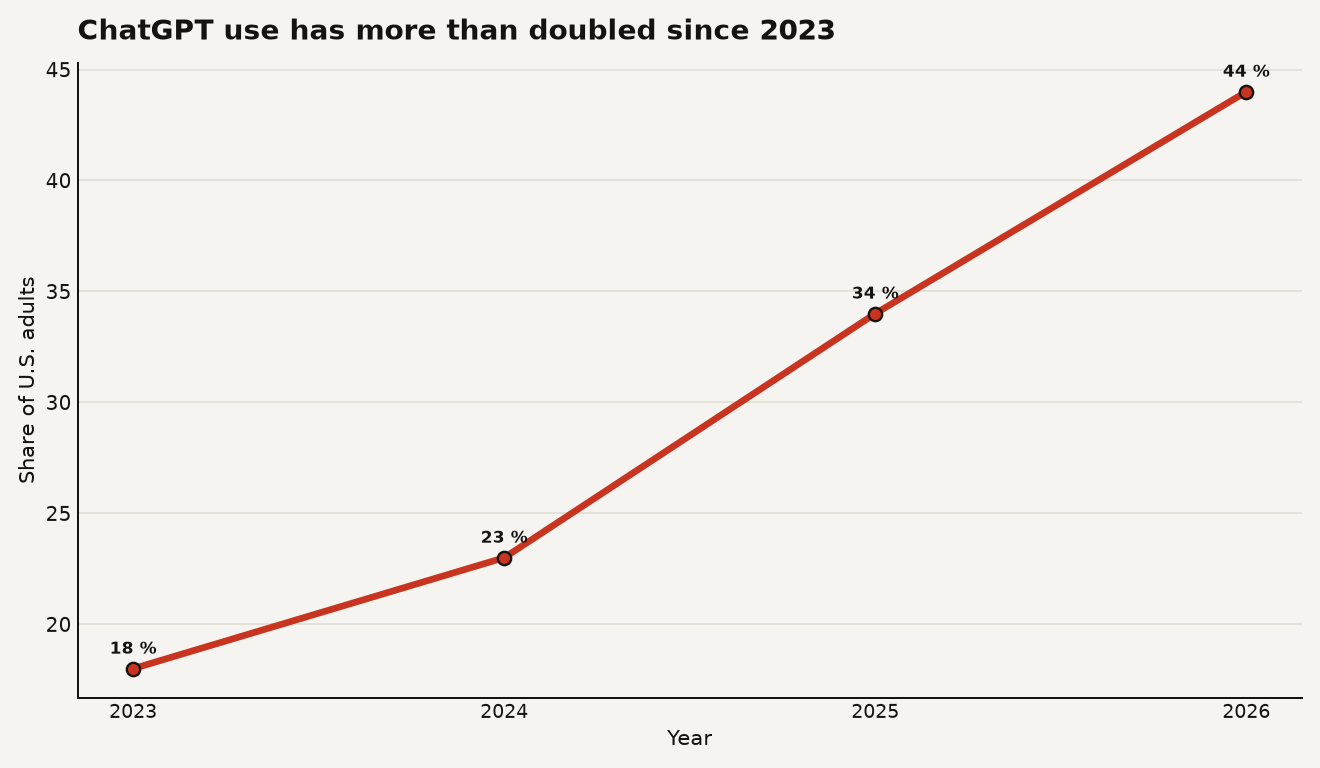
The second finding is concentration. Pew found that 44% of U.S. adults have used ChatGPT in 2026, compared with 18% in 2023, 23% in 2024, and 34% in 2025 in its ChatGPT trend data. The chart below shows the important curve: ChatGPT use more than doubled from 18% to 44% in three years.
This is the part many AI roadmaps still miss. A product can be culturally familiar and commercially fragile at the same time. People may accept a chatbot for search, drafting, or code explanation while resisting opaque automation in hiring, pricing, customer support, health, or finance.
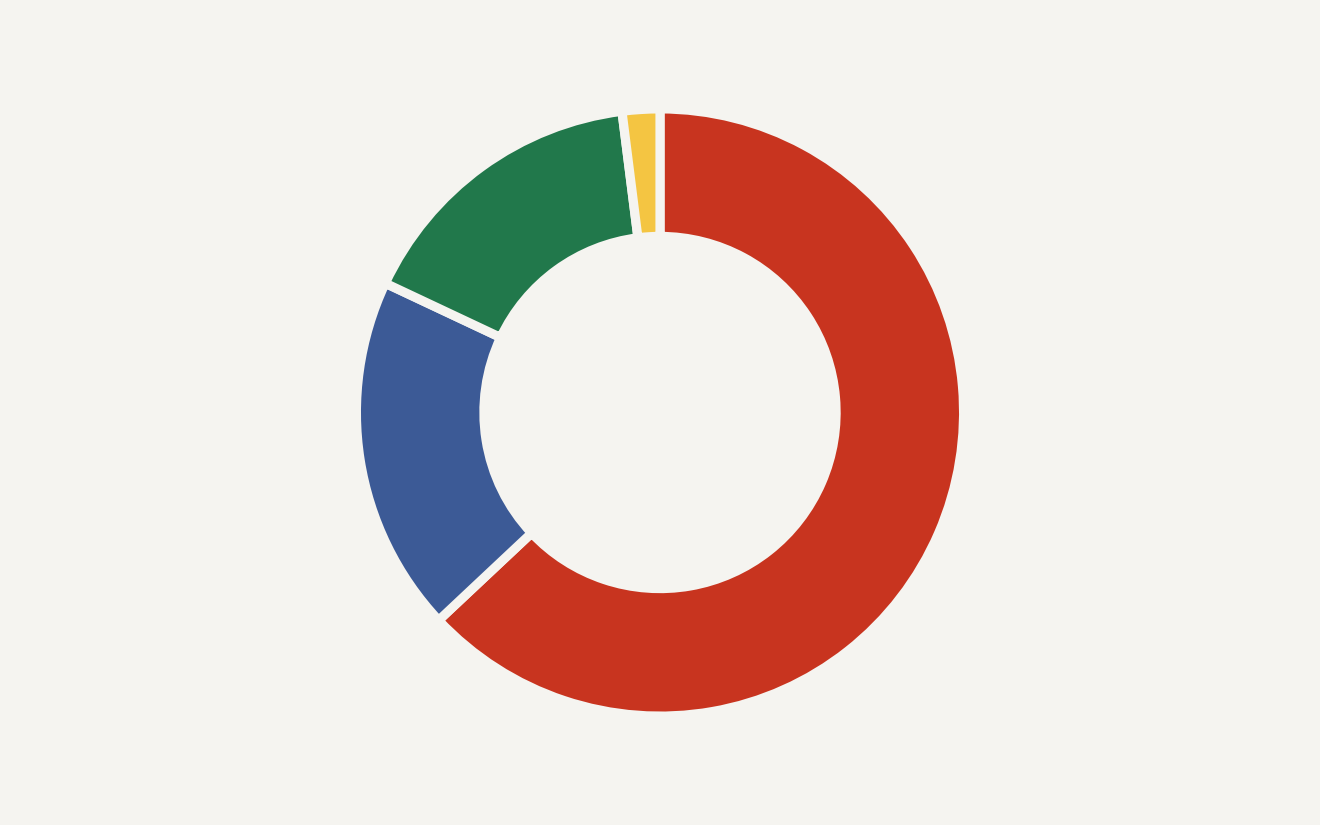
The third finding is anxiety about speed. Pew found that 63% of U.S. adults say AI is advancing too quickly, while 19% say it is moving at about the right pace, 16% are not sure, and 2% say it is moving too slowly in the report's pace of AI chart. That 2% is the lonely corner of the room where the accelerationists are refreshing model leaderboards.
The fourth finding is that usefulness has not created optimism. Pew found that 30% of U.S. adults say chatbots help their productivity, 28% say they help them stay informed, and 21% say they help their creativity in the report's chatbot impact chart. Yet Pew also found that only 16% of U.S. adults expect AI to have a positive impact on society over the next 20 years, while 40% expect a negative impact in the same report's societal impact chart.
That is the AI trust gap in one sentence: people see personal utility, but they do not buy the social contract.
Why are younger users more skeptical after using AI more?
The lazy read says younger people will normalize AI and the backlash will age out. Pew's numbers push against that.
Adults ages 18 to 29 are the heaviest adopters by reach, with 66% saying they use AI chatbots in 2026, according to Pew's age usage data. But the same age group is also the most negative about AI's future social impact, with 48% saying AI will have a negative impact on society over the next 20 years and 14% saying the impact will be positive in Pew's age opinion chart.
That is a product lesson hiding in demographic clothing. Heavy use does not automatically produce trust. Heavy use can expose the seams: hallucinated answers, creepy personalization, brittle guardrails, content slop, homework shortcuts, résumé filters, support bots that trap users in loops, and workplace pressure to do more with fewer people.
The 30 to 49 group is the daily-use workhorse. Pew found that 34% of adults ages 30 to 49 use chatbots daily, compared with 31% of adults ages 18 to 29, 19% of adults ages 50 to 64, and 7% of adults 65 and older in its daily use chart. If you sell AI into business workflows, this middle band is probably your actual operator: the manager writing specs, the analyst cleaning slides, the developer debugging a migration, the founder answering support emails after midnight.
The use cases also point to where trust breaks. Pew found that 38% of employed adults use chatbots for work tasks, 42% of U.S. adults use them to search for information, 20% use them for medical advice, and 10% use them for emotional support in the report's use case chart. The farther a task moves from convenience into consequence, the more your product needs proof, auditability, and an exit ramp to a human.
A builder should read the youth data as a warning against demographic smugness. Gen Z is not waiting to be converted. Many already converted, tested the product, and found the terms of the deal suspect.
What does this change for your product roadmap?
The commercial implication is simple: trust is now a feature with an owner. If nobody owns it, your product team has created a hidden dependency on public patience.
Pew found that 71% of U.S. adults think the increased use of AI will make their personal information less secure, while only 3% think it will make their information more secure in the report's data security chart. That number should change your default UX. If your AI feature asks for documents, calendar access, CRM records, code repositories, inbox history, or health context, users are not starting from neutral.
Here is what this means for you:
- Privacy copy cannot be legal mulch. If the model sees customer data, say what gets stored, what gets trained on, what gets logged, and how long it stays there.
- Human override is product design, not support cost. For high consequence tasks, the option to review, edit, reject, or escalate is part of the value proposition.
- Evaluation needs to be visible. A benchmark buried in a launch post will not help a buyer justify risk to a security team, board, parent, teacher, physician, or regulator.
- Defaults matter more than demos. If your app auto-summarizes, auto-sends, auto-ranks, or auto-recommends, users will judge you by failure modes, not feature count.
This is where the AI trust gap collides with the model behavior work Data Today keeps coming back to. In recommendation systems, we have already seen how model defaults can quietly steer users toward familiar brands, as in our analysis of LLM recommendation bias. Public trust erodes when users feel the machine is making choices for them while pretending to merely assist.
The enterprise version is harsher. A CIO may like productivity gains, but the buyer has to defend vendor risk, data leakage, employee displacement, audit trails, procurement exposure, and regulatory posture. Pew found that 59% of U.S. adults have little or no confidence in U.S. companies to develop and use AI responsibly in its government and corporate trust chart. That is the air your sales team breathes.
Meanwhile, investment keeps shouting louder than trust. Stanford HAI's 2026 AI Index says U.S. private AI investment reached $285.9 billion in 2025, more than 23 times China's $12.4 billion, in the report's top takeaways. Capital is racing ahead of permission. That gap can work for incumbents for a while. It can also turn small product mistakes into brand-size liabilities.
What should builders do before the backlash gets expensive?
Start by treating trust work as shipping work. The cheap version is a policy page. The useful version changes what the product does.
First, classify your AI features by consequence. A grammar rewrite, a SQL suggestion, a code explanation, a medical triage answer, and an automated loan decision do not belong in one risk bucket. Pew found that 20% of U.S. adults use chatbots to get medical advice, according to its use case table. If people are already bringing high stakes questions into general tools, builders of vertical products should assume misuse and edge cases from day one.
Second, make provenance visible. If your answer comes from retrieved documents, show the documents. If your agent changed a record, show the before and after. If your model is guessing, say so in plain language. A confidence badge that nobody understands is costume jewelry.
Third, separate assistive features from autonomous ones in pricing, permissions, and logs. A team may accept an AI draft assistant before it accepts an AI agent that commits code or messages customers. In Pew's survey, 60% of U.S. adults said they read AI summaries at the top of search results, according to the report's AI search summary chart. Summaries are already ambient. Actions still need accountability.
Fourth, instrument refusal and correction. Track where users undo AI suggestions, request human escalation, delete generated text, or distrust a citation. These are not just UX events. They are trust telemetry. If your dashboard only tracks generations, latency, and cost, you are flying with one eye closed.
Fifth, stop selling inevitability. Pew found that 67% of U.S. adults have little or no confidence in the U.S. government to regulate AI effectively, up from 62% in 2024, according to its regulation confidence chart. In that environment, "AI is coming whether you like it or not" sounds less like strategy and more like a threat. Better pitch: here is the task, here is the boundary, here is the audit trail, here is how you turn it off.
The winners will be the teams that make AI feel inspectable. That is less glamorous than a launch video. It is also harder to copy than another chat box.
Can AI companies close the gap without slowing down?
They can close part of it. They will probably have to change what speed means.
A model release every few weeks may impress developers and investors. It can also exhaust customers who need stability, version control, compliance review, and predictable behavior. For a startup, the temptation is to borrow the rhythm of frontier labs: ship a new model, rename the tiers, move the limits, update the agent, change the prompts, ask users to keep up. That rhythm punishes trust in mature workflows.
The better move is boring in the right way. Ship capability faster inside stable contracts. Give customers pinned models, changelogs, regression tests, admin controls, eval suites, retention options, and clear incident reports. If you are building for developers, publish the version behavior that affects code generation, tool calls, context handling, and security boundaries. If you are building for business users, explain what happens when the model is wrong.
The Pew data does not say Americans reject AI. It says the public has learned to use AI while doubting the system around it. That is a more complex market, and a more durable one for teams that can earn trust at the product layer.
The AI trust gap is now a roadmap input. Ignore it, and every new capability arrives with a tax: more objections, more procurement friction, more support burden, more regulation risk, more users who try the tool and keep one hand on the escape hatch.
The permission layer is the next platform
The companies racing to make AI ubiquitous have already won attention. Pew's 63% number says they have not won permission.
That should focus builders. The next moat is not just a smarter model or a lower token bill. It is the layer that lets users see, limit, contest, and trust what the system is doing. The product that earns that permission will feel less magical on purpose. Magic is fun until it asks for your data.