DeepSeek V4 Flash is live: what beginners should know
DeepSeek V4 Flash is a 284B-parameter AI model with 13B active that went live July 31, 2026. It matches frontier coding benchmarks at a fraction of the cost.
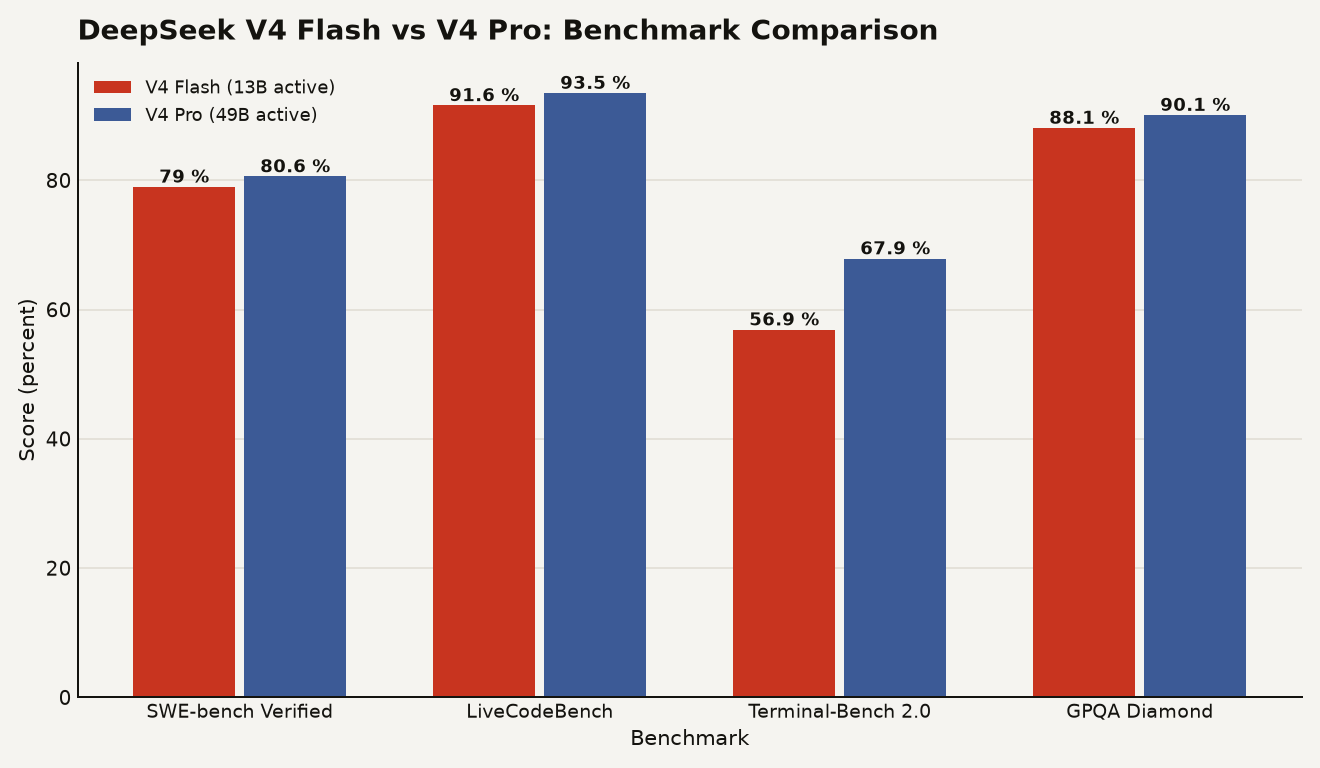
DeepSeek V4 Flash (13B active) vs V4 Pro (49B active) across four benchmarks. Source: DeepSeek V4 technical report, via HuggingFace model card. Data Today benchmark.
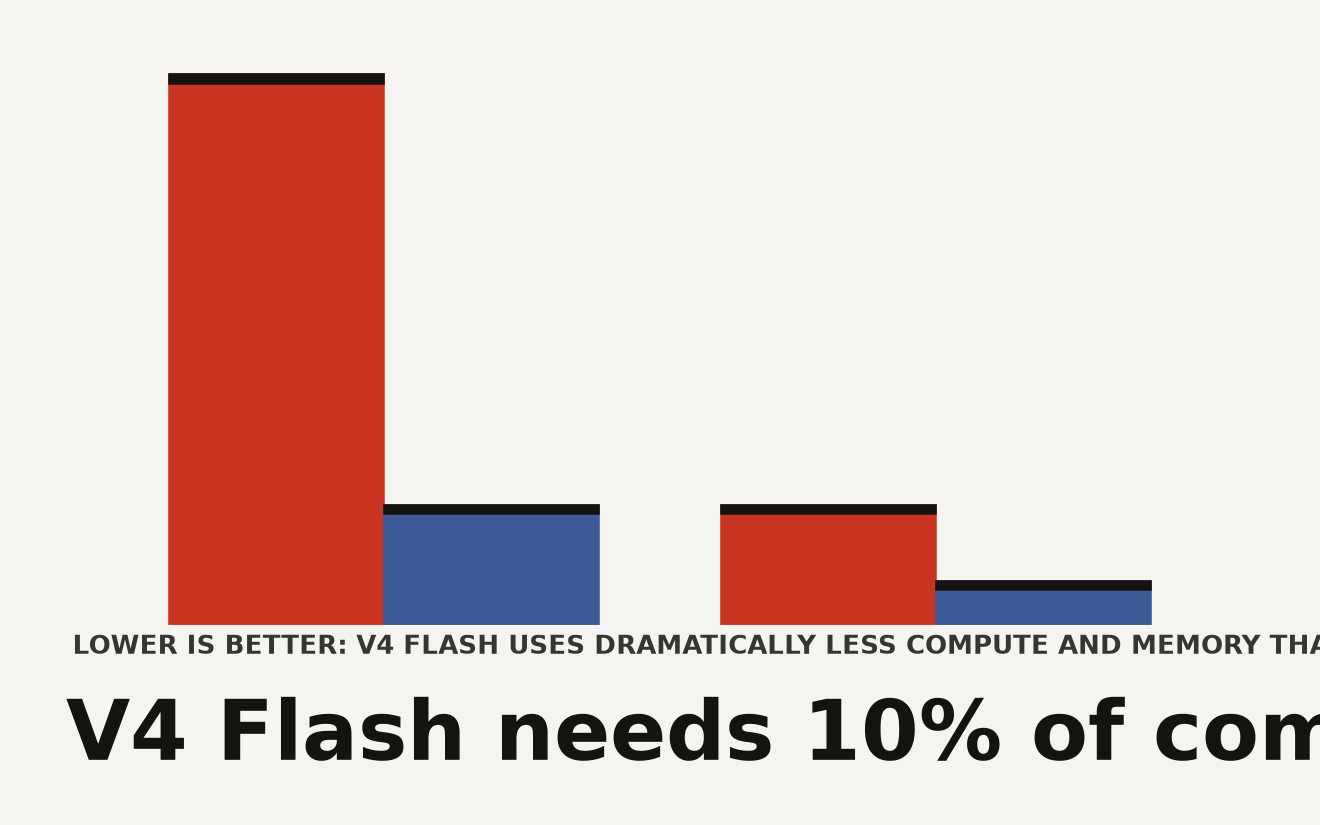
On July 31, 2026, a user on the r/LocalLLaMA subreddit spotted that DeepSeek V4 Flash had quietly gone live on DeepSeek's API. No keynote, no livestream, no balloons. The model was just there, ready to call, and the benchmark numbers attached to it were startling for the price. DeepSeek V4 Flash is a 284B-parameter AI model with 13B active parameters that went live July 31, 2026. It matches frontier coding benchmarks at a fraction of the cost. For comparison, Anthropic's Claude Opus 4.6 costs $5.00 per million input tokens and $25.00 per million output tokens, while DeepSeek V4 Flash is priced the same as the previous DeepSeek model, making it roughly an order of magnitude cheaper for similar capability on coding tasks. If you are new to AI models, here is what matters: a Chinese AI lab just shipped a model that scores 79.0% on SWE-bench Verified, a test that measures whether an AI can fix real bugs in real open-source projects. Claude Opus 4.6 scores 80.8% on the same test. The gap is 1.8 percentage points. The price gap is roughly 10x. Let's unpack what that means. ## What is DeepSeek V4 Flash and what just shipped? An AI language model is a program that predicts the next word in a sequence. It does this using "parameters," which are numbers the model learned during training. More parameters generally means the model can handle more complex tasks, but also costs more to run. DeepSeek V4 Flash uses a design called "Mixture of Experts," or MoE. In a traditional AI model, every parameter is used for every word the model generates. In an MoE model, the model has many "experts" inside it, and only a small subset of them activate for any given word. DeepSeek V4 Flash has 284 billion total parameters, but only 13 billion are active at any one time. That means it can store a lot of knowledge in the full 284B while keeping the cost of generating each word low, because only 13B worth of computation runs per token. If you want a deeper explanation of how MoE and active parameters work, check out our guide on what 21B active means in the Hy3 model. The "Flash" in the name signals that this is the smaller, faster, cheaper sibling of DeepSeek V4 Pro, which has 1.6 trillion total parameters with 49 billion active. Both models were released as preview weights on HuggingFace under the MIT license, which means anyone can download and use them for free, including for commercial purposes. Both also support a context window of one million tokens. A "token" is roughly three-quarters of a word, so one million tokens is about 750,000 words, or roughly the text of the entire Harry Potter series. This matters because it lets you feed the model enormous documents, entire codebases, or long conversation histories without losing track of earlier context. The old DeepSeek API aliases deepseek-chat and deepseek-reasoner were retired on July 24, 2026, with traffic now routing to deepseek-v4-flash in the interim. If your code still uses the old names, it may still work through this routing, but you should update your API calls to use the new model name explicitly. ## How good are the benchmark numbers really? Benchmarks are standardized tests that let you compare AI models on the same tasks. Here are the key numbers for V4 Flash, as reported in DeepSeek's technical report on HuggingFace: - SWE-bench Verified: 79.0%. This test gives the model a real bug report from a popular Python open-source project and asks it to write a fix. V4 Flash solves 79 out of 100 bugs. Claude Opus 4.6 scores 80.8%. The previous DeepSeek model, V3.2, scored about 69%. - LiveCodeBench: 91.6%. This test measures performance on competitive programming problems. V4 Flash scores 91.6%, while the larger V4 Pro scores 93.5%. - Terminal-Bench 2.0: 56.9%. This newer test measures whether a model can operate a computer terminal, running commands and navigating file systems. V4 Flash scores 56.9%, up roughly 25.8 points from V3.2 according to the Reddit announcement. - GPQA Diamond: 88.1%. This is a test of graduate-level science knowledge. V4 Flash scores 88.1%, compared to V4 Pro at 90.1%. The chart below shows V4 Flash alongside V4 Pro across four benchmarks. DeepSeek V4 Flash (13B active) vs V4 Pro (49B active) across four benchmarks. SWE-bench Verified: 79.0 vs 80.6 percent. LiveCodeBench: 91.6 vs 93.5 percent. Terminal-Bench 2.0: 56.9 vs 67.9 percent. GPQA Diamond: 88.1 vs 90.1 percent. Source: DeepSeek V4 technical report, via HuggingFace model card. Data Today benchmark. The pattern is consistent: V4 Pro is a few points ahead on every test, but V4 Flash is close behind, and it costs far less to run. The biggest gap is on Terminal-Bench 2.0, where Pro scores 67.9% versus Flash's 56.9%. That 11-point gap suggests the Pro model's larger active parameter count gives it a real edge on complex agentic tasks, which are tasks where the model has to take actions in a loop rather than just answer a single question. The Reddit post that flagged the release also noted that V4 Flash lands just one point below frontier models on the Artificial Analysis Index, a composite score that blends several benchmarks into a single number. "Frontier models" means the most capable AI models available from any lab, including OpenAI's GPT series and Anthropic's Claude line. Landing one point below them at a tenth of the price is the core of this story. ## What makes V4 Flash so much more efficient? The efficiency story is the part that matters most for builders, and it is where V4 Flash pulls away from the pack. When an AI model processes a long document, it has to store intermediate calculations in memory. This storage is called the "KV cache" (key-value cache), and it grows linearly with the length of the input. At one million tokens, the KV cache can consume enormous amounts of memory, which is why most models become expensive or slow at long context lengths. DeepSeek V4 Flash requires only 10% of the compute and 7% of the KV cache memory compared to the previous V3.2 model at one million tokens, according to DeepSeek's own analysis on HuggingFace. "Compute" here means FLOPs, or floating-point operations, which is a measure of how much math the computer has to do. Fewer FLOPs means faster generation. Less KV cache means less memory consumed, which means you can serve more users on the same hardware or handle longer documents without running out of memory. The V4 Pro model, for reference, requires 27% of the FLOPs and 10% of the KV cache compared to V3.2. Flash is even more aggressive on compression. DeepSeek achieved this through a combination of techniques. The model uses "Compressed Sparse Attention," which is a way of having the model pay attention to only the most relevant parts of a long document rather than every single word. It also uses "Manifold-Constrained Hyper-Connections," a technique that helps signals flow through the model's layers more stably. And it was trained with an optimizer called "Muon" that reportedly speeds up training convergence. None of these terms matter for using the API. What matters is the result: the model can handle a million tokens of context without the memory and compute costs that normally make long-context models impractical to deploy. ## Should you switch to V4 Flash for your projects? Here is the practical read. If you are building a coding assistant, a chatbot, or any application that involves processing long documents, V4 Flash is worth testing immediately. The combination of near-frontier benchmark scores, a one-million-token context window, and dramatically reduced memory requirements makes it one of the best value propositions on the market right now. If you are already paying for Claude Opus 4.6 or GPT-class models, the savings could be significant. V4 Flash is priced the same as the previous DeepSeek model. The larger V4 Pro costs $0.435 per million tokens, compared to Claude Opus 4.6 at $5.00 per million input and $25.00 per million output. Even if V4 Flash is priced slightly higher than V3.2 was, the ratio is still roughly 10x cheaper than the frontier alternatives. There are caveats. DeepSeek is a Chinese company, and some organizations have data residency or compliance requirements that prevent them from sending data to APIs hosted in China. If that applies to you, the open-weights release means you can download the model and run it on your own infrastructure. You will need significant GPU resources to serve a 284B-parameter model, even one with only 13B active, but the reduced KV cache makes self-hosting more feasible than it was for V3.2. The benchmarks are also self-reported by DeepSeek. They have not been independently verified by a third party, and benchmark scores do not always translate to real-world performance. A model that scores 79% on SWE-bench might still struggle with your specific codebase or coding style. Test it on your own tasks before committing. For help deciding which model to use for which task, our AI agent guide for 2026 breaks down the strengths and weaknesses of the major models available this year. ## What to watch as V4 rolls out The full general availability of V4 Pro is the next milestone to watch. The preview weights are already on HuggingFace, but the API pricing and availability for Pro have not been fully announced. If Pro follows the same pricing pattern as Flash, it could be the most capable model per dollar on the market. Watch for independent benchmark results. Once third parties like LMSYS or Artificial Analysis run their own evaluations, we will know whether the self-reported numbers hold up. The Reddit post suggests V4 Flash already appears on the Artificial Analysis Index, which is a good sign. Also watch for community fine-tunes. Because the weights are released under MIT license, developers can modify and improve the model for specific tasks. The MoE architecture makes fine-tuning more complex than a standard model, but the open-source community has gotten good at this quickly in the past. If you are running the old DeepSeek API aliases, update your code now. The routing to V4 Flash is a convenience, not a promise, and the behavior of your application may change in subtle ways when the underlying model changes. ## The real story is the price-to-performance ratio DeepSeek V4 Flash gets close enough to frontier models on the benchmarks that matter, at a price that is roughly a tenth of what they charge, with an open-weights license that lets you run it yourself. For a builder choosing where to spend their API budget, that math is hard to ignore. ## Sources - reddit.com - r/LocalLLaMA: The official release DeepSeek V4 Flash is live on the API - huggingface.co - DeepSeek-V4-Flash model card and technical report - huggingface.co - DeepSeek-V4: a million-token context that agents can actually use - kie.ai - DeepSeek V4 Release: Leaks, Preview, and GA Signals - buildfastwithai.com - DeepSeek V4 Review: Benchmarks, Pricing and Verdict - api-docs.deepseek.com - DeepSeek API Docs: V4 Preview Release