Nvidia buys Hugging Face for $12.9B: what it changes
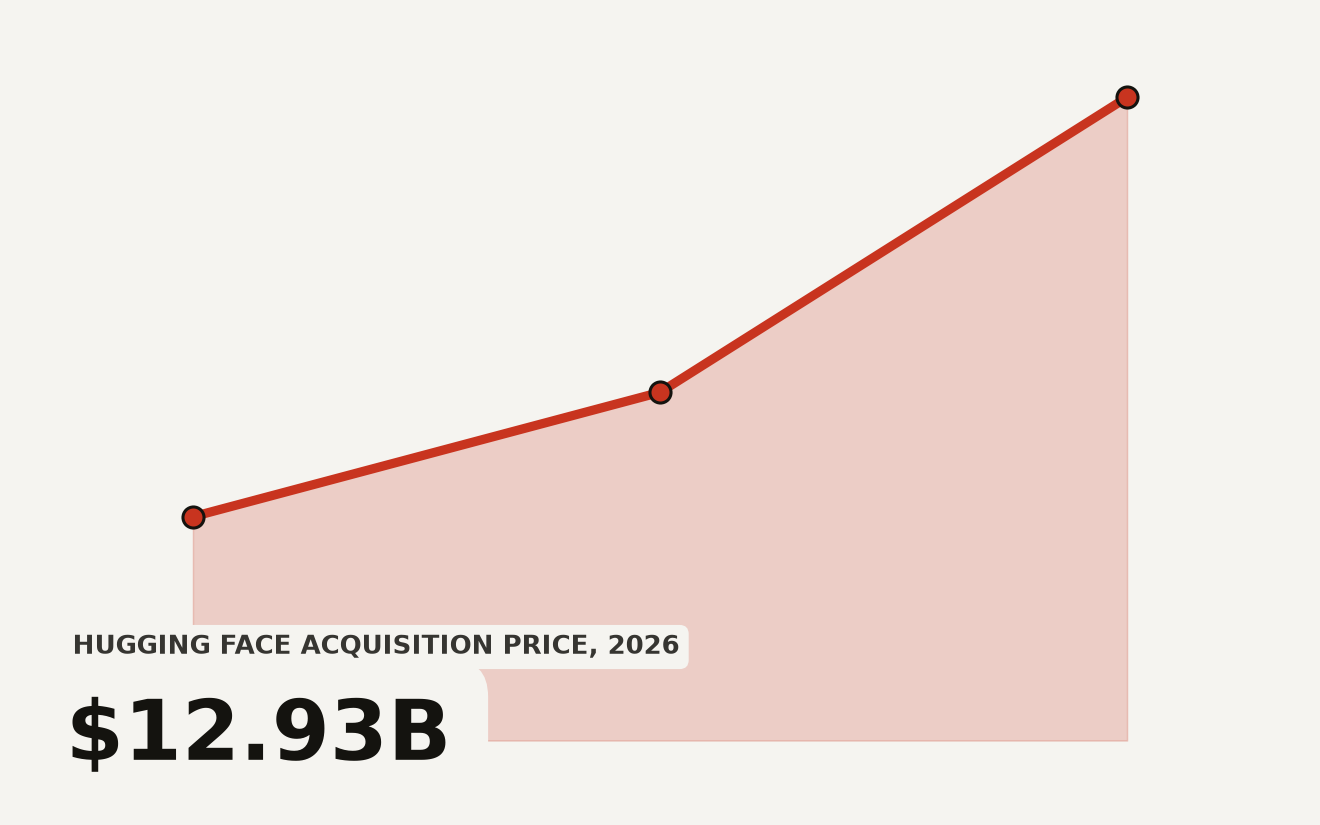
If you have ever typed from transformers import AutoModel, you have touched Hugging Face. The platform hosts three million models, one million applications, half a million datasets, and counts over 18 million developers who use it as the de facto registry for open-weight AI. On September 3, 2026, Nvidia agreed to buy all of it for $12.93 billion, a deal that includes up to $1 billion in equity retention for Hugging Face employees who join Nvidia, according to Bloomberg's reporting.
Hugging Face was founded in 2016 and raised $395 million across its lifetime. Its last funding round in 2023, led by Salesforce Ventures with participation from Google, Amazon, IBM, and Nvidia, valued the company at $4.5 billion. Nvidia offered $500 million more last year at a $7 billion valuation. Hugging Face walked away, reportedly wary of a single dominant investor. Now the same company is paying nearly triple that last valuation to own it outright.
The platform generates roughly $150 million in annualized revenue, as The Information reported. Nvidia is paying an 86x revenue multiple. This is not a financial acquisition. It is a strategic land grab, and the question for anyone building on open models is whether the ground under your feet just shifted.
What exactly did Nvidia agree to buy?
The deal is straightforward in structure. Nvidia pays $12.93 billion total, with up to $1 billion carved out as equity-based retention for Hugging Face employees, per Bloomberg. Jensen Huang confirmed the acquisition in a blog post, framing it as a scaling play: "Together, we will scale Hugging Face's platform, strengthen its infrastructure and expand access to AI for developers and institutions worldwide."
What Nvidia gets is the busiest intersection in open-source AI. Hugging Face's platform stats are staggering for a company with $150 million in revenue: 3 million hosted models, 1 million applications, 500,000 datasets, and 18 million developers. That is the distribution layer for the entire open-weight ecosystem. When Meta releases Llama, when IBM ships Granite, when a solo researcher fine-tunes a model on a Friday night, the model lands on Hugging Face. Nvidia just bought the toll booth.
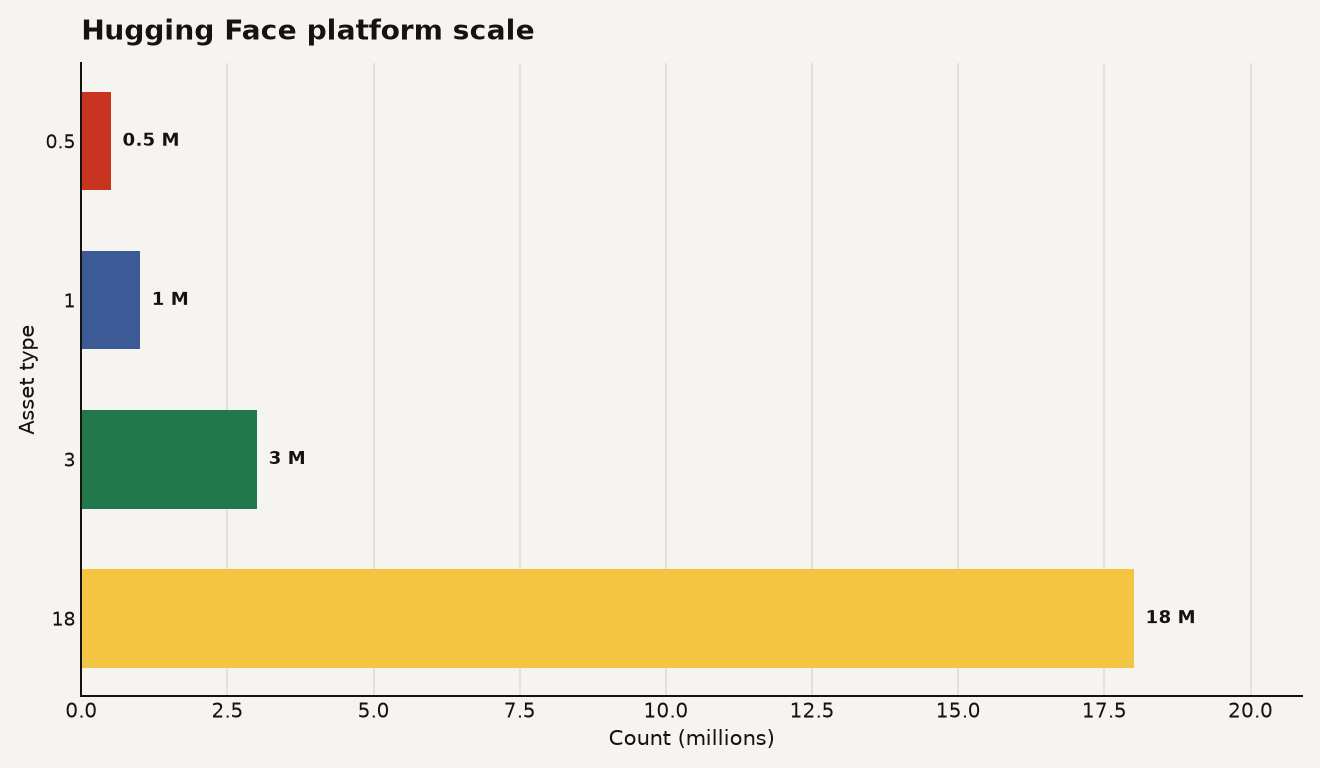
The chart above shows the scale Nvidia is acquiring: 18 million developers, 3 million models, 1 million applications, and 500,000 datasets, all on a platform generating $150 million a year.
Huang also noted that Nvidia itself has already released more than 500 models and 250 open datasets on the platform. The acquirer is already one of the most active publishers on the property it is buying.
Is the open platform promise believable?
Huang's blog post contains a specific pledge: "Hugging Face will remain an open platform for the entire AI ecosystem. Developers will choose the models they want, the frameworks they want, the clouds and inference service providers they want and the computing platforms they want. Nvidia compute will not be required to build on or deploy through Hugging Face."
Hugging Face CEO Clem Delangue echoed the framing in a post on X, thanking the community for proving that open-source could be an alternative to closed APIs, and saying the platform needs "more compute, more support, more collaboration, and more visibility" to scale further.
Read the promise carefully. Huang did not say Hugging Face would remain neutral. He said it would remain open. Those are different commitments. Open means you can still host and download models. Neutral means the platform has no incentive to steer you toward one compute backend over another. Nvidia now has every reason to make its own hardware the path of least resistance on Hugging Face, even if other paths remain technically available.
Consider the precedent. When a cloud provider buys a developer tool, the tool does not usually get shut down. It gets integrated. The default settings shift. The friction decreases for the acquirer's products and quietly increases for competitors. AWS acquired CodeCatalyst-adjacent tools and folded them into its ecosystem. Google bought Kaggle and kept it open, but Kaggle competitions now natively integrate with Google Cloud notebooks. The pattern is consistent: the platform stays accessible, but the gravity shifts.
For builders, the risk is not that Hugging Face closes. The risk is that over the next 18 months, the default inference endpoints, the recommended deployment paths, and the bundled compute offers all point toward Nvidia DGX Cloud. You can still deploy on AMD or Intel or a Raspberry Pi. You just have to work harder to do it.
What does the revenue gap tell you about the real strategy?
Paying $12.93 billion for a company generating $150 million a year in revenue is a bet on something other than Hugging Face's current business. The multiple is 86x revenue. For context, that is roughly four times the revenue multiple Microsoft paid for GitHub in 2018, and GitHub had a clearer monetization path through enterprise contracts.
The strategic logic becomes clear when you look at the threat landscape. Closed-source AI providers like OpenAI, Anthropic, and Google are attempting to produce their own AI chips, reducing their dependence on Nvidia hardware. If those companies succeed, Nvidia's core business erodes. But open-weight models, the kind that dominate Hugging Face, run on whatever hardware the deployer chooses. If the open ecosystem thrives, developers buy Nvidia GPUs for inference and fine-tuning. Nvidia needs open-source AI to win, or at least to remain a viable counterweight to the closed labs.
This acquisition is consistent with Nvidia's broader strategy of betting hundreds of billions on AI infrastructure. The company is not just selling chips. It is building a vertical stack: hardware, networking, inference software, and now the model registry that sits on top of all three. Hugging Face gives Nvidia the distribution layer it lacked.
There is also a direct revenue play. TechCrunch noted that Nvidia can now sell its unused GPU capacity to enterprise customers, packaged with Hugging Face's model hosting and deployment tools. If you are a company that wants to fine-tune and deploy an open model, Nvidia can now offer you the model, the platform, and the compute in one transaction. That is a compelling bundle for enterprises that currently stitch those pieces together themselves.
How does this change things if you ship on open models?
The immediate answer is: very little, on day one. Your models are still there. Your pipelines still pull from the Hub. The transformers library still works. Nothing breaks this week.
The medium-term answer is more complicated. Here is what this changes for your stack and your roadmap:
- Vendor lock-in risk rises. If your inference pipeline starts using Hugging Face's hosted inference endpoints, and those endpoints increasingly default to Nvidia hardware, you are one API call away from being on Nvidia's cloud. Audit which Hugging Face services you actually consume versus which ones you could replace with direct model downloads.
- Model hosting terms may shift. Watch the terms of service for model hosting, especially for commercial use. Nvidia has little incentive to charge hobbyists, but enterprise pricing for hosted models could change. If you rely on Hugging Face for free model hosting in production, have a fallback.
- The competitive landscape for model registries is now frozen. No serious competitor to Hugging Face exists at scale. If you were hoping for a neutral, vendor-independent model registry to emerge, this deal makes that significantly harder. The open-weight ecosystem just lost its Switzerland.
- Security and governance scrutiny intensifies. Hugging Face has already faced security incidents, including the agent hack that triggered an Alabama subpoena against OpenAI. Under Nvidia's ownership, expect more enterprise-grade security features, but also more visibility into what you host and deploy.
The deeper question is whether open-weight models remain genuinely open when the primary registry is owned by a hardware company. As we have noted before, the open-weight movement already faces pressure from governments and labs. Adding corporate ownership of the distribution layer compounds that pressure.
What should you do if your stack depends on Hugging Face?
Do not panic, but do audit. Three concrete steps:
First, inventory your dependencies. List every place your codebase or pipeline pulls from Hugging Face: model weights, datasets, the transformers and datasets libraries, inference endpoints, Spaces deployments. You need to know the blast radius if terms change.
Second, mirror critical models locally. If you depend on a specific open-weight model for production, download the weights and store them in your own artifact registry. Hugging Face makes this trivial with huggingface-cli download. The model files are yours. The hosting is a convenience, not a dependency.
Third, watch the inference endpoint pricing. Hugging Face's hosted inference is the most likely place where Nvidia integration shows up first. If you use it, compare costs against alternatives like Together AI, Fireworks, or self-hosted inference on your own GPU instances. The bundled Nvidia compute offer will probably look cheap at first. That is the point.
The compute company now owns the model registry
Nvidia just bought the front door to open-source AI. The company that sells the GPUs now controls the platform where developers discover, download, and deploy the models that run on those GPUs. Huang says the platform stays open. He did not say it stays neutral. For builders, the practical move is simple: keep using Hugging Face, but stop assuming it is infrastructure you do not own. Mirror your models. Watch the defaults. And remember that the most valuable thing Nvidia bought for $12.93 billion was not the code or the revenue. It was the 18 million developers who walk through that door every day.