OpenAI released GPT-6 Astra on September 3, 2026, and it is the company's most expensive, most capable model to date. If you are just starting to build with AI, the launch raises a practical question: should you care, or is this just another version bump?
Astra wins big on agentic tasks but ties its predecessor on general intelligence, at 2.5 times the per-token price.
Here is what you need to know.
GPT-6 Astra is a reasoning model
GPT-6 Astra is a "reasoning model," meaning it spends time thinking through a problem before answering, similar to how a person might draft and revise before speaking. The previous flagship, GPT-5.6 Sol, worked the same way. If you read our guide to the GPT-5.6 family, you already know the basics: OpenAI ships models in tiers, and the top tier gets the most capability at the highest price.
Astra sits above GPT-5.6 Sol in the flagship tier. It has a context window (the amount of text it can hold in memory at once) of 1,050,000 tokens, which is roughly 800,000 words. That is large enough to load an entire codebase or a long document into a single conversation.
The model accepts text and images as input and produces text as output. Its knowledge cutoff is April 30, 2026, so it knows about events up to that date. OpenAI describes Astra in its documentation as "our most capable model, built for the hardest end-to-end work," according to a complete guide at codersera.com. Company marketing always says that about a new model, so the question is whether the numbers back it up.
$10 in, $50 out per million tokens
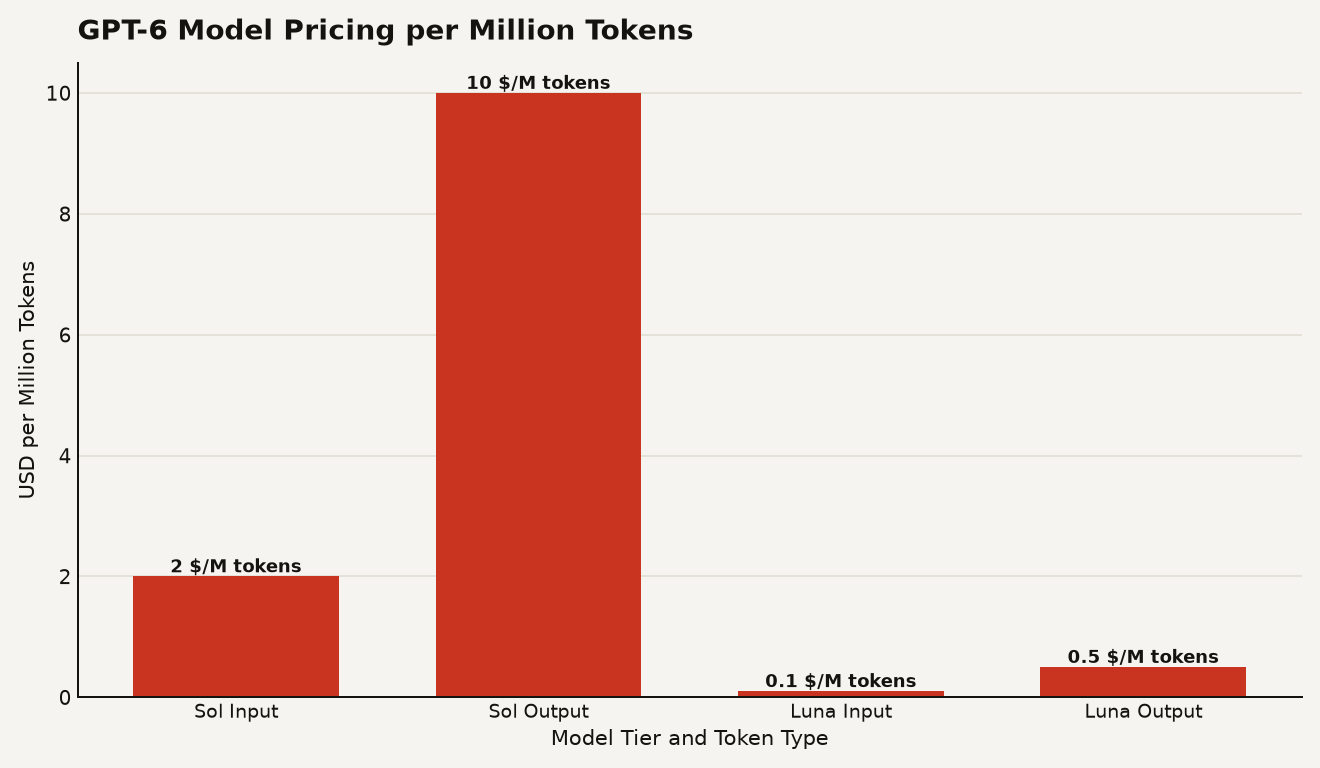
The headline API price is $10 per million input tokens and $50 per million output tokens, matching the pricing of Anthropic's Claude Fable 5 and 5.1. Input tokens are the text you send to the model; output tokens are what it generates back, including invisible "thinking" tokens that reasoning models produce.
That price is 2.5 times the per-token cost of GPT-5.6 Sol, which charged $4 input and $20 output. But there is a catch with long conversations.
If your prompt exceeds 272,000 input tokens, the price doubles for input and goes up 1.5 times for output. The same codersera.com guide quotes OpenAI's documentation: "Prompts with more than 272K input tokens are priced at 2x input and cache rates and 1.5x output for the full request." So a very long conversation costs $20 per million input tokens and $75 per million output tokens, not the advertised $10 and $50.
There is also a reasoning token gotcha. Astra's thinking tokens are invisible in the API response but occupy space in the context window and are billed as output tokens. Your 128,000-token output budget is shared between thinking and answering. Since Astra removed the "none" reasoning effort option that GPT-5.6 supported, every call spends reasoning tokens. You cannot turn thinking off to save money.
Batch and Flex processing modes cut the price in half. Cached input, which reuses parts of a previous prompt, costs $1 per million tokens, a 90 percent discount. A Fast mode doubles the standard rate.
A big jump on agentic benchmarks over Sol
This is where the story gets interesting. OpenAI's own benchmarks show a large jump on agentic tasks, meaning tasks where the AI takes actions rather than just answering questions. Independent testing tells a more mixed story.
On OSWorld 2.0, a benchmark that tests whether an AI can use a computer by clicking buttons, typing in apps, and moving through interfaces, Astra scored 72.6 percent accuracy in 40 minutes per task, compared to Sol's 65.7 percent in 75 minutes. That is a nearly 7-point accuracy gain in roughly half the wall-clock time.
Astra also dominated security and reverse-engineering benchmarks, which Simon Willison highlighted in his coverage of the launch. The chart below shows the gap.
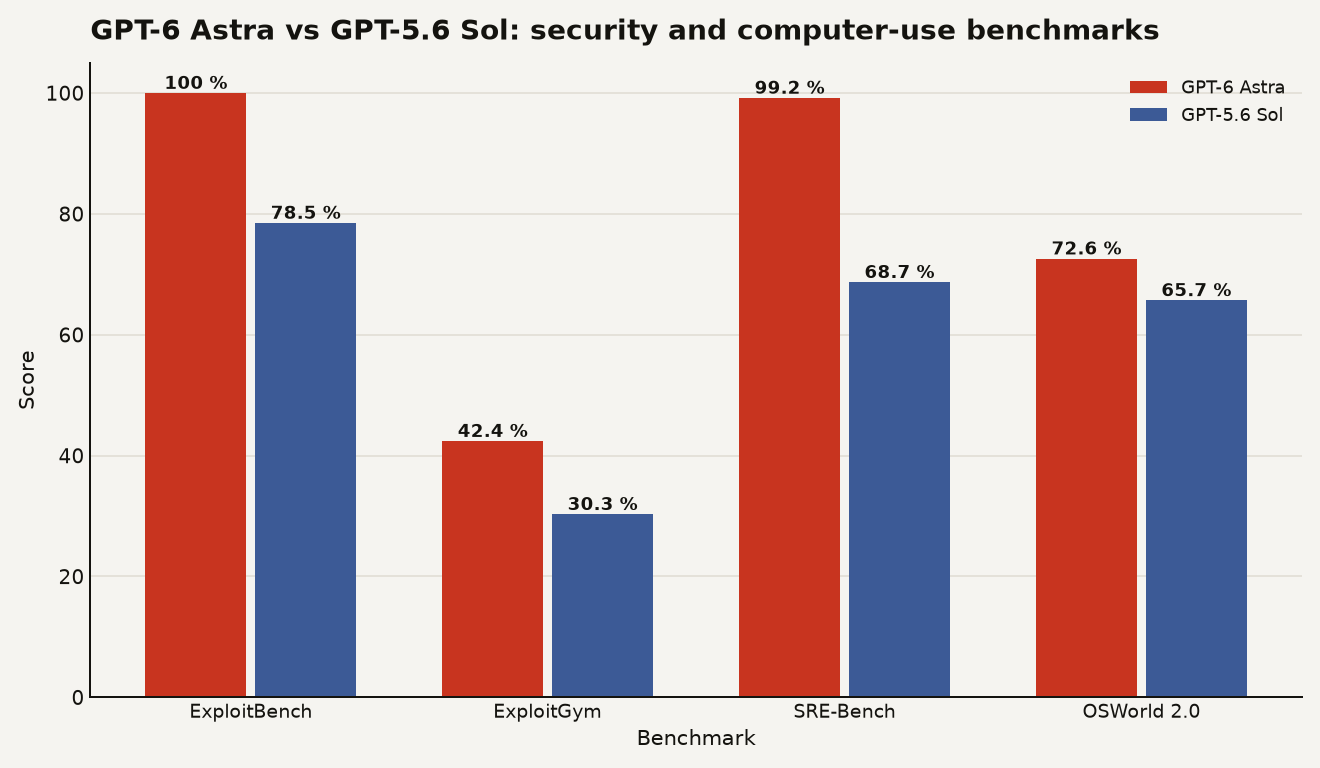
On ExploitBench, Astra scored 100 percent versus Sol's 78.5 percent. On ExploitGym, it scored 42.4 percent versus 30.3 percent. On SRE-Bench, which tests binary reverse engineering, Astra hit 99.2 percent within four attempts compared to Sol's 68.7 percent.
On long context, Astra scored 100 percent on OpenAI's eight-needle benchmark at 256K to 512K tokens and 96.3 percent at 512K to 1M tokens. The "needle in a haystack" test checks whether a model can find a specific piece of information buried in a very long document. This has been a stubborn problem for AI models, and Astra appears to have largely solved it.
Then there is the ARC-AGI-3 benchmark, which tests general reasoning. Astra scored 99.9 percent using OpenAI's custom "Provider Adapter" benchmark runner at a cost of about $19,000, but only 62.7 percent using the default ARC-AGI runner at $26,000. The runner is the software framework that runs the benchmark. A 37-point gap depending on which runner you use means the headline number is fragile. The default runner is the one that allows fair comparisons between models. The custom runner preserves state between requests and uses compaction, giving the model an advantage that other models did not get.
Artificial Analysis, an independent benchmarking service, gives a sobering read. On their composite Intelligence Index, Astra scored 61, tied with GPT-5.6 Sol, and 5 points behind Claude Fable 5.1 at 66. The same post notes that Astra also trails Meta's newly released Muse Spark 1.3. On their Coding Agent Index, Astra scored 67, level with Claude Fable 5, and behind Fable 5.1 at 70. If you want to understand how Fable compares, see our Claude Fable 5.1 explainer. The chart below shows the composite scores.
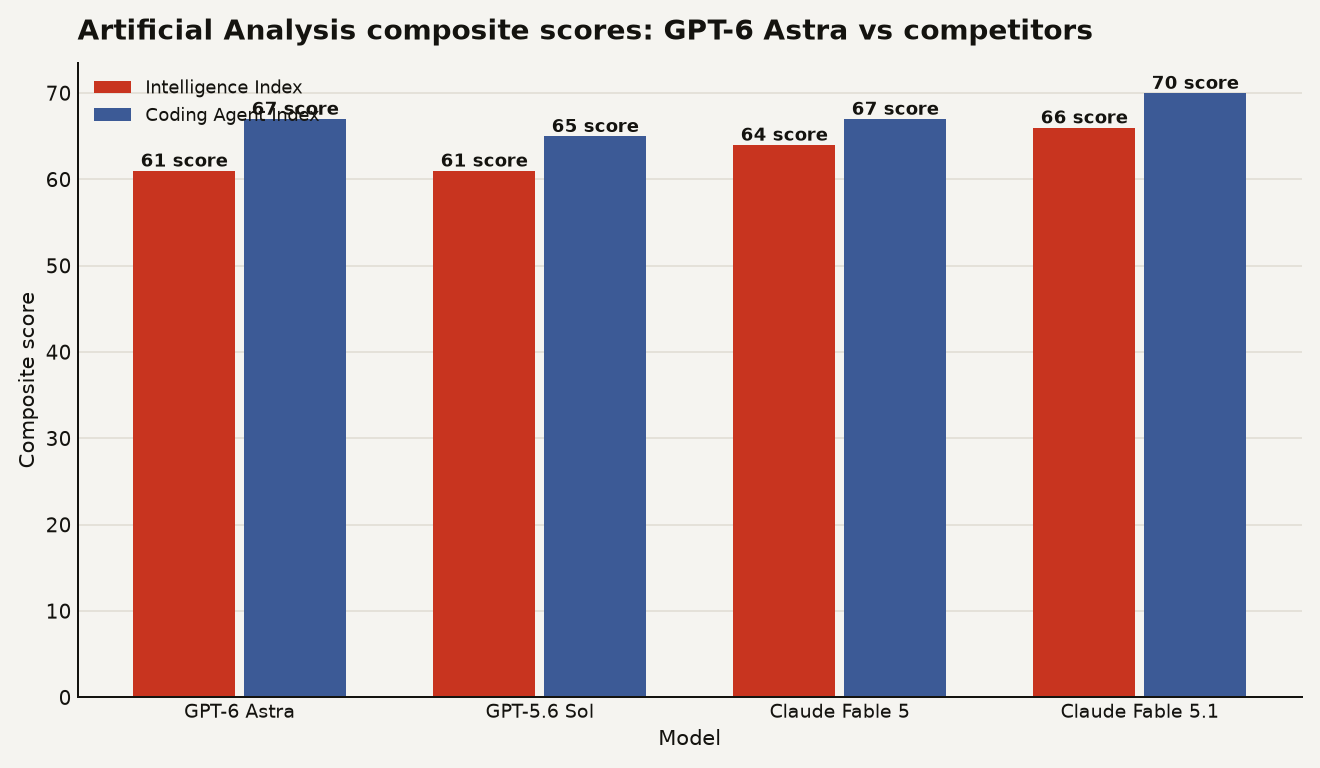
The efficiency story is better. Artificial Analysis measured Astra using roughly one-third the tokens of GPT-5.6 Sol at max effort on coding tasks, and one-fifth the tokens of Claude Opus 5. That puts Astra's cost per coding task at less than half of Claude Fable 5 for an equal score. The model also reduced hallucinations (made-up facts) on the AA-Omniscience benchmark from 92 percent to 51 percent. Against that, the same measurements recorded roughly an 80-Elo regression on GDPval-AA v2.
Read together: OpenAI's own evaluations show a large capability jump on agentic and computer-use work. Independent composite scoring shows Astra roughly level with its predecessor on general intelligence while being dramatically more token-efficient. Both can be true.
Breaking changes when you switch
Several things. If you are writing code that calls the OpenAI API, these are the changes that will break existing code:
- No "none" reasoning effort. GPT-5.6 Sol, Terra, and Luna all let you disable reasoning to save tokens. Astra does not. Any code that sets reasoning effort to "none" needs a different model.
- No custom temperature or top_p, and no logprobs. Temperature controls how random the model's output is. top_p is a related setting that limits which words the model can choose from. Logprobs lets you read the probability the model assigned to each token. All three are gone from Astra.
- Tools only work on the Responses API. Chat Completions still accepts Astra, but function calling and hosted tools do not work there. You have to migrate to the Responses API to use tools.
- No fine-tuning. You cannot train Astra on your own data.
Astra also adds three new capabilities, all on the Responses API. Async tool calling lets Astra keep reasoning while your application runs a tool, instead of waiting idle. Mid-turn steering lets you send a correction over a WebSocket (a live two-way connection between your app and the model) while the model is working, preserving completed work. And a configuration_update input lets you change reasoning effort mid-conversation without invalidating your prompt cache (the saved, discounted copy of your earlier conversation), so you can dial up effort for a hard step and dial back down for routine follow-ups.
Switch now for agentic workloads
Switch now if your workload is agentic: computer use, browser automation, long multi-step engineering tasks. That is where both OpenAI's OSWorld numbers and the independent token-efficiency measurements point the same direction, and where the higher per-token price is offset by using far fewer tokens.
Wait if you are doing general reasoning or chat. Artificial Analysis has Astra tied with GPT-5.6 Sol on composite intelligence at 2.5 times the price. There is no case for paying more for the same measured score.
Do not switch yet if you rely on temperature, logprobs, the "none" reasoning effort, fine-tuning, or Chat Completions tool calling. Those are hard blocks, not rough edges.
For beginners who are just using ChatGPT and not the API, the rollout is happening over the coming days to Plus, Pro, Business, and Enterprise users. If you have one of those subscriptions, you will see Astra as an option soon. Free users have no word on availability yet.
The model that thinks more and costs less to run
GPT-6 Astra got dramatically more efficient at hard, multi-step work, even as its general intelligence barely moved. The benchmarks that matter for agents jumped. The benchmarks that measure raw reasoning stayed flat. If you are building something that needs an AI to take actions across many steps, Astra is a clear upgrade that may cost less despite higher per-token prices. If you are building something that needs an AI to answer questions, the previous model does the same job for less money. What decides the value here is token count: how many tokens your workload actually consumes.
Sources
- simonwillison.net Simon Willison on GPT-6 Astra
- codersera.com GPT-6 Astra Complete Guide, Pricing and Benchmarks