The scary AI security story this week was a support bot allegedly changing the wrong email address.
AI agent security is now an access-control problem with a chat window on top. On June 1, 2026, 404 Media reported that attackers had used Meta’s AI support assistant to take over Instagram accounts by persuading it to attach attacker-controlled emails to targets; on June 5, MIT Technology Review framed the incident as a warning that the industry is staring too hard at frontier hacking models and too little at ordinary agents with dangerous permissions. 404 Media first reported the Instagram account takeovers after reviewing hacker material, and the important number is brutally small: one agent action could shift account recovery from the real owner to an attacker.
That is the part builders should sit with. The attacker did not need a new exploit chain, a novel cryptographic break, or an autonomous red-team model. The attacker needed an AI system that could take a privileged action and a workflow that treated the conversation as enough proof. If you are adding agents to support, billing, HR, compliance, or DevOps, this is your incident review before the incident.
Meta's support assistant failed a basic test
Meta introduced the Meta AI support assistant as a way to give users 24/7 help inside Facebook and Instagram. In March 2026, Meta said the assistant could respond typically in under five seconds and could take action on account tasks such as resetting passwords and updating profile settings. Meta’s own launch post described the product as moving beyond answers into action.
That product direction makes sense. Human support is expensive, slow, and inconsistent. Account recovery is also a miserable queue to staff because every request looks urgent and many are fraudulent. A bot that resolves routine access problems in seconds is a real cost lever.
The failure mode is also obvious in hindsight. Account recovery is a security boundary. If an agent can change the email address on an account, that agent is sitting next to your identity system with a wrench in its hand.
According to 404 Media and follow-on reporting, the attack flow was simple: use a VPN to look closer to the target’s expected location, open a support chat, ask the assistant to link a new email address to the target account, receive or submit the verification flow, then reset the password. TechCrunch reported on June 1 that Instagram had resolved a security issue and that a public video showed the bot adding a new email to the target account. TechCrunch said it verified that the attacker’s displayed mailbox received the verification code.
The affected accounts reportedly included high-profile and high-value handles, including the dormant Obama White House Instagram account and app researcher Jane Manchun Wong’s account. Even if the total number of compromised accounts turns out to be modest, the class of bug is not modest. A privileged agent made a state change that should have been mediated by hard authentication.
OWASP has a clean name for this family of failures: excessive agency. In its 2025 LLM security guidance, OWASP says the root causes are excessive functionality, excessive permissions, and excessive autonomy, and it recommends minimum necessary tool access, user-context execution, human approval for high-impact actions, and downstream authorization checks. OWASP’s excessive agency guidance reads like a post-incident checklist for this case.
The bitter lesson is that “guardrails” are the wrong mental model for this layer. Guardrails tell a model what it should do. Authorization tells a system what it can do. For account recovery, only the second one counts.
The Mythos obsession misses the point
The AI security conversation has been dominated by Anthropic’s Mythos Preview, a restricted cybersecurity model inside Project Glasswing. That attention is understandable. Anthropic says Mythos Preview found thousands of high-severity vulnerabilities and that it is committing up to $100 million in model usage credits, plus $4 million in donations to open-source security organizations. Anthropic’s Project Glasswing announcement is a serious signal that frontier models can change vulnerability discovery.
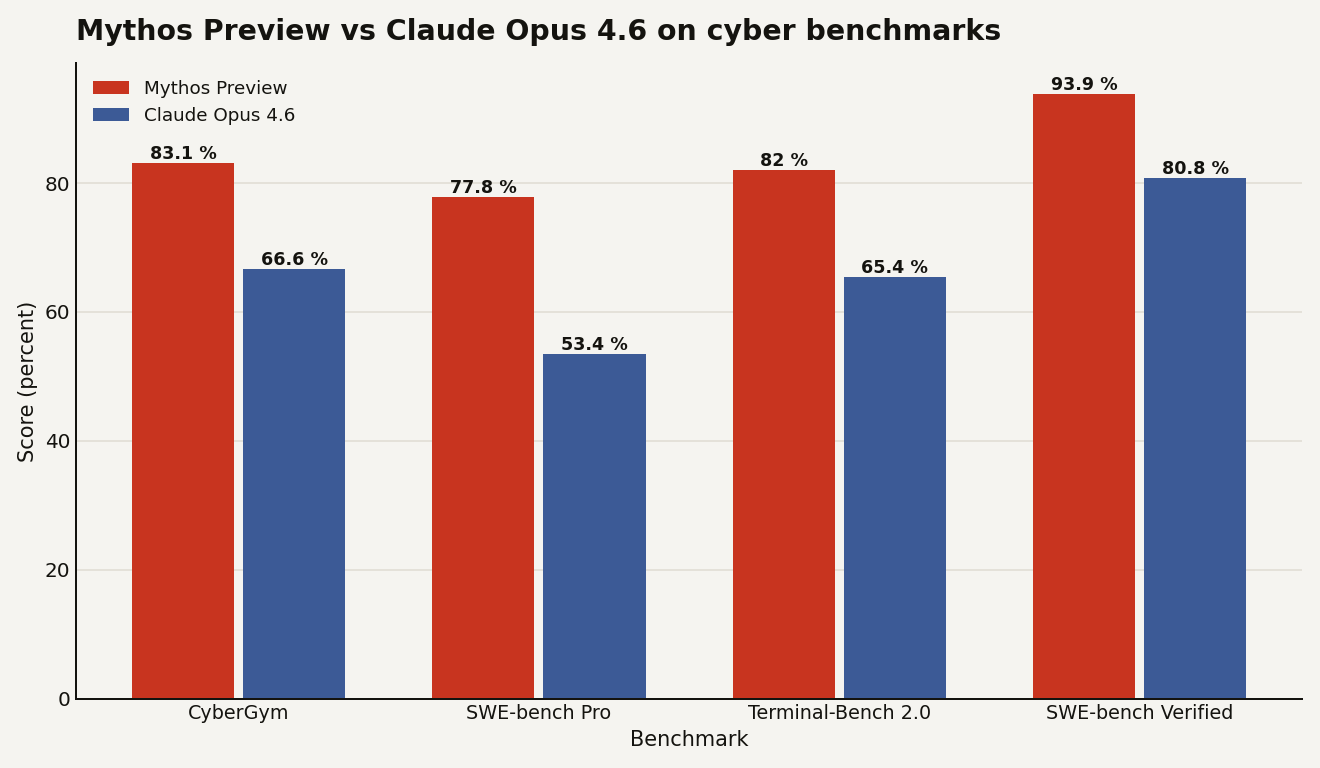
The benchmark gap is real, as the chart below shows. Anthropic reports Mythos Preview at 83.1 percent on CyberGym versus 66.6 percent for Claude Opus 4.6, and 77.8 percent on SWE-bench Pro versus 53.4 percent for Opus 4.6. Those are not rounding errors.
But the Meta incident lives in a different threat model. Mythos is about AI as an attacker or defender with high-end cyber skill. The Instagram case is about AI as a confused deputy inside a normal business workflow. The model does not need to be brilliant. It only needs enough authority to do damage.
That distinction matters because the mitigation budget goes to different places. If you think the problem is mainly superhuman exploit generation, you buy red-team tooling, scan codebases, and harden dependencies. You should do that. Anthropic said in a May 22 update that roughly 50 partners had used Mythos Preview to find more than 10,000 high or critical severity vulnerabilities, and that Mythos had scanned more than 1,000 open-source projects. Anthropic’s initial Glasswing update makes the defensive case clearly.
If you think the problem is agent authority, you review every tool call and every service account. You ask which actions are reversible, which actions are sensitive, and which actions require proof outside the model’s conversation. That work is less glamorous. It is also closer to the blast radius most companies are creating right now.
This is where our earlier warning about agents working too hard fits. Teams keep asking agents to close the loop because closed-loop automation is where the savings are. The support bot that only explains password reset steps is helpful. The support bot that can change the recovery email is a cost-cutting machine. It is also a privileged operator.
The Meta lesson for agent roadmaps
If you are shipping an agent in 2026, the Meta lesson should change the acceptance criteria, not just the red-team prompt list. A product requirement that says “the agent can resolve account issues” is not specific enough. A security requirement that says “the agent cannot transfer account ownership without independent authentication” is closer.
Here is the practical split for builders:
- Your codebase needs policy enforcement outside the model. Put the authorization check in the API, not in the system prompt. If the model asks to change an email, the downstream service should demand a fresh session, device proof, passkey challenge, or verified recovery path.
- Your roadmap needs a permission tier for agents. Separate read actions, reversible writes, irreversible writes, and identity-bearing writes. A password reset and an email change do not belong in the same risk bucket as a notification-settings update.
- Your costs move from support labor to control-plane engineering. The agent may reduce queue time from hours to seconds, but you now owe logging, review tooling, abuse detection, rollback, and case escalation.
- Your hiring plan needs security product judgment. The person who designs the recovery flow matters as much as the person tuning the prompt. This is identity engineering, not chatbot polish.
- Your moat is trust under automation. If customers believe your agent can be socially engineered into acting against them, your automation becomes a liability no demo can rescue.
The Meta numbers show the temptation. A support agent that answers in under five seconds looks like a win against overloaded help centers. Meta also said its AI-powered security systems had helped reduce new account hacks by more than 30 percent globally across Facebook and Instagram in the prior year. That is exactly why this category will keep expanding: the upside is measurable.
The failure case has to be measured too. For every agent action, track three things: who requested it, what identity context authorized it, and what independent system approved it. If the answer to the third item is “the model decided,” you have found a production bug.
Treat the agent as a non-human employee
Start by treating the agent as a non-human employee with scoped credentials. It needs an identity. It needs a role. It needs a manager, which in software terms means policy, monitoring, and kill switches.
A sane launch checklist has at least 7 gates:
- Inventory every tool the agent can call.
- Remove tools that are not needed for the exact support scenario.
- Split sensitive actions into separate APIs with separate scopes.
- Run every action in the user’s authorization context when possible.
- Require step-up authentication for account recovery, payout, deletion, and ownership changes.
- Log prompts, tool calls, policy decisions, and rollback events in one trace.
- Red-team both the language layer and the business workflow before launch.
The phrase “before launch” is doing real work there. Red-teaming an agent after it is already changing production state is closer to archaeology than security. You will learn what happened after users do.
For support agents, there is one rule worth being strict about: the model may propose, but a deterministic system disposes. The agent can classify a case, gather user-visible context, explain next steps, and route the request. When the action affects identity, money, legal status, data deletion, or external publication, the final gate should be boring software.
This does not mean every agent needs a human in the loop. Human approval for every password reset would destroy the business case. It means the approval mechanism must be independent of the model’s persuasion surface. A passkey challenge, a verified device, a recovery code, a delayed email notification with cancel window, or a risk engine threshold can all be machine-speed controls.
The worst pattern is a generic high-privilege service account behind a friendly chat UI. OWASP explicitly warns against agents using broad downstream permissions or generic privileged identities. That pattern turns prompt abuse into authority abuse.
A smarter model will not fix this
Do not bet that a smarter model will solve this class of problem by noticing suspicious requests. A stronger model might flag the Obama White House account as unusual. It might ask better follow-up questions. It might refuse more obvious abuse. Good.
But the system still needs to survive a plausible request from a patient attacker.
The durable bet is architectural: agents get less authority by default, sensitive actions move behind deterministic checks, and red-team findings block launch rather than feed a backlog. The flashy AI security story will keep being Mythos and whatever comes after it. The expensive incidents will often come from the agent you gave the keys to because it made the dashboard look efficient.
A support bot should make help faster. It should not make theft easier.
Sources
- 404 Media: Hackers Simply Asked Meta AI to Give Them Access to High-Profile Instagram Accounts. It Worked
- MIT Technology Review: The Meta hack shows there’s more to AI security than Mythos
- TechCrunch: Hackers hijacked Instagram accounts by tricking Meta AI support chatbot into granting access
- Meta: Boosting Your Support and Safety on Meta’s Apps With AI
- OWASP GenAI Security Project: LLM06:2025 Excessive Agency
- Anthropic: Project Glasswing
- Anthropic: Project Glasswing: An initial update