A security researcher dropped a working Windows privilege escalation exploit on July 17, 2026, hours after Microsoft closed its July Patch Tuesday rollout. The exploit, called LegacyHive, targets the Windows User Profile Service on fully patched systems. There is no CVE, no patch, and a public proof-of-concept. The researcher deliberately hobbled the PoC to slow mass exploitation, though the analyst who tested it says a motivated attacker can work around those guardrails.
Your fully patched Windows fleet has an unpatched privilege escalation path, and the only automated detection available right now is a set of manual Defender queries.
What exactly did Nightmare Eclipse publish?
On July 17, 2026, a researcher operating under the handle "Nightmare Eclipse" released a proof-of-concept exploit for a vulnerability in the Windows User Profile Service. The timing was deliberate: the drop came hours after Microsoft published its July 2026 Patch Tuesday updates, meaning the flaw survived the latest patch cycle and remains present on every updated Windows machine.
The vulnerability has no CVE identifier yet, which complicates tracking for security teams who filter and prioritize on CVE IDs in their vulnerability management pipelines. Microsoft told BleepingComputer that it is "actively investigating the validity and potential applicability of these claims" and supports coordinated vulnerability disclosure. That statement landed one day after the PoC was already public.
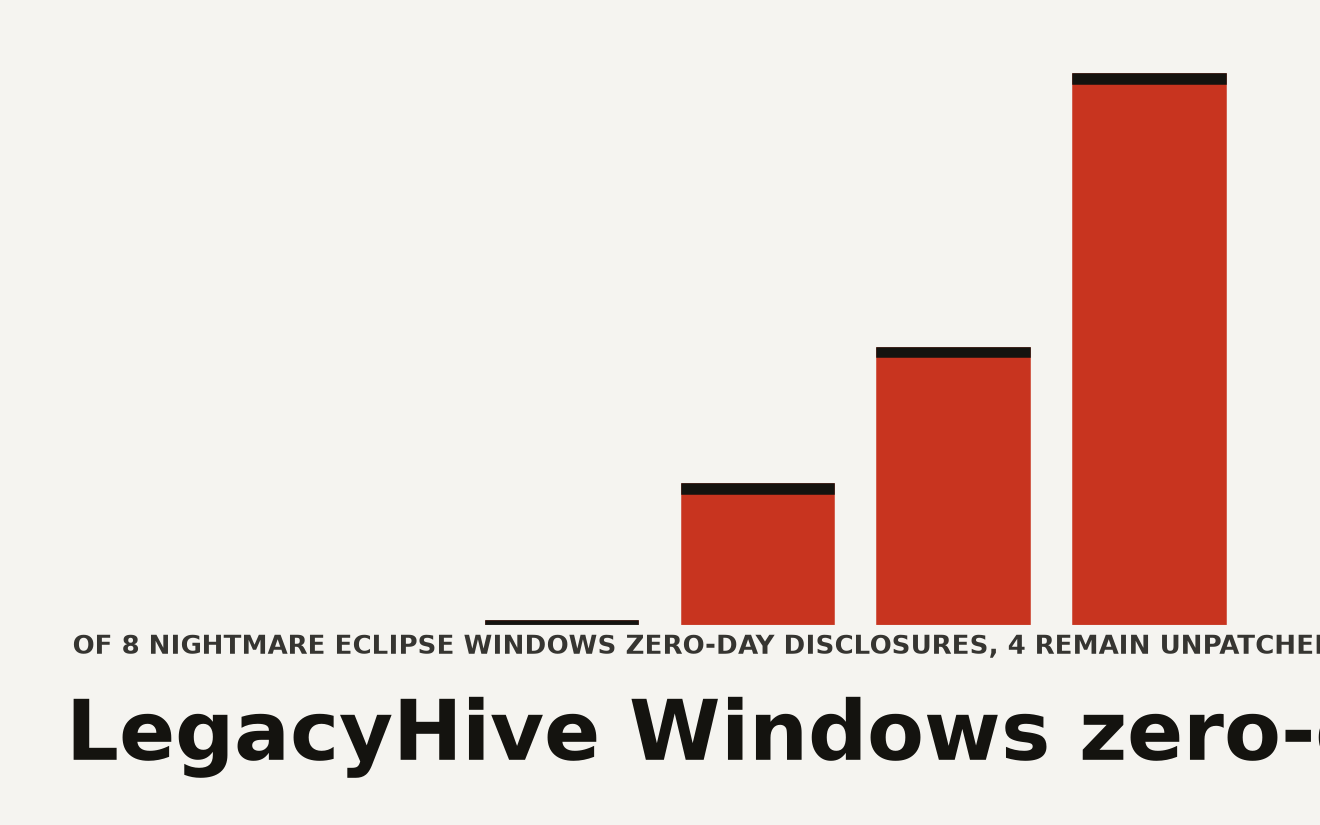
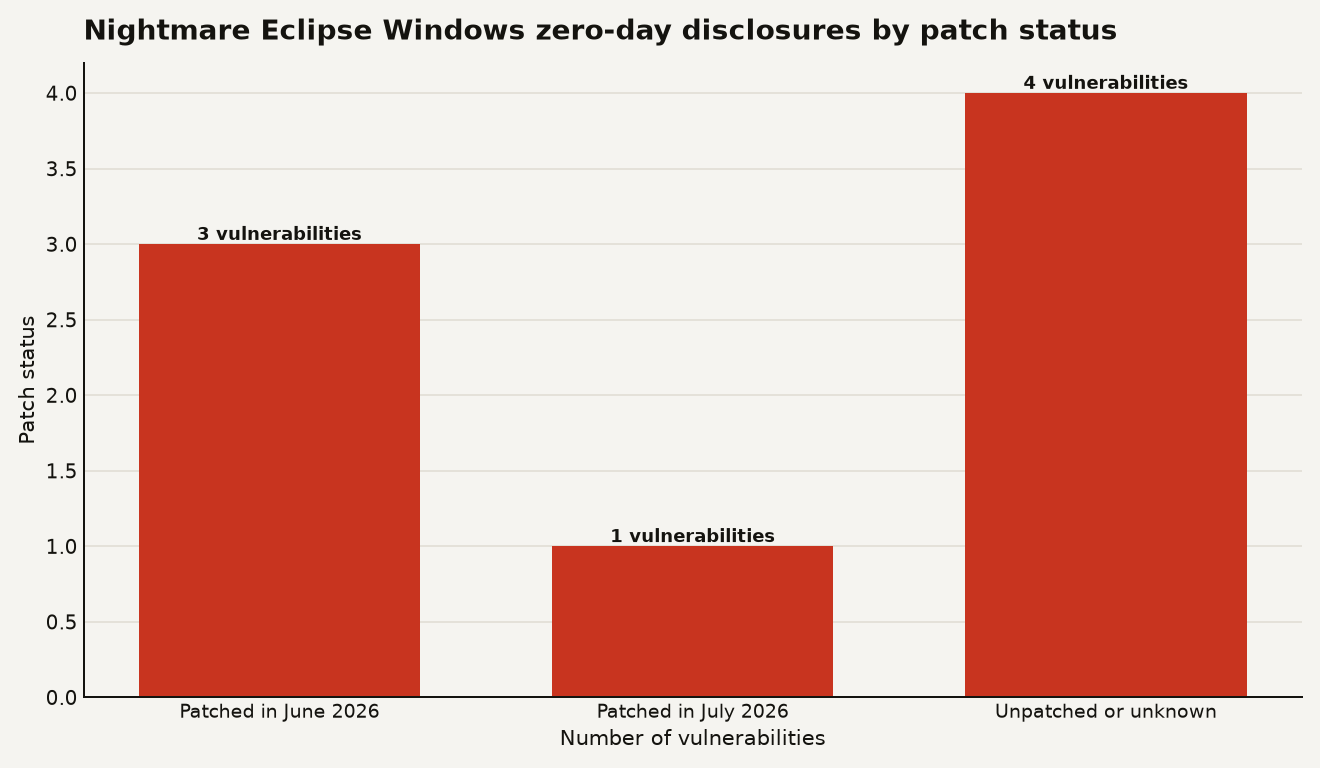
Nightmare Eclipse has been on a sustained disclosure run. In recent months the same researcher has published zero-day exploits for flaws in Microsoft Defender, BitLocker, and multiple Windows components, under names including RoguePlanet, BlueHammer, RedSun, YellowKey, GreenPlasma, MiniPlasma, and UnDefend. Microsoft patched GreenPlasma, MiniPlasma, and YellowKey in the June 2026 Patch Tuesday and RoguePlanet in the July security updates. Four of the eight disclosed vulnerabilities now have patches. LegacyHive does not, and the chart below shows the full picture across all eight.
How does the LegacyHive exploit chain work?
The vulnerability lives in the Windows User Profile Service, a core OS component that manages user registry hives. According to Nightmare Eclipse's description, successful exploitation lets an attacker mount a target user's registry hive in the current user's classes root. That gives a standard user the ability to modify the classes registry hive belonging to another account, including an administrator's.
Will Dormann, principal vulnerability analyst at Tharros, tested the PoC and confirmed the mechanism. Successful exploitation would allow non-admin users to modify the classes registry hive and gain automatic code execution when the admin account logs into the compromised system. "For example, as a novelty, we can associate .txt files to open with calc.exe," Dormann noted, illustrating how an attacker could hijack file associations through the registry. "Clever attackers or people who want to accomplish something will easily be able to figure out how to do things that are more interesting and/or don't even require user interaction."
The attack chain works in three steps. First, a non-admin user with access to a system abuses the User Profile Service to load and modify an administrator's classes registry hive, specifically the usrclass.dat file. Second, the attacker modifies registry entries to hijack file associations or embed code that runs when specific actions occur. Third, when that administrator logs in, the modified hive triggers automatic code execution in the admin context. The attacker has pivoted from standard user to full admin without needing a separate elevation exploit.
The published PoC has built-in friction. Nightmare Eclipse stripped it down to require additional credentials: a standard user password and a third username, which can be an administrator account. The original version, the researcher said, did not need extra credentials and could load any hive, not just usrclass.dat. "The PoC was stripped down as an attempt to prevent public exploitation," Nightmare Eclipse wrote. "You would need some brain cells to make the PoC do it."
That friction is real but shallow. Dormann's analysis makes clear that anyone who understands the underlying mechanism can reconstruct the broader capability. The credential requirement means an attacker needs a foothold plus stolen credentials, which is a common starting condition in real intrusions rather than an exotic one.
Why does this matter for operators running production Windows?
Privilege escalation bugs are the connective tissue of real attacks. Initial access gets an attacker through the door. Privilege escalation turns that foothold into persistence, lateral movement, and full domain compromise. An unpatched escalation path on every updated Windows machine is a gap in every defender's posture.
Here is the specific risk profile for LegacyHive:
- Chaining potential. An attacker who already has standard user access through phishing, a compromised service account, or any initial access vector can escalate to admin without a second exploit. That collapses the time between foothold and full control.
- No CVE to track. Vulnerability scanners, patch management tools, and risk dashboards filter on CVE IDs. Without one, LegacyHive is invisible to the automated pipelines most teams rely on to prioritize remediation.
- No patch timeline. Microsoft is still investigating. The gap between this PoC and a fix could be weeks. If past disclosures are a guide, the soonest a patch would land is August 2026 Patch Tuesday, and that assumes the investigation confirms the bug quickly.
- Detection is manual. Kevin Beaumont published detection queries for Microsoft Defender for Endpoint that can surface LegacyHive exploitation. If you run MDE, those queries are your only automated defense until a patch ships.
This matters most in environments where standard users share systems with administrators or where service accounts run with elevated privileges on Windows hosts. That describes most enterprise Windows estates.
What should you do before a patch ships?
You have three levers: detection, access hardening, and monitoring for the CVE assignment.
First, deploy Beaumont's Defender for Endpoint detection queries immediately if MDE is in your stack. The queries target the specific behavior the PoC exhibits when mounting and modifying registry hives through the User Profile Service. Test them in your environment to check for false positives, but do not wait for perfect tuning before enabling them in alert-only mode.
Second, tighten who has standard user access on systems where administrators also log in. The exploit requires a non-admin user to already have a session on the target machine. Reducing the number of shared or multi-user Windows hosts, especially jump servers and terminal servers, shrinks the attack surface. If you cannot eliminate shared access, prioritize monitoring on those hosts.
Third, watch for the CVE assignment. Once Microsoft assigns a CVE, your vulnerability management pipeline can track it automatically. Until then, add a manual watch item to your patch calendar for August 2026 Patch Tuesday. If Microsoft confirms the vulnerability and fast-tracks an out-of-band patch, you need to be ready to deploy outside your normal cycle.
Fourth, and more broadly: if you have been waiting for a reason to move standard users off shared Windows infrastructure, this is one. As we noted in our coverage of the SharePoint CVE on a three-day patch clock, the window between public disclosure and active exploitation keeps shrinking. LegacyHive does not have a patch yet, which means the window is open and the clock is not even running.
The longer shadow over coordinated disclosure
Nightmare Eclipse's disclosure pattern has created friction with Microsoft. The company responded to earlier releases with warnings of legal action against people engaging in "malicious activity causing real harm to our customers," language that security experts interpreted as a direct threat toward the researcher. That dynamic matters for operators because it shapes whether researchers continue to disclose through coordinated channels or drop PoCs without any notice.
If the hostility escalates and researchers bypass coordinated disclosure entirely, defenders get zero-days with no warning, no detection guidance, and no advance patch. LegacyHive is already a dropped PoC with no coordinated timeline. The pattern it represents is more dangerous than any single bug.
Microsoft says it supports coordinated disclosure. Its legal threats say something else. The people running production systems are the ones who absorb the gap between those two positions.
Sources
- BleepingComputer: New Windows LegacyHive zero-day gives hackers admin privileges