Robotics used to be a hardware problem. Today it is a data problem, and Hugging Face just shipped a framework update that treats it like one. LeRobot v0.6.0 arrives with world models that imagine future frames, reward models that detect success without task-specific training, and a deployment CLI that turns human corrections into fresh training data. The robot learning flywheel now runs on a command line.
The release, published July 7, 2026, introduces three world model policies, five new vision-language-action models, six simulation benchmarks, and a unified reward API. The most consequential change is structural: you can now deploy a policy, watch it fail, take over with a teleoperation arm to correct it, and feed those corrections straight back into fine-tuning. That closes the gap between evaluation and data collection that has slowed down physical AI teams for years.
The flywheel is the product. The models are just the components.
What shipped in the v0.6 model zoo?
Hugging Face announced LeRobot v0.6.0 with a wave of new policies that reflect where the field is moving. The framework now hosts eight VLA architectures alongside three world model policies, making it the broadest open robotics model library available.
The world models are the headline science. VLA-JEPA teaches a compact VLA built on Qwen3-VL-2B to predict future frames in latent space during training, then drops the world model entirely at inference. You get world-model supervision at zero extra deployment cost. LingBot-VA goes further, predicting future video and actions together chunk by chunk while feeding real observations back in, running inference on a single 24 to 32 GB GPU. FastWAM pairs a roughly 5B parameter video-generation expert with a compact action expert, learning to dream its own rollouts during training but skipping the dreaming at inference to directly denoise action chunks.
The new VLAs cover a wide design space:
- GR00T N1.7: NVIDIA's newest cross-embodiment foundation model, swapping in Cosmos-Reason2-2B feeding a flow-matching action head. LeRobot's integration is parity-tested against NVIDIA's original Isaac-GR00T implementation.
- MolmoAct2: AI2's VLA ported with full lifecycle support. Inference fits in roughly 12 GB at bf16, and LoRA fine-tuning fits on a single 24 GB GPU.
- EO-1: A Qwen2.5-VL-3B backbone with a flow-matching action head, pretrained on interleaved vision-text-action data.
- Multitask DiT: A roughly 450M-parameter diffusion transformer conditioned on CLIP embeddings, bringing the TRI Large Behavior Models recipe to open source.
- EVO1: A 0.77B parameter model on an InternVL3-1B backbone, small enough to fine-tune and run in real time on modest GPUs.
The spread matters. A team prototyping on a budget can start with EVO1 or Multitask DiT, then scale to GR00T N1.7 or FastWAM as compute allows. You no longer have to switch frameworks to switch model scales.
How much faster is the data pipeline?
Training on video datasets is now up to 2x faster out of the box. Multi-camera frames decode in parallel, dataloader workers ship compact uint8 frames with 4x less memory between processes, and persistent workers keep decoder caches alive across epochs.
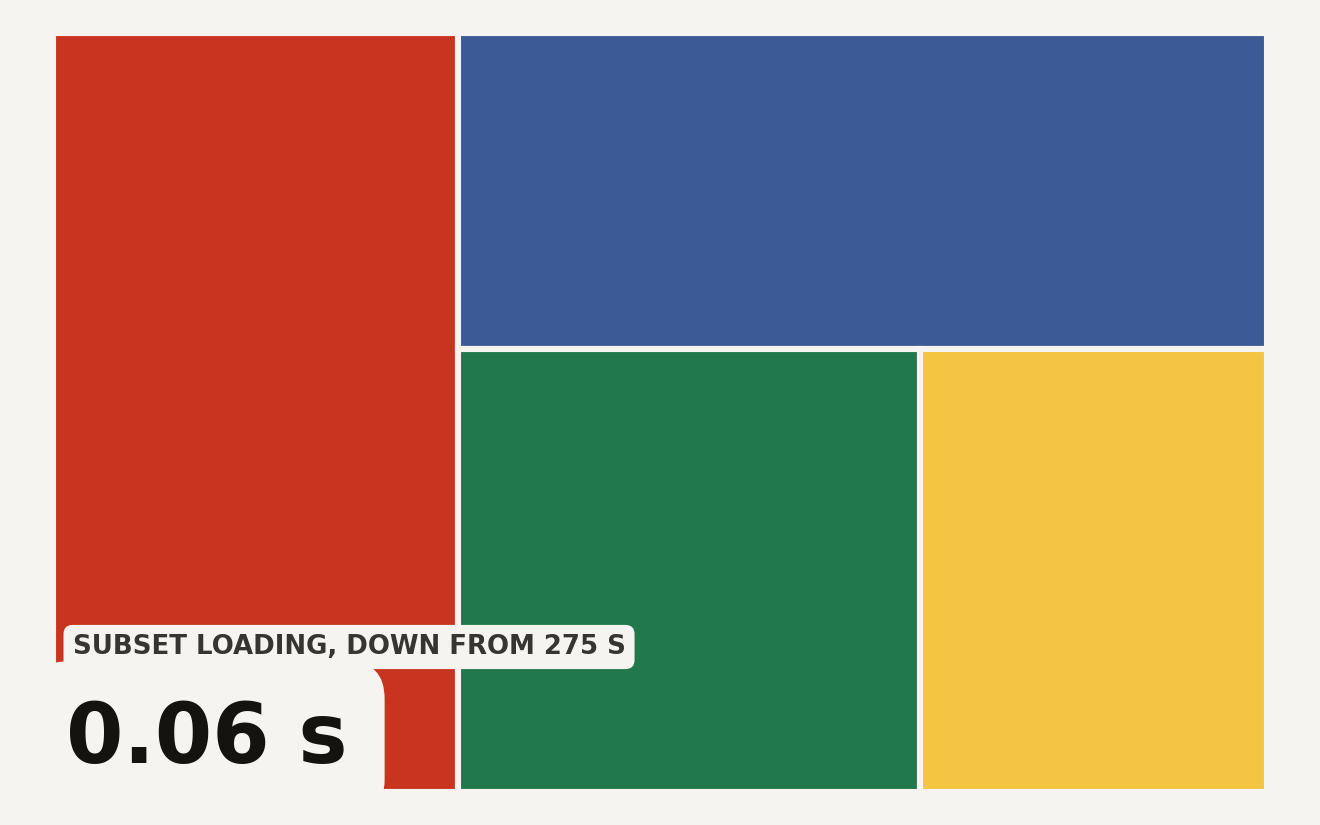
The subset loading improvement is dramatic. Loading a subset of a large dataset with the episodes argument went from 275 seconds down to 0.06 seconds in the Hugging Face benchmark. Sampling is also deterministic and resumable, so interrupted trainings restart sample-exact.
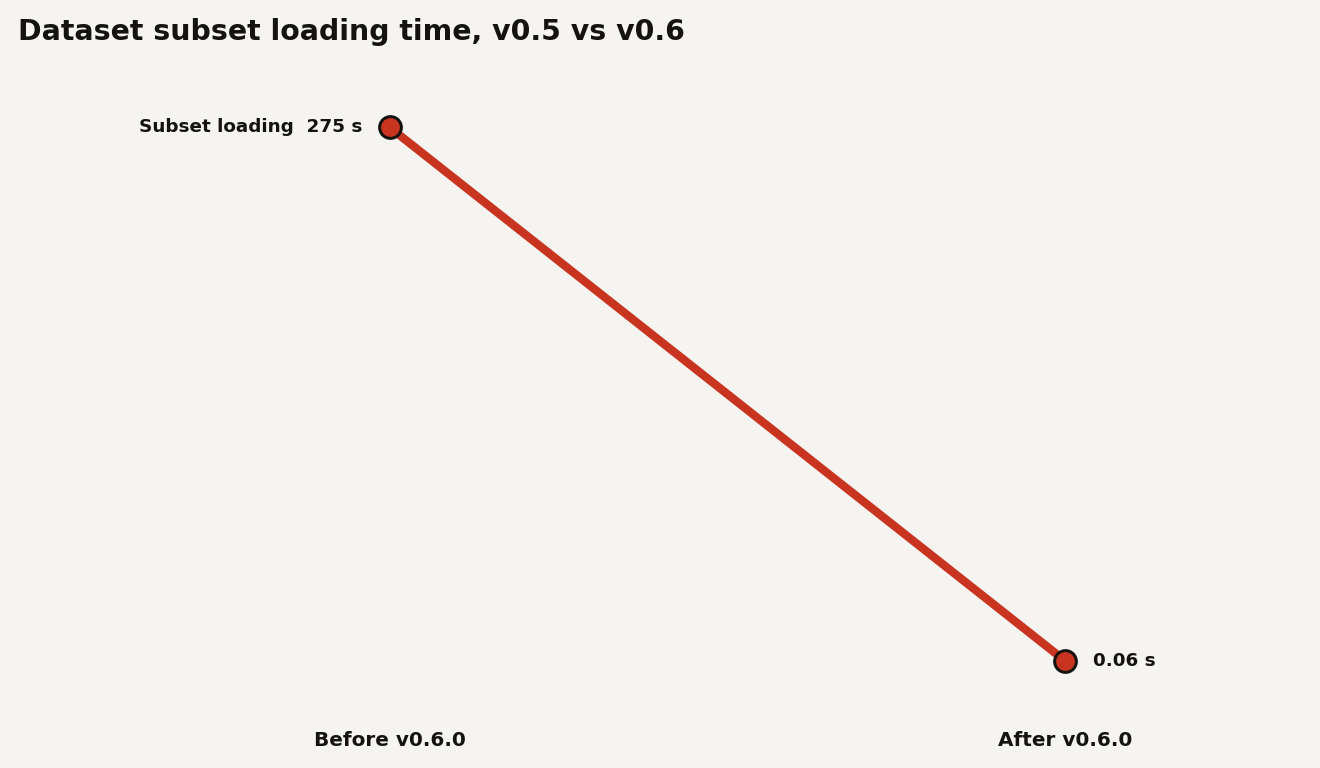
The chart above shows the drop in subset loading time, from 275 seconds to 0.06 seconds. For a team iterating on a 100-episode subset of a 10,000-episode dataset, this alone changes the daily workflow from starting a task and getting coffee to near-instant feedback.
Depth support is now end to end. Plug in an Intel RealSense, set use_depth to true, and LeRobot records depth maps captured in millimeters, compressed as compact 12-bit depth video streams alongside RGB. The depth data decodes back to physical units at training time and works across SO-100, Koch, OpenArm, reBot, Unitree G1, and other hardware.
The new lerobot-annotate CLI fills in rich language annotations automatically using a VLM that watches your episodes. Your dataset stops being one task string per episode and starts storing timestamped subtasks, plans, memory, corrections, and per-camera visual question answering pairs. A YAML recipe layer then renders these into chat-style training messages at sample time, which is the exact data format long-horizon, language-grounded robot policies need.
Can reward models replace hand-coded success criteria?
Success detection has been a quiet bottleneck in robot learning. If you cannot automatically tell when a policy succeeds, you cannot automate evaluation, and you certainly cannot train with reinforcement. LeRobot v0.6.0 introduces a unified reward models API at lerobot.rewards, mirroring the policies API, with four reward models behind one interface.
Robometer is the standout. Point lerobot/Robometer-4B at any LeRobot dataset and it scores task progress and success from raw video plus a language instruction, with no task-specific training required. It is built on Qwen3-VL-4B and trained via trajectory comparisons over a dataset of more than one million robot trajectories. For a team that has been writing custom success detectors for every new task, this is a direct replacement.
TOPReward goes further into zero-shot territory. It wraps an off-the-shelf VLM and reads the log-probability of the token True given the trajectory video and the task instruction. No reward weights at all. Any capable VLM becomes a reward function.
Both ship with labeling scripts that write per-frame progress curves into your dataset, ready for reward-aware behavior cloning, dataset quality inspection, and progress-overlay videos. The practical use is immediate: you can score your existing datasets for quality without retraining anything, and you can identify which episodes in a collection are actually demonstrating the task versus flailing.
Does DAgger deployment actually work in practice?
The new lerobot-rollout CLI makes deployment its own workflow, separated from the older lerobot-record hack. It ships with pluggable strategies: base just runs the policy, sentry records continuously and uploads to the Hub, highlight keeps a ring buffer to save interesting moments, episodic mirrors classic recording, and dagger turns deployment into data collection.
The DAgger strategy is the one that changes the unit economics of robot learning. You watch your policy run, hit a key or a USB foot pedal the moment it goes wrong, take over with your leader arm to record the correction, and hand control back. Actuated leaders are driven to the follower's pose before takeover, so the handover is jerk-free. Every correction frame is tagged with an intervention flag, and the resulting dataset is ready for the next fine-tune.
lerobot-rollout \
  --strategy.type=dagger \
  --policy.path=${HF_USER}/my_policy \
  --robot.type=so100_follower \
  --robot.port=/dev/ttyACM0 \
  --teleop.type=so101_leader \
  --teleop.port=/dev/ttyACM1 \
  --dataset.repo_id=${HF_USER}/dagger_corrections \
  --dataset.single_task="Grasp the block"
This is the flywheel in CLI form. Deploy, collect corrections, fine-tune, repeat. The friction between seeing a failure and having labeled training data for it drops to near zero. For a startup building a specific manipulation capability, this is the difference between needing a dedicated data collection team and having your engineers do it during testing.
What do the new benchmarks tell you about your policy?
v0.5.0 planted the flag on LeRobot as an evaluation hub. v0.6.0 makes it real with six new simulation benchmarks, all runnable through the same lerobot-eval CLI, each with a docs page, a Docker image, and a SmolVLA baseline checkpoint smoke-tested in CI.
The benchmarks cover distinct failure modes:
- LIBERO-plus stress-tests with roughly 10,000 perturbed variants across seven axes including lighting, camera viewpoints, and rewritten instructions. It tells you when your policy breaks under distribution shift.
- RoboTwin 2.0 covers 50 bimanual manipulation tasks on SAPIEN with heavy domain randomization, shipping with more than 100k ready-to-train trajectories.
- RoboCasa365 spans 365 kitchen tasks in 2,500 procedurally generated kitchens on a mobile manipulator, the largest task surface in the lineup.
- RoboCerebra evaluates long-horizon behavior with episodes chaining 3 to 6 sub-goals under language-grounded intermediate instructions, plus a 6,660-episode dataset.
- RoboMME tests memory across 16 tasks in 4 suites: counting repetitions, tracking hidden objects, and imitating demonstrated procedures.
- VLABench tests knowledge and reasoning in manipulation, from physics questions to composite tasks like brewing coffee end to end.
Together with the existing LIBERO, Meta-World, and NVIDIA IsaacLab-Arena, that makes nine benchmark families under one CLI. Parallel evaluation now defaults to async vectorized environments, benchmarked at up to 2x faster. If you are building a VLA and not running it through these, you are flying blind on robustness.
What should you do with this release?
If you are building robotics software, the immediate actions are straightforward. Install v0.6.0, run Robometer against your existing datasets to get progress curves and quality scores, and set up the lerobot-rollout DAgger workflow on your test robot. The depth support and language annotation pipeline are worth integrating into your next data collection sprint.
The bigger strategic question is which VLA to standardize on. The answer depends on your compute budget and task horizon. EVO1 at 0.77B parameters is the right starting point for real-time control on edge hardware. Multitask DiT at roughly 450M parameters is the right choice if you need one model to handle many tasks selected by language and want something you can train yourself. GR00T N1.7 or FastWAM are the targets if you have multi-GPU infrastructure and need maximum capability. MolmoAct2 is the middle ground if 12 GB of inference memory is your ceiling.
The cloud training integration is worth noting. The exact same lerobot-train command now runs on Hugging Face Jobs by adding a single flag, with compute billed pay-as-you-go on everything from a T4 to 8x H200. FSDP support means you can train models bigger than any single GPU by sharding parameters, gradients, and optimizer state across cards, with checkpoints gathered back into a plain single-file safetensors that loads like any other policy.
The risk to watch is benchmark overfitting. Nine benchmark families is a lot of surface area, and the community will optimize for them. The LIBERO-plus perturbation suite is the most valuable for catching robustness issues early, but a policy that aces all nine may still fail in your specific physical environment. As we have seen with benchmark saturation in LLM agent evaluations, strong scores on standard suites still leave agents exposed in open-ended deployment. Treat the benchmarks as a necessary filter, not a sufficient proof.
The flywheel is the moat
The teams that win in robotics will not be the ones with the best single model. They will be the ones with the fastest loop between deployment, failure capture, and retraining. LeRobot v0.6.0 gives you the CLI tools to run that loop at a pace that was not possible in open source before. The hardware is getting cheaper, the models are getting better, and the data pipeline just got a lot less painful.