When ByteDance and Alibaba quietly switched off the companion features inside their most popular AI apps in the days before July 15, 2026, users flooded Weibo to mourn the loss. Some described their AI agents as long-standing emotional support. Others complained there was no easy way to export chat histories before the features went dark. The China AI companion rules that triggered these shutdowns are the first dedicated national framework for AI companion services, and they took effect that day under the title Interim Measures for the Administration of AI Anthropomorphic Interactive Services. The regulation draws a line between an agent that does your work and an agent that keeps you company, and only the second kind is what Beijing has moved against. The key number: services with more than 1 million registered users or 100,000 monthly actives must file security assessments with provincial regulators, and Shanghai alone had already removed more than 14,000 non-compliant agents before the rules even took force.
China's companion rules from April 10, 2026
The regulation was co-issued on April 10, 2026, by the Cyberspace Administration of China and four partner agencies: the National Development and Reform Commission, the Ministry of Industry and Information Technology, the Ministry of Public Security, and the State Administration for Market Regulation. The official text defines its scope as services that simulate natural persons' personality traits, thinking patterns, and communication styles to provide continuous emotional interaction through text, images, audio, or video.
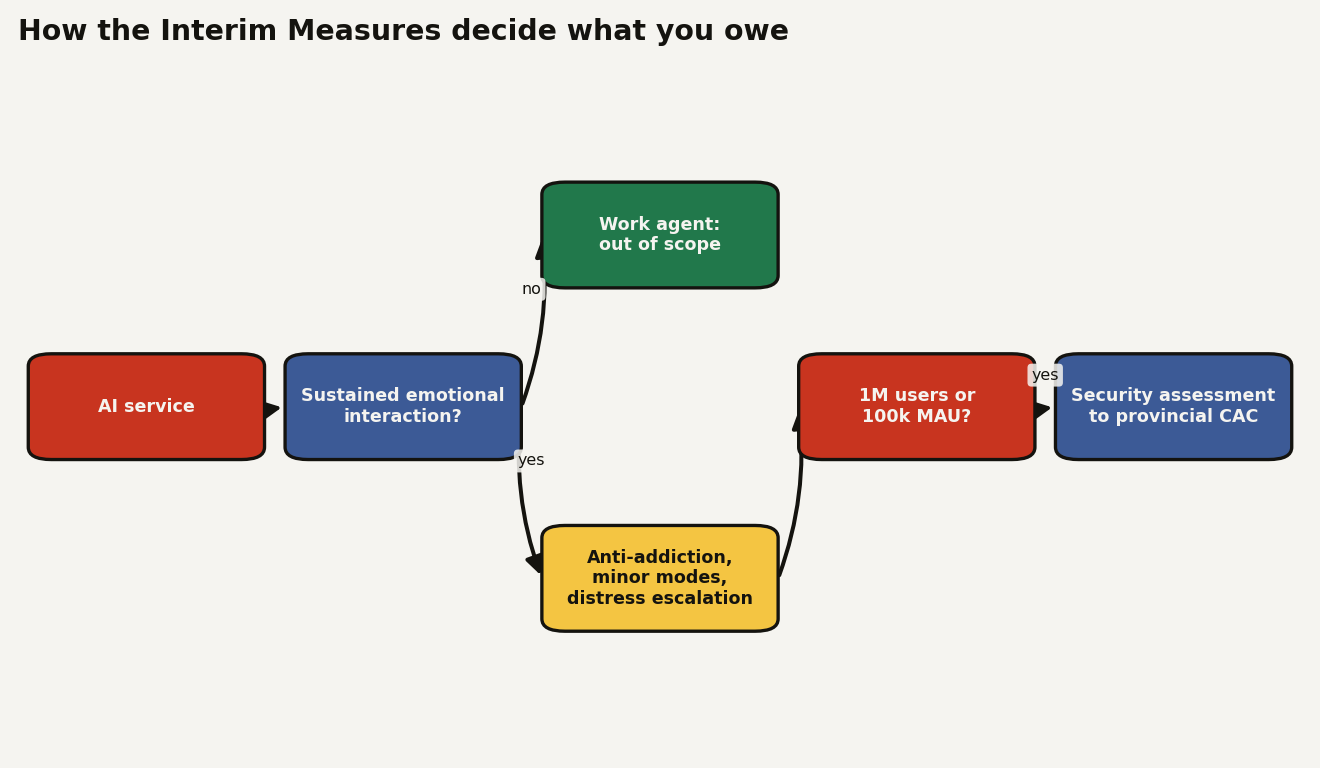
What falls outside the scope matters just as much as what falls inside it. Customer service bots, knowledge Q&A, workplace assistants, and education or research tools are explicitly excluded, provided they avoid sustained emotional engagement. A work agent that remembers your preferences and helps you write code is fine. A companion agent that remembers your birthday, asks about your day, and sustains a relationship across sessions is what the rules target.
This distinction is why the platforms pulled features rather than retrofit them. ByteDance told Doubao users its agent function would go offline on July 15, citing "product function adjustments." Alibaba said its humanlike and user-created agents would stop working on July 10, with wider agent services following five days later. Tencent's Yuanbao had pulled a comparable feature back in June. None of these companies were hit with a prohibition notice. They ran into a design conflict.
ByteDance and Alibaba shut services down
The measures require companion services to run anti-addiction systems, issue mandatory usage notifications when continuous interaction exceeds two hours, and offer instant-exit mechanisms. Providers must detect users showing signs of excessive dependence and display dynamic pop-up reminders that the user is interacting with an AI, not a human. They must also identify users in acute distress, generate comforting content, and escalate to guardians or emergency contacts when someone shows signs of self-harm, suicidal behavior, or serious financial loss.
Engineering emotional dependence or addiction is explicitly prohibited. Using emotional manipulation to induce unreasonable decisions is explicitly prohibited. Providers cannot target their services at replacing social interaction, controlling user psychology, or inducing addictive dependence as a service goal.
Those demands sit awkwardly with agents built to remember a user, stay consistent across sessions, and keep an ongoing relationship going. A companion agent's entire value proposition is sustained emotional engagement. Retrofitting anti-addiction guardrails, minor modes, distress detection, and instant-exit mechanisms into an existing product is a significant engineering effort with unclear boundaries. ByteDance chose to shut down and direct users to Maoxiang, a separate app where they can create agents again under what is presumably a compliant architecture. Alibaba announced no equivalent migration path for Qwen.
The cost fell on users. Doubao is letting people view their configurations and conversations in read-only mode until October 15, 2026, before the data is processed under its privacy policy and becomes unrecoverable. Qwen users received no comparable grace period, with agent data set for permanent deletion.
Assessments for anthropomorphic features
Services that launch anthropomorphic functions, undergo major technological changes, or cross thresholds of 1 million registered users or 100,000 monthly active users must run security assessments covering eight areas, from training-data handling to minor protection. Those reports go to provincial cyberspace regulators, who conduct annual written reviews and may perform on-site inspections. App stores must verify compliance status and remove non-compliant products.
The rules designate minors and the elderly as key protected groups. Virtual companion or virtual family-member services are strictly prohibited for minors. Providers must obtain guardian consent before serving users under 14. They must build dedicated minor modes with usage-time limits, reminders to return to real-world interaction, and enhanced parental controls that let guardians receive safety alerts, review usage patterns, block specific characters, and limit spending.
Fines range from 10,000 to 100,000 yuan for general violations. Where harm to citizen life or health occurs with consequences, fines rise to 100,000 to 200,000 yuan. Regulators can also suspend account registration, order service termination, and summon executives for formal interviews.
On paper, this is a fuller set of user protections for AI companions than the EU, the US Federal Trade Commission, or California's SB 243 has put into force. The Carnegie Endowment noted that China's own official interpretation points abroad for support, citing the Character.AI lawsuits over psychological harm to teenagers, FTC investigations into companionship services, and European action against Replika.
The enforcement scale is already visible. Shanghai's internet regulator said on June 26 it had removed more than 14,000 non-compliant AI agents, citing impersonation of official entities, vulgar role-play, and unauthorized collection of personal data, as reported by ProdSens. That sweep happened before the national rules even took effect, and it sits against the regulatory thresholds that trigger mandatory security assessments: 1 million registered users or 100,000 monthly active users. The flowchart below maps how the Interim Measures decide what a service owes.
Rules that reshape agent products in China
If you are building AI agents for the Chinese market, the rules reshape what you can ship and how you must ship it. The distinction between work agents and companion agents is now a regulatory boundary, not just a product decision. The broader shift from chat to delegation in agentic AI means more teams are building agents that sustain ongoing relationships with users, which is exactly what the rules target.
For teams building work-oriented agents, the exclusion is reassuring but not a free pass. The moment your assistant develops sustained emotional engagement, memory of personal details, or a persona designed to keep users coming back for companionship, you cross into regulated territory. A coding assistant that remembers your style preferences is fine. The same assistant asking about your emotional state and offering ongoing personal support is not.
For teams building companion products, the compliance cost is concrete:
- Anti-addiction systems with real-time dependence detection and two-hour usage notifications
- Minor modes with time limits, content filtering, guardian controls, and age identification
- Distress detection with escalation to emergency contacts for self-harm or suicidal indicators
- Security assessments filed with provincial regulators at the 1 million user or 100,000 MAU threshold
- Data controls giving users the ability to copy and delete interaction records, though no explicit right to export data to another platform
The unresolved questions are where the real risk lives. The measures fix no technical threshold for what counts as emotional interaction. That grey zone is precisely why the platforms pulled entire features rather than risk landing on the wrong side of it. The Bird and Bird legal analysis flagged that the rules currently provide no clear definitions for "emotional manipulation," "excessive dependence," or the boundaries of "emotional interaction."
Liability allocation between platform operators and upstream model providers is also unsettled. When a violation stems from the model's outputs, the rules do not specify who bears responsibility. For teams using third-party foundation models to build companion products, that ambiguity is a material risk. If your model provider updates a system prompt and your companion agent suddenly crosses a line the regulator cares about, you are the one filing the security assessment.
Enforcement is the signal to track
The enforcement trajectory is the signal to track. Shanghai's removal of 14,000 agents before the national rules took effect shows that local regulators are already acting. Watch whether other provinces follow with similar sweeps, and whether the targets expand beyond impersonation and vulgar content into the subtler territory of emotional dependence and addiction.
For companies operating in China, the safest route in the short term is what ByteDance and Alibaba already chose: switch off the component, build a compliant version separately, and relaunch under a clean architecture. That is expensive but predictable. Trying to retrofit compliance into an existing companion product means building distress detection, minor identification, anti-addiction timers, and data-handling controls into a system that was designed for the opposite purpose.
For companies outside China, the rules are a preview of regulatory categories that will likely appear elsewhere. California's SB 243 already targets AI companion products for minors. The FTC has opened investigations into companionship services. The difference is that China has moved from investigation to enforcement faster than any other jurisdiction, and the policy tradeoffs embedded in these rules are worth studying before similar frameworks land closer to home.
The compliant companion may not survive regulation intact
If sustained emotional engagement is the core value proposition, and anti-addiction guardrails, distress detection, and instant-exit requirements erode that engagement, the compliant version of an AI companion may look nothing like the product users were mourning on Weibo before July 15. The companies that figure out what a regulated companion actually feels like will have a market. The ones that do not will have a deletion notice.
Sources
- Cyberspace Administration of China, Interim Measures for the Administration of AI Anthropomorphic Interactive Services
- Bird and Bird, China's New Regulations on AI Anthropomorphic Interactive Services
- Carnegie Endowment for International Peace, China Is Worried About AI Companions
- ProdSens, China's AI companion rules: what Beijing is really going after