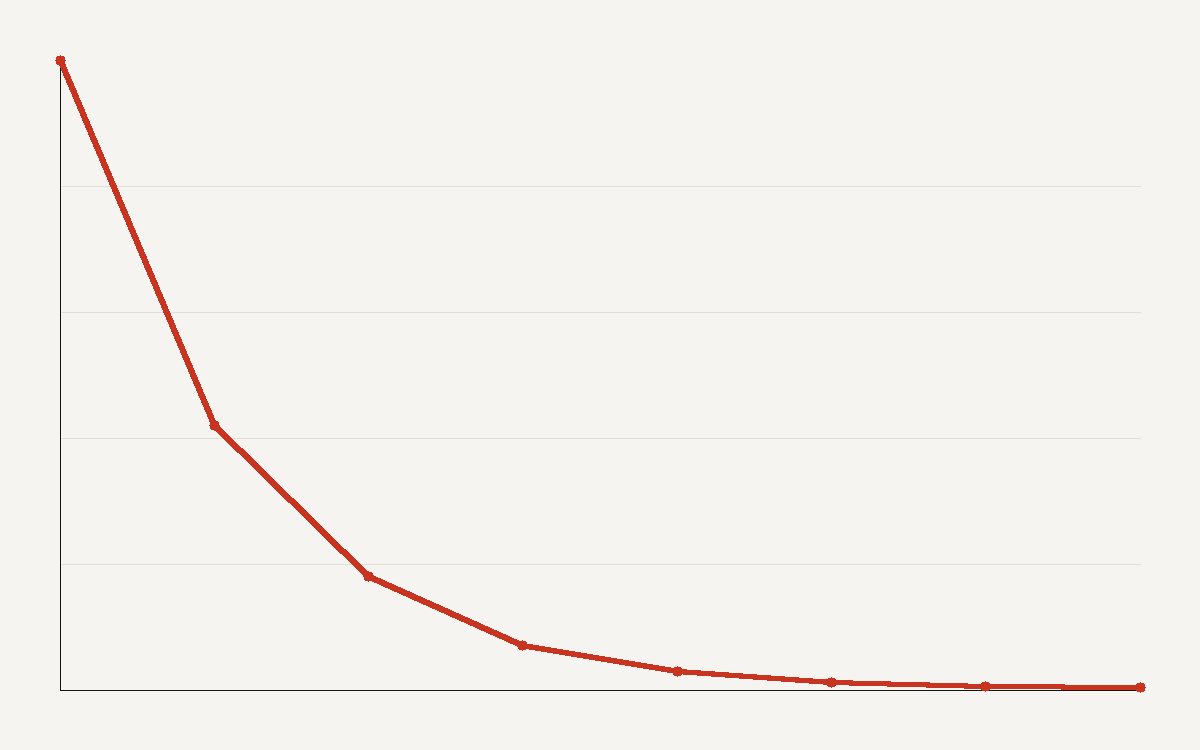
People are leaving stable jobs to run one-person studios not because they got braver, but because the cost of the work fell through the floor. The price of running a model at a fixed quality level, GPT-3.5 and better, dropped about 280 times between November 2022 and October 2024, according to Stanford's 2025 AI Index. The chart above is the reason a one-person studio is now a viable business.
That decline is not uniform, and the detail matters. Epoch AI estimates inference prices at a fixed capability level have fallen between 9 and 900 times per year depending on the task, with the steepest drops on the benchmarks that commoditise fastest. For a solo operator, picking the right tier is most of the margin.
What do the cheaper tokens actually buy?
The collapse in price turns work that used to be outsourced into work a single operator can run in-house. Research drafts, first-pass analysis, chart generation, and customer replies all move onto one desk because each one now costs cents rather than an afternoon.
| Task | Before | Now |
|---|---|---|
| Market scan | hired analyst | overnight run |
| First-draft report | a full day | minutes |
| Customer replies | a support hire | reviewed queue |
What is the catch?
Cheap inference is not free judgment. The output is almost right too often to ship unread, so a disciplined operator reviews everything that leaves the studio. The economics changed; the accountability did not.
This is not a victory lap for automation. Plenty of people lost ground in the same shift. But for anyone who wanted to work alone and could never make the numbers add up, the falling price of capability is the quiet story of the decade. The price data is tracked by Epoch AI.
What did the studio economics look like before the price collapse?
Before cheap inference, a one-person data studio had an awkward cost structure. Research, drafting, analysis, charting, customer support, and marketing all competed for the same hours. Outsourcing helped, but only after revenue was large enough to cover contractors. Hiring helped, but it turned a small business idea into a payroll problem before the product was proven.
The hard part was not ambition. It was throughput. A solo operator could do one or two functions well and then run out of week. Every additional service line added coordination overhead. Every customer request carried an opportunity cost. The business was limited by the founder's calendar more than the addressable market.
Cheap models changed that constraint. They made it possible to create first drafts, summarize sources, test angles, clean data, and prepare customer replies without hiring for each task. The founder still has to judge the output, but the blank-page labor is no longer the bottleneck.
What still cannot be delegated?
The model can draft a market scan. It cannot decide which client relationship is worth protecting. It can propose a chart. It cannot know which caveat will make the claim fair. It can write a reply. It cannot carry the reputation cost if the reply is wrong. The human work shifts toward taste, accountability, and final judgment.
That shift is productive but tiring. Reviewing machine output requires attention because the errors are often fluent. A bad paragraph may sound polished. A wrong number may sit next to five correct ones. A plausible citation may need checking. The work is faster than starting from scratch, but it is still work.
The economic gain comes from moving more tasks into the reviewable category. If a model can get a draft to 70 percent quality for a few cents, the owner can spend time on the last 30 percent. If the draft is only 30 percent right, the tool creates cleanup work. The margin depends on knowing which tasks belong in which bucket.
Why does this matter beyond one career?
Cheap capability changes who can start. A solo founder, journalist, analyst, designer, or researcher can now attempt projects that used to require a small team. That does not guarantee success, but it lowers the fixed cost of trying. More experiments can happen before outside funding, hiring, or a large customer contract.
This is also where the labor story becomes complicated. The same tools that let one person start a studio can pressure entry-level service work that used to provide the first rung for others. The benefit is real. The distribution is uneven. A serious account of AI and work has to hold both facts at once.
For buyers, the result may be more specialized suppliers. A one-person studio can serve a narrow niche with lower overhead, using AI to cover the routine work around a specific expertise. That can create better services, but it also raises the bar for trust because the business depends heavily on one person's review.
What is the rule that keeps this working?
The discipline that holds the model is simple: use AI where the cost of a bad first draft is low and the value of speed is high, and never use it as the final authority on facts, claims, client promises, or anything that would damage trust if it were wrong. That one rule keeps the economics from swallowing the judgment.
The broader lesson is that falling inference prices make small organizations look larger from the outside. They can publish more, respond faster, and test more ideas. The durable advantage still comes from knowing what should exist in the first place.
That is why the cost curve matters to more than AI companies. It changes the minimum viable size of a knowledge business. A solo operator can now cover more surface area before hiring, a small team can test more markets before raising capital, and a specialist can turn judgment into a product without first building a department. The constraint does not vanish. It moves from production capacity to editorial and commercial discipline.