The model sits at 52 on the Artificial Analysis Intelligence Index. That single number is why your timeline filled up. Qwen 3.8 27B is a downloadable, open-weights AI model that scored 52 on the Artificial Analysis Intelligence Index, a composite score from nine evaluations covering coding, science, reasoning, and professional tasks. That ties OpenAI's GPT-5.6 Luna at maximum reasoning effort and lands within one point of much larger models. The difference: GPT-5.6 Luna runs in a data center you reach through a paid API. Qwen 3.8 27B runs as a 17GB file on a capable laptop.
A 17GB file now matches a hosted frontier-tier model on a respected benchmark.
If you are new to local AI, the significance is simple. Until recently, models this capable required a cloud API key and a metered bill. This one is Apache 2.0 licensed, free to download, and usable offline.
Qwen 3.8 27B matched GPT-5.6 Luna
Alibaba's Qwen research lab released Qwen 3.8 27B on August 15, 2026. The model has 27 billion parameters (the learned weights that define a model's capability), a 262,144-token context window (how much text it can hold in working memory at once), and native image understanding. On Monday, August 17, third-party benchmarking firm Artificial Analysis published its Intelligence Index score of 52 for the model.
The index combines nine evaluations into one number. A higher score means stronger performance across coding, reasoning, science, and professional tasks. Here is where Qwen 3.8 27B lands among its neighbors:
| Model | Intelligence Index | Parameters | How you run it |
|---|---|---|---|
| Claude Opus 5 | 63 | Undisclosed | Hosted API |
| Claude Fable 5 | 62 | Undisclosed | Hosted API |
| GPT-5.6 Sol | 61 | Undisclosed | Hosted API |
| Grok 4.6 | 61 | Undisclosed | Hosted API |
| GLM-5.2 (max) | 53 | 753B | Hosted API |
| DeepSeek V4 Pro (max) | 53 | 1.7T | Hosted API |
| GPT-5.6 Luna (max) | 52 | Undisclosed | Hosted API |
| Qwen 3.8 27B | 52 | 27B | Local, 17GB file |
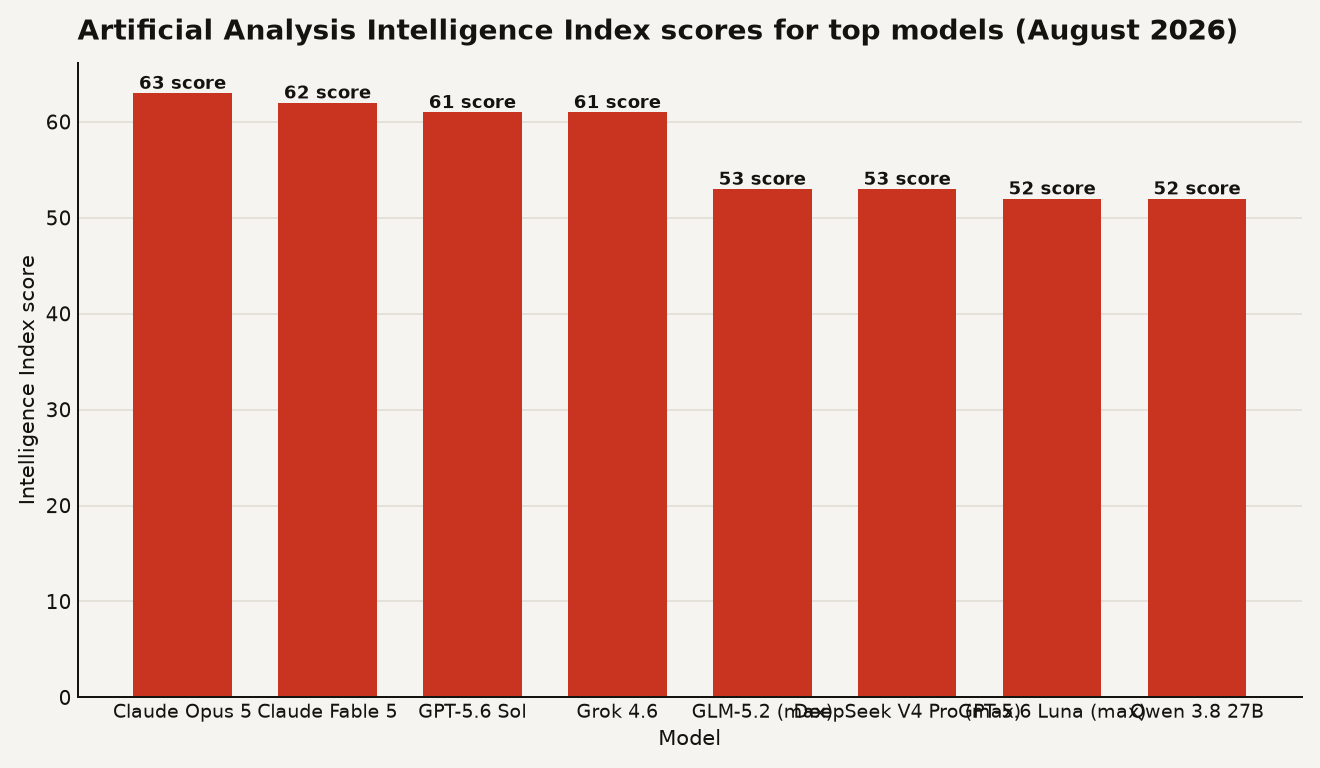
The chart above shows the cluster around 52 to 53. Every other model in that band is a hosted API product running on infrastructure that costs millions to operate. GLM-5.2 is 753 billion parameters. DeepSeek V4 Pro is 1.7 trillion. Qwen 3.8 27B is 27 billion, roughly 28 times smaller than DeepSeek V4 Pro, and it matches their scores within a single point.
Simon Willison, a developer known for his practical local-AI writing, called it a truly astonishing model. He ran the 17GB Q4_K_M quantized build (a compressed version that reduces memory usage with minimal quality loss) on a 128GB M5 Max MacBook Pro and an NVIDIA DGX Spark, using LM Studio.
Artificial Analysis reported that the model generated 160 million output tokens across its testing, versus a 43 million median for comparable open-weight models. That volume suggests the benchmark score is not a fluke from a small sample.
On the separate Agentic Index, which measures performance on agent-style workflows (where a model calls tools, searches through codebases, and completes multi-step tasks), Qwen 3.8 27B scored 51. That beat Claude Opus 4.8 at maximum reasoning effort, a frontier model Anthropic released less than three months earlier, according to reporting from VentureBeat.
A local model that matches a hosted one
The benchmark number is the headline, but the practical stakes are about what you can do without a cloud account.
What this means for you, as a beginner builder:
- You can run a frontier-tier model on consumer hardware. A 4-bit quantized copy is about 17GB. You need a machine with enough unified memory or VRAM to hold it. Willison used a 128GB M5 Max MacBook Pro and an NVIDIA DGX Spark. A high-end gaming desktop with 24GB of VRAM can also work, though you may need to drop to a smaller quantization level.
- You can use it offline. No API key, no per-token billing, no data leaving your machine. If you are working with private code or sensitive documents, that matters.
- You can modify it. The Apache 2.0 license permits commercial use, modification, and redistribution. You can fine-tune it, ship it inside a product, or redistribute it without asking permission.
- You can give it long documents. The native 262,144-token context window (roughly 200,000 words) lets you feed in entire codebases or long PDFs without chunking. It is extendable to one million tokens via YaRN, a technique for stretching a model's context length beyond its training range.
The tradeoff is speed. Willison reported 15 to 30 tokens per second on his hardware, compared to 74 tokens per second for GPT-5.6 Sol and 184 for GPT-5.6 Luna through hosted APIs. Local inference is slower because the model is dense (every parameter is active for every token, unlike Mixture-of-Experts models that activate only a fraction of their parameters), and dense models are bottlenecked by memory bandwidth.
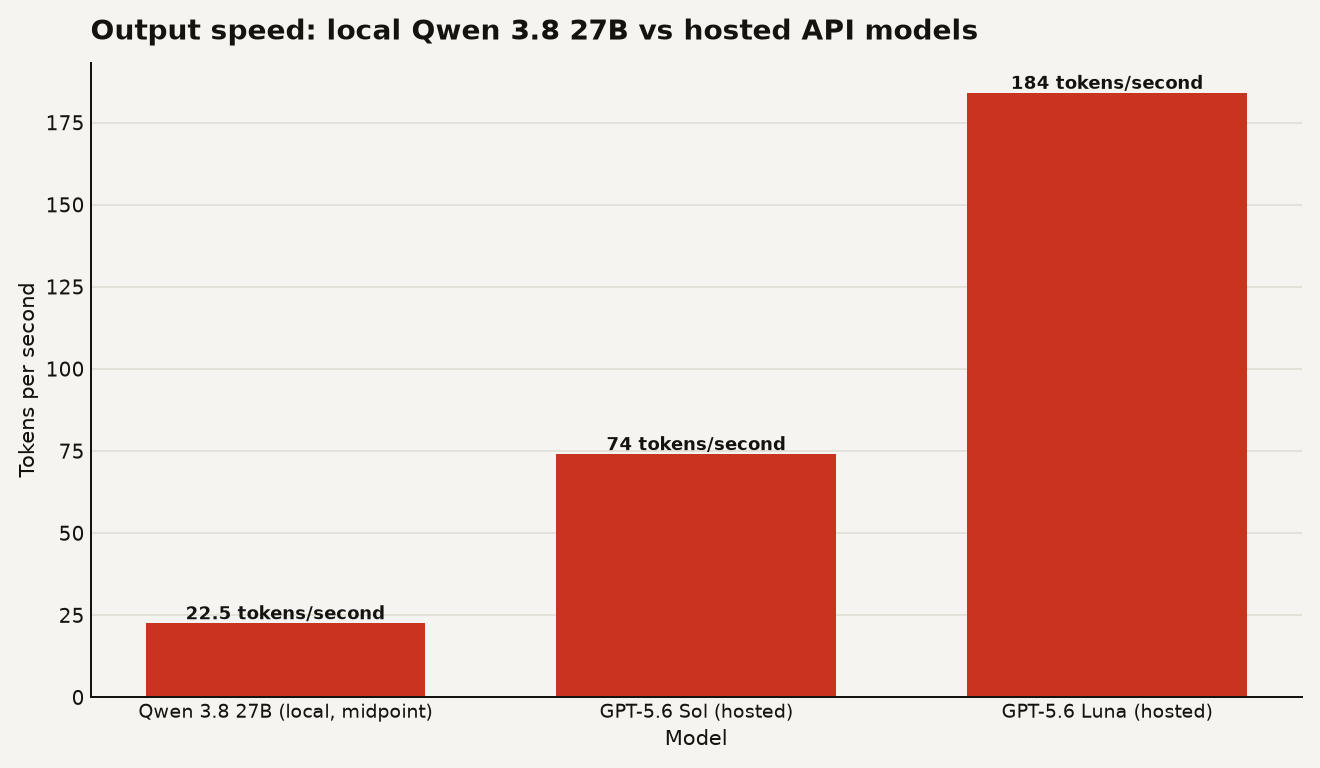
The chart above compares output speed in tokens per second. The hosted models are faster, but they cost money per token and require an internet connection. The local model is slower, but it is free after the hardware and runs offline.
There is a second catch: the default reasoning setting. Qwen 3.8 27B ships with its reasoning effort set to xhigh, which means it spends a lot of time "thinking" (generating internal reasoning tokens) before answering. Willison's request to draw an SVG of a pelican on a bicycle took 21 minutes and over 22,000 reasoning tokens. His recommendation is to start with low or no reasoning levels for everyday use. We cover that in detail in our guide to Qwen 3.8 27B's overthinking default.
If you are weighing this against other local options, the comparison is straightforward. The model is dense, so it needs more memory bandwidth than a Mixture-of-Experts model of the same raw parameter count. If you already read our explainer on what active parameters mean, the distinction is the same: a 27B dense model activates all 27B parameters for every token, while a MoE model might activate only 3B to 8B. The dense model is smarter per active parameter but slower per token.
Qwen 3.8 27B is the model to start with
If you have a capable machine and want to try local AI, Qwen 3.8 27B is the model to start with. Here is the practical path:
- Check your hardware. You need roughly 17GB of free memory for the Q4_K_M quantized build. A Mac with 32GB or more of unified memory is a good starting point. An NVIDIA GPU with 24GB of VRAM (like an RTX 4090) also works. If you have less, look for a smaller quantization, such as Q3 or Q2, though quality drops.
- Install LM Studio. It is the easiest way to download and run GGUF files (the format used for quantized local models) on Mac, Windows, and Linux. Search for "Qwen 3.8 27B" inside the app and pick a Q4_K_M build.
- Turn down the reasoning. Before you ask your first question, set the reasoning effort to low or off. The default
xhighsetting will make the model spend minutes thinking before it answers. You can always raise it for hard problems. - Try a coding task. Willison used the model to write and test a Python utility that converted an agent transcript from JSONL to Markdown. That is a good test: give it a small, self-contained coding job and see if the result runs.
- Compare it to your current API model. Run the same prompt through GPT-5.6 Luna or Gemini 3.7 Flash and compare. The benchmark says they are close. Your own task may disagree.
If your hardware is more modest, a 27B dense model may be too slow to be a daily driver. In that case, a smaller model like our Bonsai 27B guide for phones or a lighter MoE model may serve you better. The benchmark gap between 52 and 63 is real. Claude Opus 5 at 63 is still meaningfully better. But the gap between "requires a data center" and "runs on your laptop" just closed by a lot.
There is one more performance lever. Qwen 3.8 27B supports Multi-Token Prediction (MTP), an architecture trick where a smaller mechanism guesses several tokens ahead and the main model verifies the guesses. Willison reported a 72 percent speed improvement on his DGX Spark after enabling MTP through llama.cpp, compared to his default LM Studio configuration. If you are comfortable with command-line tools, enabling MTP is the single biggest speed win available. We expect inference software like LM Studio to bake this in over the coming months.
Inference software has to close the speed gap
The open question is whether inference software can close the speed gap. The benchmark score is settled: a 17GB file now matches a hosted model. The experience is still slower. Willison's 72 percent MTP gain is a preview of what is coming, but 15 to 30 tokens per second is still a noticeable wait compared to hosted models at 74 to 184.
The bet I would make: local models at this size class will be good enough for most coding and document tasks within six months, as inference software improves and MTP-style optimizations ship by default. The bet I would not make: that they will replace hosted APIs for latency-sensitive applications any time soon. If you need sub-second responses or high throughput, the cloud is still the right tool.
For beginners, the takeaway is simple. The line between "requires a cloud API" and "runs on your laptop" just moved. A model that ties GPT-5.6 Luna on a respected benchmark is now a 17GB download. Try it, turn down the reasoning, and see if it handles your work. If it does, you just cut your API bill to zero for that task.