Tencent just dropped a 295-billion-parameter AI model called Hy3, and if you are just starting to explore how large language models work, it is one of the most interesting open releases of the year. An "open" model means anyone can download the underlying weights, the mathematical parameters that define how the model processes language, and run it or modify it themselves rather than only accessing it through a paid cloud API. Hy3 is published under the Apache License 2.0, which permits commercial use with almost no strings attached.
Hy3 uses a Mixture-of-Experts architecture that activates only 21 billion of its 295 billion parameters per token, meaning it aims to deliver the quality of a much larger model at a fraction of the compute cost.
Tencent's Hy3 and how it is built
Hy3 was developed by the Tencent Hy Team and released on July 6, 2026. A "model" in this context is a neural network trained on massive amounts of text and code to predict the next piece of content. Parameters are the learned numbers inside that network; more parameters generally means the model can represent more complex patterns, but also costs more to run. Hy3 has 295 billion total parameters, placing it in the heavyweight class alongside proprietary systems like OpenAI's GPT series.
The twist is the Mixture-of-Experts design. Instead of running every part of the network on every word, the model has 192 "experts," small sub-networks each specializing in different patterns. For any single token (a token is roughly a piece of a word), a routing mechanism selects only the top 8 experts out of 192 to process it. The result is that only about 21 billion parameters are active for any given prediction, even though the full model is 14 times larger. This is why Tencent claims Hy3 "rivals flagship open-source models with 2 to 5x parameters" while keeping inference costs down.
A third ingredient is the Multi-Token Prediction layer, which adds 3.8 billion parameters on top of the base network. MTP trains the model to predict multiple future tokens at once during training, and at inference time it can be used for speculative decoding, a technique where a fast draft model proposes tokens and the main model verifies them, speeding up output. The context length, the amount of text the model can hold in memory at once, is 256,000 tokens, which is enough for a thick book or a large codebase.
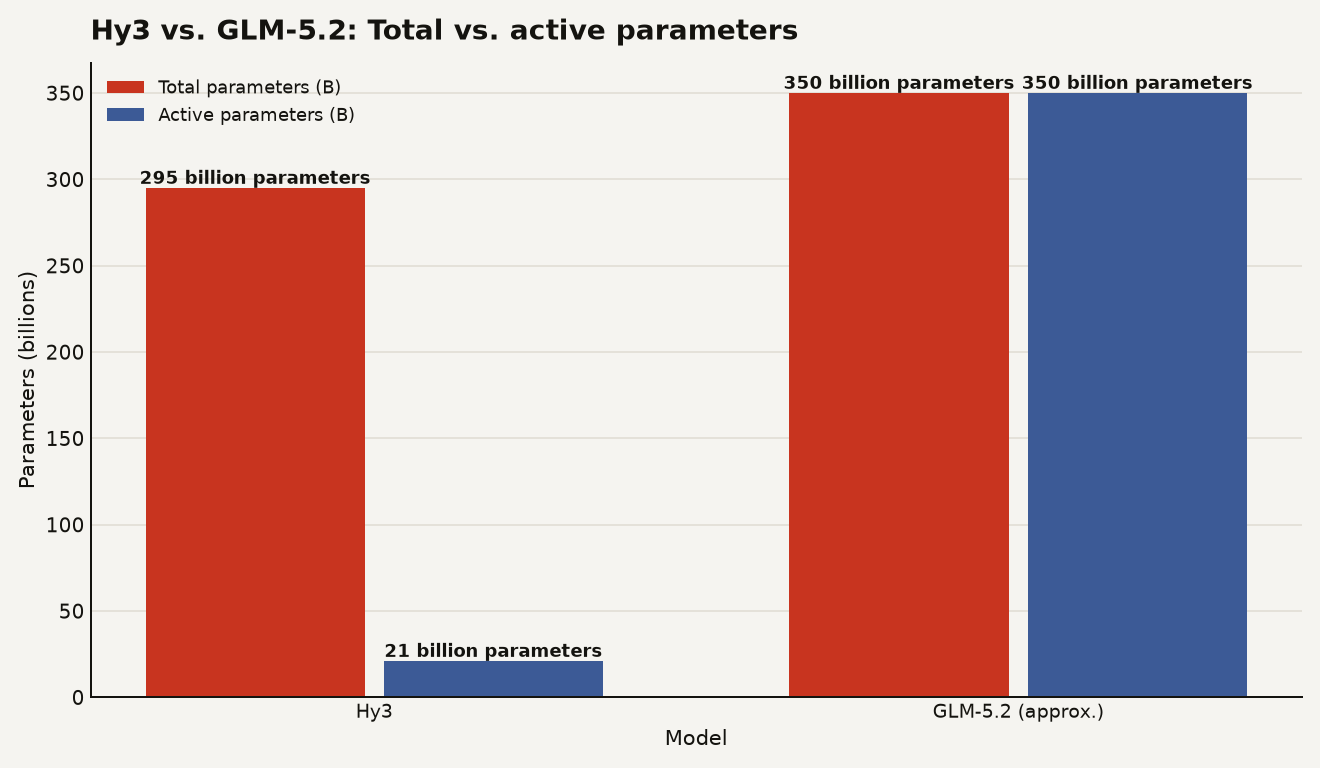
As the chart above shows, Hy3's total footprint of 295 billion parameters is comparable to GLM-5.2's roughly 350 billion, but its active parameter count of 21 billion is an order of magnitude smaller, which is where the cost savings come from.
Strong claims against similar-size open models
Tencent's own claims are strong. They say Hy3 outperforms similar-size models and is competitive with flagship open-source models that have 2 to 5 times more parameters. An independent report from VentureBeat confirms that Hy3 beats GLM-5.2 across most benchmarks except coding. GLM-5.2 is a leading open-weights model from Zhipu AI, so beating it on general tasks is a real claim.
Tencent also ran a blind evaluation where 270 domain experts used Hy3 on real work tasks and scored it 2.67 out of 4, outperforming GLM-5.1 at 2.51 out of 4. The advantages were largest in frontend development, data and storage, and CI/CD tasks (continuous integration and continuous delivery, the pipelines that automatically test and ship code). On SWE-Bench Verified, a benchmark that tests whether an AI agent can solve real GitHub issues, accuracy variance across different agent frameworks stayed within 4 percent, meaning Hy3 behaves consistently regardless of which tooling wraps it.
The internal quality metrics are where the practical gains show up. From the Hy3 Preview in late April to the final July release, the multi-turn issue rate (errors in understanding context across multiple back-and-forth messages) dropped from 17.4 percent to 7.9 percent. The hallucination rate, where the model states false information as fact, fell from 12.5 percent to 5.4 percent. Commonsense error rates fell from 25.4 percent to 12.7 percent.
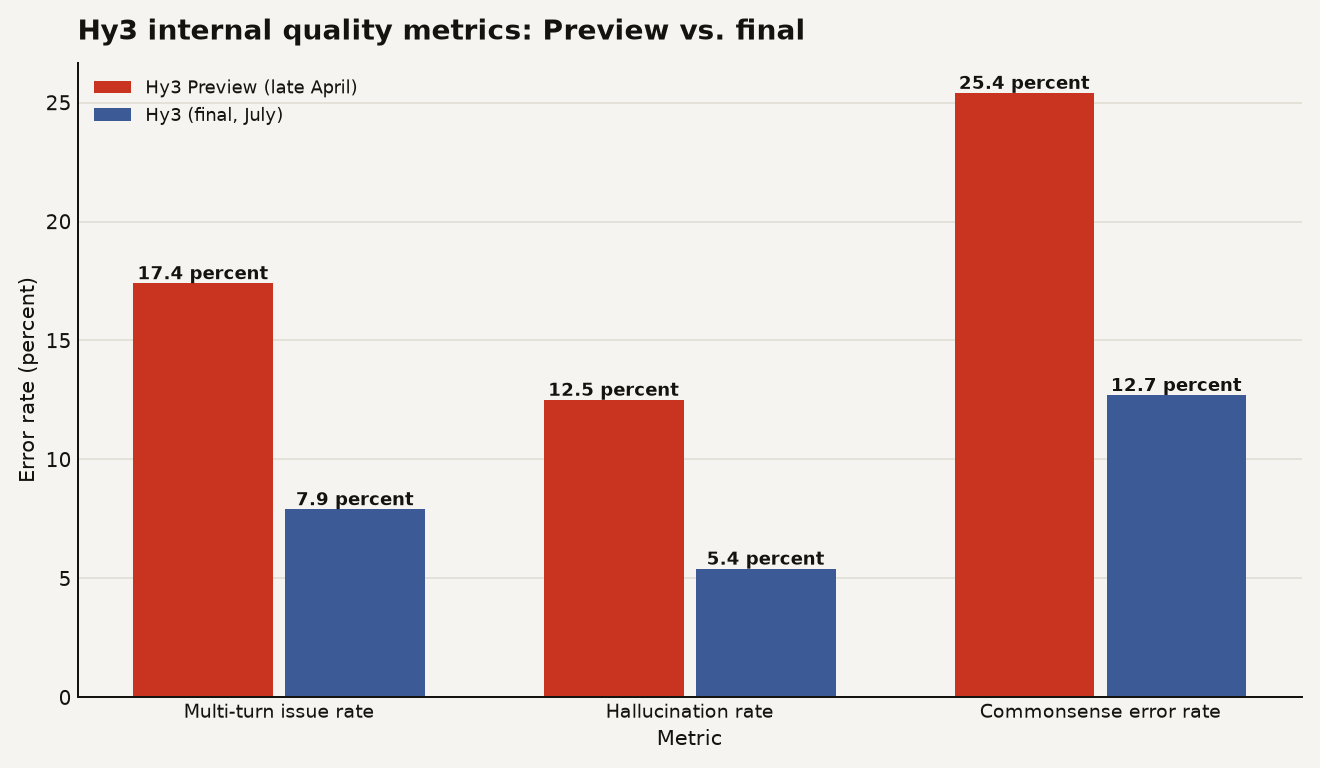
The chart above breaks down those gains. The most dramatic cut is in commonsense errors, which nearly halved, followed by hallucination rate which more than halved. For a beginner, this matters because hallucinations and context loss are the two most frustrating things about using LLMs today.
598 gigabytes is too big for most machines
Here is where the excitement hits a wall for most beginners. The full Hy3 model is 598 gigabytes on Hugging Face. The FP8 quantized version, which compresses the weights from 16-bit to 8-bit numbers to save space and memory, is still 300 gigabytes. Quantization is a tradeoff: it makes the model smaller and faster but can slightly degrade output quality.
Tencent recommends running Hy3 on 8 GPUs with large memory capacity, specifically H20-3e or equivalent. These are datacenter-class accelerators, not consumer graphics cards. If you do not know what an H20 is, you do not own one. For context, a high-end consumer GPU like an NVIDIA RTX 4090 has 24 gigabytes of video memory, meaning you would need roughly 13 of them to hold the quantized Hy3, which is not practical for a home setup.
However, you do not need to run it locally to try it. Simon Willison notes that Hy3 is available for free on OpenRouter until July 21, 2026. OpenRouter is an API aggregator that lets you call hundreds of models through a single interface, and the free tier means you can experiment with Hy3 from a simple script or a chat UI without any hardware investment. If you want to understand the mechanics of calling an OpenAI-compatible API, our MCP explainer covers what a standard API call actually looks like and why it matters for agents.
If you are lucky enough to have access to an 8-GPU server, Tencent provides dedicated recipes for vLLM and SGLang, two open-source inference engines that load and serve the model efficiently. The vLLM startup command looks like this:
vllm serve tencent/Hy3 \
--tensor-parallel-size 8 \
--speculative-config.method mtp \
--speculative-config.num_speculative_tokens 2 \
--tool-call-parser hy_v3 \
--reasoning-parser hy_v3 \
--enable-auto-tool-choice \
--port 8000 \
--served-model-name hy3
The tensor-parallel-size 8 flag splits the model across 8 GPUs. The speculative-config flags enable Multi-Token Prediction for faster output. The tool-call-parser and reasoning-parser flags tell vLLM how to parse Hy3's special tool-use and reasoning formats, which are custom to this model.
Try Hy3 on OpenRouter first
If you are new to LLMs, the smartest move is to try Hy3 through OpenRouter before the free window closes on July 21. Pick a task you actually do: summarize a document, draft an email, generate a small HTML page. Compare its output side by side with another model like GPT-4o or Claude. Pay attention to how it handles multi-turn conversations, since Tencent's biggest quality gains were in context retention and reducing hallucination.
A few practical notes on the API. Tencent recommends temperature=0.9 and top_p=1.0 as default sampling parameters, which is unusual since most models use temperature around 0.7. Temperature controls randomness; higher values produce more varied output. Hy3 also supports a reasoning_effort parameter you can set to "no_think" for direct answers or "high" for deep chain-of-thought reasoning on complex problems. If you are asking it to solve a math problem or debug code, use "high". If you just want a quick paragraph, use "no_think".
For those thinking about deployment, the Apache 2.0 license is the green light. You can use Hy3 in commercial products, modify it, and distribute it without paying Tencent. The catch is infrastructure: unless you have datacenter GPUs, you will be calling it through an API provider rather than running it yourself. If you want a model you can run on a consumer laptop, this is not it. For that lane, our Qualcomm GenieX guide is a better starting point, covering a local LLM runtime built for Snapdragon laptops.
21 billion active parameters is the number that matters
The headline number is 295 billion parameters, but the number that matters is 21 billion active. That gap is the entire bet behind Mixture-of-Experts: build a model with the knowledge capacity of a giant, but run it with the speed and cost of a mid-size system. Hy3 is not the first MoE model, but it is one of the most aggressive ratios of total to active parameters in the open-weights space, and the quality metrics suggest the tradeoff is paying off. For a beginner, the lesson is that raw parameter counts no longer tell you how fast or expensive a model is. The architecture underneath those parameters is what determines whether you can afford to use it.
Sources
- Hugging Face: tencent/Hy3 model card
- GitHub: Tencent-Hunyuan/Hy3 repository
- VentureBeat: Tencent's Apache-licensed Hy3 takes on GLM-5.2 at half the size
- simonwillison.net: tencent/Hy3 link post