A 2.8 trillion parameter AI model from a Chinese startup just posted benchmark numbers that match or beat the most expensive models from OpenAI and Anthropic. On July 16, 2026, Moonshot AI announced Kimi K3, calling it their most capable model to date and the first open 3T-class model. They are rounding 2.8 trillion up to 3 trillion, but the jump is real: K3 is nearly three times the size of its predecessor Kimi K2.6, which sat at roughly 1 trillion parameters. You can use it today through the Kimi website or API, and the open-weight release is promised by July 27, 2026.
The headline: Kimi K3 reaches an Elo of 1547 on Artificial Analysis's private long-horizon knowledge evaluation, up 732 points from K2.6, trailing only Anthropic's Claude Fable 5.
If you are new to AI models, here is the quick version of what those words mean, then we will get into what changes for you.
Moonshot AI and Kimi K3
Moonshot AI is a Beijing-based AI lab founded in 2023. It is one of China's most watched model labs, the same class of company as DeepSeek or Zhipu AI. Their consumer product, the Kimi chatbot, was already popular inside China for handling very long documents. VentureBeat reports that K3 is being positioned as the largest open-source model ever released, rivaling top US systems.
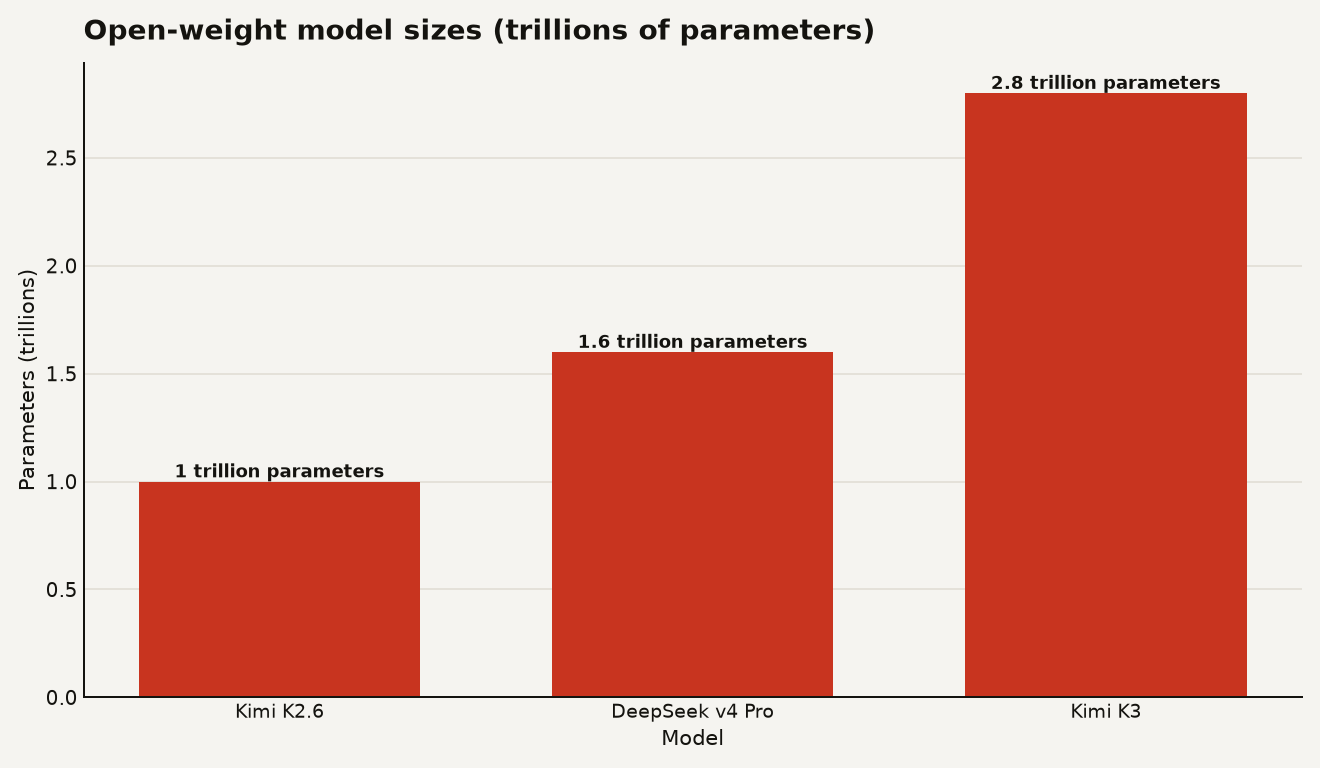
A parameter is a number inside the model that gets adjusted during training. More parameters generally means the model can represent more complex patterns. To give you scale: GPT-3 from 2020 had 175 billion parameters. Kimi K3 has 2.8 trillion, or about 16 times that. Its predecessor Kimi K2.6 was roughly 1 trillion, and DeepSeek's v4 Pro, the previous open-weight champion, sits at 1.6 trillion.
Open weight (sometimes called open source, though purists argue the terms differ) means the lab publishes the trained model files so anyone can download, study, and modify them. You can run an open-weight model on your own hardware with no per-call API bill. Closed models like OpenAI's GPT-5.6 or Anthropic's Claude Fable 5 keep their weights private, so you can only access them through paid APIs.
This is why the release date matters. Today you can only use K3 through Moonshot's API or website. On or before July 27, 2026, Moonshot says the weights will be public. After that, anyone with enough hardware can run it themselves.
K3 against Claude Opus 4.8 on Moonshot's numbers
Moonshot's self-reported benchmarks have K3 mostly beating Anthropic's Claude Opus 4.8 max and OpenAI's GPT-5.5 high, while losing to Claude Fable 5 and GPT-5.6 Sol. The independent evaluation from Artificial Analysis, covered by Axios, broadly agrees, placing K3 second only to Claude Fable 5 on their long-horizon knowledge work evaluation with an Elo of 1547. Elo is a rating system borrowed from chess; higher means the model wins more head-to-head comparisons against other models on similar tasks.
K3 also leads Arena.ai's Frontend Code arena, a leaderboard where human judges compare models on web UI coding tasks. Willison's post notes it surpassed even Claude Fable 5 there, which is notable because frontend code has been Anthropic's strong suit for two generations.
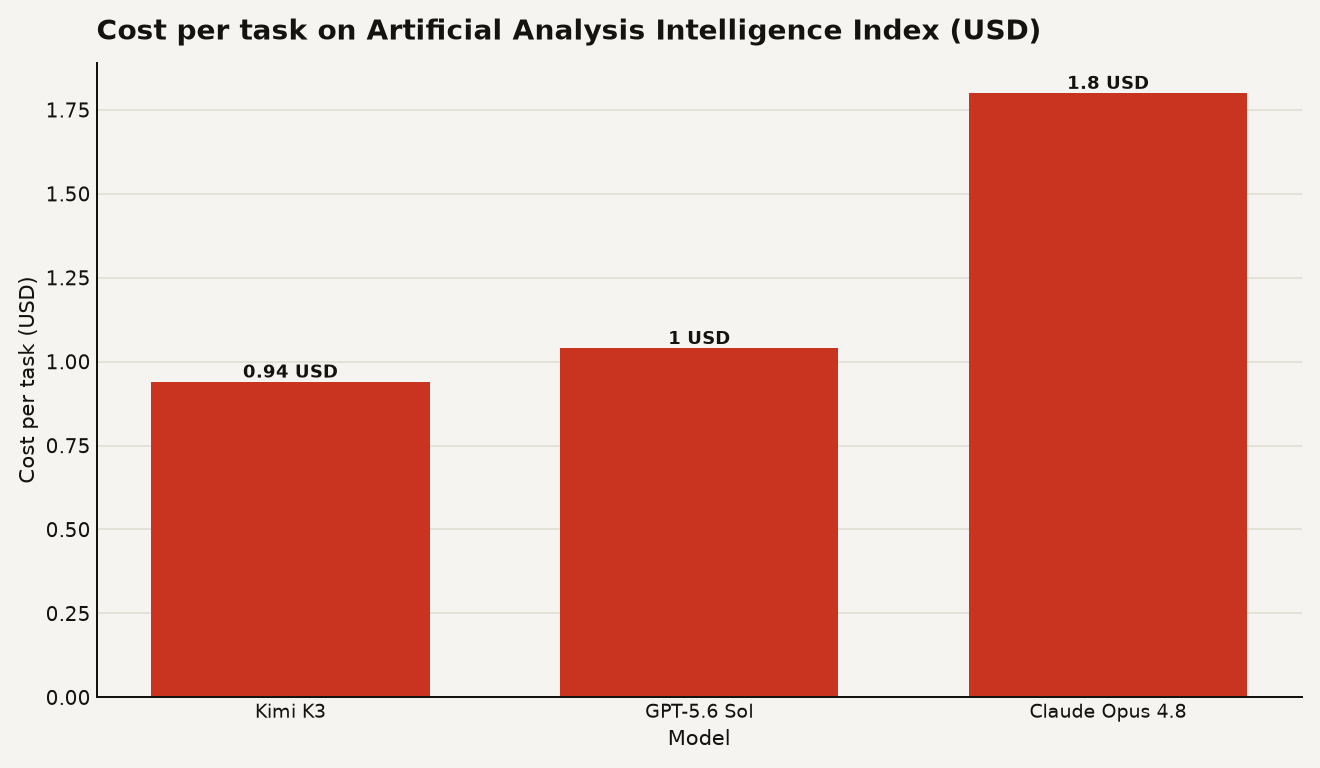
Cost tells a more nuanced story. On the Artificial Analysis Intelligence Index, K3's cost per task was $0.94, similar to GPT-5.6 Sol at $1.04, and roughly half the price of Opus 4.8 at $1.80. K3 also uses 21% fewer output tokens than K2.6 did, meaning it gets to an answer with less wasted text.
The chart below compares open-weight model sizes in trillions of parameters.
API pricing is where things get interesting for your wallet. K3 costs $3 per million input tokens and $15 per million output tokens. That matches Anthropic's Claude Sonnet tier and makes K3 the most expensive model a Chinese lab has ever released. Its predecessor K2.6 was $0.95 and $4 per million tokens, so the per-token price jumped roughly three to four times. The bet Moonshot is making: the quality justifies a premium tier, and they no longer need to compete on price alone.
The chart below shows how K3's cost per task stacks up against two top US closed models on the same evaluation.
2.8 trillion parameters will not fit a laptop
Short answer: no, not on a laptop.
To run a model locally, you need RAM (or VRAM on a GPU) large enough to hold the weights. A 2.8 trillion parameter model in standard 16-bit precision needs roughly 5.6 terabytes of memory. A top-spec MacBook Pro with 128 GB of unified memory holds about 2% of that. Even DeepSeek's 1.6 trillion parameter model is beyond consumer hardware at full precision.
The workaround the community uses is quantization, which compresses the numbers to fewer bits: 4-bit, 2-bit, or even 1-bit. Even aggressively quantized, K3 would likely need several hundred gigabytes, which means a multi-GPU server, not a desktop. If you want to run serious models on a phone or laptop today, something like the Bonsai 27B model is a far better fit. K3's open-weight release matters for cloud providers, research labs, and companies that want to fine-tune or host the model privately, not for hobbyists running it on a MacBook.
Simon Willison's pelican test
Simon Willison, a well-known developer and AI tooling writer, has been running the same prompt, "Generate an SVG of a pelican riding a bicycle," through every new model for 21 months. He is the first to admit it was never a rigorous benchmark. It started as a joke about how hard models are to compare. But for the first year it correlated surprisingly well with overall model quality.
That connection has weakened. The pelicans from GPT-5.6 and Claude Fable 5 are now outclassed by GLM-5.2, and Willison does not consider GLM-5.2 a frontier-class model. His honest read: the pelican test no longer predicts general quality, so do not use it to rank models against each other.
What the test still does well is force you to actually try a model and surface quirks. For Kimi K3, the pelican prompt revealed several things worth knowing:
- K3 only has one reasoning effort level right now: max. Reasoning tokens are hidden thinking the model does before it answers. K3 burned 13,241 reasoning tokens to produce 3,417 tokens of actual SVG output. That is expensive for a single image task.
- The pelican cost 25 cents to generate. For comparison, a similar prompt on a cheaper model costs under a cent.
- K3 seems to carry a hidden system prompt of roughly 85 tokens. The prompt "hi" counted 86 tokens, and a 10-token prompt ballooned to 95. K3 refused to leak the system prompt when asked.
- Vision works well. When Willison fed the rendered pelican image back to K3 and asked for alt text, it produced an accurate, detailed description for 0.6 cents.
The takeaway for you: reasoning models like K3 think a lot, and that thinking costs money. If you are building an app where cost per call matters, the max-only reasoning setting is a red flag. Watch for Moonshot to add lower reasoning tiers, which is what every other frontier lab has done.
Watch before you switch
Here is the honest read for a beginner coder or AI hobbyist.
If you are building on OpenAI or Anthropic today and your app works, there is no urgent reason to switch on July 16. K3's quality is competitive but not clearly ahead of Claude Fable 5 or GPT-5.6 Sol, and those closed models have mature tooling, SDKs, and ecosystem support. K3 is a Chinese API with a newer ecosystem around it.
Where K3 does matter:
- If you need an open-weight model at the frontier. Once weights drop on July 27, K3 becomes the largest open model available. For teams that want to host privately, fine-tune, or avoid US API lock-in, this is the model to watch. The previous guide on what 1.6 trillion parameters means covered why these huge open weights matter for the ecosystem.
- If you do frontend or UI coding. K3 leads the Arena.ai Frontend Code arena. If you generate web components or UI code with AI, it is worth a side-by-side test against Claude Fable 5.
- If you are cost-sensitive at the task level. At $0.94 per task on Artificial Analysis, K3 is competitive with Sol and cheaper than Opus. But the per-token price is high, and the max-only reasoning means a single complex prompt can cost a quarter. Calculate your actual cost per task before committing.
What I would not do: assume the pelican test, or any single prompt, tells you everything. Run your own real workload through the API, check the token counts and the bill, and compare against what you use now. That is the only benchmark that matters for your codebase.
What this means for the open-weight race
The open-weight frontier moved from 1 trillion to 1.6 trillion to 2.8 trillion parameters in under a year. DeepSeek held the crown briefly with v4 Pro. Moonshot now holds it, and the gap between the best open weights and the best closed models is measured in single-digit Elo points, not generations.
For you, that means the choice between open and closed is becoming a choice about control and cost. Quality is no longer the dividing line. If you need to run on your own infrastructure, avoid sending data to a US API, or fine-tune on proprietary data, the open-weight side can finally serve you a frontier-class model. The catch is hardware: these models are huge, and running them yourself means renting GPUs, not opening a laptop.
The real signal from Kimi K3 is the price tag. A Chinese lab felt confident charging Anthropic-level prices, and that tells you more about the state of open weights than any benchmark.
Sources
- simonwillison.net: Kimi K3, and what we can still learn from the pelican benchmark
- venturebeat.com: China's Moonshot AI releases Kimi K3, the largest open-source model ever
- axios.com: China's open-weight Kimi model stuns AI world with frontier-level results