A 7-billion-parameter model just walked into a room full of 27-billion-parameter models and started winning arm wrestling matches. That is the story behind K2 Horizon 7B, a new open-weights AI model released by IFM on September 14, 2026. A Reddit post on r/LocalLLaMA put it plainly: the model ranks between Qwen 3.6 27B and Qwen 3.6 35BA3B on the Artificial Analysis Intelligence Index, a composite benchmark that scores models on reasoning, knowledge, mathematics, and coding. For a model you can run on a single consumer graphics card, that is a startling result.
K2 Horizon 7B scores 21 on the Artificial Analysis Intelligence Index, where the median for comparable models is just 8. It sits at rank 9 out of 142 models tracked. The model has a 524,288-token context window (roughly 786 pages of text), ships under the Apache 2.0 license, and is free to download and self-host. But before you clear space on your hard drive, you should know what the benchmarks actually measure, what they leave out, and what happened when real testers tried to use this model for real work.
What is K2 Horizon 7B and who made it?
K2 Horizon 7B is part of a family of six models released by IFM, a research lab, ranging from 0.9 billion to 375 billion parameters. The "7B" in the name means the model has 7 billion parameters, which are the internal numbers a neural network uses to make predictions. Think of parameters as the model's brain cell connections: more connections usually means smarter, but also bigger and slower to run. A 7B model is small enough to run on a single graphics card in a decent desktop computer, while models in the hundreds of billions typically need data-center hardware.
IFM calls this its "most comprehensive open release to date." In its launch announcement, the lab says it is releasing the full training lifecycle: pretraining data recipes, intermediate checkpoints, training code, configurations, fine-grained logs, evaluation results, and final weights. The models ship under the Apache 2.0 license, which means you can use them commercially without asking permission. Datasets are released under their applicable licenses where redistribution is possible, and IFM says it discloses how data was constructed when it cannot share the data directly.
The 7B model is what IFM calls a "dense" model, meaning every parameter is active during every inference. This is different from a "mixture of experts" or MoE model, where only a fraction of parameters fire on any given query. Dense models are simpler to deploy and reason about, but they use more compute per token than an MoE of the same total size. For a beginner, the practical takeaway is that K2 Horizon 7B is a straightforward, single-file model with no routing tricks. For more on how MoE models spread their parameters across specialized sub-networks, see our guide to Qwen 3.8 27B, which takes the opposite approach.
How does a 7B model beat models three or four times its size?
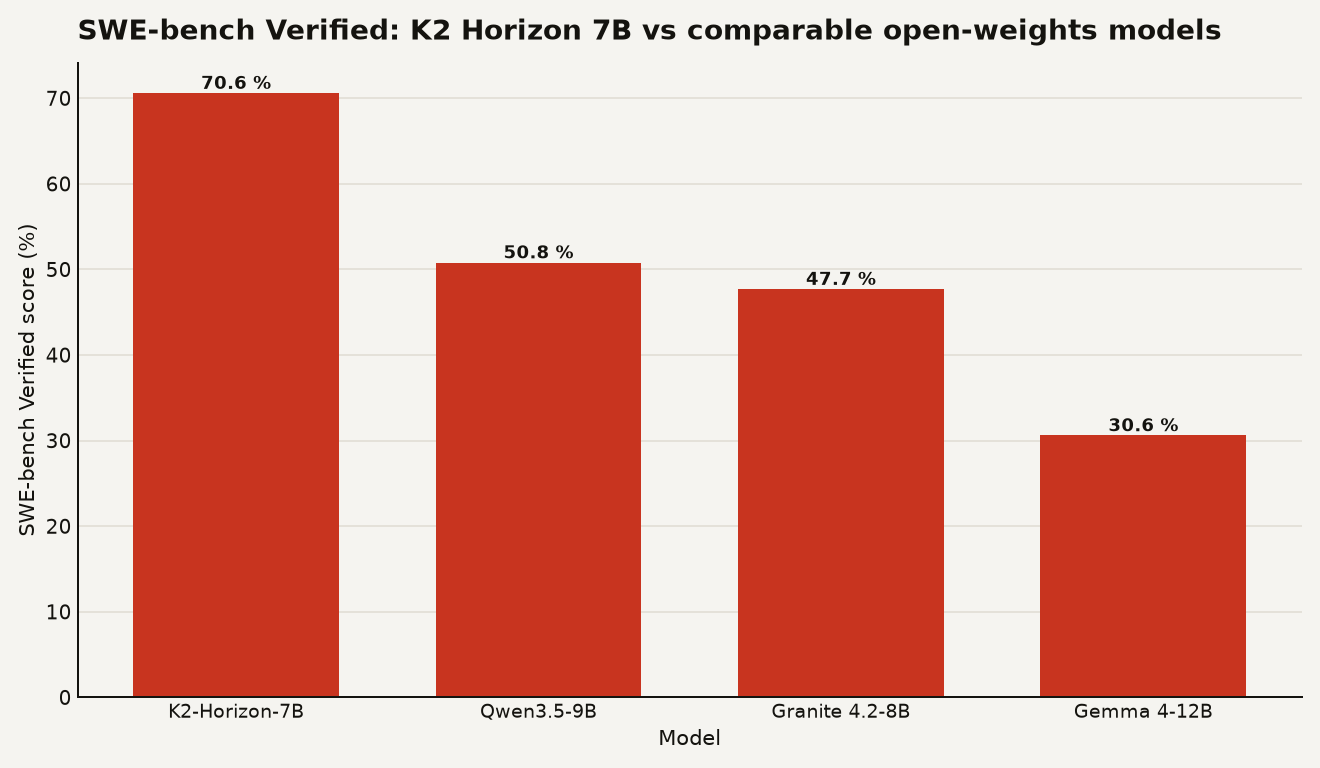
The benchmark numbers are where K2 Horizon 7B stops being interesting on paper and starts being interesting in practice. On SWE-bench Verified, a test where the model must fix real bugs in real software projects, K2 Horizon 7B scores 70.6, compared to Qwen3.5-9B at 50.8, Granite 4.2-8B at 47.7, and Gemma 4-12B at 30.6, according to the model card on Hugging Face. A 7B model outscoring a 12B model by 40 points on a software engineering benchmark is a generational jump, and the chart below shows the gap.
On competition mathematics, the model scores 73.3 on the HMMT February 2026 benchmark, beating Qwen3.5-9B at 65.7 and Gemma 4-12B at 63.1. On Terminal-Bench 2.1, which tests whether a model can use a terminal to complete agentic coding tasks, K2 Horizon 7B scores 39.1, compared to Qwen3.5-9B at 29.2 and Gemma 4-12B at 27.3. The same Hugging Face model card reports all of these results.
On agentic tool use, measured by the tau3-Banking benchmark, the model scores 25.8, which beats Qwen3.5-9B at 7.0 and Granite 4.2-8B at 7.6. On BrowseComp, a deep web research benchmark, it scores 59.0, ahead of GPT-5 at 54.9 and DeepSeek V4 Flash at 53.5. That last number is worth pausing on: a 7B open-weights model outscoring a frontier proprietary model on a web browsing benchmark. Whether that holds up in your hands is a different question, which we will get to shortly.
The Artificial Analysis Intelligence Index, which tracks all of this on its model page, gives K2 Horizon 7B a composite score of 21. The page notes the model generated 160 million tokens during evaluation, which it calls "very verbose" compared to the median of 76 million tokens. That verbosity matters: it means the model writes long answers, which can be a feature or a bug depending on your use case.
Can you actually run it on your own hardware?
Yes, with caveats about VRAM and patience. The 7B model consumed roughly 16.76GB of VRAM during local testing by MindStudio, a platform for building AI applications, which published a hands-on report after running all three single-GPU sizes on a machine with 96GB of VRAM. That VRAM footprint means the 7B fits comfortably on a single 24GB consumer GPU like an RTX 3090 or RTX 4090, the same cards hobbyists already use for gaming and other local models. The chart below shows how the three sizes compare in memory usage.
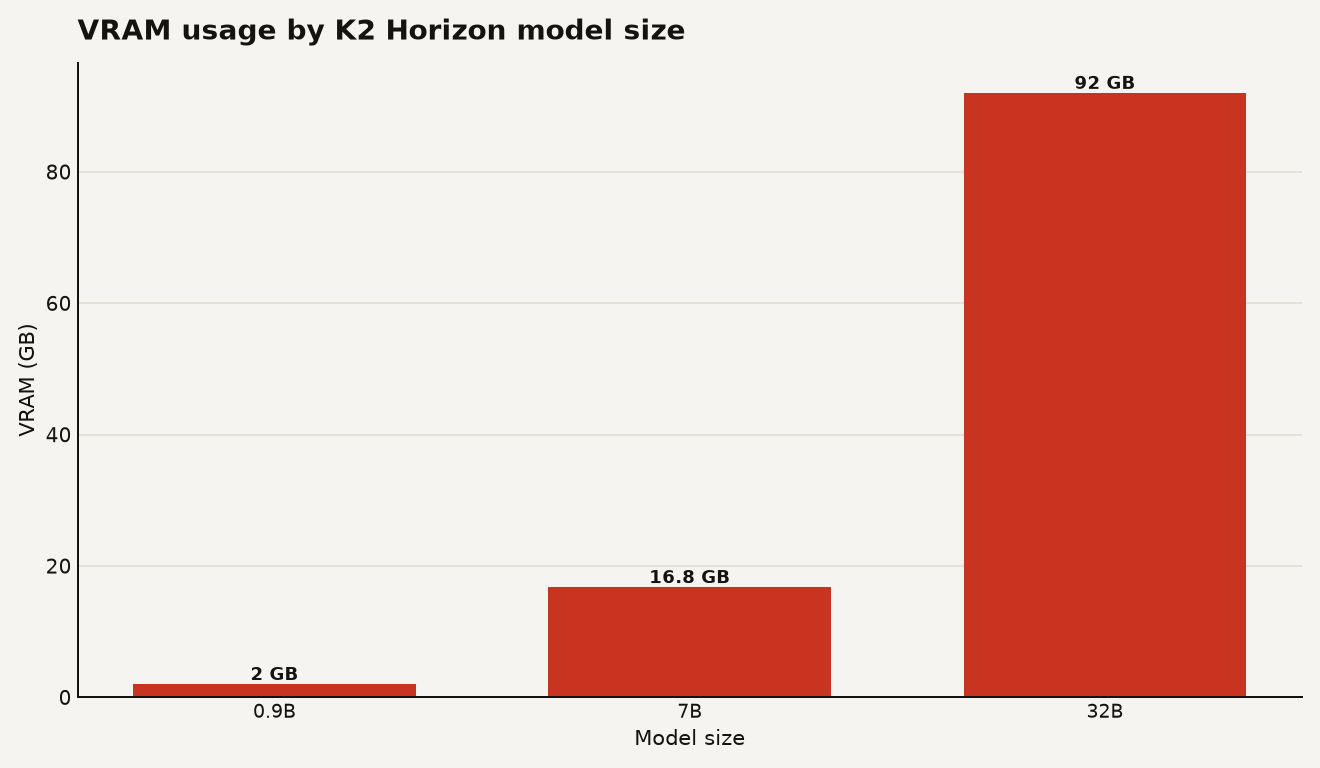
For reference, the 0.9B model needed just over 2GB, and the 32B model consumed roughly 92GB with KV cache enabled at a 65,000-token context. The 32B effectively requires an A100 or H100 class GPU, or renting cloud time. The 7B is the practical sweet spot for someone with a single consumer or prosumer GPU.
You can run K2 Horizon 7B through vLLM, a popular open-source inference server, or through llama.cpp using GGUF versions on Hugging Face. The GGUF format lets you run the model on CPU-only machines or with partial GPU offloading, though it will be slower. If you have a 24GB GPU, vLLM is the better path for speed. If you have a Mac or no discrete GPU, llama.cpp with a quantized GGUF file will work but will test your patience.
What broke when real testers tried to use it?
The benchmarks look great. The hands-on experience is more complicated. MindStudio's testing found three real problems that beginners should know about before committing to this model for any serious work.
First, a from-scratch coding task, building an HTML, CSS, and JavaScript animation of a rotating kebab in front of a vertical broiler, produced non-functional or visually broken output across all three single-GPU sizes. The 7B could not complete a self-contained front-end task that required no external references. That is a gap between the SWE-bench score and real-world coding that matters.
Second, tool calling did not work through vLLM's built-in parser for any of the three sizes tested. The model could not save files or execute tool calls as instructed, forcing the testers to write a separate Python script as a workaround. If you are building an agent that needs to call tools, this is a blocking issue.
Third, multilingual quality dropped off sharply for low-resource languages. English, Spanish, French, Russian, Polish, and Czech translated cleanly. Bengali, Swahili, Tamil, Punjabi, and Urdu produced garbled, mixed-script text with English words bleeding in. If your use case involves only English or major European languages, this may not matter. If it involves anything else, it matters a lot.
MindStudio notes that this is explicitly a stage-one checkpoint, not a final release, which explains some of the rough edges. IFM's own blog post describes a full post-training pipeline including mid-training, supervised fine-tuning, model merging, reinforcement learning, and agent training, which would normally produce more polish. The model you can download today is an intermediate product.
What should beginners actually do with it right now?
Here is the honest read based on the evidence:
- Try it for research and reasoning tasks. The BrowseComp and long-context reasoning scores are genuinely strong. If you want a local model for reading long documents or doing web research, K2 Horizon 7B is worth experimenting with.
- Do not rely on it for production coding yet. The SWE-bench score is impressive, but the hands-on coding test failed. Use it as a coding assistant with low stakes, and keep your expectations modest.
- Do not build agentic tool-calling workflows on it yet. Tool calling did not work through vLLM in independent testing. Wait for either a post-training update from IFM or a vLLM parser fix.
- Run it on a 24GB GPU if you have one. The 7B at 16.76GB of VRAM is the sweet spot. If you only have a Mac or no GPU, use the GGUF file with llama.cpp and expect slower speeds.
- Watch for the next checkpoint. IFM released intermediate checkpoints on purpose. The model will get better. The question is how fast.
If you want a broader comparison of which AI to use for different tasks this year, our 2026 AI agent guide covers the landscape and where local models fit in.
The real story for the GPU poor
A 7B model that scores like a 27B model on a composite intelligence index is a sign of where open-weights AI is heading. The gap between what fits on your graphics card and what used to require a data center is closing fast, and K2 Horizon 7B is a concrete example of that gap shrinking in September 2026. But a benchmark score is a promise, and a hands-on test is a receipt. Right now, K2 Horizon 7B has the promise but not the polish. Download it, play with it, and watch the next checkpoint. Just do not bet your production app on it this week.