Writing code that runs on a graphics card is notoriously painful. You typically need to learn CUDA, Nvidia's specialized programming system, or an equivalent from another hardware maker, and the code looks nothing like the Python most AI developers already know.
The Mojo open source release puts the full compiler and toolchain on GitHub under Apache 2.0, one week after the 1.0 milestone.
Mojo is a programming language created by Chris Lattner, the engineer behind the LLVM compiler infrastructure, the Clang compiler, and the Swift programming language. On August 18, 2026, Modular, the company behind Mojo, released the entire compiler and toolchain under the Apache 2.0 license. Anyone can now read, modify, and redistribute the core tools that build and run Mojo programs, with almost no strings attached. A compiler is the program that translates human-readable source code into instructions a processor can execute. A toolchain is the full collection of supporting programs around the compiler: the debugger, the code formatter, the package manager, and the editor integration that gives you autocomplete and error highlighting.
Mojo, Modular and the open source release
Mojo launched publicly in 2023 through Modular, a startup co-founded by Lattner. The language is designed for writing fast code that runs on diverse AI hardware: regular processors (CPUs), graphics cards (GPUs), and specialized AI accelerator chips. It uses syntax inspired by Python, so it looks familiar to the millions of developers who already write Python, but under the hood it compiles to machine code with the speed of systems languages like C and C++. Modular was acquired by Qualcomm in June 2026, the chip maker behind many phone and laptop processors. That acquisition raised a real question: would a chip company keep a programming language open, or would it pull the code behind closed doors? On August 18, 2026, Modular answered by shipping the full compiler and toolchain under Apache 2.0.
Here is what the open source release includes:
- The Mojo compiler, which translates Mojo source code into instructions for processors and graphics cards
- The full toolchain: the debugger, package manager, code formatter, and editor integration tools
- Everything licensed under Apache 2.0, one of the most permissive open source licenses in existence. You can use it in commercial products, modify it, and distribute your modifications, all without paying royalties or forcing your own code to become open source
The release caps what Modular calls a "progressive opening" of the Mojo stack. The standard library, meaning the built-in functions and data types that ship with the language, went open source in 2024. The MAX kernels, which are pre-written and optimized code for common AI operations like matrix multiplication, followed in 2025. Now the compiler and toolchain complete the picture in August 2026.
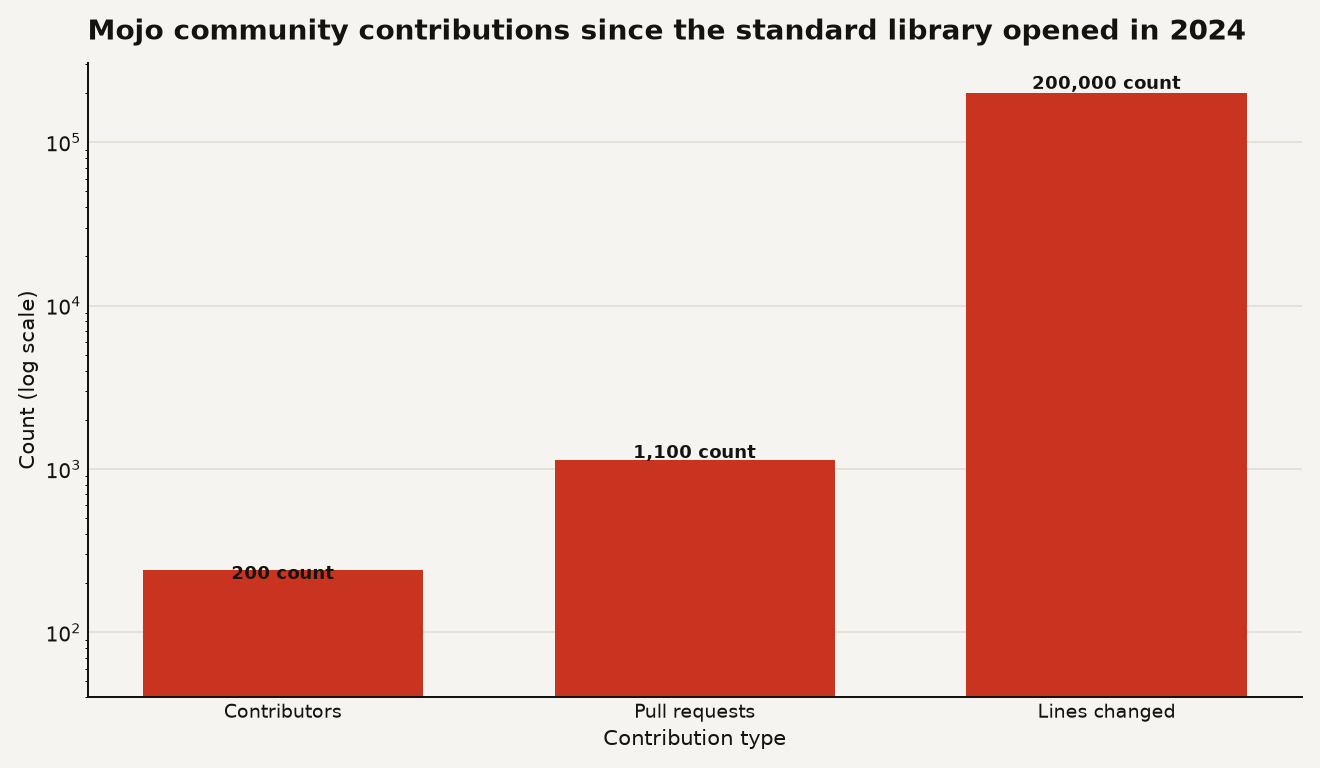
The community has already been active during that phased opening. Since the standard library first opened in 2024, nearly 200 contributors have landed more than 1,100 pull requests, changing over 200,000 lines of code, according to Modular's own 1.0 release blog post. A pull request is a proposed code change submitted by someone outside the core development team, which project maintainers review and then accept or reject. The chart below shows the scale of that community engagement.
Why open source took until now
When Mojo first launched in 2023, Modular promised open source from the start. The company kept the compiler closed for over three years anyway. The stated reason was that the language's architecture was still changing rapidly, and they wanted it to stabilize before exposing the internals to the world.
That stabilization arrived with the 1.0 release on August 11, 2026. A 1.0 version number is a significant milestone in the programming language world. It signals that the language's core design is settled: the code you write today should keep working as the language evolves, with changes being primarily additive, meaning new capabilities get added, rather than breaking, meaning existing features change how they work. Modular described this as a commitment that "the code you write today won't break out from under you."
The Qualcomm acquisition in June 2026 added urgency to the open source question. Developers worried that a chip company buying a language company might steer the language toward Qualcomm's own hardware at the expense of other platforms. The Apache 2.0 release directly addresses that fear. Even if Qualcomm decided to take Mojo in a Qualcomm-specific direction, the community could fork the code, meaning they could copy the open source codebase and maintain an independent version that supports all hardware vendors.
Mojo also brings a feature that matters for code quality: memory safety. In languages like C and C++, you as the programmer are responsible for managing memory manually, and mistakes can cause crashes or security vulnerabilities. Mojo uses automatic memory management, similar to Rust, which means the language itself catches many common memory errors before your code ever runs. The 1.0 release specifically added diagnostics for reference invalidation, which means the compiler can now detect when a piece of data you are pointing to has been moved or deleted out from under you.
The Python superset promise was dropped
When Mojo first appeared, the headline pitch was ambitious: it would be a "superset of Python." That meant any valid Python code would also be valid Mojo code, so you could take an existing Python project and run it in Mojo without rewriting anything. The appeal was obvious to AI developers, almost all of whom work in Python.
That plan changed. Around August 2025, Modular quietly updated its stance, as Simon Willison noted, saying "Mojo may or may not evolve into a full superset of Python, and it's okay if it doesn't." Today, Mojo is its own language with Python-inspired syntax. You can still import Python libraries and call them from Mojo code, which is useful for gradual migration, but you cannot expect existing Python files to run unmodified.
For a beginner, this matters because it changes the value proposition. Mojo is its own language that looks like Python and can talk to Python libraries, but you will need to learn its own rules, types, and conventions. Modular is betting that AI-assisted coding tools, the kind of copilots you may already use to write code, can smooth the migration from Python to Mojo. That is a bet on tooling maturity, not a guarantee.
Python-only workflows can ignore Mojo
If your workflow is "write Python, call an API, get results," Mojo is not something you need to learn today. Mojo targets a different layer of the software stack: the code that runs directly on hardware, not the code that talks to cloud services.
But there are three scenarios where Mojo could matter for you as a builder:
- You want to run AI models on your own hardware instead of paying for cloud API calls. Mojo, combined with MAX (Modular's inference engine, the software that actually executes AI models on hardware), is designed to make this easier across different chip types. If you are exploring local AI, our guide to Qualcomm's GenieX local LLM runtime covers a related tool in the same space.
- You need to write custom GPU code for a model or pipeline that standard frameworks do not support well. Mojo's pitch is that this is much less painful than writing raw CUDA.
- You care about hardware vendor lock-in. Mojo and MAX together support Nvidia GPUs, AMD GPUs, AWS Trainium chips, Google TPUs, and Qualcomm's Cloud AI 100 and Dragonfly accelerators. Writing your acceleration code in Mojo means you are not tied to one vendor's programming system.
The MAX platform itself is not fully open source. Modular announced that MAX is now "source-available" with an open alliance program, which means you can see the source code but the licensing terms are more restrictive than Apache 2.0. The Mojo language is the fully open part; MAX is the commercial product built on top of it. Modular Cloud, the company's hosted service for running AI models, is also now publicly available, with MiniMax named as a flagship customer.
A practical read for beginners
Here is the practical read.
If you are just starting out with AI development, stick with Python. The ecosystem is larger, the tutorials are everywhere, and your existing skills transfer directly to almost every AI framework and service. Mojo is not going to replace Python for prototyping, experimentation, or most application-level code in the near term.
If you are curious about performance or hardware programming, Mojo is now worth a weekend exploration. You can install it from mojolang.org and try the tutorials. The 1.0 release includes "Mojo AI Skills" for common tasks like creating new projects, writing GPU code, and porting code from other languages, which are designed as beginner-friendly entry points. The language server, the tool that gives you code completion and error highlighting in editors like VS Code, is reportedly much more stable in 1.0 than in previous versions. Modular also announced that native Windows support is coming, thanks to a collaboration with the Microsoft Windows team, which means the language will soon be accessible to developers who do not use macOS or Linux.
If you are building production AI infrastructure and currently depend on a single vendor's tooling, Mojo plus MAX is worth evaluating as a hedge. The open source license means you can prototype without a commercial relationship, and the cross-hardware support means you are not betting on one chip maker.
What you should not do is assume that the open source release means the ecosystem is mature. A 1.0 label means the core language is stable, but the library ecosystem, tutorial coverage, and community knowledge are still years behind Python's. The community contribution numbers are healthy for a three-year-old language, but they are a fraction of what a mature ecosystem looks like. Treat Mojo as a promising tool with real upside, not a solved problem.
The open question
Modular, now owned by a chip company, just gave away the core of its language to the world. That is either a sign of confidence that an open ecosystem will grow faster than a proprietary one, or a calculated bet that the value has already moved up the stack to MAX and Modular Cloud. Either way, the code is on GitHub under Apache 2.0, and that is exactly where a language that wants to be the standard for AI hardware programming needs to be. Whether developers show up to build on it is the part nobody can engineer.