Google shipped its third Gemini Flash model in six weeks on September 2, 2026, and this one comes in two flavors. Gemini 3.8 Flash is the main model, aimed at people building software and running AI agents. Gemini 3.8 Flash Cyber is a security-focused variant designed to find and fix vulnerabilities in code. The standard Flash model costs the same as the previous version during an introductory window: $0.75 per million input tokens and $3.75 per million output tokens, doubling on January 1, 2027.
If you are a beginner who just started playing with AI tools, the headline is that Gemini 3.8 Flash is free to try in Google AI Studio and available to paid Google AI Pro and Ultra subscribers in the Gemini app.
Google's pitch is simple: 3.8 Flash thinks harder than 3.7 Flash, trading extra compute for better answers on complex tasks. For anyone who read our Gemini 3.7 Flash explainer for beginners, this is the follow-up you probably expected. The twist is the Cyber variant, which Google is gating behind a new program called Fairwind, available only to vetted security teams and government agencies.
Two models from one foundation
Two models, one foundation. Both share the same underlying training, but they serve different jobs.
Gemini 3.8 Flash is the general-purpose model. It handles text, images, audio, and video, with a context window (the amount of text and media the model can process in one request) of up to 1 million tokens. A token is roughly three-quarters of a word, so 1 million tokens is about 750,000 words, or a thick novel's worth of material. Google positions it as their "most intelligent workhorse model," meaning it sits between the ultra-fast budget models and the expensive flagship models in the Gemini lineup.
Gemini 3.8 Flash Cyber is the specialized security model. It shares the same brain but is tuned for finding bugs and writing patches. Google is only giving it to "trusted defenders" through the Fairwind Program, which means vetted government authorities, critical infrastructure operators, and software maintainers. You cannot just open a web page and start chatting with it.
The general model is available in several places:
- Google AI Studio: free, browser-based, for developers and tinkerers who want to call the model directly.
- Gemini app: for Google AI Pro and Ultra subscribers on phones and desktop.
- Gemini Enterprise: for businesses using Google Cloud.
- Google AI Mode in Search and Gemini in Google Sheets: for everyday tasks inside Google products.
Google also showed off demos in Google Antigravity, a creative coding environment where the model built a 3D game, a retro DOS-style version of Google Maps, and an interactive topographic map, all from single prompts. These are showpieces, not products. But they demonstrate the model's ability to hold a complex task in working memory and iterate on it across many steps.
3.8 Flash works harder than 3.7
Google's own framing is that 3.8 Flash "works harder." That is a specific design choice, not marketing. On complex tasks, the model runs more reasoning steps and calls tools (external functions it can trigger, like running code or searching the web) more often. The trade-off is that it sometimes burns more tokens to get a better answer.
Here is where the numbers land. On HLE-Verified, a benchmark that tests multi-step reasoning across STEM, humanities, and professional fields, 3.8 Flash scores 54.9 percent. Google says it outperforms 3.7 Flash and other frontier models on the Vals Finance Agent V2 benchmark (finance analysis) and Harvey's Legal Agent Benchmark (legal research tasks). Google did not publish the exact scores for those two in the announcement.
For software engineering, Google cites the DeepSWE v1.1 benchmark, which tests whether a model can autonomously solve complex engineering problems end to end. Google says 3.8 Flash "outperforms most larger frontier models" on this benchmark, again without publishing the exact number in the announcement.
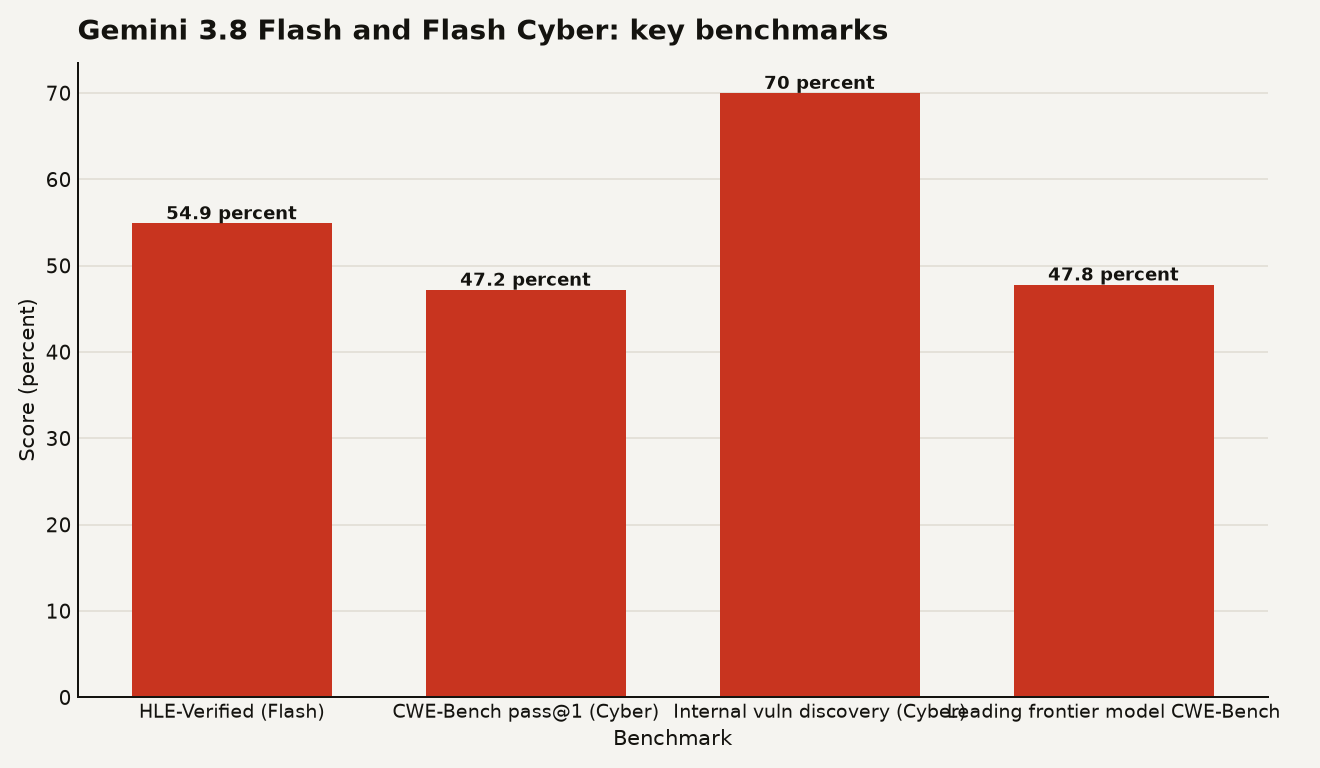
The chart above shows the benchmark numbers Google did publish. The HLE-Verified score of 54.9 percent, the CWE-Bench patching score of 47.2 percent, and the internal vulnerability discovery rate above 70 percent are the three headline figures.
For beginners, the main point is that 3.8 Flash is measurably better at tasks that require multiple steps of reasoning, like debugging a script, analyzing a dataset, or researching a topic across several sources. But it is not free of the limitations that affect all foundation models. Google's own model card notes that 3.8 Flash "may exhibit some of the general limitations of foundation models, such as hallucinations," meaning it can still confidently state things that are wrong.
The Cyber variant has real results
This is the more interesting release for anyone who works in software security, and it has real-world results attached.
On CyberGym, the standard industry benchmark for autonomous vulnerability discovery, Google says 3.8 Flash Cyber surpasses both its previous 3.5 Flash Cyber model and significantly larger frontier models. Google also ran an internal benchmark across 20 programming languages (not just C and C++, which CyberGym focuses on), and the model achieved a success rate exceeding 70 percent at finding vulnerabilities.
For patching, Google points to CWE-Bench, an external benchmark run by a company called Collinear. Here 3.8 Flash Cyber scored 47.2 percent on pass@1 (meaning the model's first attempt at a fix was correct 47.2 percent of the time). A leading frontier model scored 47.8 percent. The difference is negligible on accuracy, but Google emphasizes that 3.8 Flash Cyber is offered at a significantly lower cost.
The real-world claims are stronger:
- Google's Chrome Security team found that 3.8 Flash Cyber produced 2.6 times more correct patches to Chrome vulnerabilities than the best commercial models that are much larger.
- Security company Wiz found the model achieved 7.5 to 9.7 percent higher recall (it found more real vulnerabilities) at 2.3 to 5.2 times lower cost compared to other leading frontier models on their internal penetration testing benchmark.
- Google's Cloud Vulnerability Research team used the model to find a critical foundational vulnerability in less than 2 hours, something that usually takes months of research.
These are Google's own claims and Google's own customers reporting. Treat them as directionally interesting, not independently verified. But if you work in security, the pattern is worth noting: a smaller, cheaper model that is specifically trained on cybersecurity tasks is keeping pace with or beating larger general models on real work.
Prices change on January 1
This is the part beginners should pay close attention to. The $0.75 per million input tokens and $3.75 per million output tokens is an introductory price that expires on December 31, 2026.
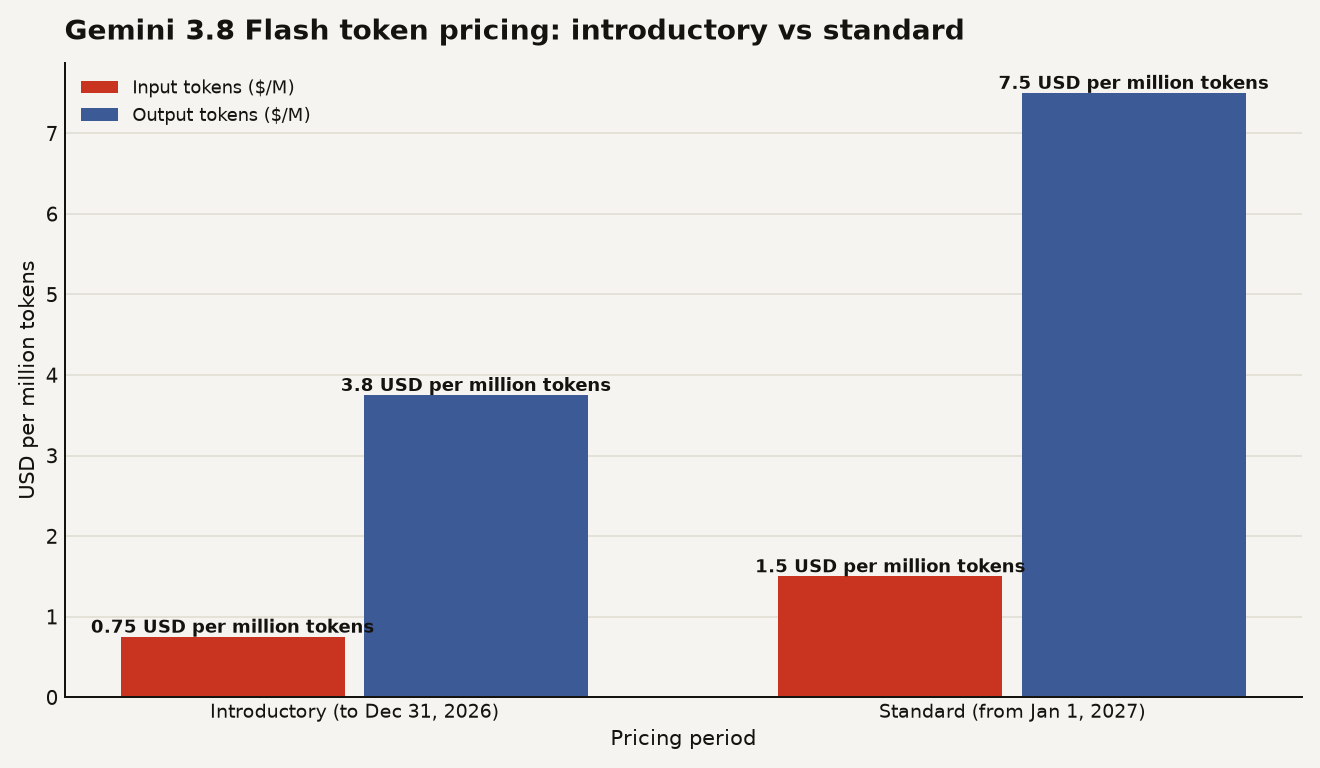
The chart above shows the difference. Starting January 1, 2027, the price doubles to $1.50 per million input tokens and $7.50 per million output tokens. If you are building an app or running automated workflows that call the API thousands of times, this matters a lot. A workflow that costs $100 per month at the introductory price will cost $200 per month at standard pricing, assuming the same usage.
There is also the token consumption issue. Because 3.8 Flash "works harder," it uses more tokens on complex tasks, especially at higher effort levels. Google gives developers effort control through "thinking levels" so you can dial this down. At the medium thinking level, you can still solve complex tasks while keeping token usage more modest. If your priority is cost and speed above all, Google says 3.7 Flash remains fully supported and is the better choice for efficiency-first workloads.
For free users in AI Studio, the pricing does not directly matter. But if you are thinking about building something real, plan your budget around the standard price, not the introductory one.
Switching depends on where you already are
For most beginners, the answer depends on where you already are.
If you are already in the Google ecosystem (using the Gemini app, Google AI Studio, or Google Cloud), 3.8 Flash is a clear upgrade from 3.7 Flash at the same introductory cost. You get better reasoning and coding for free during the introductory window. There is no reason not to try it.
If you are using a different provider like OpenAI or Anthropic, the decision is less obvious. The benchmark numbers Google publishes are Google's own measurements on Google-selected benchmarks. They are useful for comparison, but they are not the same as an independent third-party evaluation. The best approach is to test 3.8 Flash on your own tasks, the prompts you actually use, and compare the results and cost yourself. Our guide to which AI to use for tasks in 2026 walks through how to think about this kind of comparison.
A few practical notes:
- For coding: Google's DeepSWE results and the Antigravity demos suggest the model is strong at multi-file coding tasks. If you use AI to help write or debug code, try it on a real project, not just a toy prompt.
- For agents: If you are building automated workflows (where the AI calls tools, reads results, and decides the next step), 3.8 Flash is designed for exactly this. The improved prompt injection robustness, measured by Gray Swan, matters here because agents that read web pages or user input are vulnerable to malicious instructions hidden in that input.
- For cost-sensitive projects: Use the thinking level control. Start at medium, check whether the results are good enough, and only bump up to high for tasks where the extra accuracy is worth the extra tokens.
Fairwind gates access to the Cyber model
Probably not, unless you work in security. The Fairwind Program is Google's gated access channel for 3.8 Flash Cyber. It is aimed at government authorities, critical infrastructure operators, and software maintainers. You need to apply, and Google vets who gets in.
The reason for the gate is that 3.8 Flash Cyber ships with fewer safety guardrails around cybersecurity tasks. It can find and exploit vulnerabilities, which is useful for defenders but dangerous in the wrong hands. Google's Frontier Safety Framework governs what the model can and cannot do, and the Cyber variant is explicitly more permissive on cyber tasks than the standard model.
If you are a solo developer curious about AI-powered security scanning, the standard 3.8 Flash model is what you can actually use. It will not match the Cyber variant on vulnerability discovery, but it is available right now in AI Studio.
A solid upgrade inside Google's ecosystem
Gemini 3.8 Flash is a solid, free-to-try upgrade if you are already in Google's world. It thinks harder, costs the same during the introductory window, and handles multi-step tasks better than 3.7 Flash. The Cyber variant is fascinating but locked away. The real risk for anyone building on the API is the price doubling on January 1, 2027. Plan for that now, not in December.