If you run an on-premises N-able N-central server, you have a CVSS 10.0 problem this weekend. A pre-authentication remote code execution flaw in the RMM platform gives attackers a direct path to every machine you manage, and the patch window is already closing.
A maximum-severity pre-auth N-central RCE means any exposed on-prem server is one HTTP request away from full compromise.
N-able released N-central 2026.3 Hotfix 4 on September 6, 2026, to fix CVE-2026-86218, a pre-authentication remote code execution vulnerability rated CVSS 10.0 Critical under the CVSS 4.0 scoring system. The flaw, classified as CWE-96 (improper neutralization of directives in statically saved code), affects all N-central versions before build 2026.3.1.14. Hosted N-central customers are already patched. Everyone running on-premises needs to move now, because the Shadowserver Foundation tracks nearly 1,500 N-central servers exposed to the public internet, most in the United States and Europe.
CVE-2026-86218, a pre-auth RCE
The vulnerability is a pre-authentication remote code execution bug. Pre-auth means the attacker needs no credentials. No username, no password, no API key. The request hits the N-central server and the server runs the attacker's code. N-able's own status page describes it plainly: a critical-CVSS-rated vulnerability that could allow for pre-authenticated remote code execution on the N-central server.
The CVSS 4.0 vector string is AV:N/AC:L/AT:N/PR:N/UI:N/VC:H/VI:H/VA:H/SC:H/SI:H/SA:H. Every element in that string is worst-case. Network exploitable, low attack complexity, no user interaction, no privileges required, and high impact across every confidentiality, integrity, and availability dimension for both the vulnerable system and downstream systems. The Vulnerability-Lookup database confirms the 10.0 score and the CWE-96 classification.
Static code injection means the server takes some input and writes it into a context where it gets executed as code rather than treated as data. This is the same family of flaw that has broken template engines, server-side includes, and configuration parsers for years. N-able has not published full technical root-cause details, and given the active exploitation concerns, they may not for a while.
Two additional high-severity vulnerabilities, CVE-2026-86206 and CVE-2026-86207, were also patched over the same weekend. These allow authentication bypass, giving attackers full access to the N-central platform even if they cannot exploit the RCE directly. The combination is brutal: one flaw gives you code execution without credentials, the other two give you full platform access if you have any foothold at all.
| CVE | Severity | Type |
|---|---|---|
| CVE-2026-86218 | CVSS 10.0 Critical | Pre-auth RCE (CWE-96) |
| CVE-2026-86206 | High | Authentication bypass |
| CVE-2026-86207 | High | Authentication bypass |
N-able and Huntress disagree on exploitation
N-able says no confirmed production exploitation. Huntress says maybe, and their evidence is hard to ignore.
The cybersecurity company has been tracking active attacks against N-central servers and flagged CVE-2026-86218 as a potential zero-day. Their investigation began after a compromised N-central server was found in one of their customers' environments. The problem is that the logs on that server had already rotated by the time Huntress arrived, so they cannot definitively tie the compromise to this specific CVE versus the two auth-bypass flaws patched earlier.
What Huntress did observe is consistent with a deliberate, strategic attacker. The threat actors conducted high-level reconnaissance targeting Domain Controllers specifically, requested process lists from compromised systems before disconnecting, and moved quickly across multiple hosts after gaining initial access. They used the default "MSP Support" username tied to legitimate N-central Take Control sessions to blend in, then abused the built-in Take Control feature to pivot into managed endpoints and deployed Cloudflare-based tunnels for persistence using a service named "Cloudflared".
The attack chain is textbook RMM abuse. Get into the management console, use its own remote access tools to reach downstream machines, and the traffic looks legitimate because it is legitimate RMM traffic. The only difference is who is driving.
Huntress also noted that by the time of their latest update, 28.6% of reachable self-hosted N-central servers were still unpatched, down from 55.6% in their earlier check of cloud servers. Cloud-hosted servers were almost fully patched because N-able applied the fix automatically. The laggards are the self-hosted deployments, which is exactly where the exposure risk is highest.
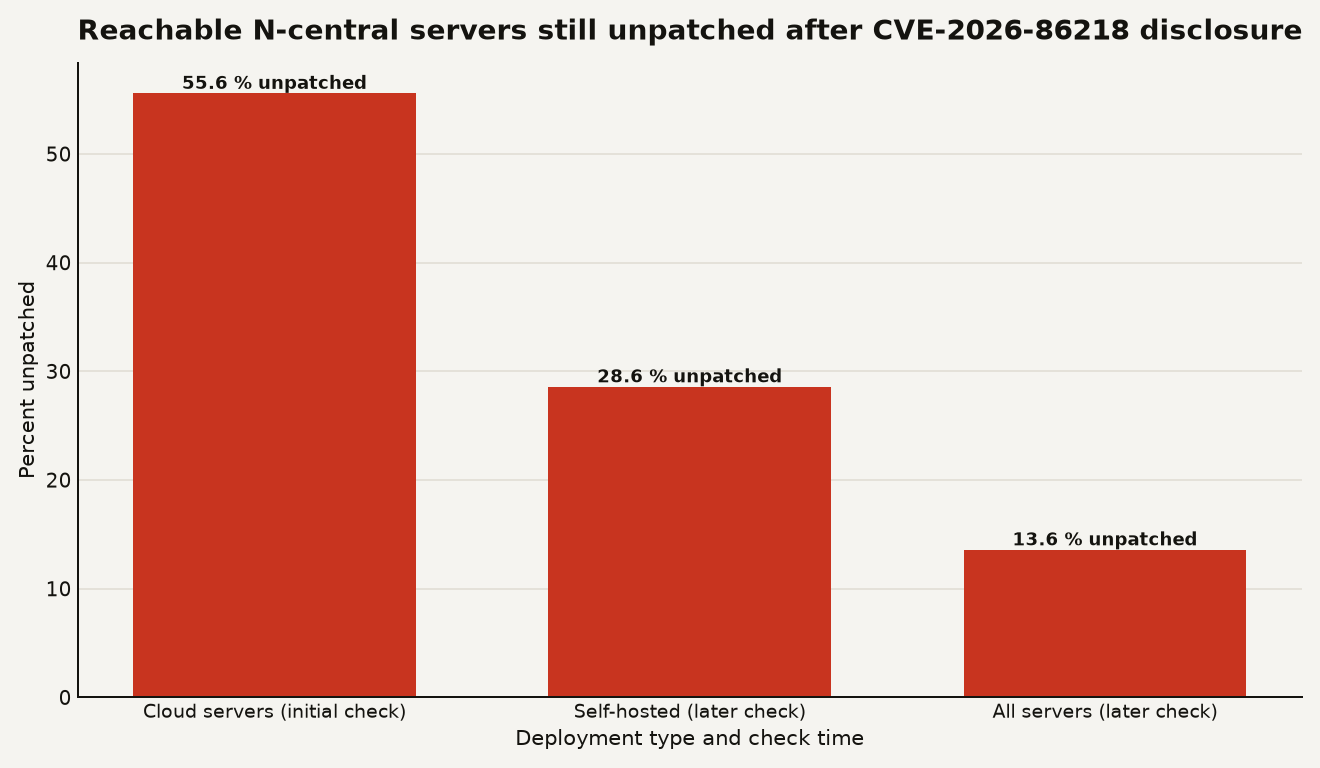
The chart above shows the patching gap. The initial check found 55.6% of cloud servers unpatched. By the later check, the overall unpatched rate dropped to 13.6%, but self-hosted servers remained at 28.6%. Every percentage point there is a server an attacker could reach.
A compromised RMM reaches every client
Remote monitoring and management platforms are the nervous system of IT operations. MSPs and internal IT teams use N-central to monitor thousands of endpoints, push patches, run scripts, and take remote control of machines. When you compromise an RMM, you compromise every device it manages.
This is why the attacker behavior Huntress described is so concerning. They were not interested in the N-central server itself. They used it as a launchpad to reach Domain Controllers. If an attacker gets Domain Admin through a compromised RMM, they own the entire customer environment. Every endpoint, every server, every account.
The blast radius scales with the RMM's footprint. A single MSP running N-central might manage dozens of clients, each with hundreds or thousands of endpoints. One pre-auth RCE on the management server becomes a supply chain attack delivered through the tool meant to prevent one. This is the same class of risk we saw with the SimpleHelp RMM vulnerability that needed its own patch drill, and it is why RMM compromises rank among the most damaging incidents in the MSP space.
The historical pattern reinforces the urgency. One year ago, N-able patched CVE-2025-8875 and CVE-2025-8876, which were being exploited in the wild. CISA ordered federal agencies to patch within a week. Days later, Shadowserver found 880 N-central servers still vulnerable despite the CISA directive. If the same lag plays out this time, those 1,500 exposed servers will be under sustained attack for weeks.
The Blue Report 2026 data adds another layer. Across 338 million simulations in production environments, once attackers obtain valid credentials, only 37% of their actions are blocked. When an RMM compromise gives attackers legitimate credentials and legitimate RMM tooling, most defensive controls will not fire because the activity looks like normal administrator work.
Upgrade to build 2026.3.1.14
The immediate action is simple: upgrade to build 2026.3.1.14 (Hotfix 4). N-able lists supported upgrade paths from 2025.4, 2026.1, 2026.2, and all 2026.3 hotfix builds. If you are on an older version, jump to any of those first, then upgrade to HF4.
If you are on a hosted N-central instance, no action is needed. N-able has already applied the patch.
Beyond the hotfix itself, here is the hardening checklist:
- Restrict console access: The N-central web console should not be reachable from the public internet. Put it behind a VPN, restrict with firewall IP rules, and front it with SSO if available. If Shadowserver can see your server, attackers can too.
- Enforce MFA on all N-central accounts: Authentication bypass flaws like CVE-2026-86206 and 86207 mean password-only logins are not enough. MFA on every account, including service accounts where supported.
- Limit inbound access to known IP ranges: Office networks, admin VPNs, and nothing else.
- Review Take Control session logs: Look for sessions initiated from the "MSP Support" username or from IP addresses outside your expected ranges. N-able listed 173.249.252[.]200 as an indicator of compromise.
- Hunt for persistence: Check users' Documents folders for a file named
svchost.exe, a classic masquerading filename that does not belong in a user profile. Look for registered Windows services namedCloudflared, which indicates the attacker deployed a Cloudflare tunnel for persistent outbound access. - Check your agent versions: The hotfix does not require agent upgrades to protect against CVE-2026-86218, but N-able recommends updating agents as a best practice.
If you cannot patch immediately and your N-central server is internet-facing, consider whether taking it offline is the right risk decision. A compromised RMM is a force multiplier against every downstream client. Losing central visibility and patching capability hurts, but it hurts less than an attacker using your management platform to reach your customers' Domain Controllers.
The patch gap is the vulnerability
RMM vendors ship critical patches. Cloud-hosted instances get fixed automatically. Self-hosted deployments lag. Attackers scan for the laggards and compromise them through the exact flaws that were already patched. The gap between "patch available" and "patch applied" is where every RMM incident lives. N-able did the right thing by shipping Hotfix 4 on a Saturday. The question is whether you do the right thing by Monday, because the 880 servers that stayed unpatched after last year's CISA deadline are proof that the patch gap is wider than anyone wants to admit.
Sources
- BleepingComputer - N-able patches max severity N-central flaw amid ongoing attacks
- N-able Status - N-central 2026.3 Hotfix 4, CVE-2026-86218 security update
- Huntress - Critical N-able N-central Vulnerability and Active Exploitation
- Vulnerability-Lookup - CVE-2026-86218 vulnerability record