Remote support tools are supposed to shorten the distance between an operator and a broken machine. SimpleHelp CVE-2026-48558 turns that convenience into the shortest path between an unauthenticated attacker and a technician session.
The urgent number is 10.0. CVE-2026-48558 carries a CVSS 3.1 score of 10.0, and the vulnerable condition affects SimpleHelp versions 5.5.15 and earlier plus 6.0 pre-release versions when OpenID Connect authentication is configured.
The story moved from patch advisory to incident queue because Blackpoint Cyber says an intrusion began with confirmed exploitation of CVE-2026-48558, then moved into two previously undocumented malware families: TaskWeaver and Djinn Stealer. That changes the operator response. You are no longer just checking a version string. You are deciding whether a trusted remote management plane handed out access and whether that access was used to steal the credentials that keep your build systems, cloud accounts, and customer environments stitched together.
Remote monitoring and management software has become a recurring blast-radius problem because it centralizes power by design. If you run SimpleHelp for internal IT, patch as if production depends on it. If you are an MSP, treat this as a possible customer-to-customer pivot story until your logs prove otherwise. We have seen the same pattern around exposed management planes in our guide to CISA KEV edge gear: the asset that makes operations easier also becomes the asset attackers automate against first.
The SimpleHelp OIDC login flaw
The bug is in SimpleHelp's OpenID Connect login flow. The NVD entry says vulnerable deployments accept identity tokens during login without verifying their cryptographic signature, which lets a remote unauthenticated attacker submit a forged token and obtain a technician session.
That sentence should make every operator sit up because OIDC is supposed to move identity risk toward the identity provider. Here the vulnerable application accepted the shape of identity without proving the signature behind it. In practical terms, the application could trust a claim that the identity provider never actually vouched for.
Horizon3.ai, which disclosed the issue to SimpleHelp, narrowed the vulnerable configuration to servers using generic OIDC or Azure AD OIDC with at least one provider configured, at least one TechnicianGroup associated with that provider, and group-authenticated logins enabled on that TechnicianGroup. Horizon3.ai also says successful exploitation can create a new Technician account, bypass technician MFA enrollment by letting the attacker register a device at first login, access managed endpoints, and execute privileged technician actions.
That last part is the operator impact. A technician account in an RMM system is a remote hands account. It can touch endpoints, run scripts, transfer files, and make attacker activity look like administration from a system your estate already trusts.
The exposed population is big enough to justify emergency discovery. Horizon3.ai reported about 14,000 SimpleHelp servers exposed to the internet at disclosure time, and its sample suggested roughly 7.2 percent used the vulnerable OIDC authentication method. That works out to about 1,008 potentially OIDC-configured exposed servers if the sample rate holds across the exposed population.
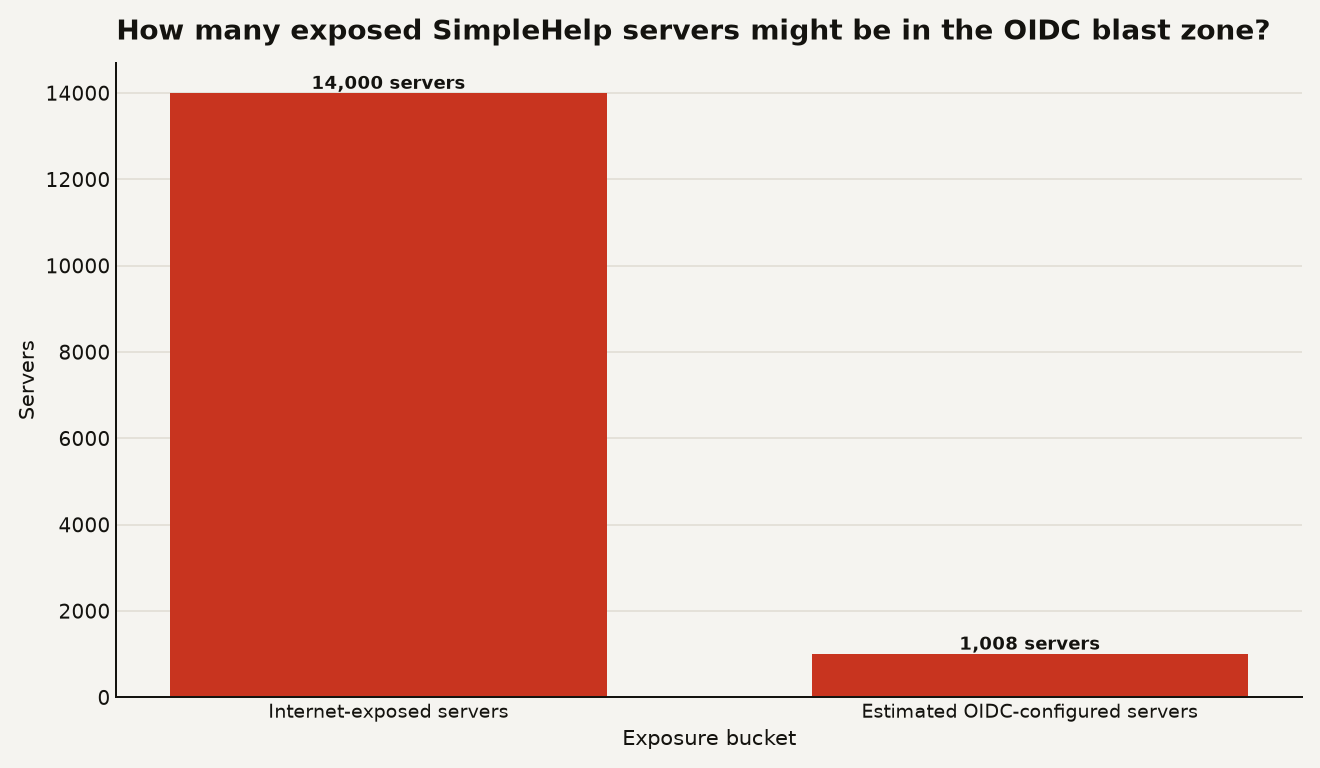
The chart above is the whole reason this should be a same-day change window, not a quarterly patch ticket. Even if the 7.2 percent sample rate is imperfect, the shape is bad: thousands of public RMM servers, roughly a thousand plausible OIDC targets, and a confirmed malware chain now attached to the CVE.
SimpleHelp released version 5.5.16 on May 26, 2026, and its release notes say that build closes a critical vulnerability and is recommended for all SimpleHelp users. Horizon3.ai says the patched versions are SimpleHelp 5.5.16 and SimpleHelp 6.0 RC2, which gives operators a clean version target rather than a mitigation scavenger hunt.
CISA then added the flaw to its Known Exploited Vulnerabilities catalog. The NVD page mirrors the KEV entry and lists CVE-2026-48558 with a June 29, 2026 addition date and July 2, 2026 due date for required action under federal guidance.
The bypass lands in privileged software
The exploitation path leads into software that already has permission to manage machines. That means your response has to include endpoint, identity, and secrets handling, not just the SimpleHelp server.
Blackpoint Cyber's Adversary Pursuit Group says the actor used the SimpleHelp access to deploy TaskWeaver as jquery.js through node.exe, and the company describes TaskWeaver as a heavily obfuscated Node.js loader with an encrypted reusable payload delivery channel. That is a smart attacker choice. Node.js blends into many developer and admin environments, and a file named jquery.js abuses the muscle memory of people who have seen that filename for 20 years.
TaskWeaver is small in command surface but large in consequence. Blackpoint reports that the only command identified in the loader was deliver, while delivered JavaScript ran with full Node.js access to capabilities such as require, process, Buffer, and timers. For defenders, that means command count is a weak comfort metric. One generic execution primitive can still fetch a stealer today, a backdoor tomorrow, or an internal scanner after lunch.
Djinn Stealer is the payload that should scare product and platform teams. Blackpoint says Djinn Stealer targets Windows, macOS, and Linux and collects credentials tied to cloud platforms, source control, package registries, infrastructure tooling, AI development assistants, browsers, SSH, and cryptocurrency wallets.
The AI credential angle deserves special attention because many teams are still treating coding assistants like a productivity surface rather than an identity surface. Blackpoint says Djinn looks for data associated with Claude, Gemini, Codex, Cline, OpenCode, and Kilo, which means attacker interest has caught up with how builders actually work. If an assistant token can read repos, call internal tools, reach issue trackers, or hold shell session context, it belongs in the same incident plan as GitHub tokens and cloud keys.
For your business, the second-order risk is larger than the compromised endpoint. A stolen package registry token can poison a release. A stolen Terraform or cloud credential can modify infrastructure. A stolen AI assistant session can expose the working memory of your engineering org. RMM gets the attacker in. Portable credentials let the attacker stay useful after you wipe the first machine.
Scope, cut exposure, then hunt
Start with scope, then cut exposure, then hunt. Speed matters, but random motion creates blind spots.
First, identify every SimpleHelp server, including customer-dedicated instances, lab instances, old DR nodes, and externally reachable admin portals. The NVD configuration data lists SimpleHelp versions up to but excluding 5.5.16 and 6.0 pre-release versions as affected, so 5.5.16 or 6.0 RC2 should be your minimum target.
Second, remove internet exposure while you patch. Horizon3.ai recommends that if immediate patching cannot be performed, teams should restrict technician authentication to approved source IP addresses through Administration, then Login Security. A VPN or identity-aware proxy is not a full fix for a broken auth flow, but it can shrink the set of people who can reach the broken door.
Third, check whether you use OIDC for SimpleHelp technicians. The vulnerable path depends on OIDC and specific group-authenticated login settings, so your inventory needs configuration evidence, not a Slack poll. If you use Azure AD OIDC or generic OIDC, assume you are in scope until a patched build and reviewed configuration say otherwise.
Fourth, hunt for rogue technician accounts. Horizon3.ai tells administrators to review group-authenticated technician accounts under Administration, Technicians, then Show Group Authenticated Users, and to investigate unfamiliar names or email addresses.
Fifth, search SimpleHelp server logs. Horizon3.ai lists /opt/SimpleHelp/logs/server.log and historical /opt/SimpleHelp/logs/<YYYYMMDD-HHMMSS>/server.log as relevant locations, and it gives example strings such as Registering technician login for ... and Configuration save requested ... [New Anon] as evidence of technician creation.
Sixth, hunt for the malware chain across endpoints touched by the RMM server. Blackpoint lists TaskWeaver's file indicator as jquery.js with SHA-256 00cc86d1144020c24c8fbb3a8dc6b908926497ebd23be3bf854360f93d1c8f4c, and it lists Djinn Stealer's decoded payload hash as f4a72600a3735c2a4d843875ea61bbb6f935a1af51a81f2fbc992ce11ba94afc.
Your 24-hour checklist should be blunt:
- Patch every SimpleHelp server to 5.5.16 or 6.0 RC2.
- Disable or restrict technician OIDC access until configuration is reviewed.
- Put the SimpleHelp admin surface behind source restrictions.
- Remove unknown technician accounts and terminate active technician sessions.
- Search for
node.exe <path>\jquery.js,jquery.js, and a payload namedupload. - Block or investigate the network indicators Blackpoint published, including
*.trycloudflare[.]com,a[.]dev-tunnels[.]com, and96[.]126[.]130[.]126:58942. - Rotate secrets reachable from compromised admin and developer endpoints.
The rotation step is where teams will be tempted to go soft. Resist it. If Djinn ran on a developer workstation, rotate GitHub, package registry, cloud, SSH, deployment, vault, and AI assistant credentials associated with that user and machine. If Djinn ran on an MSP technician box, widen the rotation and customer notification plan.
RMM is tier-zero infrastructure
Treat RMM as tier-zero infrastructure. That means your SimpleHelp server deserves the same operating model as your identity provider, CI/CD control plane, and production cloud root accounts.
The useful control set is boring, which is good. Boring controls are the ones you can run every week:
- No direct public admin interface unless there is a documented exception with an owner and expiry date.
- Source IP restrictions for technician login, even when OIDC is healthy.
- Phishing-resistant MFA for technicians, with enrollment paths monitored like privileged access changes.
- Separate admin workstations for RMM use, with browser profiles and tokens isolated from daily developer work.
- Script execution logging from the RMM plane into the SIEM, with alerts on Node.js staging, PowerShell download cradles, curl to tunnel domains, and unusual file transfer volume.
- Short-lived credentials for cloud and deployment systems, especially on machines that remote support tools can control.
Also add an identity review to every RMM patch event. A clean version number does not remove a technician account created yesterday. The account review is the cheapest part of this response, and skipping it is how a patched server stays owned.
For AI tooling, stop pretending local assistant state is harmless. If your coding assistant can read private repositories, call internal tools, open cloud consoles, or store long-lived sessions, its credentials need inventory, revocation, and endpoint detection coverage. This incident ties RMM exploitation to stealer rules for AI development tools, which is exactly where modern build rooms are softest.
Run remote support like a bank vault
You can trust remote support systems only when you operate them like blast-radius machines. SimpleHelp CVE-2026-48558 is a clean reminder that convenience is a privilege amplifier. Patch the bug, yes. Then prove the remote support plane cannot quietly become your attacker’s release engineer.