Alibaba's Qwen team uploaded Qwen3.8-2.4T-A95B to Hugging Face on August 12, 2026. It has 2.4 trillion total parameters, making it the largest open-weight model anyone has shipped to date. Reddit's r/LocalLLaMA put the release on the front page within hours. Only about 95 billion parameters activate per token, which is the key to understanding why this model matters. The Qwen3.8 open weights give you a model that approaches the capability of closed, proprietary systems, with one catch: you probably cannot run it on your own hardware.
Let us define the key terms. "Open weights" means the model's trained parameters are freely downloadable, so you can inspect, modify, and serve the model yourself rather than calling a company's API. "Mixture of experts," or MoE, is a design where the model contains many sub-networks called experts, and for each piece of text it processes, it only activates a small subset. Think of it as a hospital with 512 specialists: for any one patient, only about 11 doctors are actually consulted. This lets the model be very large in total capacity while keeping the compute cost of generating each token relatively low. "Parameters" are the learned numbers inside the model that determine its behavior. More parameters generally mean more knowledge and reasoning ability.
Qwen3.8-2.4T-A95B, decoded
The name tells you most of what you need to know. "Qwen3.8" is the model family version. "2.4T" means 2.4 trillion total parameters. "A95B" means about 95 billion parameters are active per token. The model uses 512 experts total, with 10 routed experts and 1 shared expert firing per token, according to MindStudio's hardware analysis.
The architecture sets it apart from previous open models. Qwen3.8-2.4T-A95B uses a hybrid attention design across 92 layers. Most layers use a mechanism called linear attention (specifically Gated DeltaNet), which is cheaper to compute. Every fourth layer uses full attention, which is more expensive but better at tracking long-range dependencies in text. This split is how the model keeps inference cost down while maintaining quality over long conversations.
The excitement comes from the capability level. This is a "Max-tier" model, meaning it sits at the top of Alibaba's Qwen lineup, the class of model previously available only through their hosted API. Now the weights are downloadable. Top AI Product reports that it scores 92.6 on GPQA Diamond (a graduate-level science reasoning benchmark) and 67.7 on SWE-bench Pro (a software engineering benchmark). The best closed model on SWE-bench Pro scores 80.0. Qwen3.8 is behind on that metric, but it is the strongest model you can self-host.
One important detail: the weights ship under a custom "qwen3.8-max" license, not Apache 2.0. They are open for download and use, but the license terms are more restrictive than fully open source. Read the terms before building a product on top of it.
vLLM's FP8 and NVFP4 benchmark results
The vLLM blog published benchmark results comparing two quantized versions of the model: FP8 and NVFP4. "FP8" means each parameter is stored using 8 bits. "NVFP4" uses 4 bits with a specific format developed by NVIDIA. Lower bit precision means less memory and faster inference, usually at some cost to quality. But here, the 4-bit version matches or slightly exceeds the 8-bit version on both benchmarks tested, as shown in the chart below.
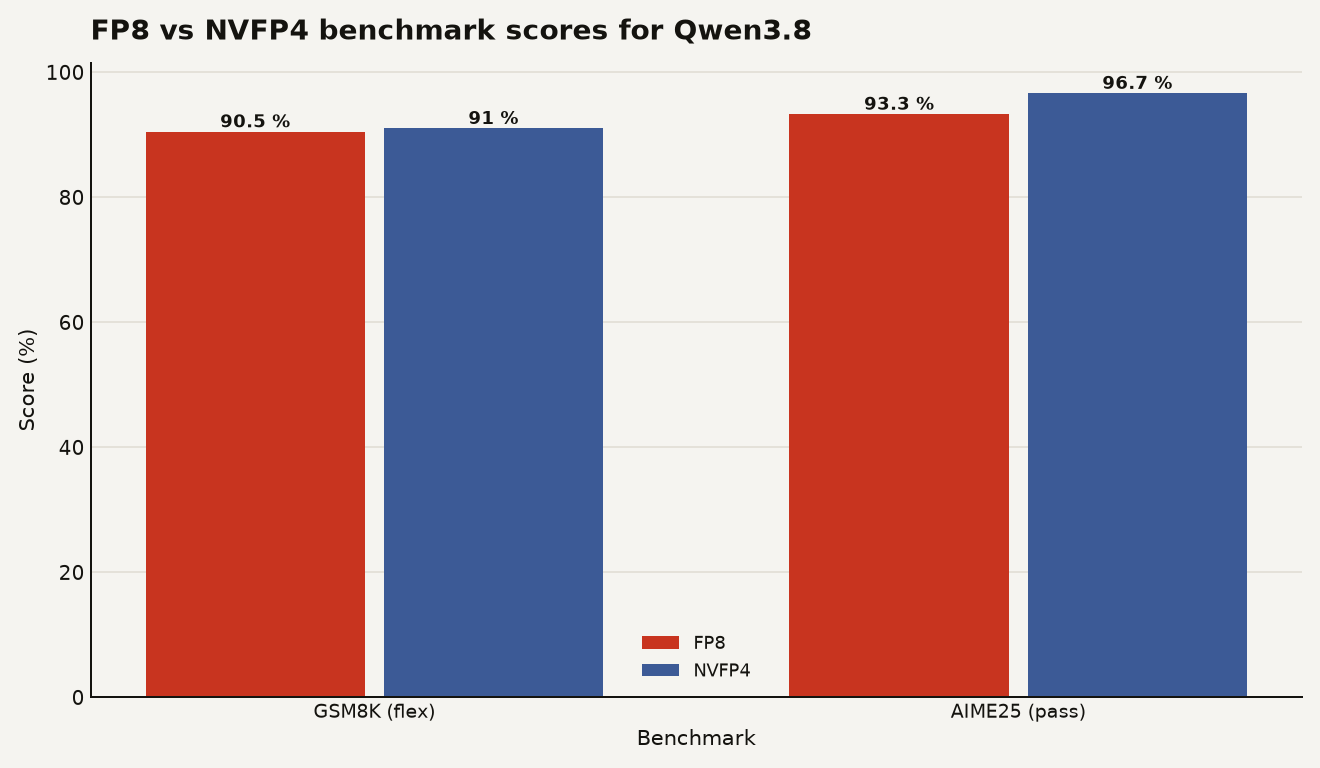
On GSM8K (a grade-school math benchmark), FP8 scores 90.52 percent and NVFP4 scores 91.05 percent. On AIME25 (a competition math benchmark), FP8 scores 93.33 percent and NVFP4 scores 96.67 percent. The Inferact team achieved this by carefully selecting which layers to quantize and using activation calibration to preserve quality.
These are strong numbers for an open-weight model. The GPQA Diamond score of 92.6 puts it in the same conversation as top-tier closed models. But benchmarks measure specific, structured tasks. Does it hold up on the messy, open-ended work you actually need it for: writing code, parsing documents, answering questions about your specific data? Try before you commit.
A multi-node GPU cluster is required
Short answer: probably not, unless your hardware is a multi-node GPU cluster.
The model has a split personality on hardware. Because only 95 billion parameters activate per token, the compute cost per token is similar to a 95 billion parameter dense model, which modern GPUs can handle. But the memory footprint tracks the total parameter count: all 2.4 trillion parameters need to sit somewhere in memory, ready to be routed to. You cannot page experts in from disk fast enough for interactive use, so in practice all 2.4T parameters need to live in GPU memory or be sharded across many GPUs.
The memory picture is shown in the chart below.
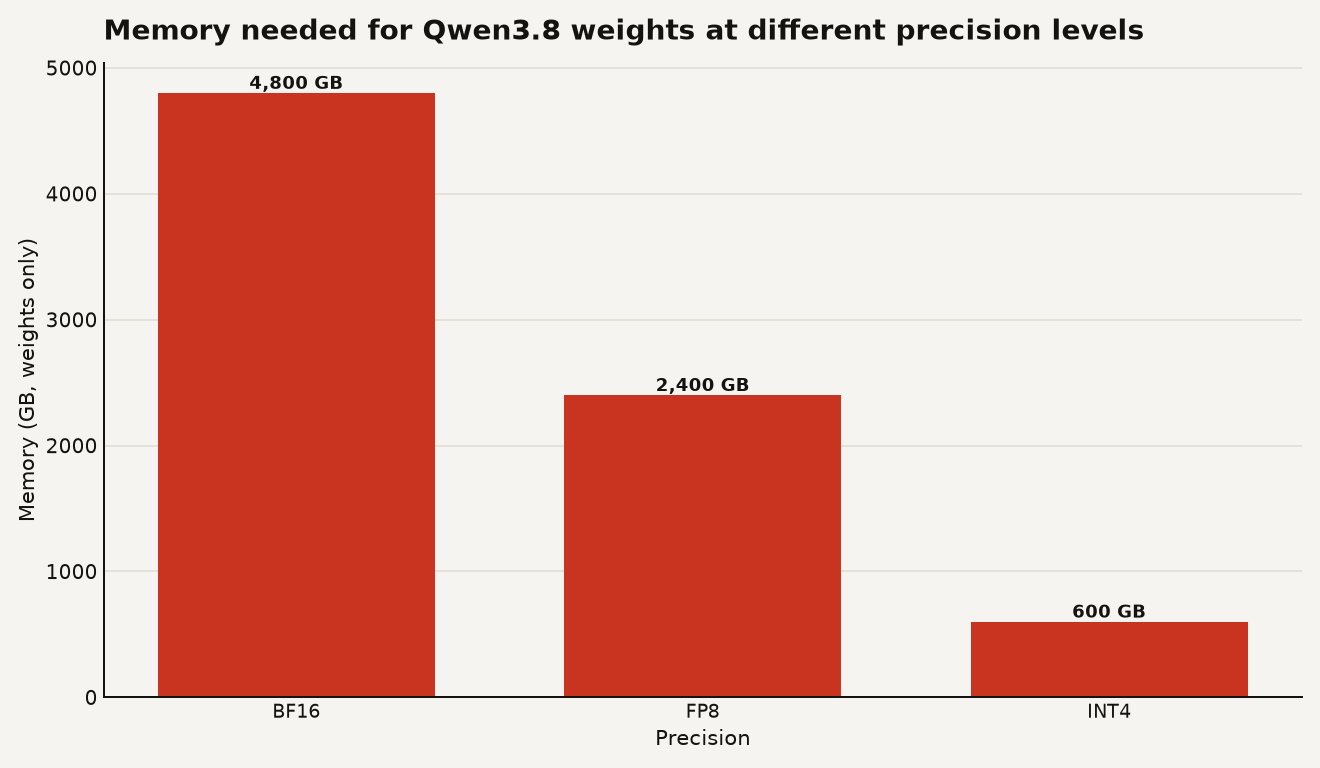
At BF16 precision (16 bits per parameter), the weights alone require about 4,800 GB of memory. At FP8, that drops to roughly 2,400 GB. Even at aggressive INT4 quantization (4 bits per parameter), you need somewhere in the range of 600 GB to 1 TB just for weights, before accounting for the memory needed to process text, according to MindStudio's hardware analysis. For context, a single high-end GPU like an NVIDIA H100 has 80 GB of memory.
The vLLM team says the full precision version requires at least two NVIDIA B300 or AMD MI355X nodes, while the FP4 quantized version can run on a single node. A "node" means a server with multiple GPUs, not a single GPU card. The supported serving frameworks are vLLM and SGLang, both designed for distributed inference across many GPUs.
If you are used to downloading a model from Hugging Face and running it with a single command, this is a different category of deployment. This is infrastructure work: standing up and tuning a distributed cluster, managing expert routing, and handling memory across devices.
Use the hosted API
For most people reading this, the practical path is the hosted API. Alibaba offers Qwen3.8-Max through their DashScope platform at $2 per million input tokens and $6 per million output tokens, with OpenAI-, Anthropic-, and DashScope-compatible endpoints, as Top AI Product reports. That is a reasonable price for experimenting with a near-frontier model without buying GPUs.
Two things to know before you start:
- Thinking mode is mandatory. Every response includes a chain of thought before the answer. There is no flag to disable it. Responses take longer and consume more tokens as a result. The hosted Qwen3.8-Max version supports a non-thinking mode, but the open-weight version does not.
- The model is text-only. No image input, no audio, no video. If you need multimodal capabilities, look elsewhere.
If you want to experiment locally with something from the Qwen3.8 family, the release also includes a 27 billion parameter dense model that is far more tractable on consumer hardware. A 27B dense model can run on a single high-end GPU with quantization. This is the model to try if you want to explore the Qwen3.8 architecture without a cluster. For a deeper look at how massive MoE models compare, our explainer on Kimi K3's 2.8 trillion parameters covers the same tradeoffs at similar scale.
If you do have GPU infrastructure and want to self-host, start with the NVFP4 checkpoint from Inferact. It fits on a single multi-GPU node and the benchmark numbers suggest no quality loss over FP8. The vLLM serve command is straightforward, with tensor parallelism set to 8 and speculative decoding enabled to speed up generation:
vllm serve Inferact/Qwen3.8-2.4T-A95B-NVFP4 \
  --linear-backend flashinfer_cutedsl \
  --tensor-parallel-size 8 \
  --enable-auto-tool-choice \
  --tool-call-parser qwen3_coder \
  --reasoning-parser qwen3 \
  --speculative-config '{"method":"mtp","num_speculative_tokens":3}'
The model supports a native context length of 262,144 tokens, extensible to about 1 million tokens. "Context length" is how much text the model can process in a single request. Longer context means more memory for the KV cache (the memory used to store conversation history), so plan accordingly.
Closed-tier capability in downloadable weights
Qwen3.8-2.4T-A95B is a milestone for open AI: closed-tier capability in downloadable weights. But "open" does not mean "accessible." The gap between downloading the weights and actually serving the model is enormous, and most builders will use the API. That is fine. The important shift is that a model this capable is now available outside the walled garden, and the license, while not fully open, gives you the option to inspect, modify, and self-host if you invest in the hardware. For beginners, the 27B dense sibling is the one to try. For teams with GPU racks, the NVFP4 checkpoint is the starting point. The ceiling on what you can run without a subscription just went up.