On September 22, 2026, OpenAI released two new AI models called GPT-6 Sol and GPT-6 Luna. These are smaller, cheaper siblings of GPT-6 Astra, the flagship model OpenAI launched earlier in September. Sol is built for coding and complex multi-step tasks. Luna is built for fast, repetitive work like summarizing documents or answering quick questions. Both cost half what their previous versions did, and both are available right now in ChatGPT, in OpenAI's API, and in GitHub Copilot. If you are just starting to use AI tools and wondering which model to pick, the short answer is: try Luna first for everyday tasks, reach for Sol when you need deeper reasoning or code help, and reserve Astra for the hardest problems. But there is a lot more detail worth knowing, because the pricing and caching changes affect your wallet more than you might expect. GPT-6 Sol and Luna both cut API prices by 50 percent compared to their GPT-5.6 predecessors.
What are GPT-6 Sol and Luna, and how do they differ?
OpenAI now sells AI models in tiers, the way a car company sells trims. GPT-6 Astra is the top-of-the-line model: the most capable, the most expensive, the one you use when you need the best possible results. Sol sits in the middle. Luna is the entry-level option. All three belong to the same GPT-6 generation, which means they share the same underlying training improvements. Sol and Luna just run faster and cost less because they are smaller and optimized differently.
A "model" in this context is a specific version of a large language model, or LLM. An LLM is the software that generates text, code, and answers by predicting what word comes next based on patterns it learned during training. When you type a question into ChatGPT, a model processes your words and produces a response. Different models trade off speed, cost, and capability differently.
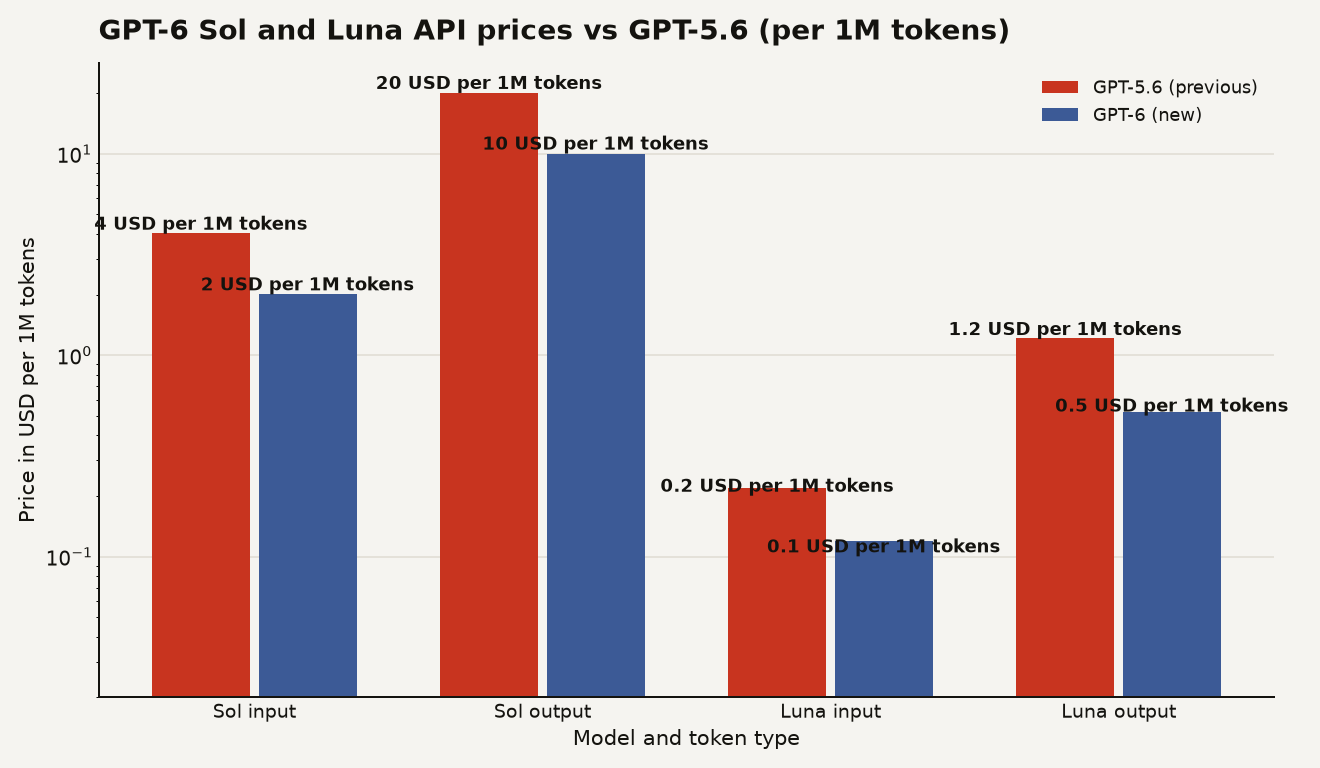
Sol is designed for what OpenAI calls "complex coding and agentic workflows." An agentic workflow means the AI performs a series of steps on its own to finish a task, like reading a file, writing code, running tests, and fixing errors, all without you guiding each step. Sol supports reasoning effort levels from "none" up to "max," which lets you control how much the model thinks before answering. Higher effort means better answers but slower responses and higher cost. At API prices, Sol costs $2 per million input tokens and $10 per million output tokens, down from $4 and $20 in the GPT-5.6 generation.
Luna is designed for "high-volume tasks with a clear goal," as OpenAI puts it. Think summarizing a stack of documents, pulling names and dates out of text, or answering straightforward questions at scale. Luna costs $0.10 per million input tokens and $0.50 per million output tokens, down from $0.20 and $1.20. It also has a context window of 1,050,000 tokens, which means it can read roughly 800,000 words in a single request. That is a large amount of text, enough to process a thick book or a long meeting transcript in one go.
The chart below shows how the new prices compare to the old ones. Every single price point dropped by exactly half.
How much better are they than the old models?
OpenAI published several benchmark results to show that Sol and Luna improved over their GPT-5.6 predecessors and compete well against Anthropic's models. A benchmark is a standardized test that measures how well an AI model performs on specific tasks. You should always treat vendor benchmarks with healthy skepticism, because the vendor picks the tests and controls the setup. But they still give you a rough sense of where a model stands.
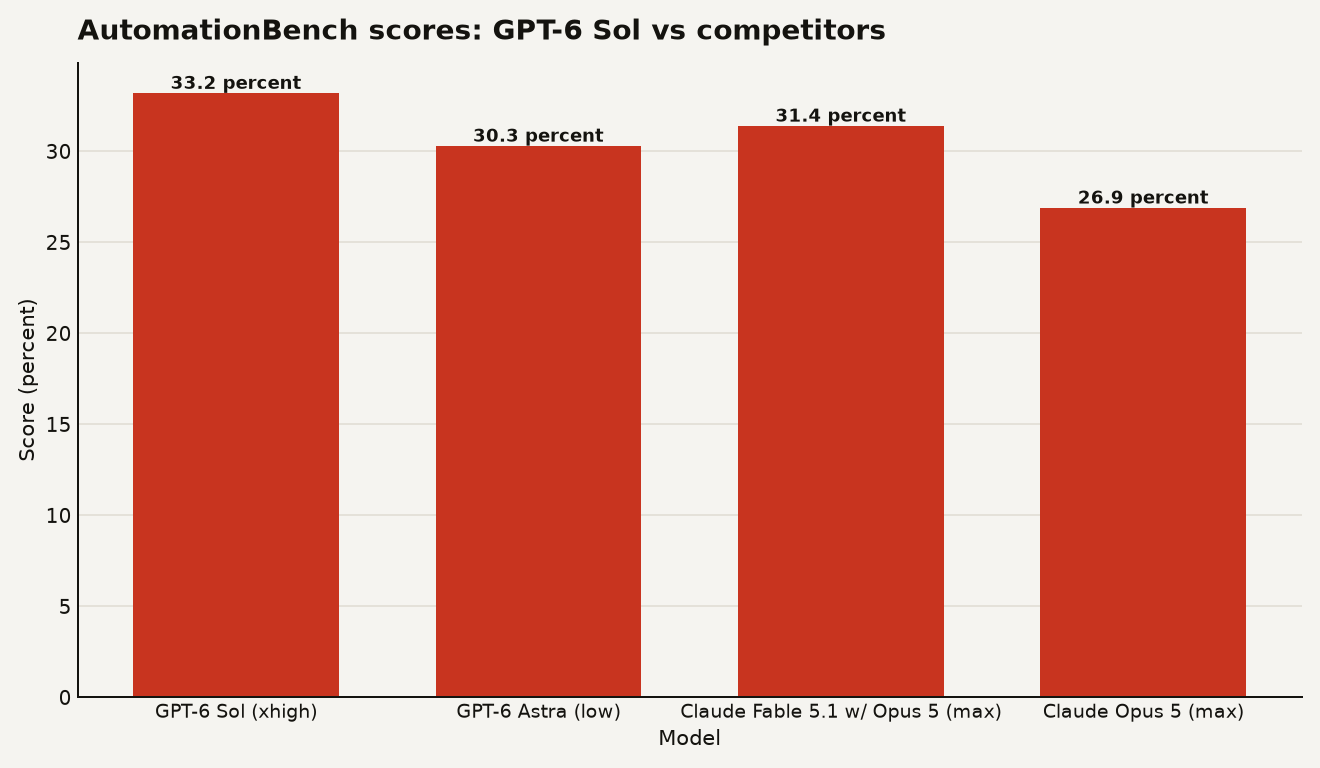
On AutomationBench 1.0.6, which tests AI agents on business workflows using 47 tools across sales, marketing, operations, support, finance, and HR, GPT-6 Sol at xhigh effort scored 33.2 percent and outperformed Claude Opus 5 at max effort, which scored 26.9 percent. Sol did this at roughly 9 percent of Opus 5's cost per task. Sol also beat Claude Fable 5.1, which scored 31.4 percent but cost over 8.9 times more per task. OpenAI noted that the Fable datapoint actually understates its real cost, because it omits the cost of Opus 5 fallbacks that occurred on about 40 percent of tasks.
The chart above shows these scores side by side.
On factuality, OpenAI says GPT-6 Sol makes about half as many mistakes as its GPT-5.6 predecessor on an internal evaluation based on real ChatGPT conversations where users flagged errors. The company also says Luna at higher effort levels matches the factual reliability of GPT-5.6 Sol at about one hundredth the cost. These are internal evaluations, not independent ones, and OpenAI itself notes that the test conversations are not representative of typical usage, where errors are rarer. Treat the claim as directional, not definitive.
On coding, OpenAI tested Sol and Luna on DeepSWE v1.1, which measures performance on complex software engineering tasks in real codebases. GPT-6 Sol at max effort scored 68.8 percent, within 1.1 percentage points of Claude Fable 5's highest score of 69.9 percent at xhigh effort, but at approximately 80 percent lower cost per task. Luna at max effort scored 66.6 percent, comparable to Claude Opus 5 and Fable 5 at medium effort, at 93 to 96 percent lower cost per task.
For a beginner, the practical takeaway is simpler than the benchmark wall: both models are meaningfully better than their predecessors, Sol competes with Anthropic's best coding models at a fraction of the price, and Luna punches above its weight for a model that costs pennies per million tokens.
What changed with caching, and why does it matter for costs?
This is the part that matters most if you are building anything with the API, even a simple script. "Prompt caching" means the model saves the beginning of your conversation or instructions so it does not have to reprocess them from scratch every time you send a follow-up message. Think of it like keeping a document open on your desk instead of printing it again each time you need to check a detail.
OpenAI improved caching for all GPT-6 models so that cached input tokens now cost 90 percent less than uncached input tokens. For Sol, that means cached input costs $0.20 per million tokens instead of $2. For Luna, cached input costs $0.01 per million tokens instead of $0.10. If your application reuses the same system instructions, context, or conversation history across multiple requests, the savings compound quickly.
OpenAI also gave developers new controls. You can now change reasoning effort (how hard the model thinks) and toggle tools on or off between requests without breaking the cache. Previously, changing these settings could force the model to reprocess everything from scratch. Now, earlier context stays cached. OpenAI also added a Prompt Caching Dashboard and a diagnostics tool to help you see what is being cached and what is not.
GitHub reported that over the past several months, these improvements reduced the share of prompt tokens requiring fresh processing by more than 50 percent across billions of requests to OpenAI models through Copilot. That is a real-world data point from a large production system, not just a lab claim.
Which model should I actually use?
Here is a practical breakdown for different situations you might find yourself in:
- You are a free ChatGPT user: You get GPT-6 Luna in the desktop app. Use it for summaries, quick questions, and drafting text. You will not have access to Sol or Astra without upgrading.
- You are a ChatGPT Plus, Pro, Business, Enterprise, or Edu user: You get both Sol and Luna in ChatGPT Work and Codex (OpenAI's coding tool). Use Luna for fast everyday tasks. Switch to Sol when you need help with code, complex analysis, or multi-step problems. Reach for Astra only when Sol is not cutting it.
- You are writing your first API script: Start with Luna. At $0.10 per million input tokens and $0.50 per million output tokens, you can experiment freely without worrying about costs. Move to Sol when your project needs stronger reasoning or coding ability.
- You are using GitHub Copilot: Both models are available now. Sol is on Pro+, Max, Business, and Enterprise plans. Luna is on Pro, Pro+, Max, Business, and Enterprise. Pick Sol for interactive coding sessions and Luna for quick completions and small tasks.
- You are building an agent that runs many steps: Use Sol for the heavy lifting and consider Luna for intermediate steps that do not require deep reasoning. Take advantage of caching aggressively, because your agent will reuse context across steps. The 90 percent discount on cached reads is where the real savings live.
One thing worth noting: Anthropic released a new version of Claude Opus 5.5 just 90 minutes before OpenAI's announcement, according to TechCrunch. The competition between these two companies is intense and fast-moving. If you are choosing between GPT-6 and Claude models, the price gap is now significant. Sol and Luna match or beat Anthropic's top models on several benchmarks at a fraction of the cost per task. But benchmarks are not your application. The only reliable way to know which model works better for your specific use case is to test both.
What is the real story here?
The headline is not that OpenAI released two new models. Companies release models all the time. The headline is that frontier-level AI intelligence is getting dramatically cheaper, fast. Sol went from $4 and $20 per million tokens to $2 and $10. Luna went from $0.20 and $1.20 to $0.10 and $0.50. Cached reads cost a tenth of full price. These are not incremental tweaks. They reshape what it costs to run AI in production.
For beginners, this means the barrier to building with AI keeps falling. A year ago, running a coding agent that calls the API hundreds of times could rack up a real bill. Today, the same workload costs half as much, and caching can cut it further. If you have been hesitant to try the API because of cost concerns, this is a good moment to start. Luna in particular is cheap enough that you can learn by doing without stress about the bill.
If you want to understand the flagship model that Sol and Luna are built on, read our GPT-6 Astra beginner's guide. For a broader view of which AI to use for which task, our AI agent guide for 2026 covers the full landscape.
Sources
- openai.com - Introducing GPT-6 Sol and Luna
- community.openai.com - Announcing GPT-6 Sol and GPT-6 Luna in the API, Codex and ChatGPT
- techcrunch.com - OpenAI launches GPT-6 Sol and Luna, boasting lower cost and fewer mistakes
- developers.openai.com - GPT-6 Luna Model documentation
- developers.openai.com - GPT-6 Sol Model documentation
- github.blog - OpenAI's GPT-6 Sol and GPT-6 Luna now available in GitHub Copilot