A 285 billion parameter AI model that can read text and look at images just ran on a stack of used gaming cards. The feat shows how far open AI tooling has come, and how much weight the word "frontier" still carries when the frontier comes to your garage.
DeepSeek V4 Flash Vision Exp is the first multimodal version of the DeepSeek V4 Flash AI model. "Multimodal" means it can process both text and images, unlike text-only models that can only read and write words. In August 2026, DeepSeek shipped this experimental model as a research preview, built on the 285 billion parameter V4 Flash backbone with a new 32 layer vision tower that lets it understand pictures.
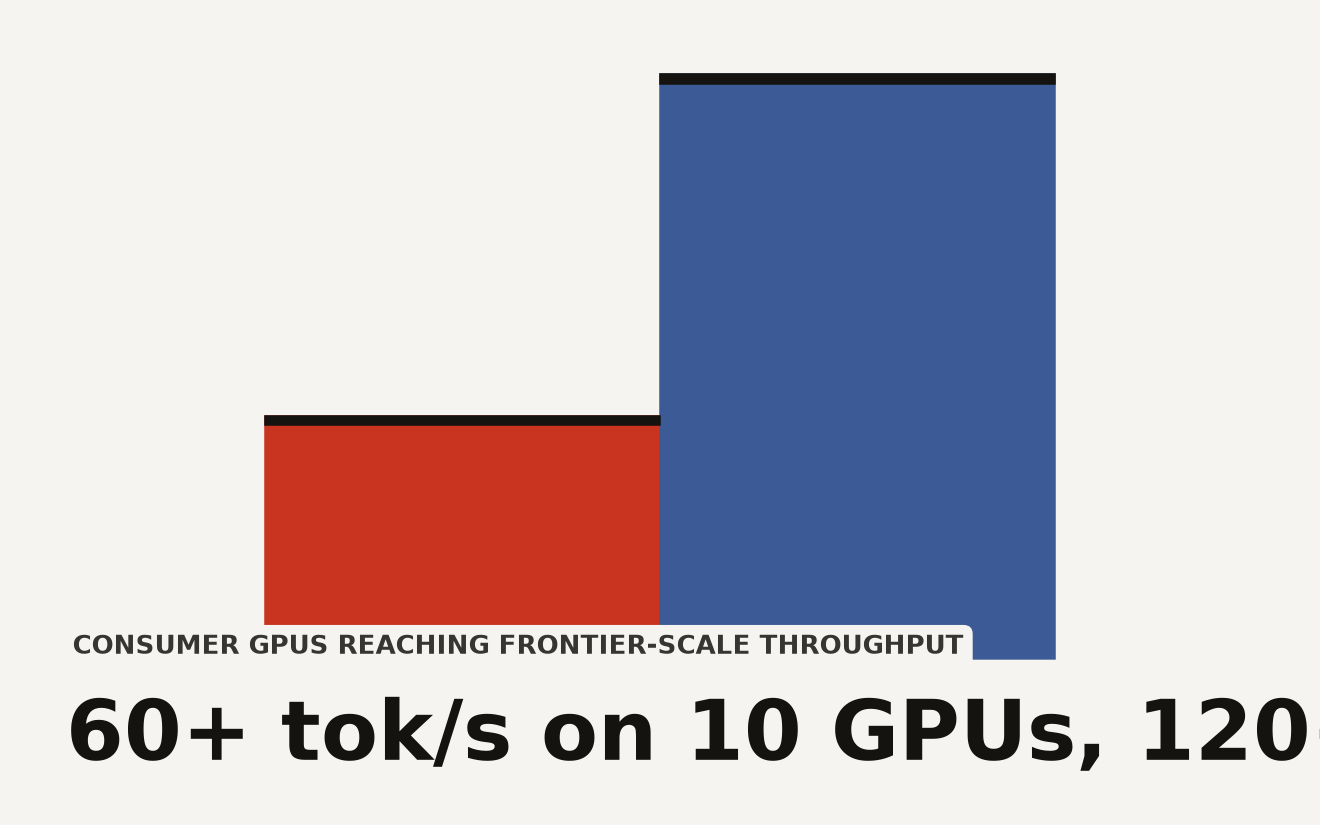
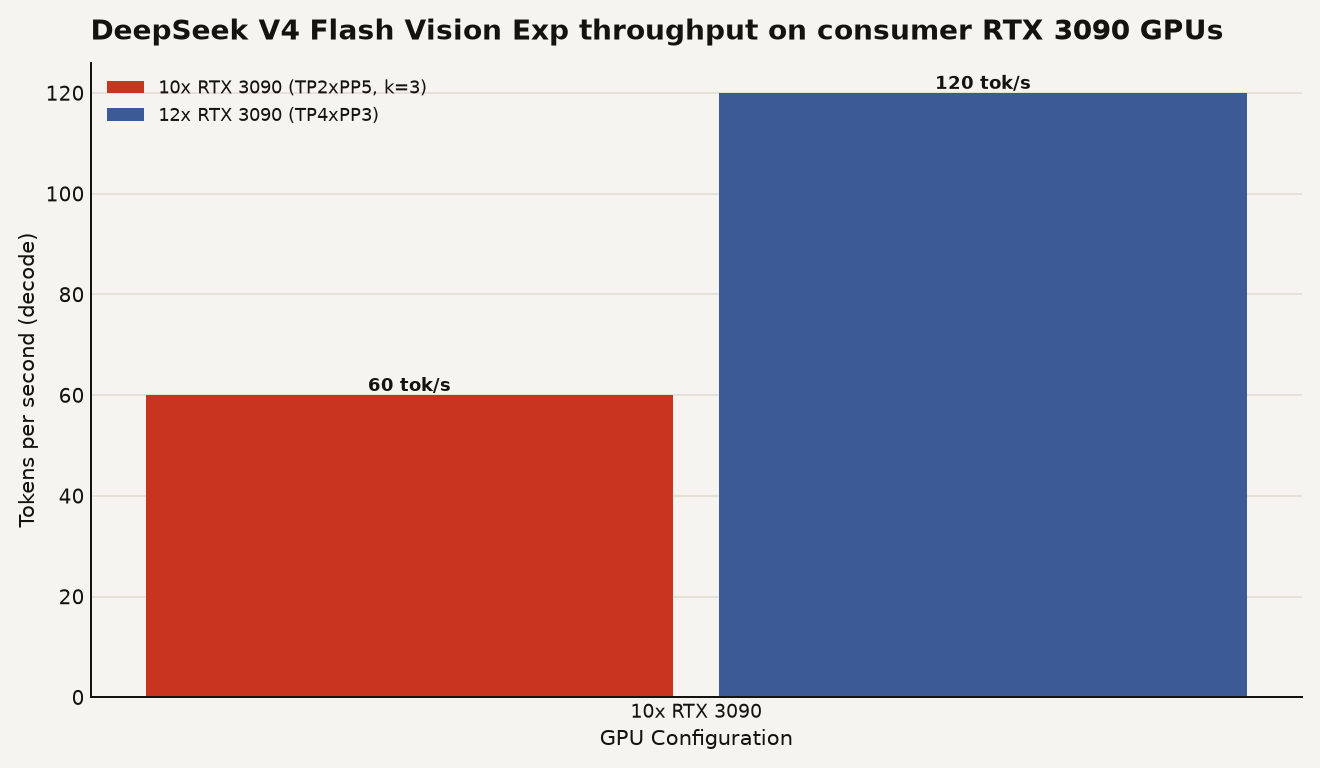
A community tester on the r/LocalLLaMA subreddit got the full model running on ten to twelve RTX 3090 GPUs, the consumer graphics cards that thousands of gamers and crypto miners already own. They hit 60 tokens per second on 10 cards and 120 tokens per second on 12 cards, with full vision, tool calls, and speculative decoding all working. The model processed image inputs, text inputs, and tool use requests without any of those features crashing. For context, a single RTX 3090 normally struggles to run a 70 billion parameter model at usable speeds. This is 285B, and it runs four times faster than the wall.
If you are new to all this, we have an explainer on how the base model works and why it is a big deal. Check out our guide to DeepSeek V4 Flash for beginners.
How does a 285 billion parameter model fit on gaming GPUs?
To understand why this matters, you need to understand three ideas: Mixture of Experts, FP4 quantization, and speculative decoding. Each one shrinks a different bottleneck that keeps big models off small hardware.
Mixture of Experts, or MoE, is an architecture where the model does not use all of its parameters on every word it generates. DeepSeek V4 Flash has 285 billion parameters total, but only activates about 13 billion on any given token. Think of it like a large company where only a few departments are working on any given task at a time, but all of them are on staff. The catch: every expert lives in GPU memory, even the sleeping ones. You need enough total memory to hold the whole staff, even if most of them are idle.
FP4 quantization is how you shrink the file size. "Quantization" means reducing the precision of the numbers that make up the model, similar to compressing a high resolution photo into a JPEG. The model takes up less space and runs faster, at the cost of a small quality drop. FP4 means storing the model's expert weights in 4 bit floating point numbers. Combined with FP8, which is 8 bit precision for the attention and routing parts of the model, the full 285 billion parameter model shrinks to about 157 GB on disk, according to the r/LocalLLaMA community report.
Speculative decoding is how you get more words per second without buying more hardware. Normally, an LLM generates one word at a time, verifying each before moving on. Speculative decoding adds a small "draft" model that guesses several upcoming words at once. The main model verifies all those guesses in one pass, accepting the right ones and rejecting the wrong ones. When the guesses are good, you get multiple words for the price of one.
DeepSeek V4 Flash ships with a draft module called DSpark. The community tester ran it with k equals 3, meaning the draft model predicts 3 tokens ahead. They used DSpark with full multimodal support, so the image processing did not break the speculative decoding pipeline. The combination of MoE, FP4, and DSpark is why a model this size can run at all, let alone hit 60 tokens per second.
Why does 60 tokens per second matter for a beginner?
If you have never run a local AI model, the throughput numbers might feel abstract. Here is the translation. Most people read at about 4 to 5 words per second. A decent local model running on a single GPU might generate 15 to 25 tokens per second. At 60 tokens per second, the text is appearing faster than you can comfortably read it. At 120 tokens per second, the output is too fast to follow in real time without pausing.
The real story is the hardware cost. A used RTX 3090 currently sells for about $700 to $900. Ten of them is roughly $7,000 to $9,000 in GPUs. That is not cheap, but it is a fraction of what an enterprise AI server costs. An Nvidia H100 data center GPU, which is the standard card for running models of this scale, costs upward of $30,000 for a single unit, and you would need several. The community tester ran this model with a 240 watt power cap per GPU, which keeps heat and electricity costs manageable for a home or small lab setup.
For a beginner, this means the floor for serious AI experimentation is dropping fast. You do not need a data center contract to work with frontier scale multimodal models. The math is simple. Ten used 3090s, a mining rig frame, and some patience with Linux gets you a system that can run a 285B model with vision. That was not possible six months ago.
What is the catch with running V4 Flash Vision on 3090s?
The catch is that "running" and "serving at production quality" are different verbs. This setup is a proof of concept, not a turnkey product.
First, the software stack is fragile. The community tester had to build a custom vLLM image compatible with SM86, the compute architecture code for RTX 3090. The model needs tensor parallelism split across multiple GPUs, pipeline parallelism split across multiple stages, and careful tuning of the KV cache, which is the memory the model uses to remember the conversation context. Get any of those wrong and the model fails to load, or loads but crashes on the first image.
Second, the model is explicitly experimental. DeepSeek calls it Vision Exp, where Exp means experiment. The official documentation notes that for text only tasks, the text-only V4 Flash model ignores the vision components. The vision model exists to add image understanding for agent benchmarks, where the AI needs to see a screen or interpret a chart. If you just want text, use the text-only model. It is faster and simpler.
Third, the throughput numbers depend on specific conditions. The 60 tokens per second figure was measured on 10 GPUs with a 240 watt power cap, using DSpark speculative decoding at k equals 3. The 120 tokens per second figure used 12 GPUs in a different parallelism layout (TP4xPP3). Your numbers will vary based on your exact hardware, cooling, and software versions. The model also supports up to 1 million tokens of context without offloading to system RAM, or 4 million tokens with RAM offload. Long context prefill, which is the initial processing of a very long prompt, hit about 3,500 tokens per second.
Should you build a 3090 cluster for V4 Flash Vision?
Only if you already have the cards or enjoy the process. For most beginners, the answer is no. The software setup requires comfort with Linux, compiling software from source, and debugging GPU memory errors. If that sounds intimidating, you should start smaller.
If you want to learn how local AI works, start with a model that fits on one GPU. Our guide on the DeepSeek V4 Flash 0731 release explains how the base model works and what changed in the latest official release. That model is substantially stronger on agentic benchmarks than the preview version, scoring 82.7 on Terminal Bench 2.1 versus 61.8 for the preview. You can run smaller variants of that model on a single 3090 or even a 4060 Ti.
If you are set on the 3090 cluster path, here is what you need:
- Ten to twelve RTX 3090 GPUs, each with 24 GB of VRAM (the memory on the card)
- A mining rig frame or server chassis that can hold them all and keep them cool
- A motherboard with enough PCIe lanes to connect them all, and riser cards if needed
- A power supply capable of delivering 2,400 to 3,000 watts sustained
- Linux, the vLLM serving software, and willingness to read error logs
The community tester provided pre-built images and reproducible steps, which lowers the barrier significantly. But reproducible does not mean easy. Plan for a weekend of troubleshooting if this is your first multi-GPU setup.
The frontier is already in the secondary market
The fact that a 285 billion parameter multimodal model runs at all on used gaming cards is remarkable. The fact that it hits 60 tokens per second is a sign that the gap between frontier AI and consumer hardware is closing faster than the major AI labs might like.
For beginners, the lesson is simple. You do not need to wait for API access or pay per token to experiment with state of the art models. The open source ecosystem has made it possible to run them yourself, if you are willing to learn the plumbing. The 3090 cluster is not the future of AI deployment. It is a snapshot of a moment where the tooling got good enough, and the secondary market got cheap enough, to make the impossible merely difficult.
Sources
- reddit.com , r/LocalLLaMA community report on DeepSeek V4 Flash Vision Exp on 10 to 12 RTX 3090 GPUs
- recipes.vllm.ai , vLLM Recipes page for DeepSeek V4 Flash serving configurations
- huggingface.co , DeepSeek V4 Flash Vision Exp model page on Hugging Face
- local-ai-zone.github.io , Local AI Zone technical deep dive on DeepSeek V4 Flash architecture, quantization, and VRAM requirements
- github.com , GitHub repository documenting DeepSeek V4 Flash Vision Exp deployment with DSpark on DGX Spark