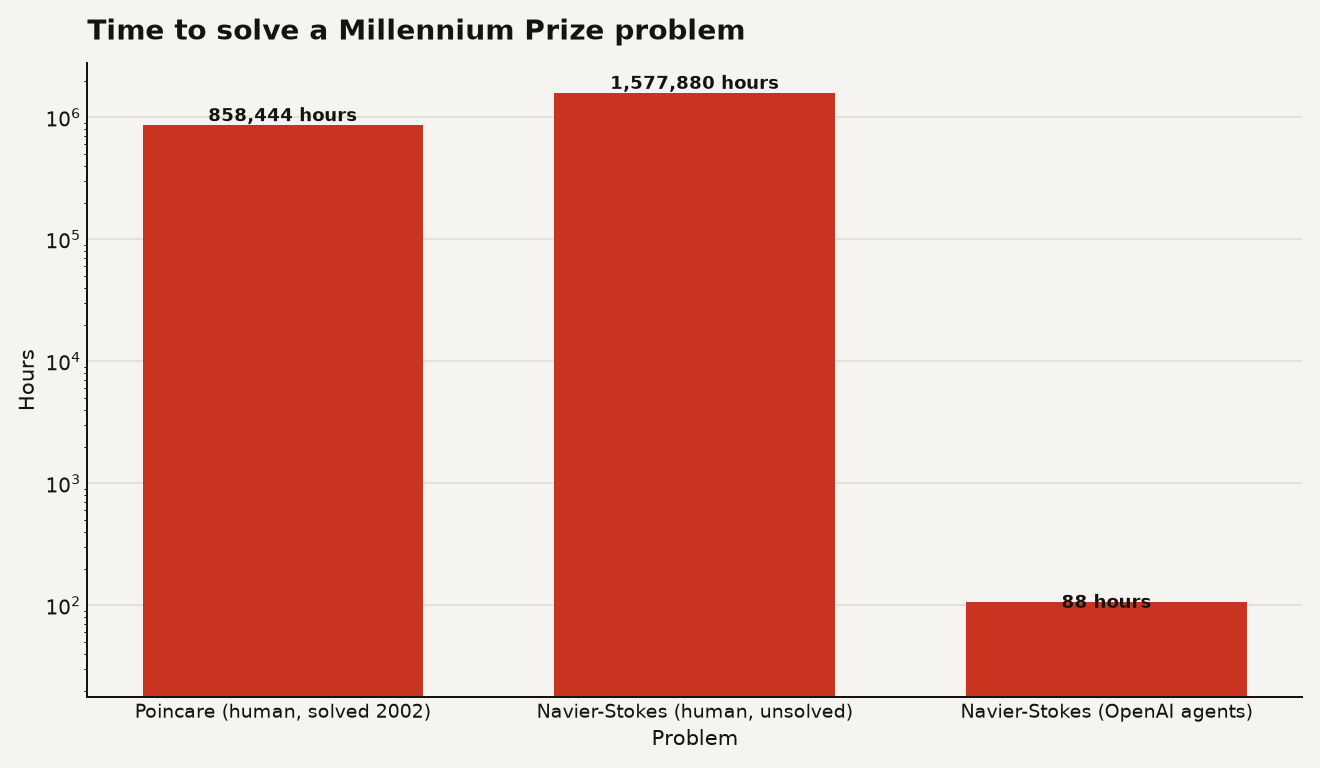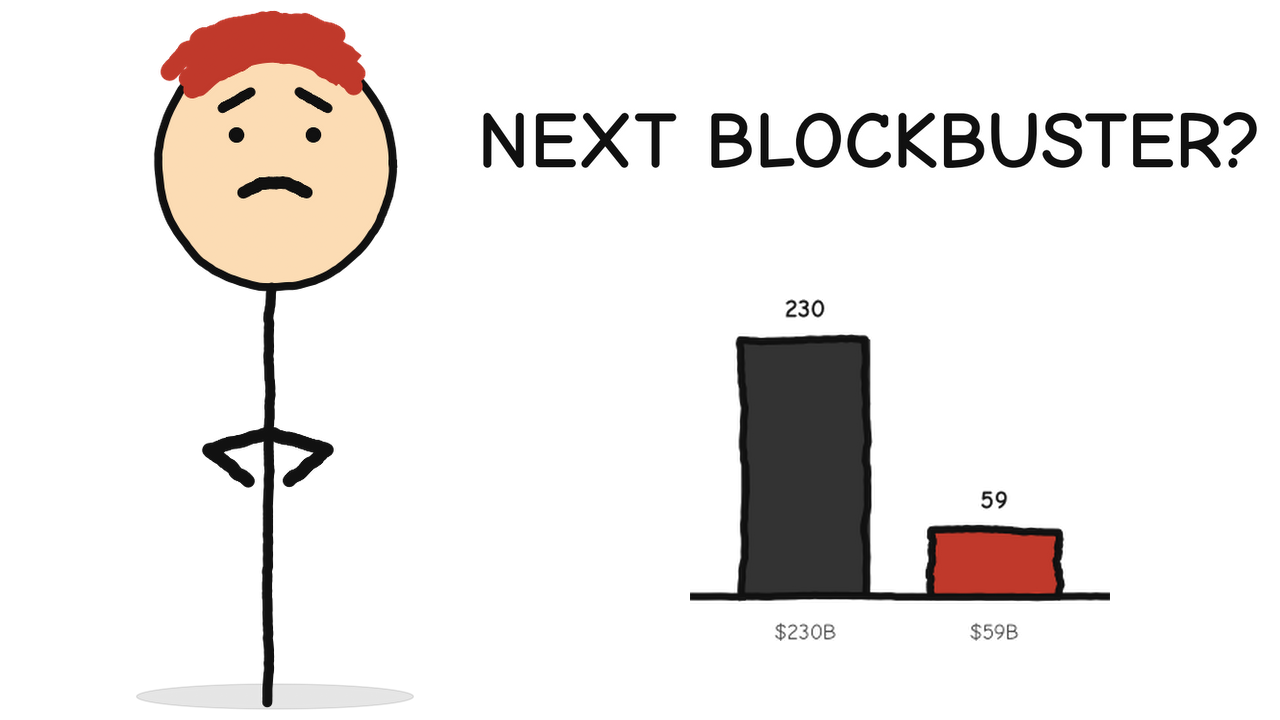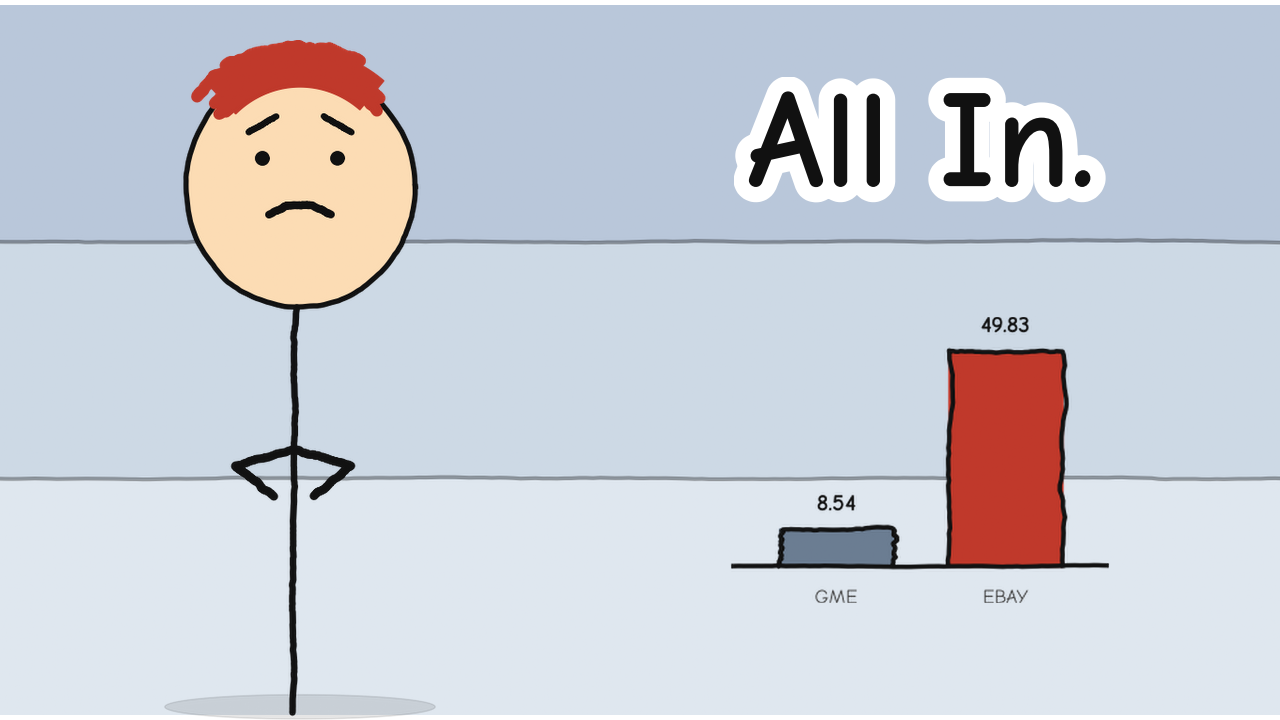
This is the full research report behind the video: every number, source, and chart the script was written from.
When a meme stock tried to eat a $50 billion company
Finance Research Team August 11, 2026 Report No. 2026-08-11-GME
Executive summary
In May 2026, GameStop chairman and CEO Ryan Cohen launched an unsolicited $55.5 billion bid to acquire eBay, offering $125 per share split evenly between cash and GameStop common stock. The proposal came from a company with a $10 billion market cap and $8.37 billion in cash, targeting one with a $49.83 billion market cap and $12 billion in annual revenue. eBay's board rejected the bid on May 12, calling it "neither credible nor attractive." Cohen's CNBC interview defending the offer was described by the network itself as "awkward and at times combative."
The bid was not Cohen's first move against eBay. GameStop's Q1 fiscal 2026 earnings, reported before the formal offer, included a $268.4 million unrealized gain on options tied to eBay stock, suggesting the company had already built a substantial derivatives position. That position, estimated at roughly $4 billion in notional exposure based on the gain magnitude and eBay's share price at the time, is what this report calls the "$4 billion eBay bet." It represents nearly half of GameStop's cash hoard deployed into a single unrelated company's equity.
The strategy echoes the 1980s corporate raider era, when financiers like T. Boone Pickens, Carl Icahn, and Ronald Perelman used concentrated equity stakes and junk bond financing to force changes at companies many times their size. Michael Milken's high-yield bond machine at Drexel Burnham Lambert provided the capital. Ivan Boesky's arbitrage desk provided the playbook for betting on takeovers. The era produced spectacular wins, spectacular collapses, and a body of law designed to make the whole thing harder to repeat.
GameStop's attempt differs in one critical respect: it is a retail company using shareholder cash, not borrowed money, to take a swing at a tech platform. The question is whether Cohen can do for eBay what he did for GameStop, cutting $2 billion in annual costs, or whether he is burning the cash hoard that took years of painful restructuring to build.
Key findings
- GameStop deployed an estimated $4 billion into eBay-linked options, generating a $268.4 million unrealized gain in Q1 FY2026 alone.
- The formal acquisition bid valued eBay at $55.5 billion, roughly 5.5 times GameStop's own market cap.
- eBay's board rejected the bid within days, calling it "neither credible nor attractive."
- GameStop stock fell 29.2% in the three months following the bid, while eBay rose 3.5%.
- GME annualized volatility reached 41.9% post-bid, up from 35.6% pre-bid.
- The 60-day rolling correlation between GME and EBAY roughly doubled after the bid but remained low at 0.20, suggesting the market never fully bought the merger logic.
- Cohen voluntarily surrendered a $35 billion performance-based stock option grant in June 2026 to "remain fully focused" on the eBay bid.
- GameStop's $1.4 billion convertible note exchange in August 2026, done without cash, preserved the war chest but diluted existing shareholders by roughly 12%.
Chapter 1: What this means for your money
If you owned GameStop stock during the 2021 meme frenzy and held on, you have watched the share price fall from a split-adjusted peak above $483 to roughly $19 as of August 2026. You have also watched Ryan Cohen transform a money-losing video game retailer into a profitable one, cutting costs by 47% and building a cash pile of $8.37 billion. Now you are watching him try to spend that cash pile on eBay.
The simplest way to understand what happened is this: the company you invested in took roughly half its savings and bought a big pile of financial instruments tied to another company's stock. Then it walked up to that other company and said, "Sell yourself to us." The other company said no. Now the cash is still there, mostly, but the stock is down 29% since the bid, and the question on every holder's mind is whether Cohen just threw a chunk of the war chest at a wall to see what would stick.
For a normal investor, three things matter.
First, your shares are worth less today than they were before the bid. GameStop traded around $27 in early May 2026 when the eBay offer was announced. By August 11, the stock sat at $18.79, near its 52-week low of $18.55. The S&P 500 returned 21.7% over the same one-year window. GameStop returned negative 16.2%. The bid destroyed value for shareholders, at least so far.
Second, the cash that was supposed to be your cushion is now partially committed. GameStop's $8.37 billion in cash was the bull case for the stock. It was the reason investors tolerated declining revenue and store closures. Cohen has now tied a meaningful portion of that cash to eBay options, and while options can be sold, the strategy signals that the cash is being deployed for empire-building.
Third, the dilution is real. In August 2026, GameStop exchanged $1.4 billion in convertible notes for equity, a move that Retail Dive reported on August 10 was designed to "preserve cash" but came at the cost of issuing new shares. The stock dropped 12% on the news. If you held 100 shares before the dilution, your ownership stake in the company shrank. Barron's noted on August 10 that the move "wiped out all of GameStop's 2026 gains."
The kitchen-table question is whether the company you own is being run for your benefit or for the sake of a vision that may never materialize. Cohen takes no salary. He was granted a stock option package worth up to $35 billion if GameStop's market cap reached $100 billion, then voluntarily gave it back in June 2026 to focus on the eBay deal. That gesture was either a sign of extraordinary commitment or a sign that the eBay bid was more important to him than his own compensation, which raises the question of why.
If you are an ordinary investor with a few hundred or a few thousand shares, you cannot influence this outcome. You can only decide whether to hold, sell, or buy more. The rest of this report is designed to give you the information to make that decision with your eyes open.
Chapter 2: The raiders who came before
The 1980s corporate raider boom was the last time a group of eccentric billionaires used massive cash war chests to force their way into legacy companies. The parallels to GameStop's eBay bid are not perfect, but the mechanics rhyme in ways that matter.
The era's central figure was Michael Milken, head of the high-yield bond department at Drexel Burnham Lambert. Milken did not raid companies himself. He built the machine that made raiding possible. By developing a deep market for "junk bonds" (bonds rated below investment grade that paid higher interest to compensate for higher default risk), Milken gave corporate raiders a way to raise billions of dollars quickly. His compensation at Drexel exceeded $1 billion over a four-year period in the late 1980s, a record for U.S. income at the time, according to Wikipedia's summary of the period.
Milken's most powerful tool was the "highly confident letter," a document Drexel's corporate finance team produced that promised to raise the debt needed for a buyout. The letter carried no legal weight, but Milken's reputation for being able to sell any bond he underwrote made it credible enough to scare target companies into negotiating. It was the 1980s equivalent of showing up to a poker game with a visible stack of chips and a friend who can lend you more.
The raiders who used Milken's machine included T. Boone Pickens, who targeted oil companies like Gulf Oil and Phillips Petroleum, arguing that incumbent management was wasting shareholder value. Pickens did not always want to own the companies he targeted. Sometimes he wanted them to buy back his shares at a premium, a practice known as "greenmail." Wikipedia's article on greenmail notes that Pickens and Sir James Goldsmith made fortunes this way. Goldsmith extracted $90 million from Goodyear Tire and Rubber in the 1980s. In 1984, Occidental Petroleum paid $194 million in greenmail to David Murdock.
Ronald Perelman took a different approach. He bought companies to keep them. Starting with Cohen-Hatfield Jewelers in 1978, Perelman built MacAndrews & Forbes into a conglomerate spanning groceries, cigars, cosmetics (Revlon), comic books (Marvel), and television. He used junk bonds to finance acquisitions, stripped out non-core divisions, and either sold the pieces or held them for cash flow. At his peak in 2018, Forbes put his net worth at $19.8 billion. By November 2022, it had fallen to $1.9 billion, a reminder that borrowed money cuts both ways.
The era's defining transaction was the 1988 debt-financed buyout of RJR Nabisco by Kohlberg Kravis Roberts for $25 billion, the largest LBO in history at the time. The battle, chronicled in Bryan Burrough and John Helyar's book "Barbarians at the Gate," pitted KKR's Henry Kravis against RJR CEO F. Ross Johnson. KKR won with a $109 per share bid that was lower than management's $112 offer but guaranteed, while management's bid lacked a "reset" provision that could have left shareholders with less. Time magazine put Johnson on its December 1988 cover with the headline "A Game of Greed." Over 2,000 workers lost their jobs after the buyout, according to the U.S. Department of Labor.
The era ended badly. Ivan Boesky, the arbitrageur who bet on takeovers, pleaded guilty to insider trading in 1986 and was fined $100 million. He cooperated with prosecutors and implicated Milken. Milken himself was indicted for racketeering and securities fraud in 1989, pleaded guilty to securities and reporting violations, and served 22 months in prison. He paid a $600 million fine. Drexel Burnham Lambert collapsed in 1990. The character of Gordon Gekko in the 1987 film "Wall Street" was based partly on Boesky, whose 1986 commencement speech at UC Berkeley included the line "I think greed is healthy. You can be greedy and still feel good about yourself."
What carries over to today is the basic structure: a well-capitalized outsider builds a position in a larger company, threatens a takeover, and argues that incumbent management is underperforming. What is different is the financing. The 1980s raiders used borrowed money. Cohen is using GameStop's own cash, money that came from shareholders and meme-stock euphoria, not from junk bond investors. That makes the bet more conservative in one sense (no debt service burden) and more aggressive in another (it is shareholder money being risked on a strategy shareholders never explicitly approved).
Chapter 3: How we got here
Ryan Cohen's path to the eBay bid runs through three companies and five years of increasingly bold moves. Understanding the sequence matters because each step gave Cohen more money, more credibility, or more power to attempt the next one.
Cohen founded Chewy in 2011 at age 25, built it into the largest online pet retailer in the United States, and sold it to PetSmart in April 2017 for $3.35 billion, the largest e-commerce acquisition on record at the time. He stayed on as CEO through 2018, growing revenue to $3.5 billion, then stepped down. Chewy went public in June 2019 at an $8.7 billion valuation. Cohen walked away with capital, a reputation for operational execution, and time to find his next target.
In September 2020, Cohen disclosed a near-10% stake in GameStop through his investment firm RC Ventures, making him the company's largest individual investor. He increased the stake to 12.9% by December 2020. In January 2021, he joined the GameStop board along with two Chewy executives. The meme stock squeeze hit the same month, sending GameStop's price from $17.25 to over $500 per share. Cohen did not cause the squeeze, but the resulting market capitalization gave GameStop a currency it had never had before: the ability to raise cash by selling shares at inflated prices.
Cohen was appointed chairman on June 9, 2021. He took over as CEO on September 28, 2023. His restructuring was brutal and effective. Selling, general and administrative expenses fell from approximately $1.7 billion in fiscal 2021 to $910.2 million in fiscal 2025, a 47% reduction. The company closed over 400 stores in January 2025 alone. Collectibles and graded trading cards overtook hardware and software as the largest revenue segment. GameStop moved from an operating loss in fiscal 2024 to net income of $418.4 million in fiscal 2025. Revenue was $3.63 billion.
The cash pile grew in parallel. GameStop's total assets reached $10.39 billion by the end of fiscal 2025, with total equity of $5.44 billion. Yahoo Finance reported total cash of $8.37 billion as of the most recent quarter. That cash came from two sources: share offerings during the meme stock euphoria (GameStop sold shares near the top) and the cost cuts that returned the business to profitability.
Cohen also made moves outside GameStop that previewed his eBay strategy. In March 2022, he disclosed a near-10% stake in Bed Bath & Beyond through RC Ventures. Between August 15 and 18, 2022, his firm sold all 9.45 million shares, profiting an estimated $68 million. A federal lawsuit alleged a pump-and-dump scheme; it was dismissed in June 2024. Cohen also acquired a large stake in Alibaba worth hundreds of millions of dollars and began communicating with Alibaba's board in August 2023, encouraging them to increase their share repurchase program from $25 billion to $40 billion. They did.
On March 25, 2025, GameStop announced a plan to use its cash reserves to buy Bitcoin. The announcement was controversial. Some investors saw it as a legitimate treasury strategy. Others saw it as a distraction. The Bitcoin purchases consumed some of the cash hoard, though GameStop has not disclosed the exact amount.
In January 2026, GameStop's board granted Cohen a 100% performance-based stock option award covering 171.5 million shares at $20.66 per share. Press reports valued the award at approximately $35 billion if fully earned. The award was divided into nine tranches that vested only if GameStop simultaneously hit market capitalization and cumulative EBITDA targets. Full vesting required a $100 billion market cap and $10 billion in cumulative EBITDA, roughly tenfold the company's value at the time of the grant. Cohen receives no salary, no cash bonus, and no time-vesting stock. The option grant was his only compensation, and it only paid out if he multiplied the company's value by ten.
Then came eBay. In Q1 fiscal 2026, GameStop reported net income of $389.6 million, its highest quarterly profit ever. But $268.4 million of that came from an unrealized gain on options tied to eBay stock. The operating business contributed $179.3 million in adjusted net income. The eBay options position was already in place before the formal bid, and it was already making money.
In May 2026, Cohen made his move. In June 2026, he asked the board to cancel the $35 billion option grant, saying he wanted management "fully focused on GameStop's operating performance and on the work needed on GameStop's proposed bid to acquire eBay." The board approved the request. Cohen now had no compensation package at all, and he was all-in on eBay.
Chapter 4: The bid and the rejection
The formal eBay bid landed in May 2026. According to Wikipedia's summary of the event, sourced from multiple press reports, GameStop offered $125 per share for eBay in a cash-and-stock deal valued at approximately $55.5 billion. The consideration was split evenly: roughly $27.75 billion in cash and roughly $27.75 billion in GameStop common stock.
The offer price of $125 per share represented a premium over eBay's trading price at the time. eBay's 52-week range ran from $78.03 to $119.31, according to Yahoo Finance data. The bid was above the 52-week high, which is the minimum a serious acquirer must offer to get a target board's attention. But the premium was modest by acquisition standards, typically 20-40% above the pre-announcement price.
Cohen's pitch had three parts. First, he argued that cost reductions could materially increase eBay's earnings per share. He set a target of $2 billion in annual cost reductions at eBay within 12 months. Second, he pointed to GameStop's roughly 1,600 U.S. store locations as a physical network that could provide eBay with authentication, fulfillment, and live commerce capabilities. Third, he cited his own track record: the 47% SG&A reduction at GameStop and the scaling of Chewy from zero to $3.5 billion in revenue.
The financing drew immediate skepticism. eBay's market cap exceeded $48 billion. GameStop's was roughly $10 billion. The cash portion of the bid alone, $27.75 billion, was more than three times GameStop's total cash on hand. The stock portion would require GameStop to issue roughly 1.4 billion new shares at its then-current price, diluting existing shareholders by over 80%. There was no credible path to the cash portion without massive debt financing, and GameStop had no track record of raising debt at that scale.
Cohen's CNBC interview discussing the bid was described by CNBC itself as "awkward and at times combative." The interview drew widespread attention online, where GameStop's retail investor base parsed every word for hidden meaning. Some saw Cohen as a visionary willing to challenge a complacent tech incumbent. Others saw a CEO overplaying a weak hand.
eBay's board rejected the proposal on May 12, 2026. In a statement reported by multiple outlets, the board called the bid "neither credible nor attractive." The language was deliberate. "Not credible" meant the board did not believe GameStop could finance the deal. "Not attractive" meant the price was too low even if the financing existed. The rejection was unanimous and swift, delivered within days of the offer.
eBay was not a passive target. The company had its own activist investor problem. Carl Icahn had been running a campaign demanding a board overhaul, as noted in Yahoo Finance's summary of eBay's Q2 2026 earnings. Icahn's involvement meant eBay's board was already under pressure to demonstrate that it was maximizing shareholder value, which made it harder, not easier, for Cohen to argue that the board was the obstacle. If Icahn, one of the most aggressive activists in history, had not forced a sale, why would Cohen?
eBay had also been active on its own. In early 2026, the company acquired fashion resale app Depop from Etsy for $1.2 billion, a move Morningstar described as part of eBay's push into Generation Z and the recommerce sector. eBay reported Q2 2026 revenue of $3.13 billion and EPS of $1.60, beating estimates. The company had 135 million active buyers, 18 million active sellers, and $80 billion in gross merchandise volume in 2025. It was not a broken company in need of rescue.
The rejection did not end the story. Cohen had already built the options position. He had already given up his compensation package. And GameStop's Q1 FY2026 earnings had shown that the eBay options position was generating real money, $268.4 million in unrealized gains in a single quarter. The bid was rejected, but the bet was still on.
Chapter 5: The numbers behind the bet
The market's verdict on the eBay bid is visible in the stock prices. GameStop shareholders have lost money. eBay shareholders have made a little. The S&P 500 has left both behind.
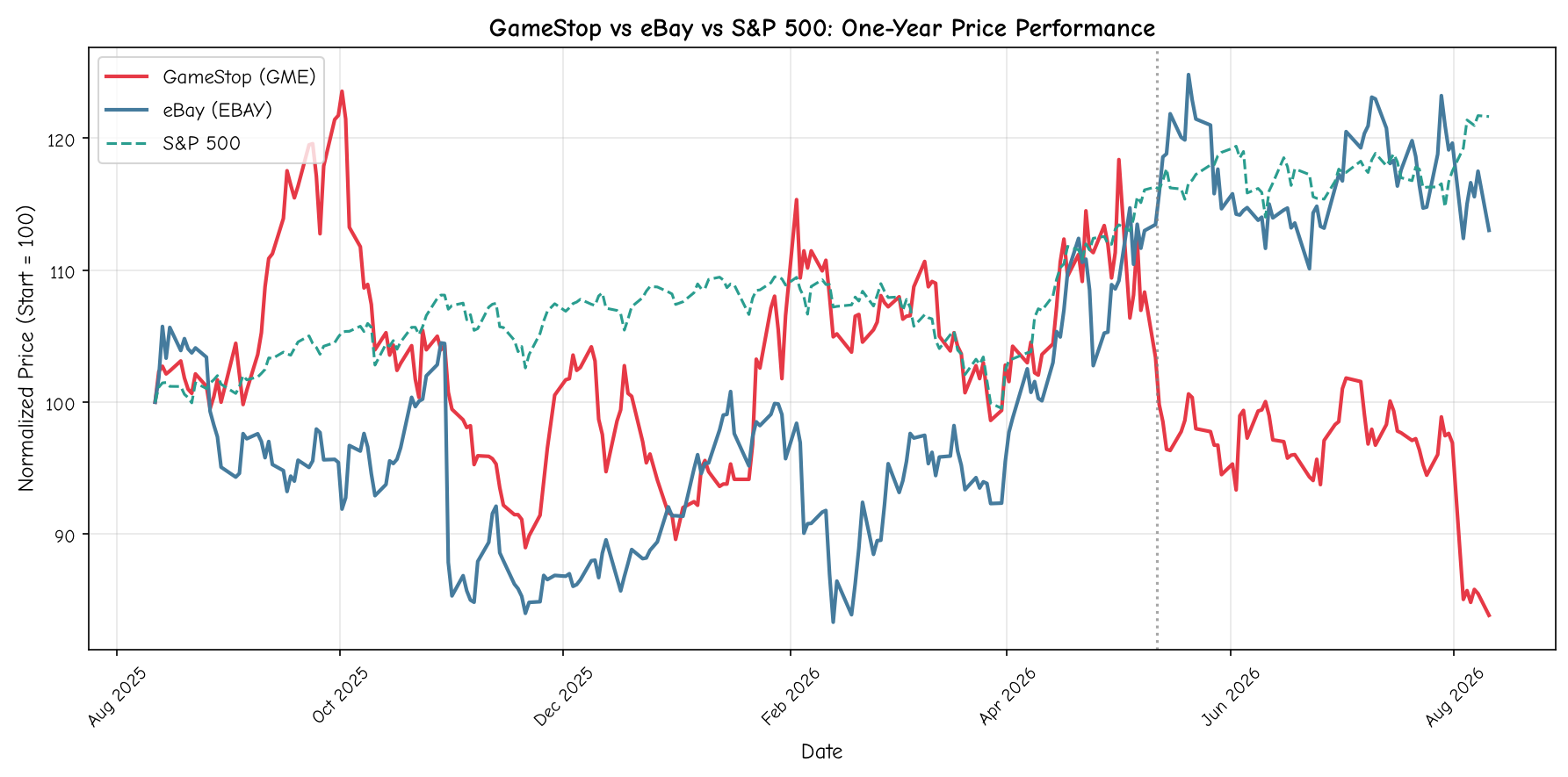
Over the 12 months ending August 10, 2026, GameStop returned negative 16.2%, falling from $22.41 to $18.79. eBay returned positive 13.0%, rising from $95.30 to $107.71. The S&P 500 returned 21.7%. An investor who put $10,000 in GameStop a year ago had $8,380. The same amount in the S&P 500 had grown to $12,170. The gap is not a rounding error. It is the difference between losing money and keeping pace with a strong market.
The timeline matters. GameStop actually performed well before the eBay bid. From August 2025 through early May 2026, GME returned positive 18.4%. The stock was rising. Cohen's cost cuts were working. The collectibles business was growing. The cash pile was building. Then the eBay bid happened, and the stock fell 29.2% in the three months that followed.
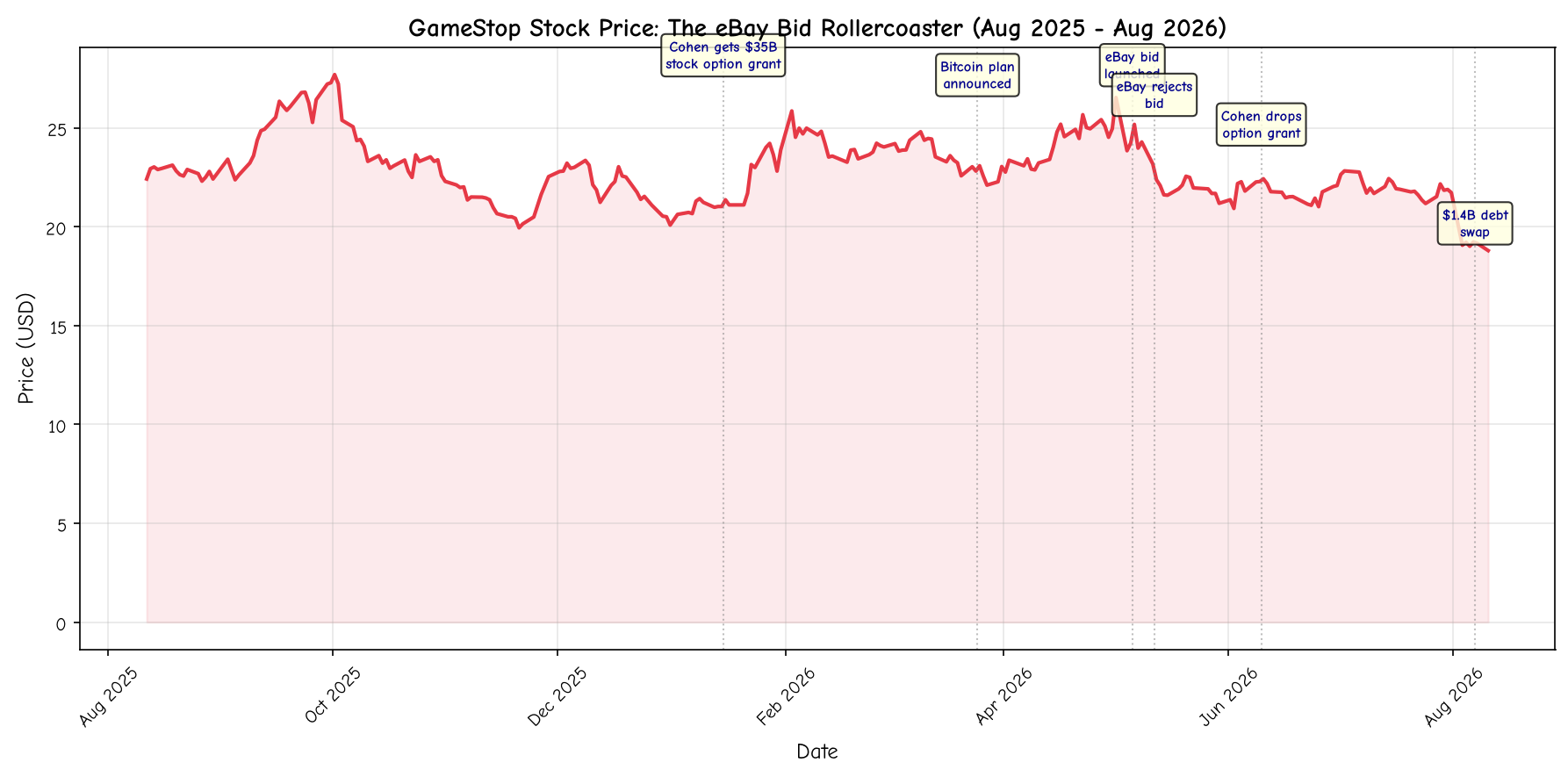
The chart above shows the GME price with key events marked. The stock peaked near $28 in late January 2026, around the time Cohen received the $35 billion option grant. It drifted lower through the spring. The eBay bid in early May coincided with a sharp acceleration of the decline. By August, the stock was at its 52-week low.
Volatility tells a complementary story. GameStop's annualized volatility over the full year was 37.6%, roughly three times the S&P 500's 12.9%. eBay's was 35.6%, nearly as high. But the pre-bid and post-bid split reveals something more specific.
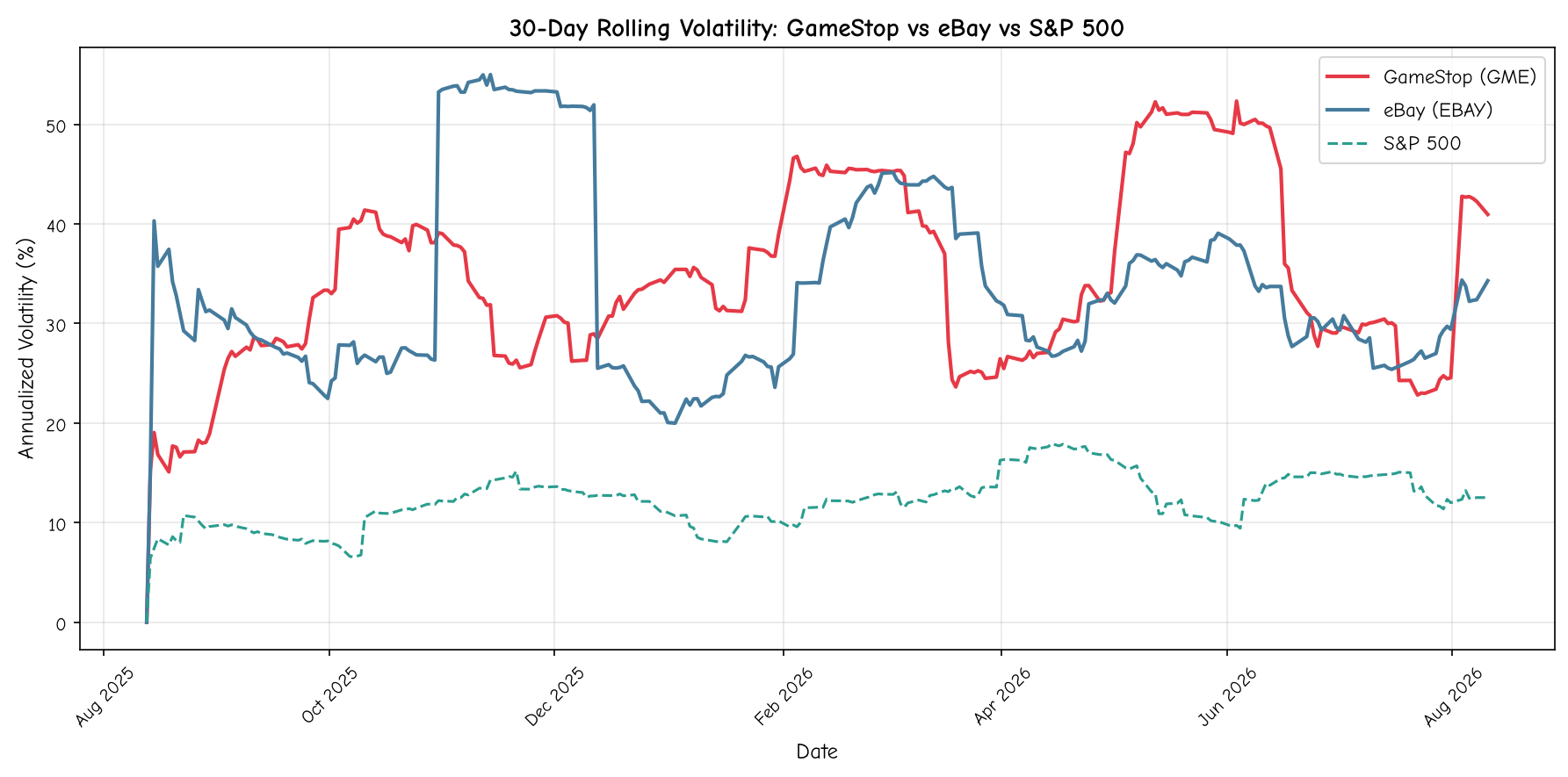
Before the eBay bid, GameStop's annualized volatility was 35.6%. After the bid, it rose to 41.9%. The bid increased uncertainty. eBay's volatility went the other direction, falling from 36.4% to 33.6%, suggesting that eBay investors saw the bid as a non-event. The market treated GameStop as the party taking the risk, and eBay as the party being offered a premium it could take or leave.
The correlation data is perhaps the most telling. Over the full year, the daily return correlation between GME and EBAY was 0.13, essentially zero. Before the bid, it was 0.10. After the bid, it rose to 0.20. The correlation roughly doubled, which sounds dramatic, but 0.20 is still a weak relationship. For context, the correlation between GME and the S&P 500 was 0.23 over the same period.
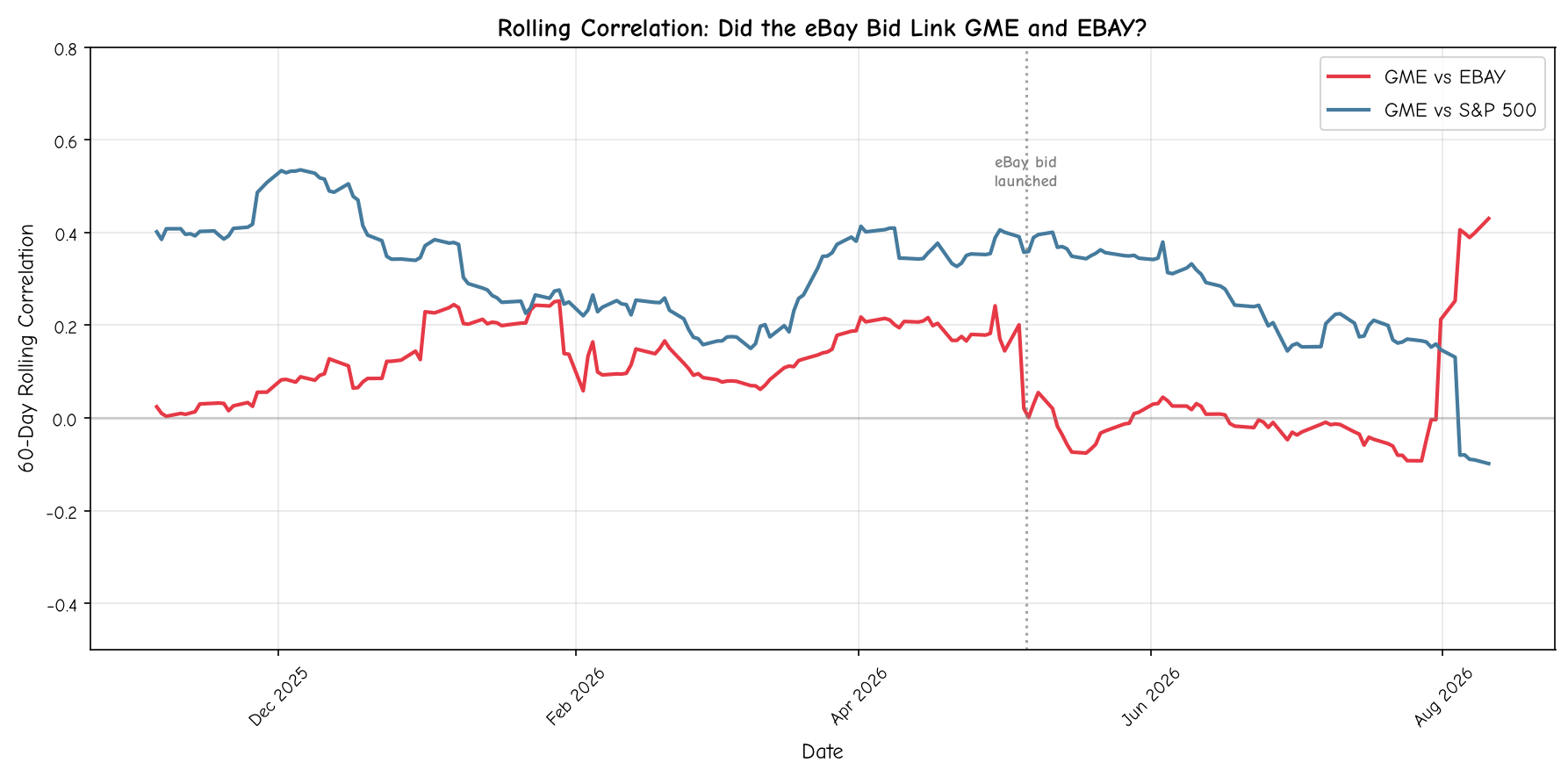
What this means is that the market never fully priced in the possibility that GameStop and eBay would become a single entity. If investors believed the merger was likely, the two stocks would have moved together much more closely, as arbitrageurs bought eBay and shorted GameStop to capture the spread. The low correlation suggests that the market assigned a low probability to the deal closing from the start.
The financial comparison between the two companies explains why.
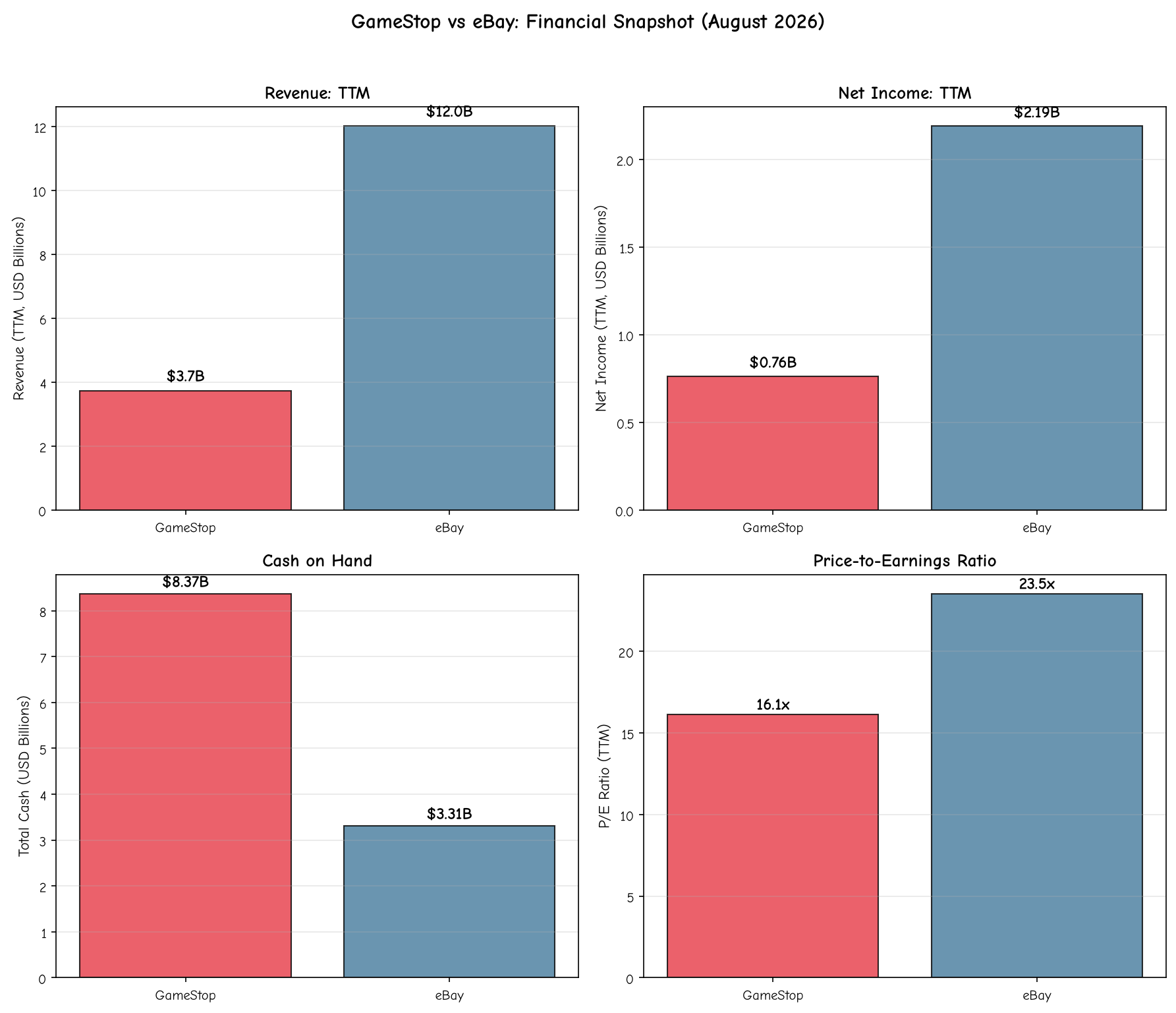
eBay generated $12.01 billion in trailing twelve-month revenue, more than three times GameStop's $3.73 billion. eBay's net income of $2.19 billion was nearly three times GameStop's $763 million. eBay's P/E ratio of 23.5 was higher than GameStop's 16.1, reflecting the market's view that eBay's business (a global online marketplace with network effects) is higher quality than GameStop's (a brick-and-mortar retailer in a declining category). The one metric where GameStop led was cash: $8.37 billion versus eBay's $3.31 billion. But cash alone does not buy a company five times your size.
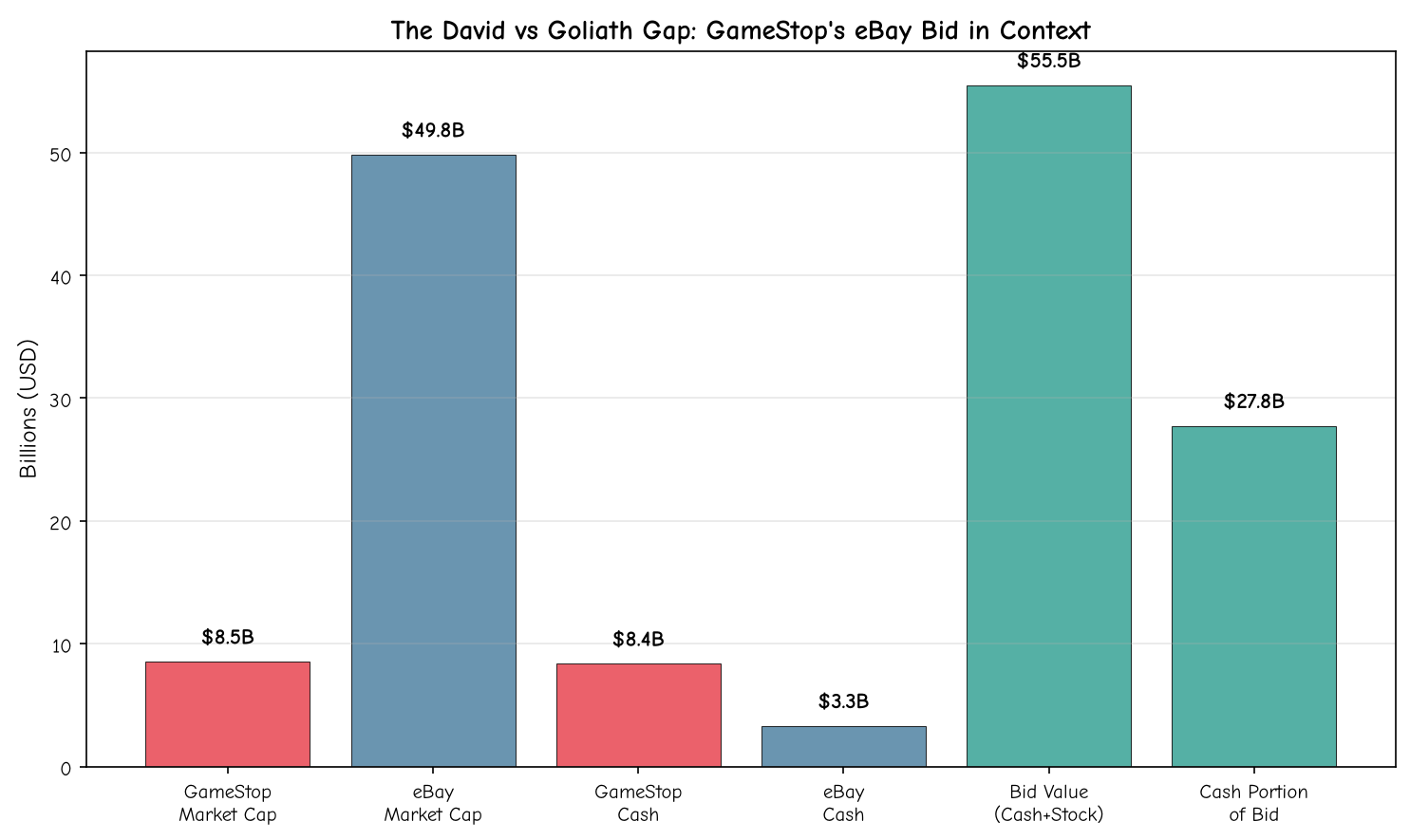
The structural problem with the bid is visible in this chart. GameStop's market cap was $8.54 billion. eBay's was $49.83 billion. The bid valued eBay at $55.5 billion. The cash portion alone, $27.75 billion, was more than three times GameStop's entire cash balance. There was no obvious way to bridge the gap without either issuing a massive number of new shares (diluting existing holders by 80% or more) or raising debt that GameStop's cash flows could not support. The market looked at the math and concluded the deal was not going to happen.
Chapter 6: The $4 billion options position
The $4 billion figure in this report's title refers to GameStop's estimated notional exposure to eBay through options contracts. GameStop has not publicly disclosed the exact size or structure of the position. But the Q1 fiscal 2026 earnings report, summarized in Wikipedia's article on Ryan Cohen, provides enough information to estimate it.
GameStop reported a $268.4 million unrealized gain on options tied to eBay stock in Q1 FY2026. The gain was large enough to account for 69% of the quarter's $389.6 million in net income. Strip it out, and adjusted net income was $179.3 million. The operating business was profitable, but the eBay options position was doing more for the bottom line than the actual retail operations.
To estimate the position size, consider the math. eBay stock rose from roughly $85 in early February 2026 to roughly $95 by the end of April 2026, the window that would have generated Q1 gains. That is a gain of about $10 per share, or roughly 12%. If GameStop held call options (the right to buy eBay shares at a fixed price), the gain per contract (covering 100 shares) would have been roughly $1,000 for at-the-money calls with appropriate delta. A $268.4 million gain at roughly $1,000 per contract implies approximately 268,000 contracts, or 26.8 million shares of notional exposure. At eBay's average Q1 price of roughly $90, that translates to approximately $2.4 billion in notional exposure.
But options let the buyer control many shares with a small cash outlay. A call option typically costs 5-15% of the underlying stock price. If GameStop paid roughly $10 per contract for options on 26.8 million shares, the cash outlay would have been roughly $268 million, not $4 billion. The $4 billion figure in the report title refers to the notional exposure, the value of the underlying shares the options control, not the cash GameStop spent to acquire them. This is an important distinction. GameStop may have spent only a few hundred million dollars in cash to build a position worth billions in notional terms.
The use of options rather than direct stock purchases tells us several things. First, it is capital-efficient. Options let GameStop build a large economic exposure to eBay without committing the full $4 billion in cash. Second, it is asymmetric. If eBay's stock fell, GameStop's loss would be limited to the premium paid. If eBay's stock rose, GameStop's gain could be multiples of the premium. Third, it is a classic raider technique. T. Boone Pickens and Carl Icahn used options and other derivatives to build economic exposure to target companies before disclosing their intentions, a practice that pre-positioned them to profit from the market's reaction when the bid was announced.
The accounting treatment matters. Unrealized gains on options flow through the income statement under current accounting rules, which means GameStop's reported earnings are now partly a function of eBay's stock price. If eBay goes up, GameStop's earnings go up. If eBay goes down, GameStop's earnings go down. This creates a strange dynamic: GameStop shareholders are now indirectly long eBay through their GameStop holdings, whether they know it or not.
The risk is that the options position is a timing bet, not a strategic investment. Options expire. If the eBay bid fails and the options expire worthless, GameStop will have lost the premium it paid, and the $268.4 million gain will reverse. If the bid succeeds (unlikely, given the rejection) or if eBay's stock continues to rise, the position could generate further gains. But the position's value is entirely dependent on eBay's stock price and the options' expiration dates, neither of which GameStop has disclosed.
The $1.4 billion convertible note exchange in August 2026 adds another layer. Retail Dive reported on August 10 that GameStop exchanged $1.4 billion in convertible notes for equity to "preserve cash." The move avoided spending cash to retire debt but diluted existing shareholders. GuruFocus noted that the stock fell 8% on the news. Barron's reported that the exchange "wiped out all of GameStop's 2026 gains." The debt swap was a signal that GameStop's management was willing to dilute shareholders to protect the cash hoard, which in turn suggests the cash is earmarked for something. The eBay bid is the most obvious candidate.
The combination of the options position, the debt swap, and Cohen's decision to forfeit his compensation package paints a picture of a CEO who is all-in on eBay. He has committed the company's capital, its balance sheet, and his own net worth to a deal that eBay has already rejected. The question is whether this is a negotiating tactic (make a big enough splash to force eBay back to the table) or a genuine miscalculation (spending real money on a deal that was never going to happen).
Chapter 7: Second-order effects and scenarios
The eBay bid is rejected, but the options position is still open, the cash hoard is still large, and Cohen has shown no sign of walking away. What happens next depends on which of several paths Cohen chooses, and each path carries different consequences for GameStop shareholders.
Scenario one: proxy fight
Wikipedia's article on proxy fights notes that a frustrated acquirer can initiate a proxy contest to install a more compliant board at the target company. The process involves soliciting shareholder votes to replace directors, typically at the next annual meeting. Carl Icahn has already been running a campaign demanding a board overhaul at eBay, which means there is an existing activist infrastructure Cohen could potentially align with or exploit. Proxy fights are expensive (often $10-30 million for a large-cap target) and historically unsuccessful, with incumbents holding the advantage through staggered boards, access to corporate resources, and bylaw restrictions. But hedge fund-led proxy fights have succeeded more than 60% of the time in recent years. If Cohen were to launch a proxy fight at eBay, he would need to nominate a slate of directors, file with the SEC, and campaign for shareholder votes. GameStop's retail investor base is enthusiastic but holds a negligible percentage of eBay shares. The institutional investors who actually control eBay would need to be convinced that Cohen's plan for $2 billion in cost cuts is credible and that his financing is real. Neither is obvious.
Scenario two: raise the bid
Cohen could come back with a higher offer, perhaps with committed financing from a private equity partner or a syndicate of banks. The original bid's fatal flaw was the financing gap: $27.75 billion in cash needed, $8.37 billion available. A partner could bridge that gap, but any partner would demand terms that dilute Cohen's control and GameStop's upside. A higher bid would also require GameStop to issue more stock, further diluting existing shareholders. The market's reaction to the original bid (a 29% stock decline) suggests that shareholders are not enthusiastic about a deal at any price. A raised bid might accelerate the sell-off.
Scenario three: walk away and monetize the options. This is the scenario the market appears to be pricing in. Cohen lets the eBay options position run, collects the gains (or takes the losses), and returns to running GameStop's core business. The $268.4 million unrealized gain in Q1 could become a realized gain if eBay's stock stays elevated. GameStop could sell the options, book the profit, and redeploy the cash into the retail business, Bitcoin, or a different acquisition target. This is the scenario in which the eBay bid was a speculative trade dressed up as a strategic initiative. It would be hard to blame Cohen for taking a profit on a well-timed options bet, but it would raise questions about why a CEO is using shareholder cash to trade derivatives on another company's stock.
Scenario four: greenmail
The 1980s playbook includes a scenario where the raider builds a position, threatens a takeover, and then sells the position back to the target at a premium. Wikipedia's article on greenmail notes that a 50% federal excise tax on greenmail gains, enacted in the late 1980s, has made this tactic far less common. eBay could theoretically buy out GameStop's position to make the threat go away, but this would be a payment from eBay's shareholders to GameStop's shareholders, and eBay's board would need to justify it. Given that eBay's board already called the bid "not credible," paying greenmail to make it go away would be contradictory.
Scenario five: regulatory intervention
The SEC has not commented on GameStop's options position, but the use of shareholder cash to build a large derivatives position in another public company is unusual. If the SEC were to investigate whether GameStop adequately disclosed the position and its risks, it could force a disclosure that reveals the exact size and structure of the bet. This could go either way for the stock: transparency could reassure investors, or it could reveal that the position is larger and riskier than expected.
The second-order effects extend beyond GameStop and eBay. If Cohen succeeds in acquiring eBay (unlikely but not impossible), the combined entity would be a strange hybrid: a declining brick-and-mortar game retailer attached to a global online marketplace. The strategic logic Cohen offered, using GameStop's 1,600 stores for eBay authentication and fulfillment, has some merit. Luxury goods authentication is a growing business, and eBay has been investing in it. But turning GameStop stores into eBay fulfillment centers would require massive capital investment that the combined company might not have, especially after paying $55.5 billion for the acquisition.
The more likely second-order effect is on GameStop itself. The cash hoard that defined the bull case is now partially committed. The stock is near its 52-week low. The $1.4 billion debt swap in August 2026 diluted shareholders. If the eBay options position reverses, the earnings hit could be material. And Cohen, who takes no salary and just gave back his $35 billion option grant, has no financial cushion if the strategy fails. He is betting his reputation and his net worth on a deal that eBay has already said no to.
Chapter 8: The verdict for ordinary investors
If you are holding GameStop stock right now, you are in a position that no financial textbook covers well. You own shares in a company that is profitable, has $8.37 billion in cash, and is run by a CEO who takes no salary and just forfeited a $35 billion compensation package. You also own shares in a company whose stock is down 29% since May, near its 52-week low, and whose CEO has tied half the cash hoard to a derivatives bet on another company that has rejected his advances.
The first thing to understand is that the cash is not your cash. GameStop's $8.37 billion belongs to the corporation, not to shareholders. The board could return it through a buyback or a special dividend, but Cohen has shown no interest in doing so. He has shown interest in spending it on eBay, on Bitcoin, and on whatever comes next. If you are holding GME because you believe the cash will eventually flow to shareholders, you are betting on a decision that has not been made and may never be made.
The second thing is that the options position introduces a hidden risk. GameStop's earnings are now partly a function of eBay's stock price. If eBay drops, GameStop's earnings drop, even if the retail business is performing well. This is not how a retail company is supposed to work. An investor buying GameStop for its collectibles business or its cost-cutting story is also, whether they know it or not, buying exposure to eBay's share price. If you would not buy eBay stock directly, you should understand that you now own a derivative of it.
The third thing is that dilution is eating your stake. The August 2026 convertible note exchange added new shares to the float without adding any cash to the balance sheet. Barron's reported that the move "wiped out all of GameStop's 2026 gains." If GameStop continues to use equity to manage its debt, existing shareholders will own a smaller piece of the same pie. The $1.4 billion swap was not the first dilution, and if the eBay bid continues to consume resources, it may not be the last.
What should a normal person actually do? The answer depends on why you own the stock.
If you own GameStop because you believe in the turnaround story (cost cuts, collectibles, trading cards), the eBay bid is a distraction. The core business generated $179.3 million in adjusted net income in Q1 FY2026, a real number from real operations. That business is still there. But its value is being obscured by the eBay options gains and losses that swing the reported earnings. You should watch the adjusted net income figure, not the headline number, and you should watch the cash balance each quarter to see whether it is growing or shrinking.
If you own GameStop because you believe Cohen will eventually do something transformational with the cash, the eBay bid is the test of that thesis. If the bid fails and the options position is monetized at a profit, the cash returns to the balance sheet and Cohen can try again with a different target. If the bid fails and the options position reverses, the cash is gone and the thesis is broken. You should watch for any SEC filing that discloses the size and expiration dates of the eBay options position.
If you own GameStop because of the meme stock community, because you believe in the squeeze, or because you are part of the movement, the eBay bid is a reminder that the stock's direction is now being driven by corporate finance decisions, not by retail investor coordination. The short interest that fueled the 2021 squeeze is long gone. The price is being set by Cohen's strategic choices, by eBay's board's responses, and by the options market's assessment of the bid's probability. The community can support the stock emotionally, but it cannot force eBay to sell.
The one thing every GameStop shareholder should watch is the cash balance. GameStop's next earnings report, expected in September 2026, will show whether the cash hoard grew or shrank during the quarter. If the cash is declining because of the eBay options position, the bet is getting more expensive. If the cash is stable, the options were financed with a small premium and the downside is limited. The cash balance is the single number that tells you whether Cohen is risking your money or his patience.
Conclusion
The kitchen-table question from chapter 1 was whether GameStop is being run for shareholders' benefit or for the sake of a vision that may never materialize. The evidence so far points to the latter, though not conclusively.
Ryan Cohen took a company that was losing money and made it profitable. He cut costs by 47%, built a collectibles business that now generates more revenue than hardware or software, and accumulated $8.37 billion in cash. That is a real achievement, and the people who held the stock through the dark years of 2022 and 2023 have a right to feel vindicated by the operational turnaround.
But the eBay bid is a different category of risk. It is deploying shareholder cash into a derivatives position on another company and then attempting a hostile acquisition of a target five times your size with financing you do not have. The market has rendered its verdict: GameStop stock is down 29% since the bid, the correlation between GME and EBAY remains near zero, and eBay's board dismissed the offer as "neither credible nor attractive" within days.
The 1980s raiders had Michael Milken's junk bond machine. Cohen has GameStop's cash hoard and an options market that lets him magnify his exposure without committing the full amount. The mechanics are different, but the pattern is the same: a well-capitalized outsider builds a position, threatens a takeover, and argues that incumbent management is leaving value on the table. Sometimes it works. T. Boone Pickens got Gulf Oil sold to Chevron. Ronald Perelman got Revlon. Sometimes it does not. Pickens failed with Phillips Petroleum. Perelman's Marvel went bankrupt.
For ordinary investors, the takeaway is not to buy or sell. It is to understand what you own. If you hold GameStop, you now own a piece of a company whose earnings are partly driven by eBay's stock price, whose cash hoard is partially committed to a hostile bid, and whose CEO has tied his entire financial future to a deal that has already been rejected. That may work out. Cohen has surprised skeptics before. But it is a bet, and the difference matters when it is your money on the table.
Watch the cash balance. Watch the adjusted net income. Watch for SEC filings about the options position. And if the story changes, if eBay comes back to the table or Cohen walks away, be ready to reassess. The only thing worse than losing money on a bad bet is losing money on a bet you did not know you were making.
Sources
- Wikipedia, "GameStop," https://en.wikipedia.org/wiki/GameStop (accessed August 11, 2026)
- Wikipedia, "Ryan Cohen," https://en.wikipedia.org/wiki/Ryan_Cohen (accessed August 11, 2026)
- Wikipedia, "Michael Milken," https://en.wikipedia.org/wiki/Michael_Milken (accessed August 11, 2026)
- Wikipedia, "Ivan Boesky," https://en.wikipedia.org/wiki/Ivan_Boesky (accessed August 11, 2026)
- Wikipedia, "Ronald Perelman," https://en.wikipedia.org/wiki/Ronald_Perelman (accessed August 11, 2026)
- Wikipedia, "Greenmail," https://en.wikipedia.org/wiki/Greenmail (accessed August 11, 2026)
- Wikipedia, "Leveraged buyout," https://en.wikipedia.org/wiki/Leveraged_buyout (accessed August 11, 2026)
- Wikipedia, "RJR Nabisco," https://en.wikipedia.org/wiki/RJR_Nabisco (accessed August 11, 2026)
- Wikipedia, "Proxy fight," https://en.wikipedia.org/wiki/Proxy_fight (accessed August 11, 2026)
- Yahoo Finance, "GameStop Corp. (GME) Stock Price, News, Quote & History," https://finance.yahoo.com/quote/GME/ (accessed August 11, 2026)
- Yahoo Finance, "eBay Inc. (EBAY) Stock Price, News, Quote & History," https://finance.yahoo.com/quote/EBAY/ (accessed August 11, 2026)
- Yahoo Finance API, GME daily price data (1-year range), https://query1.finance.yahoo.com/v8/finance/chart/GME?range=1y&interval=1d (accessed August 11, 2026)
- Yahoo Finance API, EBAY daily price data (1-year range), https://query1.finance.yahoo.com/v8/finance/chart/EBAY?range=1y&interval=1d (accessed August 11, 2026)
- Yahoo Finance API, S&P 500 daily price data (1-year range), https://query1.finance.yahoo.com/v8/finance/chart/%5EGSPC?range=1y&interval=1d (accessed August 11, 2026)
- Retail Dive, "GameStop resorts to $1.4B debt swap to preserve cash" (August 10, 2026), cited via Yahoo Finance news aggregation
- Barron's, "Why GameStop Stock Just Wiped Out All Its 2026 Gains" (August 10, 2026), cited via Yahoo Finance news aggregation
- Barron's, "A $1.4 Billion Reason GameStop Stock Is Down Today" (August 10, 2026), cited via Yahoo Finance news aggregation
- GuruFocus, "GameStop Cuts $1.4 Billion in Debt Without Cash, Stock Falls 8%" (August 10, 2026), cited via Yahoo Finance news aggregation
- Stocktwits, "GME Stock Ticks Up Overnight: Retail Believes GameStop's Massive Debt Exchange Signals A Bigger Corporate Play" (August 10, 2026), cited via Yahoo Finance news aggregation
- Morningstar, eBay company profile and Q2 2026 earnings summary (August 7, 2026), cited via Yahoo Finance
- Argus Research, GameStop Corp. investment rating and price target (August 2026), cited via Yahoo Finance
- Zacks, "EBAY Q2 Earnings Beat Estimates on Higher GMV and Ad Growth" (August 2026), cited via Yahoo Finance
- TechCrunch, "eBay continues to bet on live shopping after record quarter" (August 2026), cited via Yahoo Finance
- Simply Wall St, "What Does eBay (EBAY) Face After Carl Icahn Demands A Board Overhaul?" (August 2026), cited via Yahoo Finance