This is the full research report behind the video: every number, source, and chart the script was written from.
Executive summary
You are paying record prices for ground beef. The rancher who raised the cow is barely breaking even. The meatpacker who slaughtered it is losing hundreds of millions of dollars. The restaurant selling you the burger is eating the difference. Everyone in the American beef supply chain is turning over more money than ever before, and almost none of them are keeping any of the extra.
This is the central paradox of the US beef market in 2026. Retail beef prices are 12 percent higher than a year ago, a rise more than three times the general inflation rate, according to BBC reporting from August 6 [1]. Yet Tyson Foods, the largest beef processor in America, expects to lose between $500 million and $650 million on its beef segment in fiscal year 2026 [2]. South Dakota rancher Eric Gropper told the BBC he is selling calves for record highs, around $2,500 for a 600-pound animal, but his input costs have climbed so much that he makes no more profit than before [1].
The root cause is a supply shortage of historic proportions. As of January 1, 2025, the US cattle herd stood at 86.7 million head, the smallest since 1951 [3]. Drought, disease, and the biological reality that a cow takes three years to produce a slaughter-ready calf have created a gap that cannot be closed quickly. Four companies, Tyson, JBS, Cargill, and National Beef, control roughly 85 percent of American beef processing [1]. That concentration, reminiscent of the meatpacking oligopoly Upton Sinclair exposed in 1906, has drawn accusations of price-fixing from no less an authority than President Trump [1]. Yet the data tells a more complicated story: the packers are not profiting from the shortage. They are being squeezed by it, because they cannot raise retail prices fast enough to cover the record-high cost of live cattle.
Key findings
- The US cattle herd is at its smallest size since 1951, at 86.7 million head as of January 2025, down 8 percent from the 2019 peak of 94.7 million [3].
- Retail beef prices hit a record $8.01 per pound in 2024, up from $5.82 in 2019, a 38 percent increase in five years [4].
- Tyson Foods expects a beef segment operating loss of $500 million to $650 million in fiscal 2026, despite selling beef at record prices [2].
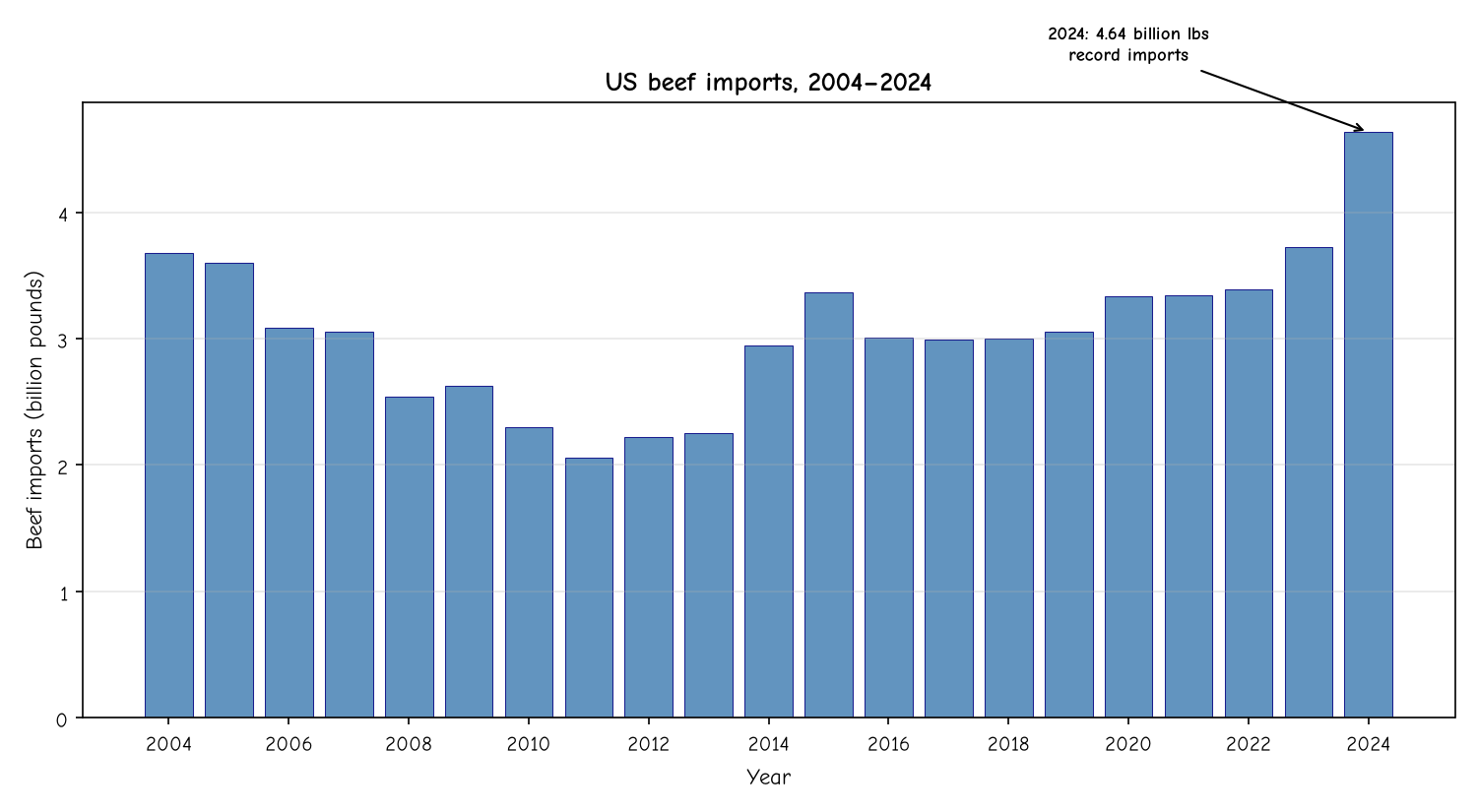
- Beef imports surged to 4.64 billion pounds in 2024, up 24 percent from 2023, as packers scrambled for supply [4].
- The rancher's share of the retail beef dollar has fluctuated between 47 and 58 percent over two decades, with no clear trend toward a smaller cut [4].
- Four companies control about 85 percent of US beef processing, a concentration level that has persisted for over a decade [1].
- The cattle cycle, driven by biology and weather, takes 8 to 12 years to complete, meaning the current shortage cannot be resolved before roughly 2028 [3].
1. Your burger costs more, and nobody is getting rich from it
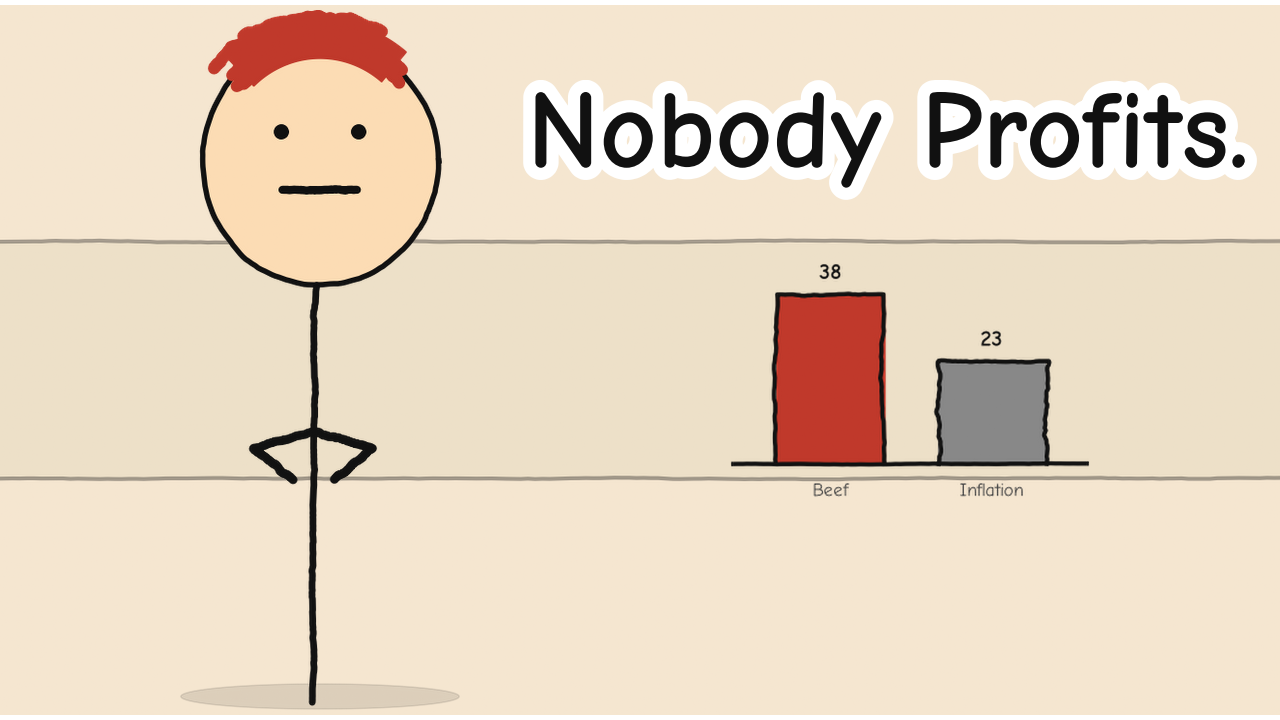
Walk into a grocery store in 2026 and the ground beef section stings. A pound of hamburger that cost $5.82 in 2019 now runs $8.01, according to USDA Economic Research Service data [4]. That is a 38 percent increase in five years. Over the same period, general inflation ran about 23 percent. Beef is outpacing everything in your cart.
Now think about the restaurant. Paul and Jessica Urban own Block 16, a burger restaurant in Omaha, Nebraska. They go through about 300 pounds of ground beef a week, making 2,800 burgers a month. When they opened in 2010, a burger cost $8.95. Today it is $11.95. Paul told the BBC he could charge $13 to maximize profit, but he will not, because he would not want to walk in and pay that himself [1]. So the restaurant absorbs the difference.
Now think about the rancher. Eric Gropper runs about 350 breeding cows on 8,000 acres of grassland in southwest South Dakota, seven miles from the nearest paved road. He sells his calves at auction once a year, and right now the bids are the highest he has ever seen: around $2,500 for a 600-pound calf, up from $2,000 two years ago [1]. He should be celebrating. He is not.
The problem is that everything Gropper buys has also gone up. A pickup truck that cost $40,000 now costs $100,000. A wooden fence post went from $6 to $19. A roll of barbed wire doubled from $60 to $130. His 13 natural wells have run dry from drought, so he trucks in water. He told the BBC: "I'm able to pay my bills, but my input costs are so drastically high that if we didn't have these record prices we'd all be broke. I sit down to do my taxes, and it feels like I made a lot of money. But in the end I really didn't make any more" [1].
This is the kitchen-table version of the story. You pay more for beef. The rancher gets more for his calves but pays more for everything else. The restaurant charges a little more but eats most of the increase. And the meatpacker, the giant corporation in the middle, is losing money on every cow it processes. The money is flowing through the system like water through a sieve. Nobody is catching it.
The instinct, when you hear that four companies control 85 percent of beef processing, is to blame the middleman. That instinct is not wrong about the structure of the industry. But it is wrong about what is happening right now. The packers are not the ones pocketing the difference between what you pay and what the rancher gets. In 2026, there is no difference to pocket. Everyone is just passing higher costs along to the next person, who passes them along again, until the costs reach you, the consumer, who has no one left to pass them to.
The question is why. Why is there a shortage? Why can the packers not raise prices enough to cover their costs? And why does a system that looks like a monopoly behave like a charity?
2. The Jungle and the Packers: a 120-year-old story
The last time Americans were this angry about meat prices and the companies controlling them was 1906. That year, Upton Sinclair published The Jungle, a novel meant to expose the working conditions of immigrants in Chicago's meatpacking plants. The public fixated not on the workers but on what Sinclair wrote about the meat itself: rats shoveled into sausage grinders, tubercular cattle processed for sale, men falling into rendering vats and being sold as lard.
Sinclair's target was the Beef Trust, a cartel of five companies, Armour, Swift, Morris, Cudahy, and Schwarzschild, that controlled the majority of American meat processing at the turn of the century. The Trust fixed prices on both sides of the market. It paid ranchers as little as possible for live cattle and charged consumers as much as possible for dressed beef. The ranchers in the 1890s and 1900s complained that they could not get a fair price at the stockyards because the packers colluded to bid as a bloc. Consumers complained that beef prices never fell even when cattle prices did.
The political response was the Packers and Stockyards Act of 1921, passed after a Federal Trade Commission investigation found that the five major packers had engaged in "unfair, unjust, discriminatory, and unlawful practices" including price manipulation, controlling the supply of cattle, and restraining interstate commerce in meat. The Act gave the Secretary of Agriculture authority to regulate packers, stockyards, and dealers, and to prohibit unfair practices and undue price discrimination. It was the first serious attempt to break the meatpacking oligopoly.
The parallel to today is structural, not behavioral. Four companies, Tyson, JBS, Cargill, and National Beef, control about 85 percent of US beef processing [1]. That is roughly the same level of concentration that existed in 1920, when the FTC found that the Big Five controlled more than 80 percent of the market. The Packers and Stockyards Act is still on the books, administered by the USDA's Agricultural Marketing Service. But enforcement has been sporadic, and the Act has been weakened by decades of regulatory narrowing and court decisions.
What does not carry over from the Sinclair era is the price-fixing behavior. In 1906, the packers were genuinely colluding. They had secret agreements to divide territory, share shipping costs, and avoid competing on price. Today, the four major packers are not accused of formal collusion in the current squeeze. They are losing money. Tyson, the biggest, reported a beef segment loss of more than $500 million in the first half of its 2025 fiscal year [1], and expects a full-year loss of $500 million to $650 million in fiscal 2026 [2]. If the packers were fixing prices, they would be raising them, not absorbing losses.
The real parallel is more subtle. The concentration of the packing industry means that when a shock hits the system, a drought, a disease outbreak, a pandemic, the effects are amplified and distributed unevenly. Four companies running 85 percent of capacity means that when cattle supply drops, those companies cannot simply idle a few small plants. They have massive, fixed-cost facilities that must run near capacity to be profitable. When the cattle are not there, the plants run below capacity, and the fixed costs spread across fewer animals. That is exactly what is happening now.
The history also offers a lesson about political cycles. The outrage of 1906 led to regulation that took 15 years to materialize and was watered down before it arrived. The current outrage, with President Trump himself accusing the packers of price-fixing [1], may follow a similar path. The Packers and Stockyards Act has been amended several times, most recently with rules proposed in 2021 under the Biden administration to strengthen enforcement. Those rules have been slow to implement and face industry resistance. The Meat Institute, the industry trade group, argued in July 2026 that reinstating mandatory country-of-origin labeling would cost consumers and the supply chain more than $1 billion annually [5]. The fight over who controls the beef dollar is not new, and it is not close to settled.
3. How the beef supply chain actually works
To understand why nobody is making money, you need to understand the chain. Beef does not go from a cow to your plate. It goes through at least four distinct stages, each with its own economics, and each stage is getting squeezed in a different way.
Stage one: the cow-calf producer
This is Eric Gropper. He keeps a herd of breeding cows on grassland, mostly in the western United States. The cows have calves, usually in spring. The calves nurse for three to seven months, then are weaned. At that point, the producer decides which female calves (heifers) to keep as replacement breeders and which to sell. The males are castrated to become steers. Most calves are sold at around six months old, at livestock auctions where buyers bid and the hammer sets the price. The producer has almost no pricing power. He takes what the auction gives him [1][3].
The average beef cow herd in the United States is about 47 head, according to the 2022 Census of Agriculture [3]. Operations with 50 or fewer head are usually side businesses, with the operator holding another job. Operations with 100 or more beef cows make up only 10.5 percent of all beef operations but hold 60.5 percent of the beef cow inventory [3]. This is a fragmented, atomistic sector. Hundreds of thousands of small producers, each with no ability to set prices, selling into a market dominated by a few large buyers.
Stage two: the feedlot
After weaning, most calves do not go to slaughter. They go to feedlots, large yards where they are fattened on corn and other grains for the final three to six months of their lives. About 95 percent of US cattle are finished this way [1]. The biggest feedlots hold well over 100,000 cattle at a time. Feedlots with sales of 1,000 or more cattle represent only 7 percent of total feedlot operations but market about 88 percent of fed cattle. Feedlots with 5,000 or more head market about 77 percent [3]. This stage is more concentrated than the cow-calf stage, but still involves many independent operators.
The feedlot buys calves at auction and sells finished cattle to the packer. Its profit depends on the spread between what it pays for calves and feed and what it gets for finished cattle. Right now, that spread is terrible. Brenda Boetel, professor of agricultural economics at the University of Wisconsin-River Falls, told the BBC that feedlots are selling cattle at record prices but buying calves at all-time highs in the first place, so they are not making bigger profits [1].
Stage three: the meatpacker
This is where the concentration lives. Four companies, Tyson, JBS, Cargill, and National Beef, control about 85 percent of American beef processing [1]. The packer slaughters the animal, breaks the carcass into cuts, and sells those cuts to supermarkets, restaurants, and food service companies. The packer's profit depends on the spread between what it pays for live cattle and what it gets for boxed beef.
This spread is called the "packer margin" or the "cutout minus live cattle spread." When cattle are cheap and beef is expensive, the packer makes a fortune. That is what happened in 2020, when the pandemic disrupted processing and cattle prices collapsed while retail beef prices spiked. Tyson's stock hit $93 per share in April 2022 [6], reflecting those fat margins. When cattle are expensive and beef prices cannot rise fast enough to cover it, the packer loses money. That is what is happening now.
Jamie Crumley owns Harpley's Meatpacking in central North Carolina, one of the remaining smaller packers. She told the BBC the price her company pays for live animals has gone up by as much as 60 percent over the past three years. Her plant is built to handle 425 to 450 cattle a day but is running at just 350 because she cannot get more animals. The building, the line, and the staff cost the same either way, so those fixed costs spread across fewer cattle. On any given day, she says she can lose anywhere from $100 to $400 on a single head [1].
Stage four: retail and food service
Supermarkets and restaurants buy boxed beef from packers and sell it to you. They have some pricing power, but it is limited by substitution. If beef gets too expensive, you buy chicken. Or you buy cheaper imported beef. This is the ceiling on the whole system. The packer cannot raise prices indefinitely because the retailer will not pay, and the retailer will not pay because you will switch to chicken.
The USDA's Economic Research Service tracks the "retail equivalent value of beef produced" and the "value of cattle and calf production." In 2024, the retail equivalent value was $161.1 billion, while the value of cattle and calf production was $83.1 billion [4]. The difference, $78 billion, is the combined margin of the feedlot, packer, wholesaler, and retailer. That wedge has grown in absolute dollars, from $35.3 billion in 2004 to $78 billion in 2024. But as a share of the total, the rancher's cut has held roughly steady, fluctuating between 47 and 58 percent over two decades [4]. The wedge is not growing because the packers are taking a bigger share. It is growing because the whole pie is bigger, since beef is more expensive at every stage.
The chain, in short, is a relay race where each runner passes higher costs to the next. The rancher passes higher input costs to the feedlot. The feedlot passes higher calf costs to the packer. The packer tries to pass higher cattle costs to the retailer. The retailer tries to pass them to you. You, at the end, have no one to pass them to. The only question is where the chain breaks. In 2026, it is breaking at the packer, because the packer cannot push prices up fast enough, and at the restaurant, because the restaurant refuses to charge $13 for a cheeseburger.
4. The 2026 squeeze: timeline of a shortage
The current crisis did not start in 2026. It started with a drought that began around 2020 and intensified through 2022 and 2023. More than 60 percent of US cattle are now grazing on drought-hit land [1]. When pasture dries up, ranchers cannot afford to keep their full herds. They sell. They cull older cows. They send heifers to slaughter instead of keeping them as breeders. This adds a temporary surge of beef to the market, which actually suppresses prices for a while. But it means fewer calves will be born the next year, and the year after that.
The US cattle inventory peaked at 94.7 million head in 2019 [3]. By January 1, 2025, it had fallen to 86.7 million, a decline of 8 percent [3]. That is the smallest herd since 1951, when the US population was about 150 million, less than half of what it is today. The country has not had this few cattle since the aftermath of World War II.
The biological clock of a cow is the real constraint. A heifer, a young female, needs about two years before she can produce her first calf. That calf needs another year to reach slaughter weight. So if every rancher in America decided today to expand their herd, the extra beef would not arrive until roughly 2029. As Eric Gropper put it to the BBC, you cannot conjure a cow overnight [1].
The timeline of the squeeze runs roughly as follows:
2020-2022
Drought intensifies across the western and southern Plains. Ranchers begin culling herds. Feed costs rise as corn prices climb. The pandemic disrupts processing, briefly inflating packer margins. Tyson stock peaks at $93 in April 2022 [6].
2023
The herd contraction accelerates. Total US slaughter falls to 33.3 million head, down from 34.8 million in 2022 [4]. Cattle prices begin rising. Tyson's beef segment starts losing money. The company's stock falls from $90 in January 2022 to $46 by October 2023 [6].
2024
The herd hits 87.2 million head as of January 1 [4]. Retail beef prices reach a record $8.01 per pound [4]. Beef imports surge to 4.64 billion pounds, up 24 percent from 2023, as packers scramble for supply [4]. Tyson reports beef segment losses exceeding $500 million in the first half of its fiscal year [1]. The company's stock recovers modestly to the mid-$50s.
2025
The herd falls further to 86.7 million head as of January 1 [3]. Tyson announces network changes on November 21 to "right size its beef business and position it for long-term success," effectively closing or idling plants [7]. The company names Jeff Schomburger to succeed Donnie King as CEO, effective October 2026 [7]. Beef imports from Mexico are disrupted, then resumed, with the Meat Institute issuing a statement on July 24, 2026 supporting the USDA's decision to resume Mexican cattle imports [5].
2026
The squeeze continues. The USDA projects domestic beef production will decrease approximately 3 percent in fiscal 2026 compared to fiscal 2025 [2]. Tyson expects a beef segment operating loss of $500 million to $650 million for the year [2]. The company's total adjusted operating income is expected to be $2.1 billion to $2.3 billion, but that is carried entirely by chicken ($1.9 billion to $2.05 billion) and prepared foods ($1.3 billion to $1.35 billion) [2]. Beef is a drag on the entire company.
The CPI data confirms the consumer experience. The Bureau of Labor Statistics reported that the meats, poultry, fish, and eggs index rose 2.6 percent over the 12 months ending June 2026 [8]. That is lower than the 4.2 percent increase over the 12 months ending December 2024 [9], suggesting the rate of price increase is moderating. But the level is still a record. Moderating inflation at record-high prices means prices are still going up, just more slowly.
Meanwhile, on the Reddit forum r/Cattle, a post titled "Nighttime Heat, No Airflow Cause Thousands of Cattle Deaths Across the Plains" appeared in early August 2026 [10]. One commenter noted that the industry's preference for black-coated cattle, the worst color for heat stress, compounds the problem. Another joked about growing "indoor cows." The community discussions about hay costs, equipment repairs, and the economics of small-scale ranching paint a picture of an industry under stress at every level, from the 47-head hobby operation to the 100,000-head feedlot.
5. The data: cattle numbers, prices, and the wedge
The story becomes clearer when you look at the numbers. The USDA's Economic Research Service maintains a dataset going back decades that tracks the US beef industry from the ranch to the grocery store [4]. Three patterns stand out.
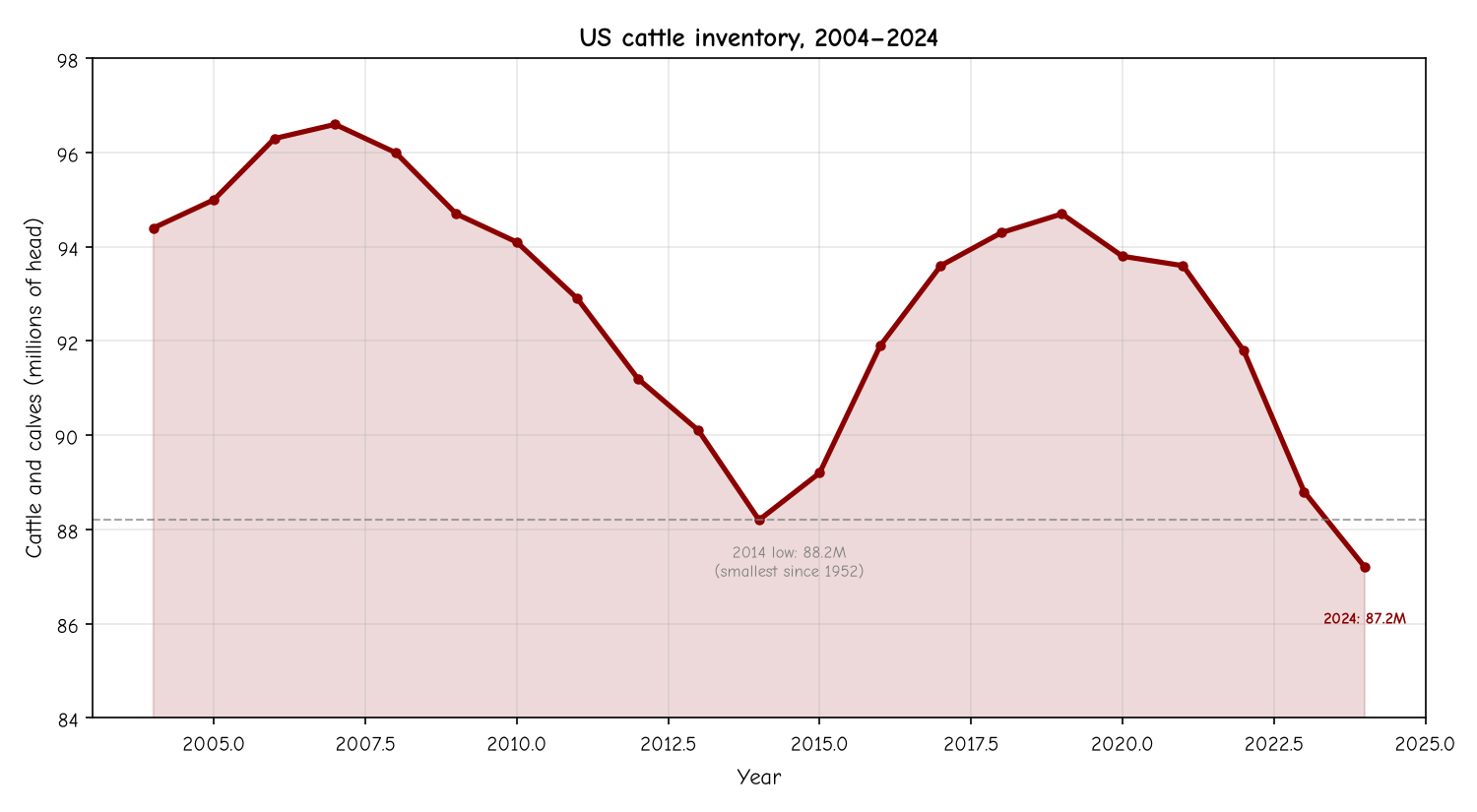
First, the cattle herd is in a historic contraction. The inventory peaked at 94.7 million head in 2019 and has fallen every year since, reaching 87.2 million as of January 1, 2024, and 86.7 million as of January 1, 2025 [3][4]. The previous cyclical low was 88.2 million in 2014, which was the smallest herd since 1952. We are now below that. The cattle cycle, which the USDA describes as an 8-to-12-year pattern of expansion and contraction driven by prices, weather, and biology, is in its contraction phase [3]. The last full cycle began in 2004 at 94.4 million head, expanded to 96.6 million by 2007, then contracted through drought and high feed prices to the 2014 low of 88.2 million. The current cycle peaked in 2019 and has been contracting for six years. If the pattern holds, the bottom is near, but the recovery will take years.
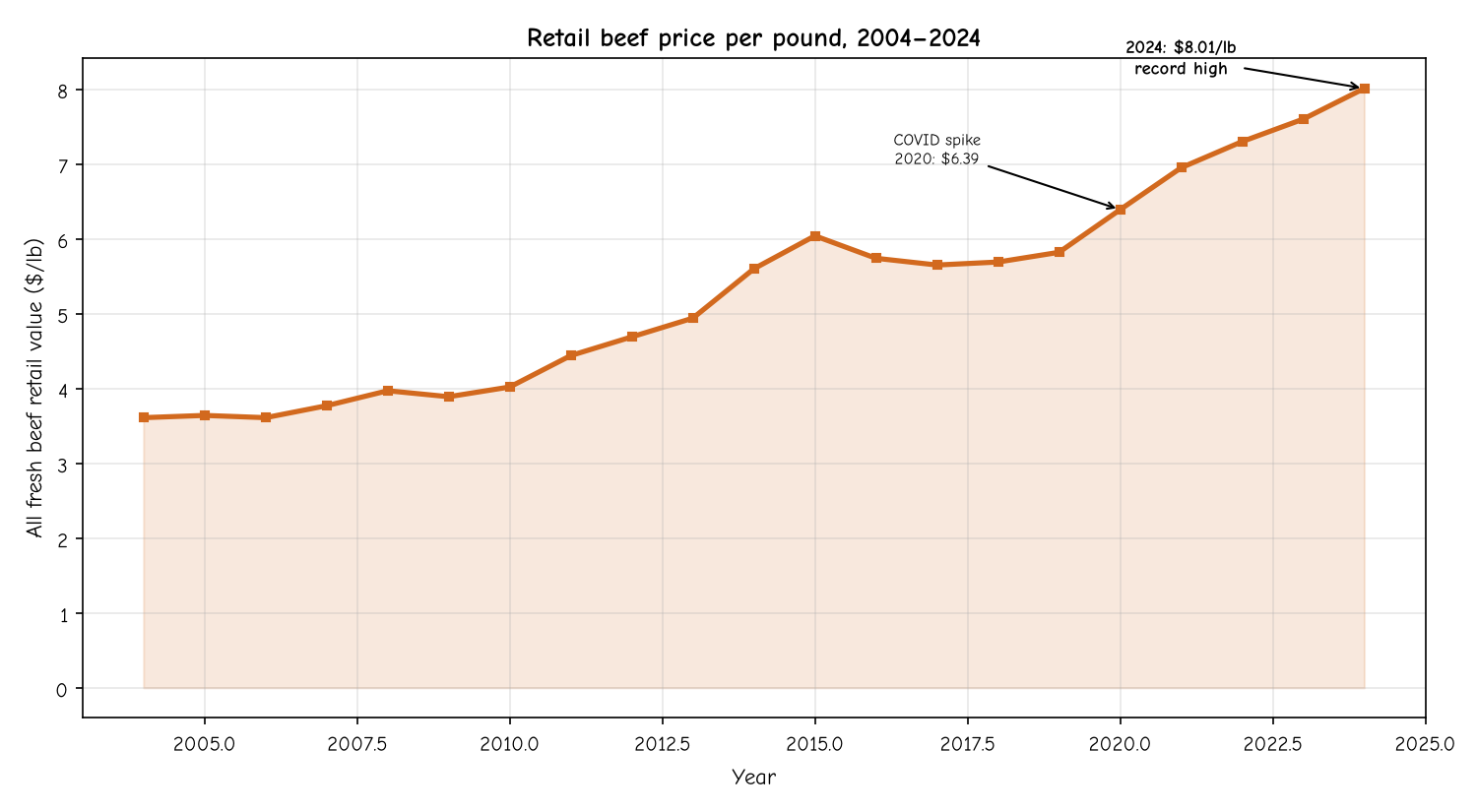
Second, retail beef prices have risen relentlessly. The "all fresh beef retail value" tracked by ERS went from $3.61 per pound in 2004 to $8.01 in 2024, a 122 percent increase over two decades [4]. The acceleration is recent. From 2004 to 2019, the price rose from $3.61 to $5.82, a 61 percent increase over 15 years. From 2019 to 2024, it rose from $5.82 to $8.01, a 38 percent increase in just five years. The pandemic and the drought compressed what would have been a gradual rise into a steep one. The retail equivalent value of all beef produced in the US reached $161.1 billion in 2024, up from $111.1 billion in 2019 [4]. That is a 45 percent increase in the total value of the market in five years.
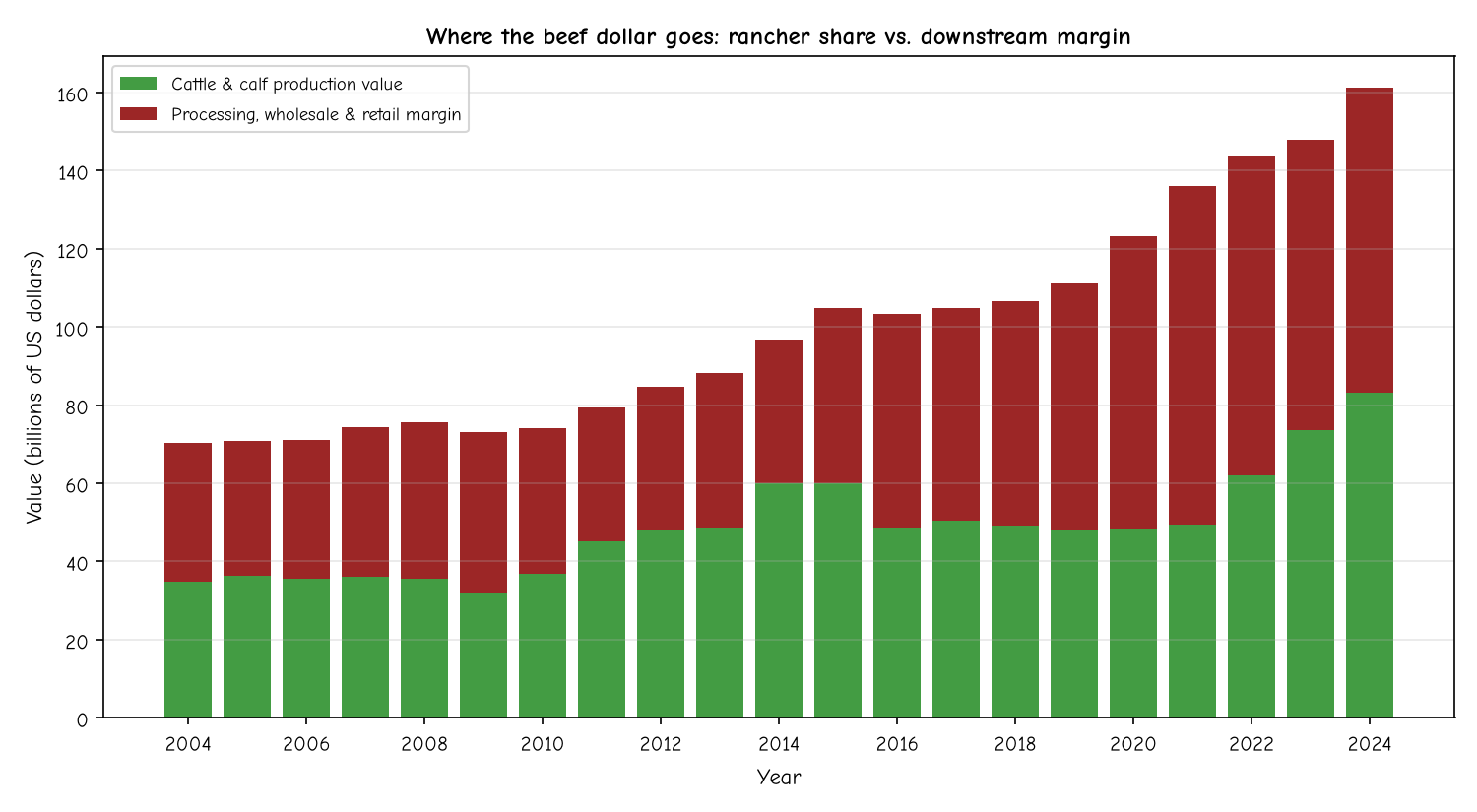
Third, the distribution of that value between ranchers and the downstream supply chain has not changed dramatically. In 2004, the value of cattle and calf production was $34.9 billion out of a retail equivalent value of $70.2 billion, meaning ranchers captured about 50 percent of the retail beef dollar [4]. In 2024, ranchers captured $83.1 billion out of $161.1 billion, or about 52 percent [4]. The rancher's share has bounced between 47 percent (in 2009, when the recession hit) and 58 percent (in 2014, when the herd was at its previous low and cattle prices spiked). It is not on a clear downward trend. The downstream margin, the wedge captured by feedlots, packers, wholesalers, and retailers combined, has grown in absolute terms from $35.3 billion in 2004 to $78 billion in 2024, but as a share of the total it has been roughly stable.
This is the finding that complicates the "greedy middleman" narrative. If the packers were systematically taking a larger share of the beef dollar, the rancher's share would be declining. It is not. The wedge is bigger because the whole market is bigger. Everyone is getting more dollars. The problem is that everyone's costs have also gone up, and in many cases the costs have gone up faster than the revenue.
The data also shows the import surge. US beef imports jumped from 3.725 billion pounds in 2023 to 4.635 billion pounds in 2024, a 24 percent increase in a single year [4]. That is a record. The US is the world's largest beef producer and consumer by volume, but it is also the second-largest importer, with most imports going into ground beef [3]. When domestic supply contracts, imports fill the gap. The imports come primarily from Canada (1.013 billion pounds in 2024) and Mexico (597 million pounds), with the rest from Australia, Brazil, and other suppliers [4]. The Meat Institute's July 2026 statement supporting the resumption of Mexican cattle imports [5] reflects the industry's dependence on foreign supply to keep processing plants running.
The export side tells a different story. US beef exports were 3.0 billion pounds in 2024, about 11.1 percent of domestic production [4]. The top markets are Japan (642 million pounds), South Korea (630 million pounds), Mexico (343 million pounds), and China (475 million pounds) [4]. Exports have been roughly flat since 2021, when they hit 3.4 billion pounds. The strong dollar and the high domestic prices have made US beef less competitive abroad. The export market is not absorbing the shortage. If anything, it is a small offset, but it is not growing.
The statistical picture, then, is of a market where supply has contracted, prices have risen at every level, imports have surged to fill the gap, and the distribution of the total value between ranchers and the rest of the chain has stayed roughly the same. The squeeze is not a story about a shifting share. It is a story about a rising tide of costs that is drowning everyone equally.
6. Tyson's losses and the packer paradox
If the packers are not the villains, what are they? The answer, at least for Tyson Foods, is that they are a company being ground down by the same forces grinding down everyone else, just at a larger scale and with more visibility.
Tyson is the only one of the Big Four packers that is publicly traded and reports segment-level financials. JBS is listed in Brazil but its US beef operations are buried in consolidated numbers. Cargill is private. National Beef is owned by Marfrig, a Brazilian company. So Tyson is the window into the packer's economics.
The numbers are stark. In fiscal 2025 (ending September 27, 2025), Tyson reported total sales of $54.4 billion and adjusted operating income of $2.287 billion, a 4.1 percent adjusted operating margin [7]. But that profit was entirely from chicken and prepared foods. The beef segment lost money. In the first half of fiscal 2025, Tyson lost more than $500 million on beef [1]. For fiscal 2026, the company expects a beef segment operating loss of $500 million to $650 million [2]. The USDA projects domestic beef production will decrease about 3 percent in fiscal 2026 compared to fiscal 2025 [2], meaning the supply situation is getting worse, not better.
The company's own guidance tells the story of a diversified food company being dragged by one segment. Chicken is expected to generate $1.9 billion to $2.05 billion in operating income in fiscal 2026. Prepared foods (brands like Jimmy Dean, Hillshire Farm, and Ball Park) are expected to generate $1.3 billion to $1.35 billion. International, $150 million to $200 million. Pork, $250 million to $300 million. Beef, negative $500 million to $650 million [2]. Add it up and the total adjusted operating income is $2.1 billion to $2.3 billion, but beef is a $500 million-plus hole.
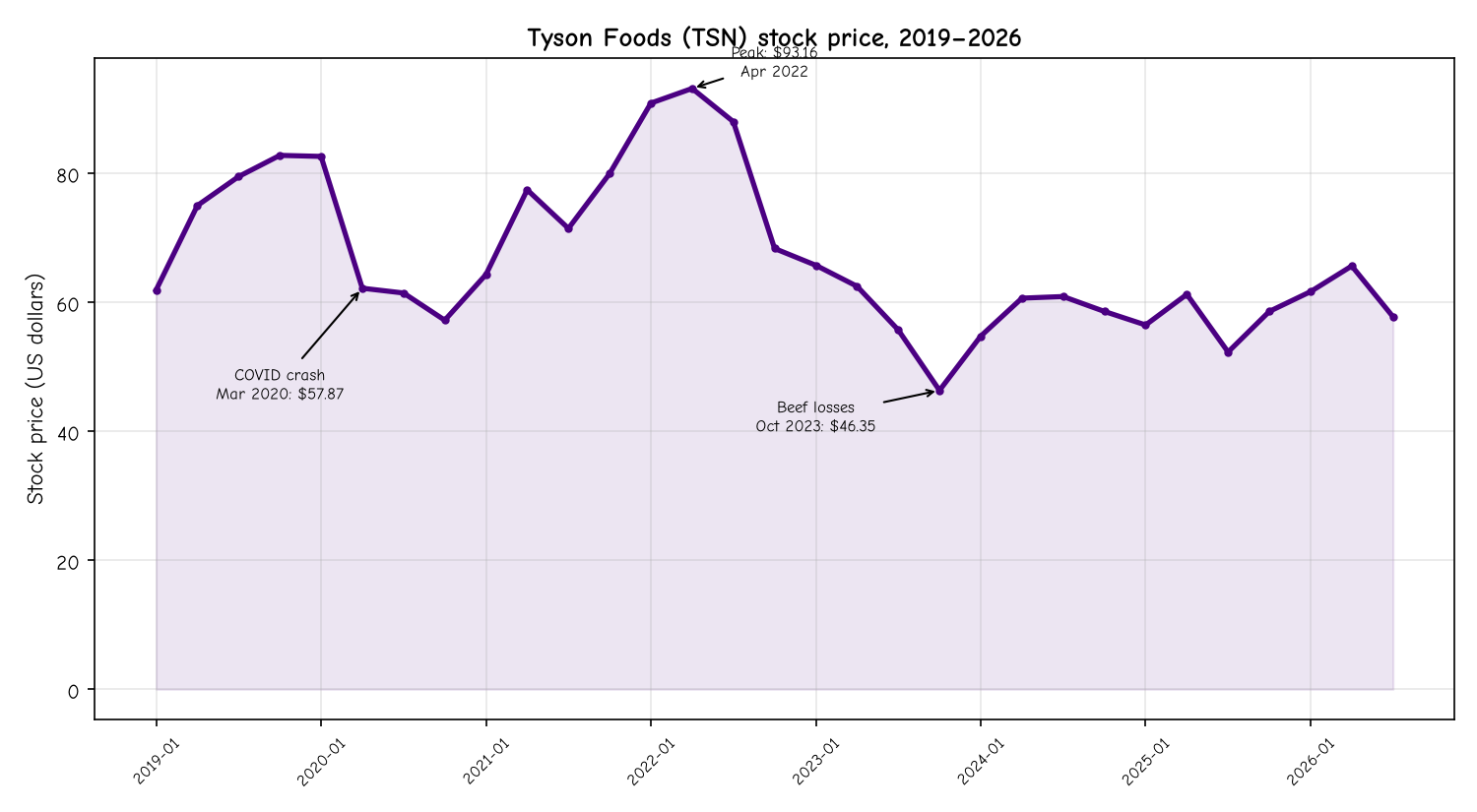
Tyson's stock price reflects this. After peaking at $93 in April 2022, when pandemic-era packer margins were fat, the stock collapsed to $46 by October 2023 as beef losses mounted [6]. It recovered to the mid-$60s in early 2026 on the strength of chicken and prepared foods, but has since drifted back to around $58 as of August 2026 [6]. The market is valuing Tyson as a chicken and prepared foods company with a beef problem, not as a beef powerhouse.
On November 21, 2025, Tyson announced "network changes designed to right size its beef business and position it for long-term success" [7]. That is corporate language for closing plants. The company did not specify which facilities, but the logic is clear. If you cannot get enough cattle to run your plants at capacity, you close the least efficient plants and concentrate volume in the ones that remain. This is the rational response to a supply shortage, but it has a side effect: it reduces the industry's total processing capacity, which means that when the cattle herd eventually recovers, the remaining plants will be even more dominant.
This is the packer paradox. The concentration that everyone worries about, four companies controlling 85 percent of processing, is not producing excess profits right now. It is producing excess losses, because the concentrated plants are too big to run efficiently at reduced volume. But the same concentration means that when the cycle turns and cattle supply increases, the surviving plants will capture all the upside. The structure that looks exploitative during a shortage will look exploitative again during a recovery, even if it is simply the economics of scale.
The CEO transition adds another layer. On May 28, 2026, Tyson announced that Jeff Schomburger would succeed Donnie King as President and CEO, effective October 4, 2026 [7]. King had overseen the company through the worst of the beef losses. Schomburger, a long-time Tyson executive, inherits a company where the beef segment is bleeding but chicken and prepared foods are thriving. The strategic question for the new CEO is whether to invest in beef for the eventual recovery or to accelerate the shrinkage and let chicken carry the company.
The smaller packers face the same math at a smaller scale. Jamie Crumley's Harpley's Meatpacking in North Carolina is running at 350 cattle per day against a capacity of 425 to 450, losing $100 to $400 per head [1]. She cannot close her plant without going out of business entirely, but she cannot make money running it below capacity. This is the squeeze at every scale.
7. Second-order effects: imports, climate, and the three-year lag
The beef squeeze does not stay in the beef market. It ripples outward in ways that are not obvious until you trace them.
The import dependency loop
When domestic cattle supply contracts, packers turn to imports. US beef imports hit a record 4.635 billion pounds in 2024, up 24 percent from 2023 [4]. Most of that is lean beef trimmings from Australia, Brazil, and Central America, blended with fattier domestic trimmings to make ground beef. The US also imports live cattle, about 2 million head in 2024, split roughly between Mexico (1.249 million) and Canada (793,000) [4]. When the USDA temporarily suspended Mexican cattle imports in 2025 over a screwworm outbreak, the Meat Institute pushed for resumption, arguing that the domestic supply chain needed the animals [5]. The US is now structurally dependent on foreign cattle and beef to keep its processing plants running. That dependency creates political leverage for exporting countries and vulnerability for the US. A trade dispute, a disease outbreak, or a tariff could cut off the supply that is currently filling the gap.
The climate feedback
The drought that triggered the herd contraction is not a one-off event. Over 60 percent of US cattle are grazing on drought-affected land [1]. Eric Gropper's 13 natural wells have run dry [1]. The Reddit r/cattle community reported thousands of cattle deaths from nighttime heat across the Plains in August 2026, with one commenter noting that the industry's preference for black-coated cattle worsens heat stress [10]. Climate change is making the western Plains hotter and drier, which means the carrying capacity of grazing land is declining. A rancher who could support 350 cows on 8,000 acres in 2010 may be able to support only 300 in 2026, because there is less grass and less water. This is a slow, structural squeeze on supply that does not show up in any single year's data but compounds over time. The cattle cycle has always been weather-driven, but the weather is now trending in one direction.
The three-year lag
The biological constraint is the most important second-order effect. A heifer needs two years to reach breeding age. Her calf needs another year to reach slaughter weight. So the decision to expand the herd made today produces beef in roughly 2029. This means the cattle cycle has a built-in lag that turns temporary shortages into multi-year events. The 2014 low of 88.2 million head was followed by a recovery that took five years to reach the 2019 peak of 94.7 million [3]. If the current contraction bottoms out in 2026 or 2027 at around 85 million head, the recovery to 94 million might not happen until 2031 or 2032. The squeeze is not a one-year story. It is a five-to-seven-year story.
The substitution ceiling
The reason packers cannot raise prices enough to cover their costs is that consumers can switch. Chicken is cheaper. Pork is cheaper. Imported beef is cheaper. The USDA projects domestic protein production (beef, pork, chicken, and turkey combined) will increase about 1 percent in fiscal 2026 [2], but that increase is coming from chicken, not beef. Chicken production is projected to rise 3 percent, while beef production falls 3 percent [2]. Tyson's own guidance reflects this: chicken is expected to generate $1.9 billion to $2.05 billion in operating income, while beef loses $500 million to $650 million [2]. The market is substituting away from beef at the margin, and that substitution caps how high beef prices can go. If ground beef hits $10 per pound, more people switch to chicken, and the packer cannot pass through the cost. The substitution ceiling is what turns a shortage into a loss rather than a windfall.
The political risk
The concentration of the packing industry is a political vulnerability. When four companies control 85 percent of processing, and beef prices are at record highs, the political pressure to "do something" is intense. President Trump has already accused the packers of price-fixing [1]. The Packers and Stockyards Act is still on the books, and the USDA has proposed rules to strengthen enforcement. The Meat Institute is fighting back, arguing in July 2026 that reinstating mandatory country-of-origin labeling would cost the supply chain more than $1 billion annually [5]. The political fight is not about whether the packers are currently profiteering, because the financials show they are not. It is about whether the structure of the industry is inherently exploitative, regardless of the current cycle. The answer to that question depends on your time horizon. In a shortage, the structure produces losses. In a recovery, it produces windfalls. Over the full cycle, the packers capture more upside than downside, because they can run their plants at full capacity when cattle are plentiful and squeeze margins, while ranchers take whatever the auction gives them.
The financial market signal
Tyson's stock price tells you what investors think about the beef business. After peaking at $93 in April 2022, the stock fell to $46 by October 2023 and has recovered only to around $58 as of August 2026 [6]. That is a 37 percent decline from the peak over four years. The market is saying that the beef business is structurally less profitable than it was, and that the chicken and prepared foods businesses are what make Tyson worth owning. If you are an investor, the signal is clear: the money in protein is in chicken and branded foods, not in commodity beef processing.
8. What happens next, and what to watch
The most likely scenario is that the cattle herd continues to contract for another year or two, bottoms out around 85 million head, and then begins a slow recovery that takes until roughly 2030 or 2031 to return to the 2019 peak. During the contraction, beef prices stay high, packers keep losing money, and imports keep rising. During the recovery, cattle prices moderate, packer margins improve, and the political pressure on the industry fades, until the next contraction begins around 2035.
The less likely but more dangerous scenario is that climate change accelerates the drought cycle and the herd does not recover. If the carrying capacity of western grazing land is permanently reduced, the US cattle herd may settle at a new, lower equilibrium, say 82 to 84 million head, and stay there. In that scenario, beef becomes permanently more expensive, imports become permanently more important, and the political fight over the packing industry intensifies as consumers blame someone for the higher prices.
The scenario nobody is talking about is a disease outbreak. The 2025 screwworm scare that briefly shut down Mexican cattle imports [5] was a warning. If a major disease, foot-and-mouth, bovine spongiform encephalopathy, or something new, hits the US herd, the contraction could accelerate dramatically. The US banned Canadian cattle imports in 2003 after a single BSE case, and it took years to fully resume trade [3]. A domestic outbreak would be far more disruptive.
For a normal person, the takeaways are practical. Beef is going to stay expensive for at least two to three more years. If you are budgeting for groceries, plan for it. If you are a rancher, the record calf prices are real but so are the record costs, and the math does not improve until the herd expands. If you are an investor, Tyson is a chicken company with a beef problem, and the beef problem is not going away soon. If you are a policymaker, the question is not whether the packers are price-fixing right now, because the financials show they are losing money. The question is whether the structure of the industry, four companies controlling 85 percent of processing, will produce windfall profits during the next recovery that look like profiteering to consumers and politicians, even if they are just the economics of scale working in the packers' favor.
The thing to watch is the January 2027 cattle inventory report from the USDA's National Agricultural Statistics Service. If the herd has stabilized or ticked up, the recovery is beginning. If it has fallen again, the squeeze has another year to run. The second thing to watch is Tyson's beef segment results. When the quarterly loss starts shrinking, the bottom is near. When it turns positive, the cycle has turned. The third thing to watch is the weather. If the western drought breaks in 2027, ranchers will start keeping heifers and rebuilding. If it does not, the herd keeps shrinking and the squeeze keeps going.
The beef price squeeze of 2026 is not a story about greedy middlemen. It is a story about biology, weather, and the economics of a concentrated industry facing a supply shock it cannot control. The rancher is not broke because the packer is stealing from him. The rancher is broke because his costs went up and his calves take three years to produce. The packer is not profiting because the packer cannot raise prices fast enough to cover the cost of cattle that are not there. The consumer is paying record prices because there are fewer cattle than at any point since 1951. The money is flowing through the system, and nobody is catching it. That will change when the herd recovers. But the herd is not recovering yet.
Sources
- BBC News, "US beef prices have soared but farmers aren't making more money," August 6, 2026. https://www.bbc.com/news/articles/cdrv0k0j662o
- Tyson Foods, "Tyson Foods Reports Third Quarter 2026 Results," August 3, 2026. https://www.tysonfoods.com/news/news-releases/2026/8/tyson-foods-reports-third-quarter-2026-results
- USDA Economic Research Service, "Cattle & Beef, Sector at a Glance," updated May 22, 2025. https://www.ers.usda.gov/topics/animal-products/cattle-beef/sector-at-a-glance/
- USDA Economic Research Service, "Cattle & Beef, Statistics & Information," updated July 2, 2025. https://www.ers.usda.gov/topics/animal-products/cattle-beef/statistics-information/
- Meat Institute, news page, accessed August 7, 2026. https://www.meatinstitute.org/index.php?ht=d/sp/i/143849/pid/143849
- Yahoo Finance, Tyson Foods (TSN) historical price data, accessed August 7, 2026. https://query1.finance.yahoo.com/v8/finance/chart/TSN
- Tyson Foods, news releases page, accessed August 7, 2026. https://www.tysonfoods.com/news/news-releases
- US Bureau of Labor Statistics, "Consumer Price Index, June 2026," released July 14, 2026. https://www.bls.gov/news.release/archives/cpi_07142026.htm
- US Bureau of Labor Statistics, "Consumer Price Index, December 2024," released January 15, 2025. https://www.bls.gov/news.release/archives/cpi_01152025.htm
- Reddit, r/Cattle community, accessed August 7, 2026. https://www.reddit.com/r/Cattle/