Splunk CVE-2026-20253 is the sort of bug that makes defenders check the locks on the guardhouse. The affected product is Splunk Enterprise, often used as the log search, monitoring, and SIEM backbone for production environments. The key number is 9.8, the CVSSv3.1 score Splunk assigned to an unauthenticated PostgreSQL sidecar flaw that can let a network-reachable attacker create or truncate files on vulnerable servers, according to the Splunk security advisory.
CISA pressure turned this from a normal maintenance ticket into a weekend incident. NIST's NVD entry says CVE-2026-20253 was added to CISA's Known Exploited Vulnerabilities Catalog on June 18, 2026, with a due date of June 21, 2026, after CISA marked exploitation as active, automatable, and capable of total technical impact on the CVE detail page. That is three calendar days for federal civilian agencies, and it is a useful private-sector signal: if Splunk can see your estate, your estate can often reach Splunk back.
The angle is simple. Treat your telemetry stack as production attack surface, not passive plumbing. Data Today has covered the same pattern in a prior Splunk Enterprise flaw guide: security tools inherit trust, network reach, and operator complacency. Attackers like all three.
What actually broke inside Splunk Enterprise?
The vulnerable component is Splunk Enterprise's PostgreSQL sidecar service. Splunk says the issue affects Splunk Enterprise 10.2.0 to 10.2.3 and Splunk Enterprise 10.0.0 to 10.0.6, while Enterprise 9.4 and earlier are unaffected in the vendor advisory. The fixed releases are Splunk Enterprise 10.4.0, 10.2.4, and 10.0.7, or later.
The bug class is missing authentication for a critical function, tracked as CWE-306. Splunk's advisory says an unauthenticated, network-reachable user could invoke file operations through the PostgreSQL sidecar endpoint without credentials, and NVD repeats the same scope in its CVE record. The practical risk is bigger than the phrase file operations sounds. Creating or truncating arbitrary files on a server that indexes your security data is already bad. Turning that primitive into code execution makes it a production incident.
That escalation path is no longer theoretical. watchTowr Labs published a technical analysis on June 12 showing that Splunk Web could proxy requests to the local PostgreSQL sidecar API and that the backup path allowed file creation and truncation, then walked the chain toward controlled file write and code execution in its technical write-up. The post is written with plenty of researcher swagger, but the operational message is dry: the sidecar endpoint should never have been reachable in a way that made external web requests matter.
Splunk updated its advisory on June 18, 2026, saying its Product Security Incident Response Team had become aware of limited exploitation and strongly recommended upgrading to a fixed release in the same advisory. That update is the line where a patch advisory becomes a hunt task.
How fast did the patch window collapse?
The timeline matters because it tells you how to staff the response. Splunk published the advisory on June 10, 2026, watchTowr published exploit-path details on June 12, Splunk added limited exploitation language on June 18, and the CISA KEV due date landed on June 21, according to Splunk, watchTowr, and NIST's CISA KEV fields for the CVE. That is 11 days from disclosure to federal deadline, and 3 days from KEV addition to due date.
The chart below compresses the clock: disclosure at day 0, public technical analysis at day 2, Splunk's workaround update at day 5, active exploitation and KEV at day 8, and the federal due date at day 11.
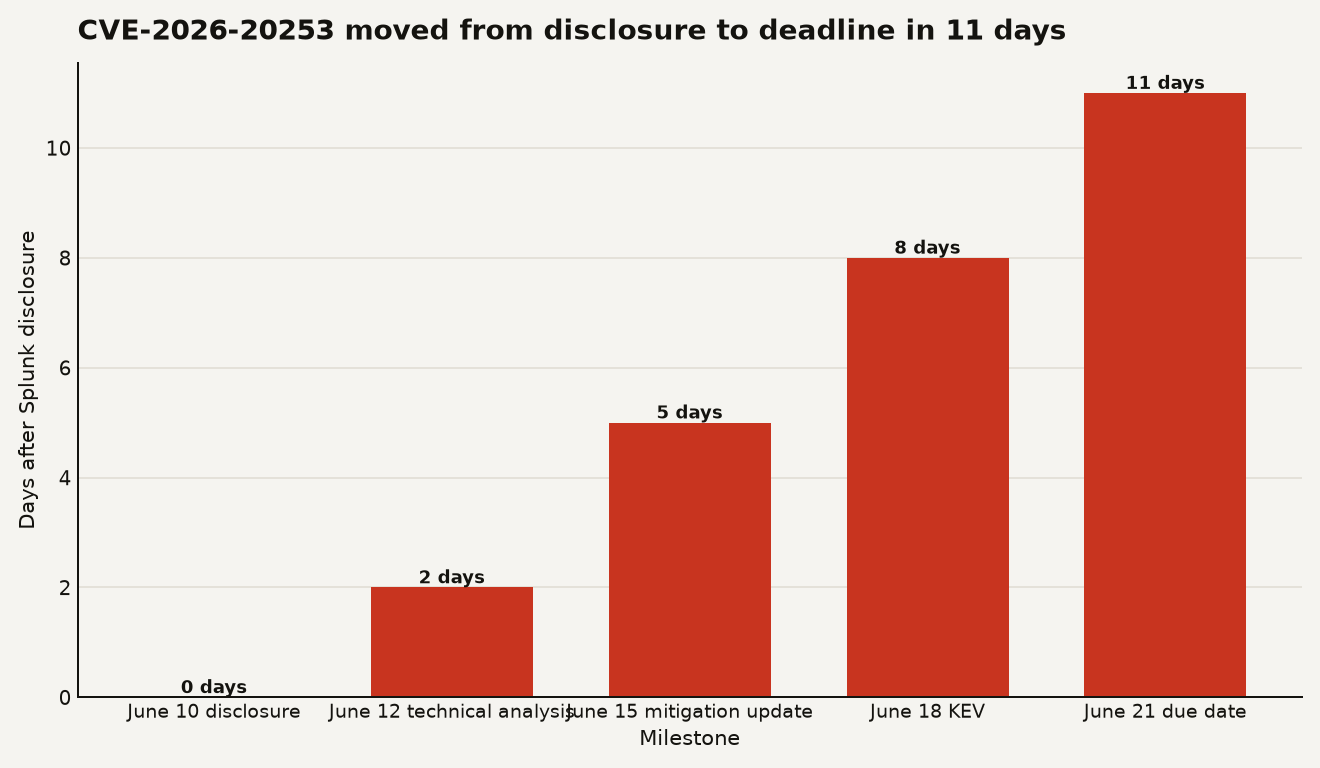
This is the part many patch programs still miss. CVSS tells you severity. The exploit timeline tells you whether your change board is now theater. A weekly vulnerability meeting will lose to a bug that moves from public advisory to exploitation language in 8 days.
Why should defenders treat their SIEM like an exposed app?
Splunk is often wired into everything. It receives logs from identity systems, firewalls, endpoint tools, cloud accounts, app fleets, deployment automation, and homegrown services. That makes a compromised Splunk node a high-trust staging point, especially when firewall rules already allow ingestion, management, and admin workflows.
This is the operator impact:
- Your log system can become a blind spot. If an attacker can tamper with files or run code on a Splunk server, your investigation data may become incomplete, delayed, or polluted.
- Your SIEM may have privileged network reach. Search heads, indexers, deployment servers, and heavy forwarders often sit on management networks that app servers cannot reach.
- Your incident response workflow depends on the tool under attack. If Splunk alerts are your first page, you need a second way to validate Splunk itself during a Splunk incident.
- Your rollback plan may conflict with evidence preservation. Fast patching is good. Wiping the only useful forensic traces is expensive.
CISA's KEV language on the NVD page says stakeholders are responsible for evaluating each asset's internet exposure and following BOD 26-04 patching guidelines for this CVE on the NVD record. Private operators should steal that sentence. The right unit of work is not every Splunk install in the abstract. It is every affected Splunk Enterprise 10.0 or 10.2 node, ranked by exposure, business role, and sidecar status.
The false comfort here is internal-only deployment. Internal reach still counts if any compromised workload, VPN user, partner path, or admin subnet can hit Splunk Web on port 8000. watchTowr's analysis specifically showed the main Splunk web application proxying requests toward the local sidecar path in its exploit walkthrough. A production attacker does not need Shodan if your first infected workload can see the management plane.
What should operators do before the Sunday, June 21 deadline?
Start with asset truth. Do not ask whether the company uses Splunk. Ask where Splunk Enterprise 10.0.0 to 10.0.6 and 10.2.0 to 10.2.3 are running, including lab search heads, cloud images, disaster recovery hosts, and forgotten proof-of-concepts. Splunk lists those exact affected branches and fixed versions in the product status table.
Then run a short, ordered response:
- Patch exposed and reachable Splunk Enterprise first. Upgrade affected 10.2 nodes to 10.2.4 or later, affected 10.0 nodes to 10.0.7 or later, or move to 10.4.0 or later, following the Splunk advisory.
- Remove unnecessary reachability. Restrict Splunk Web and management paths to admin networks, jump hosts, or zero trust access brokers. A network-reachable unauthenticated flaw deserves network containment before the maintenance window starts.
- Assume exposed vulnerable nodes need triage. Splunk says it became aware of limited exploitation in June 2026 in the advisory changelog, so patching alone should not close the ticket for internet-facing or broadly reachable nodes.
- Preserve logs outside Splunk. Export host telemetry, web access logs, process execution, file integrity alerts, and network flow data to a second store before restarting high-value nodes.
- Verify the sidecar state. Splunk documents the PostgreSQL sidecar configuration under the
[postgres]stanza, and the setting can be disabled inserver.confin the sidecar configuration documentation.
For hunting, look for abnormal requests to PostgreSQL recovery paths, unusual file creation under Splunk directories, unexpected changes to app scripts, new files under web-accessible Splunk paths, and outbound PostgreSQL connections from Splunk hosts to unfamiliar destinations. The watchTowr chain used backup and restore behavior, attacker-controlled database content, a .pgpass file path, and writes as the splunk user in the published analysis. Keep the hunt focused on the mechanics. Fancy dashboards can wait.
What if you cannot patch every Splunk node today?
Splunk gives a workaround: disable the PostgreSQL sidecar service by adding [postgres] with disabled = true to $SPLUNK_HOME/etc/system/local/server.conf, then restart Splunk Enterprise, according to the vendor mitigation section. That is useful, but it is not free.
Splunk also warns that disabling PostgreSQL breaks Edge Processor, OpAmp, and SPL2 data pipelines on affected instances in the same advisory. Core search, indexing, and dashboard functionality are listed as unaffected. That split gives operators a practical decision tree.
If the instance is a normal search or indexing node and does not use those features, disable the sidecar as a temporary containment step while you schedule the upgrade. If it runs Edge Processor, OpAmp, or SPL2 pipelines, do not flip the switch blindly. Move the node behind stricter network controls, snapshot it for forensics, and patch with a tested rollback plan. Breaking the telemetry pipeline during an active exploitation window is a gift with wrapping paper.
Also avoid a common trap: patching only the obvious production cluster. Splunk infrastructure tends to accrete helpers. Deployment servers, test search heads, stale AMIs, restore environments, and vendor-managed boxes can keep the vulnerable pattern alive after the main cluster is clean. The Fortinet credential stories had the same lesson, which is why we pushed for a full reset plan in our Fortinet exposure guide. Security tooling does not get a smaller blast radius because it has a noble job title.
Can your detector survive being the target?
This flaw is a reminder to put observability tools into the same threat model as customer-facing apps. Splunk Enterprise servers need asset owners, patch SLAs, network segmentation, external exposure checks, EDR coverage, immutable backups, and out-of-band monitoring. If the tool that tells you what happened can be rewritten by the thing that happened, you have built a witness with a glass jaw.
The bet to make after CVE-2026-20253 is boring and strong: maintain a live inventory of security infrastructure, test whether its management planes are reachable from ordinary workloads, and preapprove emergency changes for KEV-listed bugs with active exploitation. The bet to avoid is waiting for a clean IOC list. With a 9.8 unauthenticated flaw, a public exploitation chain, and a June 21, 2026 federal due date, the clock is already doing the incident manager's job.
Sources
- Splunk: SVD-2026-0603 Unauthenticated Arbitrary File Creation and Truncation in a PostgreSQL Sidecar Service Endpoint in Splunk Enterprise
- NIST NVD: CVE-2026-20253 Detail
- watchTowr Labs: Why Use App-Level Auth When Every Database Has Auth? Splunk Enterprise CVE-2026-20253 Pre-Auth RCE
- Splunk documentation: Sidecar configuration settings
- CISA: BOD 26-04 Prioritizing Security Updates Based on Risk