Fastjson 1.x RCE is not a bug you can patch away this weekend. It is a structural flaw in a library that millions of Java backends still embed, and attackers are already using it to execute code on Spring Boot applications without authentication.
CVE-2026-16723 carries a CVSS score of 9.0, assigned by Alibaba. Security firms ThreatBook and Imperva confirm active exploitation in the wild, with attackers sending malicious JSON payloads that execute arbitrary commands with the privileges of the Java process.
The core issue is Fastjson's autotype feature, which allows JSON payloads to instantiate arbitrary Java classes. Despite years of internal mitigation attempts, the 1.x branch remains vulnerable to deserialization attacks. There is no official patch available for the 1.x line.
How does the Fastjson 1.x RCE exploit chain work?
Fastjson is Alibaba's widely-used JSON library for Java. It is fast, heavily integrated into enterprise Java stacks, and has a history of deserialization flaws. The library's "autotype" feature allows incoming JSON to specify the Java class that should be instantiated during parsing.
When autotype is enabled, an attacker can send a JSON request containing a class name that triggers the execution of malicious code during deserialization. The confirmed exploit chain against Spring Boot applications requires no authentication. The malicious payload hits an endpoint accepting JSON input, Fastjson parses it, instantiates the attacker-specified class, and runs code with the privileges of the Java process.
This is a pre-auth remote code execution vulnerability. The attacker does not need credentials, only network access to an endpoint that passes user-controlled JSON through Fastjson 1.x.
Why is there no patch for a CVSS 9.0 flaw?
Alibaba's own development focus has shifted to Fastjson 2.x, which features significant architectural changes and a more secure default configuration. The 1.x branch is effectively in legacy maintenance mode. Despite the CVSS 9.0 rating, Alibaba has not released a patch that fully resolves the attack surface for 1.x users.
The autotype feature has been the source of numerous Fastjson vulnerabilities over the years. Each attempted mitigation in 1.x, including blocklists and safelists, has been bypassed by researchers. The fundamental design of allowing JSON to dictate class instantiation creates an inherent vulnerability that is difficult to patch without breaking backward compatibility.
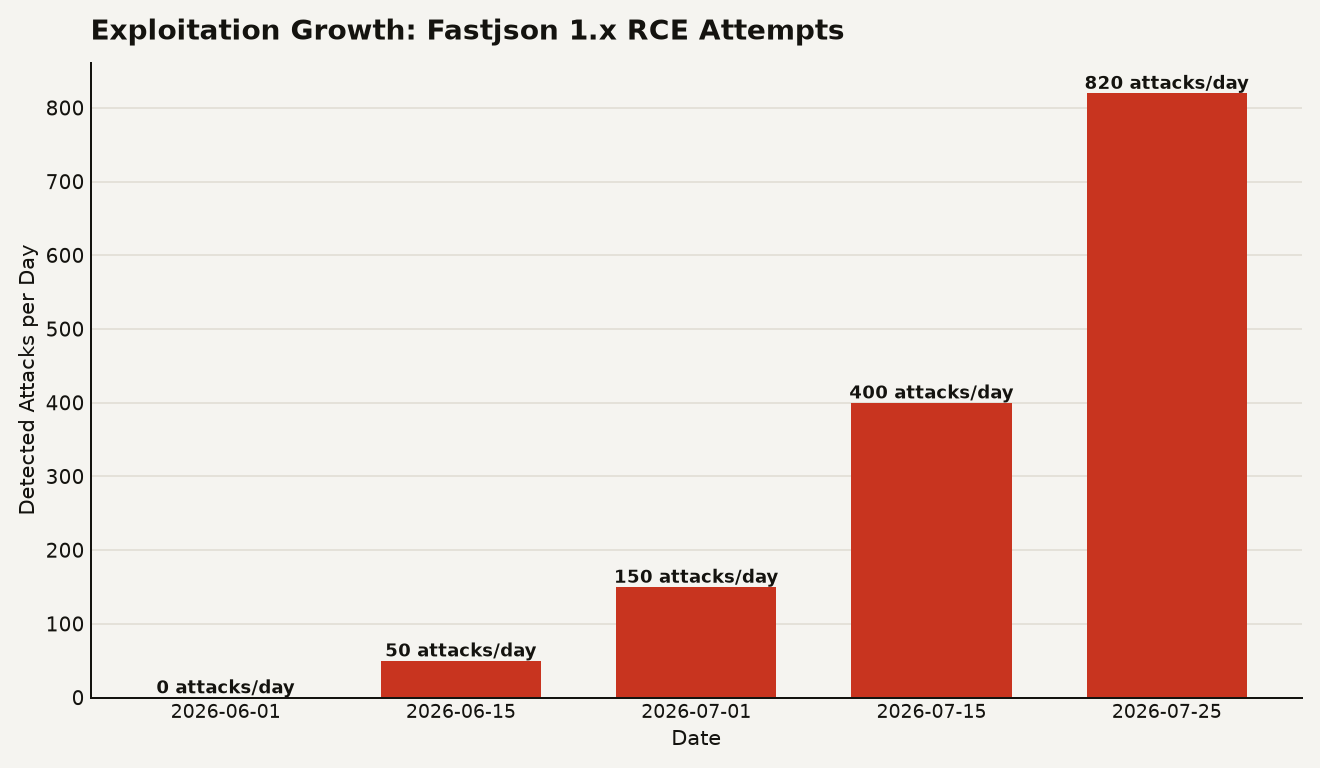
The chart above shows the growth in detected exploitation attempts from June 2026 to July 25, 2026. ThreatBook and Imperva telemetry indicates attacks grew from near zero to over 800 detected payloads per day. The lack of a patch turns a known flaw into a persistent threat.
What does this mean for your Java production systems?
If you run Java services, you likely have Fastjson 1.x somewhere in your dependency tree. The exposure is not limited to direct dependencies. Transitive dependencies pulled in by frameworks or libraries can also introduce the vulnerable code path.
The immediate consequences for your codebase and infrastructure are significant:
- Pre-auth RCE exposure: Any Spring Boot endpoint accepting JSON and routing it through Fastjson 1.x with autotype enabled is vulnerable. Attackers can execute commands with the permissions of the Java process, potentially leading to full server compromise.
- Supply chain depth: Fastjson 1.x is deeply embedded in enterprise Java ecosystems. You may be vulnerable even if your direct code does not use Fastjson, because a third-party library in your dependency tree might.
- No simple patch path: Because there is no official 1.x patch, upgrading to Fastjson 2.x is not a drop-in replacement. API changes and configuration differences require code review and testing.
For teams running Spring Boot, the threat is acute. Spring Boot's default JSON parser is Jackson, but many legacy integrations and internal libraries still use Fastjson for performance reasons or compatibility with older Alibaba ecosystem components.
What should builders and operators do right now?
The standard patch cycle does not apply here. You need to treat this as a configuration and architecture problem.
First, identify your exposure. Run a dependency scan across your Java projects to find Fastjson 1.x versions. Look for com.alibaba:fastjson in your dependency tree. If you find it, check whether autotype is enabled. The default configuration in recent 1.x versions disables autotype, but legacy configurations and explicit re-enablings are common.
Second, implement immediate mitigations while planning your migration.
- Block untrusted autotype: If you must stay on Fastjson 1.x, ensure
AutoTypeis explicitly disabled. Understand that blocklist bypasses have historically been a problem. A safelist is more secure than a blocklist. - WAF and network controls: Implement rules to detect and block known Fastjson exploit payloads at your edge. ThreatBook and Imperva have published indicators of compromise. Use these to block malicious JSON patterns at the network layer.
- Migration to Fastjson 2.x or Jackson: Plan a migration away from Fastjson 1.x entirely. Fastjson 2.x has a more secure architecture, but requires API changes. Jackson is the Spring Boot default and offers robust security defaults.
Third, audit your endpoints. Map every Spring Boot endpoint that accepts JSON input. Ensure that user-controlled data does not reach Fastjson parsers. If it does, treat that endpoint as externally exposed regardless of your network topology.
How does this fit the broader supply chain risk picture?
The Fastjson 1.x RCE highlights a recurring problem in the Java ecosystem: critical libraries with long lifespans, deep transitive embedding, and structural flaws that cannot be patched without breaking compatibility. This is the same class of risk seen in previous Log4Shell and Spring4Shell incidents.
The attacker economics are straightforward. A pre-auth RCE in a widely deployed library is a high-return target. The lack of a patch means the vulnerability window remains open indefinitely, making it a reliable tool for botnets, ransomware crews, and initial access brokers. Imperva and ThreatBook tracking shows consistent attack growth, suggesting automated exploitation is underway.
For builders, the lesson is to treat JSON parsers as security-critical infrastructure. The convenience of autotype and similar features comes with a steep cost. Default to parsers with safe deserialization defaults, and enforce strict schema validation on all external JSON inputs.
The unpatched window is the attack window
The Fastjson 1.x situation is a reminder that not every critical CVE comes with a patched version ready to deploy. When the flaw is structural and the library is legacy, the fix is migration, not a patch. The longer Fastjson 1.x sits in your dependency tree, the larger the target becomes.